
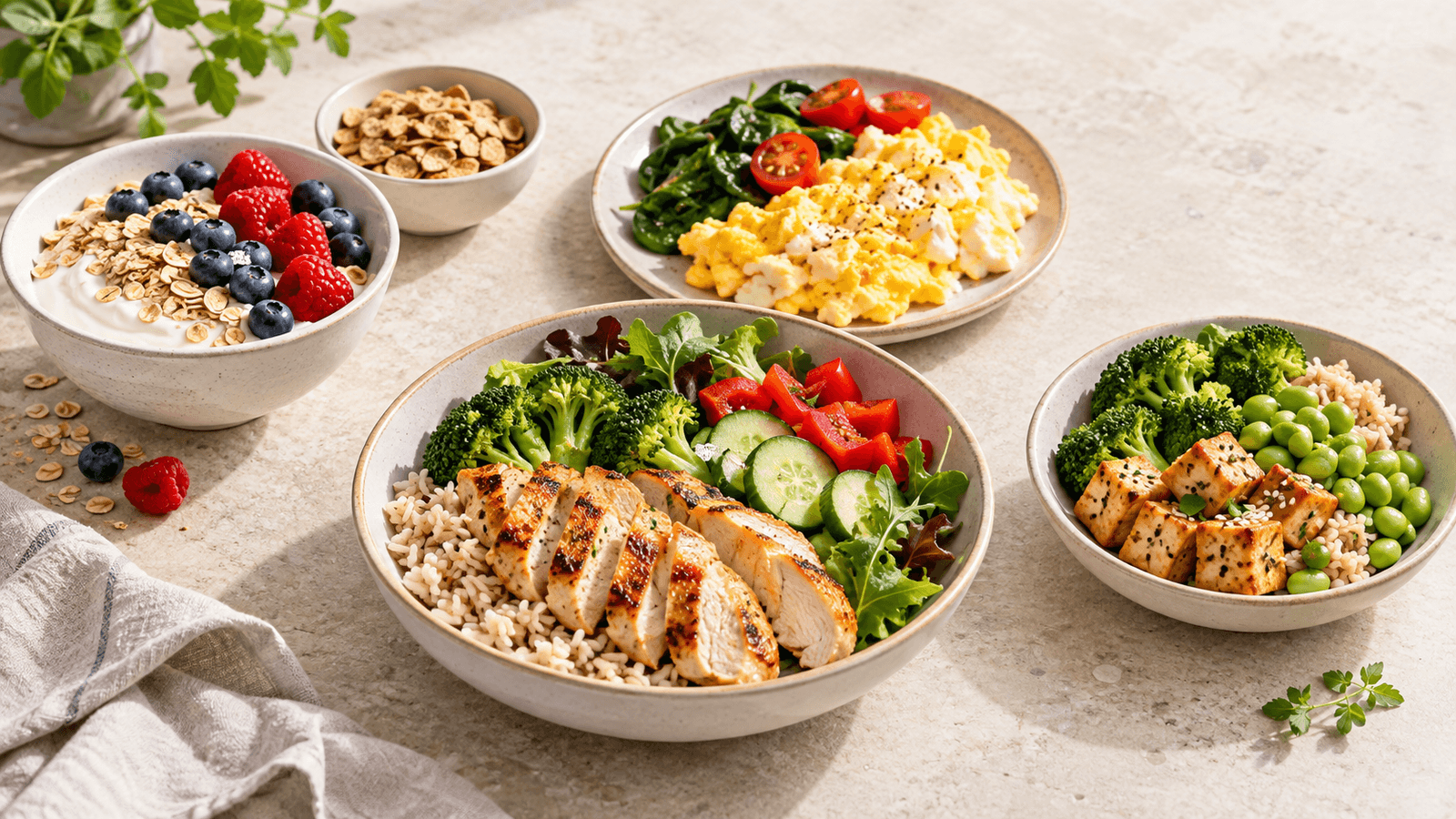
Eating more protein does not require a completely different diet.
For most people, the easiest approach is to improve the meals they already eat: make the main protein portion more substantial, choose more protein-dense versions of familiar foods and spread protein across the day instead of trying to catch up at dinner.
Small changes can add up quickly.
Replacing ordinary yogurt with skyr, adding egg whites to eggs, increasing the chicken in a lunch bowl or combining tofu with edamame can add meaningful amounts of protein without making your diet complicated.
Here are 15 practical ways to eat more protein using normal everyday foods.
Protein values in this guide are approximate and vary by brand, serving size and preparation.
15 easy ways to eat more protein
| Strategy | Example | Potential protein increase |
|---|---|---|
| 1. Build meals around protein | Increase chicken from 75 g to 150 g | ~20–25 g |
| 2. Eat protein at breakfast | Skyr instead of low-protein cereal breakfast | ~15–25 g |
| 3. Upgrade your yogurt | Regular yogurt → high-protein skyr | ~10–15 g |
| 4. Add egg whites to eggs | 2 eggs + 150 g egg whites | ~16 g extra |
| 5. Choose higher-protein snacks | Cottage cheese instead of a low-protein snack | ~15–25 g |
| 6. Add protein to salads | Chicken, tuna, tofu or edamame | ~15–40 g |
| 7. Use protein-rich dairy | Cottage cheese, quark, skyr | ~15–25 g |
| 8. Combine protein sources | Tofu + edamame | ~10–15 g extra |
| 9. Upgrade pasta meals | Lentil pasta or add chicken/TVP | ~10–30 g |
| 10. Add protein to soups | Chicken, lentils, beans or TVP | ~10–30 g |
| 11. Prepare protein in advance | Cook chicken, tofu or turkey in batches | Depends on portion |
| 12. Choose protein-dense plant foods | Seitan, tofu, tempeh, TVP | ~15–30 g |
| 13. Use leftovers strategically | Add leftover chicken to lunch | ~20–30 g |
| 14. Keep convenient proteins available | Tuna, skyr, eggs, edamame | ~10–30 g |
| 15. Use protein powder if useful | One serving | ~20–25 g |
You do not need to use all 15 strategies.
Choose the changes that fit naturally into your existing diet.
First: how much protein do you actually need?
Before trying to eat as much protein as possible, estimate an appropriate target.
Protein requirements vary according to factors such as:
- body weight
- activity
- resistance training
- age
- calorie intake
- whether you are losing weight
- whether you are trying to build muscle
For many generally healthy adults, protein intake is often discussed relative to body weight rather than as one fixed number for everyone.
For example:
| Body weight | 1.2 g/kg | 1.4 g/kg | 1.6 g/kg |
|---|---|---|---|
| 60 kg | 72 g | 84 g | 96 g |
| 70 kg | 84 g | 98 g | 112 g |
| 80 kg | 96 g | 112 g | 128 g |
| 90 kg | 108 g | 126 g | 144 g |
| 100 kg | 120 g | 140 g | 160 g |
These are examples, not universal recommendations.
Use the Mealisa Protein Calculator to estimate a practical range.
You can also read How Much Protein Do You Need per kg of Body Weight? for a detailed explanation.
Once you have a reasonable target, the question becomes much simpler:
How can you reach that amount consistently with foods you actually enjoy?
1. Build each main meal around a protein source
One of the most effective changes is deciding on the protein before building the rest of the meal.
Instead of starting with:
“I'm having pasta.”
think:
“I'm having chicken pasta.”
Instead of:
“I'm having rice.”
think:
“I'm having tofu and edamame with rice.”
Instead of:
“I'm having salad.”
think:
“I'm having tuna salad.”
This changes protein from a small addition into a central part of the meal.
Useful primary protein sources include:
- chicken
- turkey
- lean beef
- fish
- shrimp
- eggs
- cottage cheese
- skyr
- quark
- tofu
- tempeh
- seitan
- TVP
- lentils
- beans
For a larger list, see High-Protein Foods: 30 Foods to Help You Eat More Protein.
2. Make breakfast more protein-focused
Breakfast is often the lowest-protein meal of the day.
A breakfast based mainly on:
- toast
- cereal
- fruit
- pastries
- oats prepared with a low-protein drink
may contain relatively little protein.
You do not need to remove those foods.
Instead, add or substitute a meaningful protein source.
Examples include:
Skyr breakfast
Combine:
- 250 g skyr
- oats
- berries
This can provide around 25–30 g of protein, depending on the products and portions.
Eggs plus egg whites
Combine:
- 2 whole eggs
- 150–200 g egg whites
- toast
- vegetables
This can provide around 30–35 g of protein.
Cottage cheese breakfast
Use:
- 200–250 g cottage cheese
- fruit or vegetables
- whole-grain toast if desired
This can provide roughly 25–30 g of protein.
Tofu scramble
A generous serving of firm tofu with vegetables can turn a plant-based breakfast into a much more substantial protein meal.
For more ideas, see High-Protein Breakfast: 15 Easy Ideas to Start Your Day.
3. Replace low-protein yogurt with a high-protein option
Yogurts vary dramatically in protein content.
A conventional yogurt may contain only a few grams of protein per serving, while a similar portion of:
- skyr
- high-protein Greek yogurt
- high-protein soy yogurt
can provide substantially more.
For example, 200 g of plain skyr may provide around 20–22 g of protein.
This is one of the easiest changes because the meal itself barely changes.
You can still add:
- berries
- fruit
- oats
- cinnamon
Check labels because products marketed as “Greek-style” or “protein” foods do not all have the same nutritional profile.
4. Add egg whites to whole eggs
Whole eggs are nutritious and provide high-quality protein, but adding more whole eggs also increases calories and fat.
If your goal is simply to increase protein, combine whole eggs with egg whites.
For example:
2 whole eggs + 150 g egg whites
provides considerably more protein than two eggs alone.
This works well for:
- scrambled eggs
- omelets
- breakfast wraps
- vegetable egg dishes
You keep the flavor and nutrients of whole eggs while increasing protein efficiently.
5. Choose snacks that contribute meaningful protein
Snacks can either help you reach your protein target or contribute almost none.
Higher-protein options include:
- skyr
- Greek yogurt
- cottage cheese
- quark
- boiled eggs
- edamame
- chicken
- tuna
- tofu
- high-protein soy yogurt
- a protein shake
You do not need to snack if you are not hungry.
But if you already eat a snack every day, making it protein-rich can increase daily protein without adding another eating occasion.
See High-Protein Snacks: 20 Easy Ideas to Keep You Satisfied.
6. Add a real protein source to salads
A large salad can look substantial while containing surprisingly little protein.
Vegetables themselves generally contribute only modest amounts.
Turn the salad into a high-protein meal by adding:
- 120–150 g chicken
- tuna
- shrimp
- eggs plus cottage cheese
- tofu
- tempeh
- seitan
- edamame
- lentils plus another protein source
For example:
salad + 150 g chicken breast
can add roughly 40 g or more of protein.
This is much more effective than relying on a small amount of cheese, nuts or seeds as the primary protein source.
7. Use cottage cheese, quark and skyr strategically
High-protein dairy foods can increase protein without requiring additional cooking.
Cottage cheese
Use it:
- on toast
- with potatoes
- in breakfast bowls
- as a snack
- with vegetables
Quark
Use it:
- with fruit
- as a savory herb dip
- in breakfast
- in desserts
- as part of a sauce
Skyr
Use it:
- at breakfast
- as a snack
- with oats
- with berries
A 200–250 g serving of these foods can often contribute approximately 20–30 g of protein, depending on the product.
8. Combine two protein sources in one meal
You do not always need a huge portion of one food.
Combining protein sources can make meals more varied.
Examples include:
- chicken + lentils
- tofu + edamame
- eggs + cottage cheese
- turkey + beans
- tuna + white beans
- skyr + high-protein milk
- lentil pasta + TVP
- tempeh + lentils
For example, tofu alone may not provide as much protein as a large chicken portion.
Adding edamame can raise the meal total substantially without requiring an enormous tofu serving.
9. Make pasta meals more protein-rich
Pasta meals are easy to upgrade.
Instead of relying on pasta itself for protein, add a substantial protein source.
Examples:
Chicken pasta
Add 120–150 g cooked chicken.
Tuna pasta
Add canned tuna and vegetables.
Turkey pasta
Use lean ground turkey in a tomato sauce.
Lentil pasta
Lentil pasta generally provides more protein than conventional pasta.
Lentil pasta + TVP
Combining two plant-based protein sources can create a vegan meal with a substantial protein total.
The goal is not necessarily to replace pasta.
It is to make sure pasta is not the only meaningful protein contributor.
10. Add protein to soups
Soup can range from almost protein-free to extremely protein-rich depending on the ingredients.
Add:
- chicken
- turkey
- lean beef
- lentils
- beans
- tofu
- TVP
Examples include:
Chicken lentil soup
Both chicken and lentils contribute protein.
Turkey bean soup
Turkey plus beans creates a filling combination.
Lentil soup with TVP
TVP can significantly increase protein in a vegan soup.
Tofu vegetable soup
Use a generous tofu portion rather than a few decorative cubes.
11. Prepare protein in advance
Often the biggest obstacle is not knowing what to eat.
It is having nothing ready when you are hungry.
Prepare one or two protein sources in advance.
For example:
- roast chicken
- cook turkey meatballs
- bake tofu
- cook tempeh
- boil eggs
- prepare lentils
Then use them in different meals.
Cooked chicken could become:
Day 1: chicken rice bowl
Day 2: chicken salad
Day 3: chicken wrap
You do not need to prepare five identical meals.
For a flexible system, see High-Protein Meal Prep: 15 Easy Ideas for the Week.
12. Choose more protein-dense plant foods
A plant-based diet can provide plenty of protein, but some plant foods make reaching higher targets easier than others.
Particularly useful options include:
- seitan
- TVP
- tempeh
- tofu
- edamame
- lentils
- lupini beans
- lentil pasta
- high-protein soy yogurt
- soy milk
Foods such as nuts and seeds contain protein too, but they are relatively calorie-dense.
They can be valuable additions to a diet without necessarily being the most efficient primary protein source.
See 25 High-Protein Vegan Foods and 25 High-Protein Vegetarian Foods.
13. Use leftovers as protein ingredients
Leftovers do not have to become the exact same meal the next day.
Treat leftover protein as an ingredient.
Leftover chicken can go into:
- wraps
- salads
- rice bowls
- sandwiches
- pasta
- soup
Leftover salmon can become:
- a potato bowl
- a salad
- a rice bowl
Leftover tofu can go into:
- stir-fries
- wraps
- salads
- noodle bowls
Cooking slightly more protein at dinner can therefore make the next day's lunch much easier.
14. Keep convenient protein foods available
Your diet does not need to depend entirely on freshly cooked meals.
Convenient foods can prevent a low-protein meal when you are short on time.
Useful options can include:
- canned tuna
- canned beans
- skyr
- cottage cheese
- quark
- boiled eggs
- tofu
- frozen edamame
- pre-cooked lentils
- unsweetened soy milk
The exact foods depend on your dietary preferences.
Convenience is particularly useful when it helps you maintain a consistent eating pattern.
15. Use protein powder when it solves a real problem
Protein powder is optional.
You do not need it to eat a high-protein diet.
However, one serving commonly provides around 20–25 g of protein and can be useful when:
- you struggle to reach your target from food
- you need a convenient post-training option
- you have little time to prepare food
- your breakfast is otherwise low in protein
You can use it in:
- a simple shake
- oats
- yogurt
- smoothies
Do not assume a larger shake is automatically better.
Adding large amounts of:
- nut butter
- oats
- milk
- fruit
can turn a modest protein shake into a high-calorie meal.
That may be appropriate for some goals, but not automatically for everyone.
How to increase protein without eating much more food
If appetite or meal volume is a problem, focus on protein density.
Instead of simply adding another full meal, make substitutions.
Examples:
| Instead of | Try |
|---|---|
| Low-protein yogurt | Skyr or high-protein Greek yogurt |
| 2 eggs | 2 eggs + egg whites |
| Small chicken portion | Larger chicken portion |
| Low-protein plant drink | Soy milk |
| Plain pasta | Pasta + chicken, tuna or TVP |
| Tofu alone | Tofu + edamame |
| Salad alone | Salad + substantial protein |
| Low-protein snack | Cottage cheese or skyr |
These changes can raise protein considerably without dramatically increasing total food volume.
How to eat more protein without too many calories
If you are managing calories, prioritize foods with a high amount of protein relative to their calorie content.
Examples include:
- chicken breast
- turkey breast
- cod
- tuna in water
- shrimp
- egg whites
- low-fat cottage cheese
- skyr
- low-fat quark
- seitan
You do not need every protein food to be extremely lean.
Salmon, eggs, tempeh, nuts and seeds can still fit into a balanced diet.
The goal is to create enough room in your calorie budget for the rest of your food.
See Low-Calorie High-Protein Foods: 30 Foods for More Protein With Fewer Calories.
How to eat more protein for weight loss
When losing weight, simply adding protein on top of your current diet may increase calories.
Instead, think about replacement.
For example:
Instead of:
low-protein breakfast + pastry
try:
skyr + oats + berries
Instead of:
large pasta portion + tiny chicken portion
try:
more chicken + moderate pasta + vegetables
Instead of:
low-protein snack
try:
cottage cheese or skyr
The aim is to make protein a larger part of the calories you are already eating.
For more detail, see How Much Protein Should You Eat to Lose Weight? and High-Protein Foods for Weight Loss.
How to eat more protein for muscle building
If you are training to build muscle, reaching an appropriate daily protein intake is important, but protein is not the only requirement.
Muscle growth also depends on:
- resistance training
- progressive overload
- sufficient energy intake
- recovery
- sleep
A practical approach is to include a meaningful protein source at several meals rather than leaving most of your intake until the end of the day.
Examples include:
Breakfast: eggs + egg whites
Lunch: chicken rice bowl
Snack: skyr
Dinner: salmon + potatoes
See How Much Protein Do You Need to Build Muscle?.
How to eat more protein as a vegetarian
Vegetarians can build meals around:
- eggs
- egg whites
- skyr
- Greek yogurt
- cottage cheese
- quark
- tofu
- tempeh
- seitan
- TVP
- edamame
- lentils
- beans
A simple vegetarian day might include:
Breakfast: skyr + oats
Lunch: tofu + edamame bowl
Snack: cottage cheese
Dinner: lentil pasta + TVP or a dairy-based protein addition
See 25 High-Protein Vegetarian Foods.
How to eat more protein as a vegan
Plant-based protein becomes easier when you intentionally choose protein-dense foods.
A simple vegan day could include:
Breakfast: tofu scramble
Lunch: seitan rice bowl
Snack: high-protein soy yogurt
Dinner: lentil pasta + TVP
Other useful combinations include:
- tofu + edamame
- tempeh + lentils
- beans + TVP
- seitan + legumes
You do not need to combine specific plant proteins at every meal to create a “complete protein.”
Eating a varied diet across the day can provide the essential amino acids you need.
See 25 High-Protein Vegan Foods.
How to eat more protein on a budget
More protein does not have to mean expensive steak, salmon and supplements.
Budget-friendly options can include:
- eggs
- chicken
- canned tuna
- cottage cheese
- quark
- lentils
- beans
- tofu
- TVP
Buying larger packages, using frozen foods and comparing the price per useful amount of protein can help.
See Cheap High-Protein Foods: 30 Budget-Friendly Protein Sources.
How to eat more protein without meat
You can increase protein without chicken, beef, turkey or fish.
Examples include:
- eggs + egg whites
- skyr
- cottage cheese
- quark
- tofu + edamame
- tempeh
- seitan
- TVP
- lentil pasta
If you also avoid dairy and eggs, focus more heavily on soy foods, seitan, TVP and legumes.
How to eat more protein without dairy
Useful dairy-free options include:
- chicken
- turkey
- beef
- fish
- shrimp
- eggs
- tofu
- tempeh
- seitan
- TVP
- edamame
- lentils
- beans
- high-protein soy yogurt
- soy milk
Protein powder is optional; dairy-free powders are available if you choose to use one.
How to eat more protein without protein powder
It is entirely possible to reach a high protein intake using ordinary food.
For example:
| Meal | Example | Approx. protein |
|---|---|---|
| Breakfast | Eggs + egg whites + toast | ~35 g |
| Lunch | Chicken rice bowl | ~40 g |
| Snack | Skyr | ~20 g |
| Dinner | Cod + potatoes + vegetables | ~40 g |
| Total | ~135 g |
No protein powder is required.
The same principle can be applied to vegetarian and vegan diets using appropriate protein foods.
How to get 100 g of protein per day
One possible structure is:
Breakfast: 25 g
Lunch: 30 g
Snack: 15 g
Dinner: 30 g
Total:
100 g
For example:
- skyr breakfast: ~25 g
- chicken lunch: ~30–35 g
- cottage cheese snack: ~15–20 g
- fish dinner: ~30 g
You do not need exactly 25 g at every meal.
How to get 120 g of protein per day
A simple structure could be:
Breakfast: 30 g
Lunch: 40 g
Snack: 20 g
Dinner: 30 g
Total:
120 g
Or with three meals:
- breakfast: 35 g
- lunch: 40 g
- dinner: 45 g
Choose the pattern that fits your appetite.
How to get 150 g of protein per day
Higher targets require more deliberate planning.
For example:
| Eating occasion | Protein |
|---|---|
| Breakfast | ~35 g |
| Lunch | ~45 g |
| Snack | ~25 g |
| Dinner | ~45 g |
| Total | ~150 g |
This could come from:
- eggs + egg whites
- chicken or turkey
- skyr or cottage cheese
- fish, lean beef, tofu or seitan
But 150 g is not automatically an appropriate target for everyone.
Estimate your own needs rather than choosing a large round number because it sounds better.
How to spread protein across the day
You do not need perfect distribution.
However, if almost all your protein comes from dinner, improving breakfast and lunch is usually easier than making dinner enormous.
For someone targeting 120 g:
Option 1 — three meals
- breakfast: 35 g
- lunch: 40 g
- dinner: 45 g
Option 2 — three meals plus snack
- breakfast: 30 g
- lunch: 35 g
- snack: 20 g
- dinner: 35 g
Both reach the same daily target.
Easy high-protein foods to keep at home
A practical protein-focused kitchen might include several foods from this list:
Refrigerator
- eggs
- skyr
- cottage cheese
- quark
- tofu
- cooked chicken
Freezer
- fish
- shrimp
- edamame
- chicken
- frozen vegetables
Pantry
- tuna
- lentils
- beans
- TVP
- lentil pasta
- chickpea pasta
You do not need all of them.
The useful foods are the ones you will actually eat.
A simple high-protein grocery list
If you want to make protein easier for the next week, choose:
2–3 main proteins
For example:
- chicken
- salmon
- tofu
1–2 breakfast proteins
For example:
- eggs
- skyr
1 convenient protein
For example:
- tuna
- cottage cheese
- edamame
1 legume
For example:
- lentils
- beans
Then add your usual:
- vegetables
- fruit
- rice
- potatoes
- oats
- bread
- pasta
- sauces and seasonings
This is often easier than buying dozens of special “high-protein” products.
Do you need special high-protein products?
Usually not.
Products marketed as:
- protein pudding
- protein cereal
- protein bread
- protein cookies
- protein bars
can be convenient, but they are not required.
Ordinary foods such as:
- chicken
- fish
- eggs
- skyr
- cottage cheese
- tofu
- lentils
can provide substantial protein.
Compare nutrition labels rather than assuming a “high-protein” label automatically makes a product a better choice.
Common mistakes when trying to eat more protein
1. Adding protein instead of replacing foods
If your goal includes weight loss, adding hundreds of extra calories from shakes and bars may work against your calorie target.
2. Relying on nuts as the main protein source
Nuts contain protein but are relatively calorie-dense.
3. Eating tiny protein portions
A few pieces of chicken in a large rice bowl may not provide as much protein as expected.
4. Ignoring breakfast
Trying to get nearly all your protein at dinner can make higher targets unnecessarily difficult.
5. Assuming every yogurt is high protein
Check the label.
6. Buying too many specialized products
You can build a high-protein diet largely from ordinary food.
7. Forgetting vegetables, fruit and fiber
Increasing protein should not crowd out the rest of a balanced diet.
8. Trying to maximize protein
More is not automatically better.
An appropriate target is more useful than the highest possible intake.
9. Making the diet too repetitive
Chicken and rice are not your only options.
Rotate among meat, fish, eggs, dairy, soy foods and legumes according to your preferences.
10. Changing everything at once
A few consistent changes are often easier to maintain than rebuilding your entire diet overnight.
Frequently asked questions
What is the easiest way to eat more protein?
Start by increasing protein at meals you already eat.
Choose a clear protein source at breakfast, lunch and dinner and replace low-protein snacks with higher-protein options when appropriate.
How can I add 20 g of protein to my day?
Examples include:
- around 200 g skyr
- a substantial cottage cheese serving
- egg whites added to breakfast
- additional chicken or fish at a meal
- tofu plus edamame
- one protein shake
Exact amounts vary by product.
How can I add 30 g of protein to my day?
You could add one protein-focused meal component such as a substantial chicken portion, a combination of eggs and egg whites, tofu plus edamame or cottage cheese plus another protein source.
What foods are highest in protein?
Protein-dense foods include chicken, turkey, lean fish, tuna, shrimp, lean beef, egg whites, cottage cheese, skyr, seitan, TVP, tofu and tempeh.
See the full High-Protein Foods guide.
How can I eat more protein without eating more meat?
Use eggs, dairy, tofu, tempeh, seitan, TVP, edamame, lentils and other legumes.
How can I eat more protein without increasing calories too much?
Replace lower-protein foods with leaner, protein-dense options rather than simply adding more food.
Can I eat too much protein?
More protein is not automatically beneficial.
Very high intakes may be unnecessary and can crowd other foods out of the diet.
People with medical conditions affecting protein intake should follow individualized advice from an appropriate healthcare professional.
Do I need protein at every meal?
Not necessarily, but including meaningful protein across several meals can make it easier to reach your daily target.
Is protein powder necessary?
No.
It is a convenience food, not a requirement.
Are protein bars a good way to increase protein?
They can be convenient, but compare protein and calories because products vary widely.
Are beans enough for a high-protein diet?
Beans contribute useful protein and fiber, but reaching higher protein targets may be easier when they are combined with more protein-dense foods such as tofu, TVP, seitan, dairy, eggs, meat or fish depending on your diet.
Is it better to eat protein in one meal or throughout the day?
Your total daily intake is important, and spreading protein across several meals is often practical for meal size, appetite and training nutrition.
You do not need perfectly equal amounts at every meal.
Bottom line
The easiest way to eat more protein is usually not to redesign your entire diet.
Start with a few high-impact changes:
- build meals around a real protein source
- improve breakfast
- choose higher-protein yogurt or dairy
- combine whole eggs with egg whites
- make snacks contribute protein
- add substantial protein to salads, pasta and soups
- combine protein sources
- prepare protein in advance
- keep convenient options available
- use protein powder only if it genuinely makes your diet easier
A useful first step is to estimate how much protein you actually need with the Mealisa Protein Calculator.
Then look at your normal day and identify the meal with the least protein.
Improving that one meal may be all you need to make a meaningful difference.
For practical foods, see High-Protein Foods.
For complete meal ideas, see High-Protein Meals: 25 Easy Breakfast, Lunch and Dinner Ideas.
For preparing food ahead, see High-Protein Meal Prep.
And if your goal is weight loss, see High-Protein Foods for Weight Loss.
Nutrition values are approximate and vary by product, serving size and preparation. This article provides general nutrition information for healthy adults and is not individualized medical or dietetic advice.