
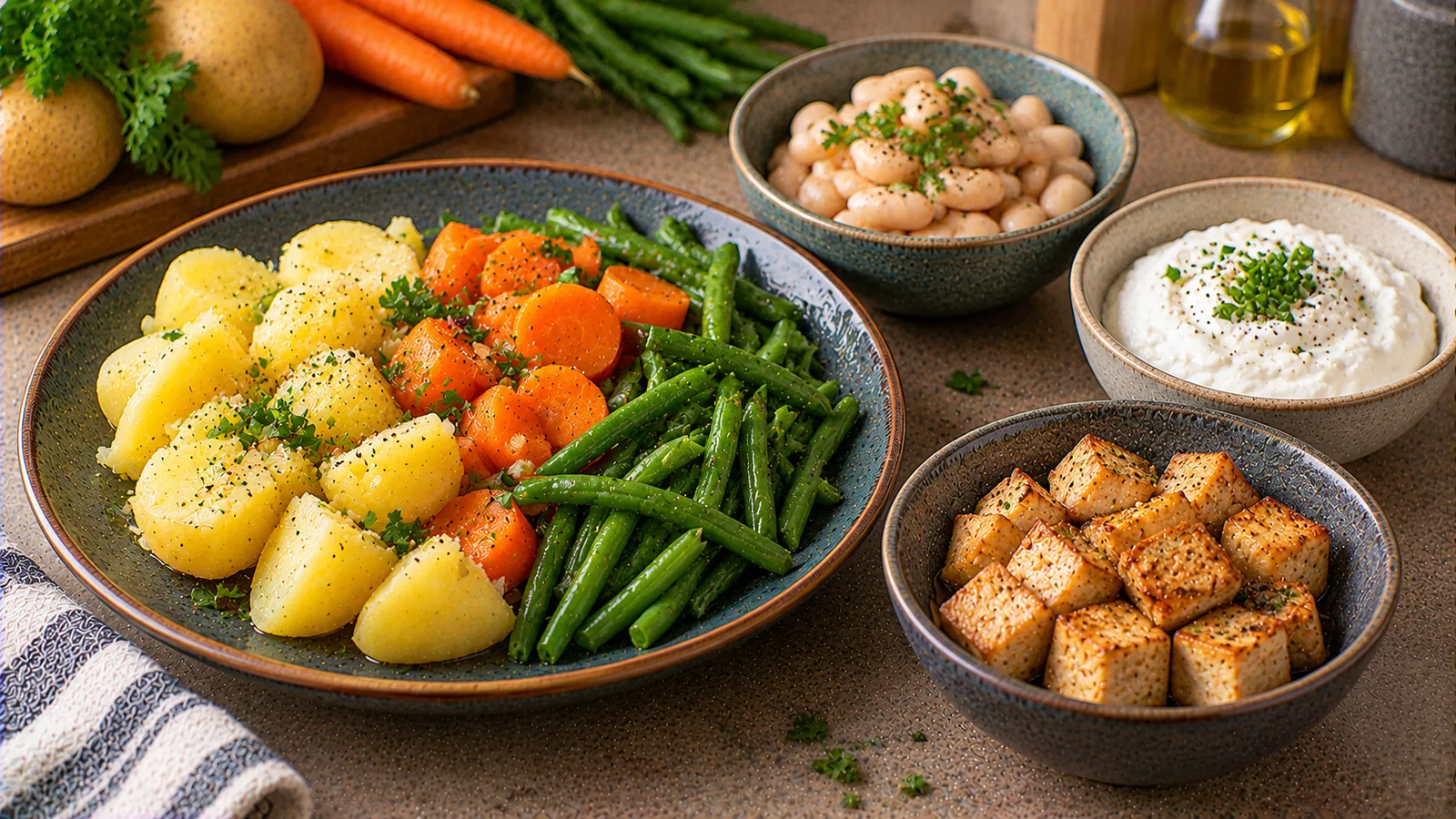
How can you add around 20 g of protein to a cheap dinner?
You do not need a protein powder or a second elaborate recipe. Choose one measured add-on to a dinner you already like: 170 g low-fat quark, 140 g smoked tofu, 90 g canned tuna after draining, or 200 g ready-to-eat drained chickpeas plus 60 g plain skyr. For the specific example nutrition labels used below, these provide 20.4 g, 21.0 g, 21.15 g and 21.0 g protein, respectively. These are add-on figures, not the total protein of dinner and not universal averages. Our budget balanced-plate guide explains how to build the rest of the plate.
The budget question has two answers. What you use can cost substantially less than the amount paid for an unopened pack. In our explicitly illustrative German price model, the add-ons use €0.40, €1.53, €1.07 or €0.95 of ingredients, respectively; the corresponding upfront checkouts are €1.19, €2.19, €1.79 and €2.28. The latter includes two separate purchases for the chickpea–skyr option. Prices are mathematical assumptions, not current REWE offers or verified supermarket quotes. A tomato, potato, rice or vegetable base is extra in every case.
Four choices on the same accounting basis
The table uses one adult dinner as the use case. Protein is taken from published retail product declarations per 100 g of edible product as sold. Tuna and chickpeas are weighed after draining; these weights must never be confused with the weight printed on a full can. Quark, skyr and tofu use the portion weighed from the indicated food itself. Calories below refer only to the add-on, not to vegetables, grains, oil or seasoning in the finished meal.
| Add-on, edible mass | Protein from add-on | Energy from add-on | Used cost (€) | Checkout (€) |
|---|---|---|---|---|
| Quark, 170 g | 20.4 g | 114 kcal | 0.40 | 1.19 |
| Smoked tofu, 140 g | 21.0 g | 244 kcal | 1.53 | 2.19 |
| Tuna drained, 90 g | 21.15 g | 89 kcal | 1.07 | 1.79 |
| Chickpeas 200 g drained + skyr 60 g | 21.0 g | 279 kcal | 0.95 | 2.28 |
The products supporting the worked examples are Omira low-fat quark, 12 g protein/100 g, REWE Bio almond-sesame smoked tofu, 15 g/100 g, ja! tuna in its own juice, 23.5 g/100 g, Yörem cooked chickpeas, 7.2 g/100 g and Berchtesgadener Land plain skyr, 11 g/100 g. Check your own pack: recipes and labels change, especially for tofu, fish and pulses.
Option 1 — 170 g quark as a savoury sauce
Measured add-on: 170 g low-fat quark. At the cited 12 g protein per 100 g, the calculation is 170 × 12 ÷ 100 = 20.4 g protein. The same label lists 67 kcal per 100 g, so this portion provides about 114 kcal. For the price illustration, a 500 g tub at €1.19 means €1.19 × 170/500 = €0.40 used after rounding, yet you still pay €1.19 at checkout when buying the full tub.
Stir quark with a little water, herbs, pepper and lemon if available. Spoon the cold sauce on a plate of hot cooked potatoes, vegetables or leftover rice just before eating. Do not boil quark hard into a thin soup: it may split and change texture. A quark topping adds protein and moisture, but it does not add vegetables or enough energy for a complete dinner on its own. Keep the familiar starch and a satisfying vegetable portion in the meal. Our measured budget vegetarian lunch examples offers further ways to calculate protein without inflating portions.
This option contains milk. Choose an alternative if you cannot consume dairy; lactose content varies and plain quark is not automatically lactose-free. Refrigerate the tub as directed, use clean utensils and respect the use-after-opening guidance. The remaining 330 g is still food you purchased; the per-dinner €0.40 is not the cash you leave the store with.
Option 2 — 140 g smoked tofu for a warm vegetable pan
Measured add-on: 140 g REWE Bio almond-sesame smoked tofu. At 15 g protein per 100 g, 140 × 15/100 = 21.0 g protein. At 174 kcal/100 g, that is about 244 kcal before frying oil. With an assumed 200 g pack costing €2.19, the amount used costs €1.53 and the till charge is €2.19. Another firm tofu can contain considerably less protein: do not silently substitute a different label and retain these numbers.
Cut the tofu into small cubes and warm in a non-stick pan with 150–200 g vegetables that are already cooked or can be safely cooked in the same pan. Use a splash of water if it sticks, or count any oil you add. Serve over a modest portion of cooked rice, bulgur or potatoes. Heat according to the tofu packaging; a browned surface is a texture preference rather than a protein boost. A pan of vegetables and tofu is quick, but it needs a realistic dinner base and seasoning that fits the rest of your diet.
Allergen note: this particular tofu contains soy, almonds, sesame and wheat in the ingredient list. It is not a safe universal 'vegan swap' for everyone with allergies. The leftover 60 g from the pack has value and should be refrigerated and used within the product's strict after-opening guidance, which the cited product states as 24 hours.
Option 3 — 90 g drained tuna folded through pasta or beans
Measured add-on: 90 g drained ja! tuna in its own juice. Its cited label gives 23.5 g protein per 100 g; 90 × 23.5/100 = 21.15 g protein. At 99 kcal/100 g, that is about 89 kcal from the fish. Assume €1.79 for a tin yielding 150 g drained tuna: €1.79 × 90/150 = €1.07 used, versus €1.79 at checkout. A can's net fill with water is not its 150 g drained weight.
Stir the fish into hot pasta, cooked grains or a tomato-and-vegetable bowl after draining; break it up with a fork and ensure the complete meal is heated appropriately if you choose to reheat it. It also works as a cool topping over hot potatoes immediately before eating. Tuna contains fish, and the salt on the actual label matters, particularly if the base dinner includes packaged sauce. One product's protein value cannot be transferred to tuna packed in oil or to a different brand without checking its declaration.
Tuna is one possible option, not a food to recommend at every dinner. Fish can contribute to mercury exposure; people who are pregnant, may become pregnant or feed young children should follow their national guidance on fish species and frequency. Do not leave unused opened tuna in its metal tin: move it into a clean food container, refrigerate and follow the manufacturer's after-opening instructions.
BfR explains why tuna intake deserves special care in pregnancy.
Option 4 — 200 g chickpeas plus 60 g skyr for a vegetarian bowl
Measured add-on: 200 g pre-cooked chickpeas measured after draining and 60 g plain skyr. On the example declarations, 200 × 7.2/100 = 14.4 g protein from chickpeas, plus 60 × 11/100 = 6.6 g from skyr, yielding 21.0 g protein from the combination. Their labelled energy entries, 121 kcal/100 g and 62 kcal/100 g, give about 279 kcal combined. This is a vegetarian dairy-containing option, not vegan.
For the illustrative shopping model, a chickpea tin with 240 g drained contents costing €0.89 contributes €0.74 when 200 g are used. A 400 g skyr tub priced at €1.39 contributes €0.21 for 60 g. Thus the used-ingredient cost is €0.95, whereas buying both unopened packs requires €2.28. This calculation applies only to our assumed 240 g drained can, not to a product with a different yield. The chickpea nutrition figure itself comes from a separately identified cooked-chickpea example; you must check whether the pack you buy matches the chosen model.
Heat the ready-to-eat chickpeas with tomatoes, garlic and vegetables until hot. Add skyr off the heat with lemon and herbs as a cool topping; boiling it into the sauce can curdle it. Serve with a modest grain or potato portion if needed. Unlike raw dried chickpeas, canned chickpeas are already cooked; dried chickpeas require appropriate soaking and thorough cooking. The German Federal Centre for Nutrition explains the difference.
What the €-per-protein calculation does — and does not — mean
For a single dinner add-on, compare protein in the actual edible portion with the price of the same portion. It is incorrect to compare a 500 g dairy tub's purchase price against just 90 g of fish on the other side of a chart. In this worked model, the used costs per approximately 20–21 g protein range from €0.40 to €1.53, but these are not audited live retail prices. Discounts, leftovers, spoiled food, different brands and package sizes can reverse the ranking. Our protein-per-euro supermarket comparison explains the broader supermarket comparison.
If you have to purchase a complete pack, budget for €1.19, €2.19, €1.79 or €2.28, respectively. If you already own a partial pack, the relevant incremental use can differ again, but it is not financially honest to call the contents free. The grain-and-vegetable base is not included: allowing another 150–250 g vegetables and an appropriate starch is a practical illustration, not a calculated nutrient recommendation or fixed portion for every adult.
Use the formula add-on protein (g) = edible portion (g) × declared protein (g per 100 g) ÷ 100. For a two-part addition, add the two calculated numbers. Use the equivalent price formula only when the declared purchase weight and edible weight have been reconciled; drained weight matters for cans. Calories, fats, carbohydrates, fibre and salt should be reviewed too, because two foods supplying 20 g protein can make very different dinners.
The nutrition goal is personal, not a universal dinner rule
20 g is a convenient shopping target for these examples, not a mandatory protein requirement at every dinner. EFSA's adult population reference intake is 0.83 g protein per kg body weight per day for generally healthy adults; individual circumstances, pregnancy, older age, training and medical conditions can change needs. A person advised to restrict protein for kidney disease should not increase it on the strength of this article. Assess the entire day, meal satisfaction and overall dietary variety rather than treating a higher number as automatically better.
These products also differ in dietary suitability: dairy intolerance, soy/seed/wheat allergy, fish allergy, salt restriction and fish-consumption advice can rule out an option. If the base dinner already contains beans, eggs or cheese, its protein counts too. The table does not claim that every meal should use an entire extra 20 g addition.
Sources and calculation notes
- Omira low-fat quark — per-100-g product declaration.
- REWE Bio almond-sesame smoked tofu — per-100-g declaration and allergens.
- ja! tuna in its own juice — protein and drained weight.
- Yörem cooked chickpeas — protein per 100 g; plain skyr — per-100-g declaration.
- BZfE — preparation of cooked versus dried pulses; EFSA — adult reference intakes for protein.
All € prices are editorial arithmetic assumptions, not taken from those retailer pages. Nutrition figures describe those named sample products, not every quark, tofu, tuna, chickpea or skyr brand. Whole-dinner nutrition was deliberately not invented; only measured additions were calculated.