
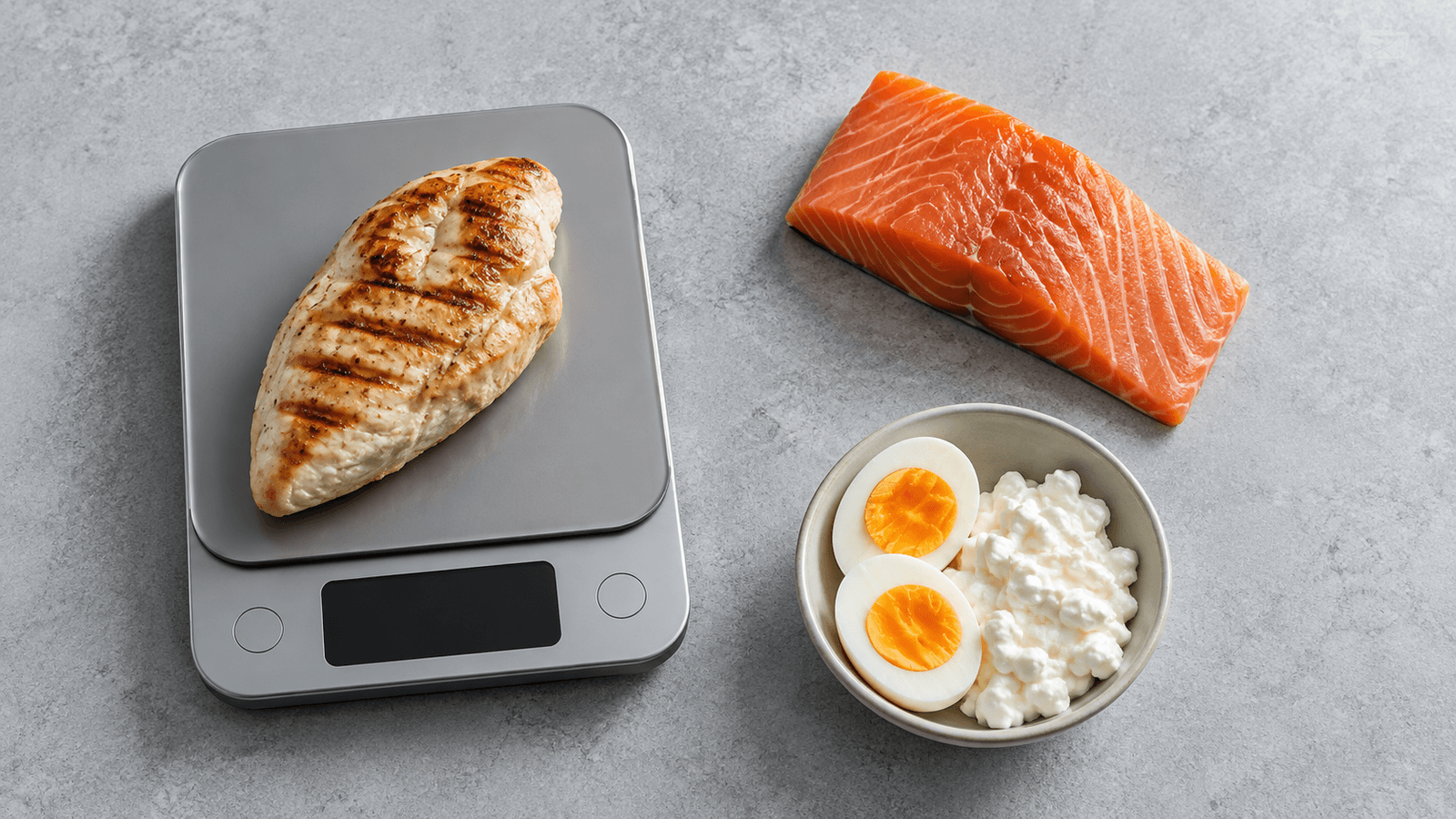
Protein needs are often expressed in grams per kilogram of body weight because the same fixed amount of protein can mean very different things for people of different sizes.
For healthy adults, 0.83 grams of protein per kilogram of body weight per day is the European population reference intake. People who exercise regularly or have specific fitness goals often use higher practical targets. (EFSA)
A simple way to estimate your intake is:
Body weight in kilograms × protein target in g/kg = grams of protein per day
For example, an 80 kg person eating 1.6 g/kg would consume:
80 × 1.6 = 128 grams of protein per day
Protein per kg: quick guide
Different protein targets can be useful in different situations.
| Protein target | Example use |
|---|---|
| 0.83 g/kg | European population reference intake for healthy adults |
| 1.0 g/kg | Simple higher-than-reference target |
| 1.2 g/kg | Active lifestyle or practical higher-protein intake |
| 1.4 g/kg | Regular exercise / higher-protein target |
| 1.6 g/kg | Strong practical target for resistance training |
| 1.8 g/kg | Higher end for frequent training |
| 2.0 g/kg | Upper end of a common sports-nutrition range |
These values are not rigid categories. Your appropriate intake depends on factors such as activity, training, calorie intake, age and individual circumstances.
If you want an estimate based on your own weight and goal, use the Mealisa Protein Calculator.
Protein per kg body weight table
The table below converts common protein targets into grams per day.
| Body weight | 0.8 g/kg | 1.2 g/kg | 1.4 g/kg | 1.6 g/kg | 2.0 g/kg |
|---|---|---|---|---|---|
| 45 kg | 36 g | 54 g | 63 g | 72 g | 90 g |
| 50 kg | 40 g | 60 g | 70 g | 80 g | 100 g |
| 55 kg | 44 g | 66 g | 77 g | 88 g | 110 g |
| 60 kg | 48 g | 72 g | 84 g | 96 g | 120 g |
| 65 kg | 52 g | 78 g | 91 g | 104 g | 130 g |
| 70 kg | 56 g | 84 g | 98 g | 112 g | 140 g |
| 75 kg | 60 g | 90 g | 105 g | 120 g | 150 g |
| 80 kg | 64 g | 96 g | 112 g | 128 g | 160 g |
| 85 kg | 68 g | 102 g | 119 g | 136 g | 170 g |
| 90 kg | 72 g | 108 g | 126 g | 144 g | 180 g |
| 95 kg | 76 g | 114 g | 133 g | 152 g | 190 g |
| 100 kg | 80 g | 120 g | 140 g | 160 g | 200 g |
| 105 kg | 84 g | 126 g | 147 g | 168 g | 210 g |
| 110 kg | 88 g | 132 g | 154 g | 176 g | 220 g |
| 115 kg | 92 g | 138 g | 161 g | 184 g | 230 g |
| 120 kg | 96 g | 144 g | 168 g | 192 g | 240 g |
The 0.8 g/kg column is included as an easy rounded reference. The European population reference intake for healthy adults is slightly higher at 0.83 g/kg per day.
How do you calculate protein per kg?
The calculation only requires two numbers:
- Your body weight in kilograms
- Your chosen protein target in grams per kilogram
Then multiply them.
Weight (kg) × protein (g/kg) = protein per day
For a 70 kg person targeting 1.4 g/kg:
70 × 1.4 = 98 g/day
For a 90 kg person targeting 1.6 g/kg:
90 × 1.6 = 144 g/day
For a 60 kg person targeting 2.0 g/kg:
60 × 2.0 = 120 g/day
This is why grams per kilogram are more useful than telling everyone to eat the same fixed amount of protein.
What does 0.83 g of protein per kg mean?
The European Food Safety Authority sets a Population Reference Intake of 0.83 g of protein per kilogram of body weight per day for adults, including older adults.
For a 70 kg adult:
70 × 0.83 = approximately 58 g/day
For an 80 kg adult:
80 × 0.83 = approximately 66 g/day
This is a population reference value intended to cover the needs of the majority of healthy adults. It should not be confused with a target designed specifically to maximize athletic performance or muscle growth.
Is 1 g of protein per kg enough?
For many generally healthy adults who are not training heavily, 1 g/kg already sits above the European population reference intake.
Examples:
- 60 kg → 60 g/day
- 70 kg → 70 g/day
- 80 kg → 80 g/day
- 90 kg → 90 g/day
Whether that amount is appropriate depends on your circumstances and goals.
Someone performing regular resistance training may choose a higher intake.
Is 1.2 g of protein per kg enough?
At 1.2 g/kg, protein intake becomes:
- 60 kg → 72 g/day
- 70 kg → 84 g/day
- 80 kg → 96 g/day
- 90 kg → 108 g/day
- 100 kg → 120 g/day
This can be a practical higher-protein intake for active people and can also fit some weight-management diets.
If your primary goal is losing body fat, see How Much Protein Should You Eat to Lose Weight?.
Is 1.4 g of protein per kg enough?
A target of 1.4 g/kg falls within a commonly cited sports-nutrition range for exercising individuals.
At this intake:
- 60 kg → 84 g/day
- 70 kg → 98 g/day
- 80 kg → 112 g/day
- 90 kg → 126 g/day
- 100 kg → 140 g/day
It can be a useful target for people who train regularly without automatically pushing protein intake toward the highest end of the range.
Is 1.6 g of protein per kg enough?
For many people doing resistance training, 1.6 g/kg per day is a strong practical target. (Morton et al.)
Examples:
- 60 kg → 96 g/day
- 70 kg → 112 g/day
- 80 kg → 128 g/day
- 90 kg → 144 g/day
- 100 kg → 160 g/day
Research on resistance training and protein supplementation suggests that benefits for gains in fat-free mass do not continue increasing indefinitely as protein intake rises.
For a detailed muscle-building explanation, read How Much Protein Do You Need to Build Muscle?.
Is 2 g of protein per kg too much?
Two grams per kilogram is at the upper end of a commonly used range for exercising people.
It equals:
- 60 kg → 120 g/day
- 70 kg → 140 g/day
- 80 kg → 160 g/day
- 90 kg → 180 g/day
- 100 kg → 200 g/day
That does not mean everyone who exercises needs 2 g/kg.
A person already consuming enough protein may not gain additional muscle simply by increasing protein further.
Total calories, training quality, recovery and consistency also matter.
Protein per kg for muscle gain
People performing resistance training generally use higher protein targets than the basic population reference intake.
A practical range for many healthy exercising adults is approximately 1.4–2.0 g/kg/day, with around 1.6 g/kg/day being a useful target for many people focused on building muscle.
For an 80 kg person:
- 1.4 g/kg = 112 g
- 1.6 g/kg = 128 g
- 1.8 g/kg = 144 g
- 2.0 g/kg = 160 g
Protein alone does not build muscle. Progressive resistance training provides the primary stimulus, while sufficient protein supports recovery and muscle protein synthesis.
Protein per kg for weight loss
Protein can be useful during weight loss because a higher-protein diet may make meals more satisfying and can help support lean mass when combined with appropriate training.
A practical range often used during weight loss is around 1.2–1.6 g/kg/day, depending on activity and individual circumstances.
For a 75 kg person:
- 1.2 g/kg = 90 g
- 1.4 g/kg = 105 g
- 1.6 g/kg = 120 g
Protein does not override energy balance. Fat loss still requires an appropriate calorie deficit over time.
Read the full guide: How Much Protein Should You Eat to Lose Weight?.
Protein per kg for people who exercise
Exercise changes the context in which protein is used.
Someone who regularly performs resistance training creates repeated demands for muscle repair and adaptation.
Sports-nutrition recommendations therefore commonly use higher protein intakes than basic population reference values.
The appropriate point within a range depends on:
- type of training
- training frequency
- training volume
- total calorie intake
- body size
- goal
- dietary preferences
There is no single grams-per-kilogram number that is optimal for every person.
Protein per kg vs protein per pound
If you track your weight in pounds, you can either convert your weight to kilograms or convert the protein target itself.
To convert body weight:
Weight in pounds ÷ 2.205 = weight in kilograms
For example:
176 lb ÷ 2.205 ≈ 80 kg
Then:
80 kg × 1.6 g/kg = 128 g protein/day
Some approximate conversions are:
| g/kg | Approx. g/lb |
|---|---|
| 0.8 | 0.36 |
| 1.0 | 0.45 |
| 1.2 | 0.54 |
| 1.4 | 0.64 |
| 1.6 | 0.73 |
| 1.8 | 0.82 |
| 2.0 | 0.91 |
Using kilograms is often simpler because many nutrition recommendations are already expressed in g/kg.
Should protein be calculated from current or goal weight?
For many people, current body weight is the simplest starting point.
However, body-weight formulas are estimates rather than individualized prescriptions.
At very high or very low body weights, a simple calculation based only on total body weight can become less informative.
Body composition, activity, calorie intake and health status can all affect how useful a particular target is.
Rather than forcing one formula to fit everyone, use the calculation as a practical starting point.
How much protein should you eat per meal?
Once you have calculated your daily target, you can divide it across your normal meals.
For example, someone targeting 120 g/day and eating four times could average:
120 ÷ 4 = 30 g per meal
Someone targeting 150 g/day across four meals could average:
150 ÷ 4 = 37.5 g per meal
The amounts do not need to be identical at every meal.
For example, 150 grams could be distributed as:
- Breakfast: 30 g
- Lunch: 40 g
- Snack: 30 g
- Dinner: 50 g
Your total daily intake is more useful than trying to make every meal mathematically identical.
What foods make it easier to reach a protein target?
Protein can come from both animal and plant foods.
Examples include:
- chicken and turkey
- fish and seafood
- eggs
- lean meat
- Greek yogurt and skyr
- cottage cheese
- milk
- tofu and tempeh
- lentils
- beans
- chickpeas
- edamame
- seitan
Protein powders can also be convenient, but they are not required.
A varied diet makes it easier to combine adequate protein with other important nutrients.
Example: calculating protein for a 75 kg person
Suppose someone weighs 75 kg.
Their daily protein intake at several targets would be:
| Target | Protein per day |
|---|---|
| 0.83 g/kg | ~62 g |
| 1.0 g/kg | 75 g |
| 1.2 g/kg | 90 g |
| 1.4 g/kg | 105 g |
| 1.6 g/kg | 120 g |
| 1.8 g/kg | 135 g |
| 2.0 g/kg | 150 g |
This illustrates why saying "eat 100 grams of protein" without considering body weight gives incomplete information.
For this person, 100 grams equals approximately 1.33 g/kg/day.
Example: calculating protein for a 100 kg person
For someone weighing 100 kg:
| Target | Protein per day |
|---|---|
| 0.83 g/kg | 83 g |
| 1.0 g/kg | 100 g |
| 1.2 g/kg | 120 g |
| 1.4 g/kg | 140 g |
| 1.6 g/kg | 160 g |
| 1.8 g/kg | 180 g |
| 2.0 g/kg | 200 g |
The same 100 grams that represented 1.33 g/kg for a 75 kg person represents only 1.0 g/kg for a 100 kg person.
Common mistakes when calculating protein per kg
1. Multiplying pounds directly by a g/kg target
If your weight is in pounds, convert it to kilograms first.
2. Treating one number as perfect for everyone
Protein requirements and practical targets vary with activity, goals and individual circumstances.
3. Assuming more protein always produces better results
Once intake is already sufficient, increasing protein further does not automatically produce more muscle or faster fat loss.
4. Ignoring the rest of your diet
Protein is only one macronutrient. Total calories, dietary quality, carbohydrates, fats, fiber and micronutrients still matter.
5. Confusing a population reference intake with a sports target
A reference intake intended to cover basic nutritional needs is not the same thing as a target designed around resistance training or another specific goal.
Frequently asked questions
How many grams of protein per kg should I eat?
It depends on your goal and activity.
For healthy adults, the European population reference intake is 0.83 g/kg/day. Exercising people often use higher targets, with sports-nutrition guidance commonly falling around 1.4–2.0 g/kg/day.
Is 1.5 g of protein per kg enough?
For many active people, 1.5 g/kg represents a substantial protein intake.
For an 80 kg person, that equals:
80 × 1.5 = 120 g/day
Whether a higher intake is useful depends on training, calorie intake and goals.
Is 1.6 g/kg good for building muscle?
For many resistance-training adults, 1.6 g/kg is a strong practical target.
For more detail, see How Much Protein Do You Need to Build Muscle?.
How much protein is 1.6 g/kg for 70 kg?
70 × 1.6 = 112 grams of protein per day.
How much protein is 1.6 g/kg for 80 kg?
80 × 1.6 = 128 grams per day.
How much protein is 2 g/kg for 90 kg?
90 × 2.0 = 180 grams per day.
Should I use lean body mass instead of body weight?
Most simple public protein recommendations are expressed relative to total body weight because it is easy to measure and apply.
In some situations, body composition can make more individualized calculations useful, but that requires more information than a simple body-weight formula provides.
Use the Protein Calculator
You do not need to calculate every number manually.
The Mealisa Protein Calculator estimates a practical protein range using your weight, activity and goal.
It can also show how your target translates into protein per meal.
Bottom line
Protein per kilogram makes it easier to adjust protein intake to body size instead of giving everyone the same fixed number.
For healthy adults, the European population reference intake is 0.83 g/kg/day.
People who exercise regularly often use higher protein targets, with approximately 1.4–2.0 g/kg/day commonly used in sports nutrition.
Your ideal target depends on your activity, training, calorie intake, goals and individual circumstances.
For a personalized starting estimate, use the Mealisa Protein Calculator, or read How Much Protein Do You Need Per Day? for a broader overview.
This article provides general nutrition information for healthy adults and is not a substitute for individualized medical or dietetic advice. People with kidney disease, pregnancy, other medical conditions or specific dietary requirements should discuss major dietary changes with an appropriate healthcare professional.
Sources
Evidence and authoritative guidance used for the nutrition and health information in this article: