
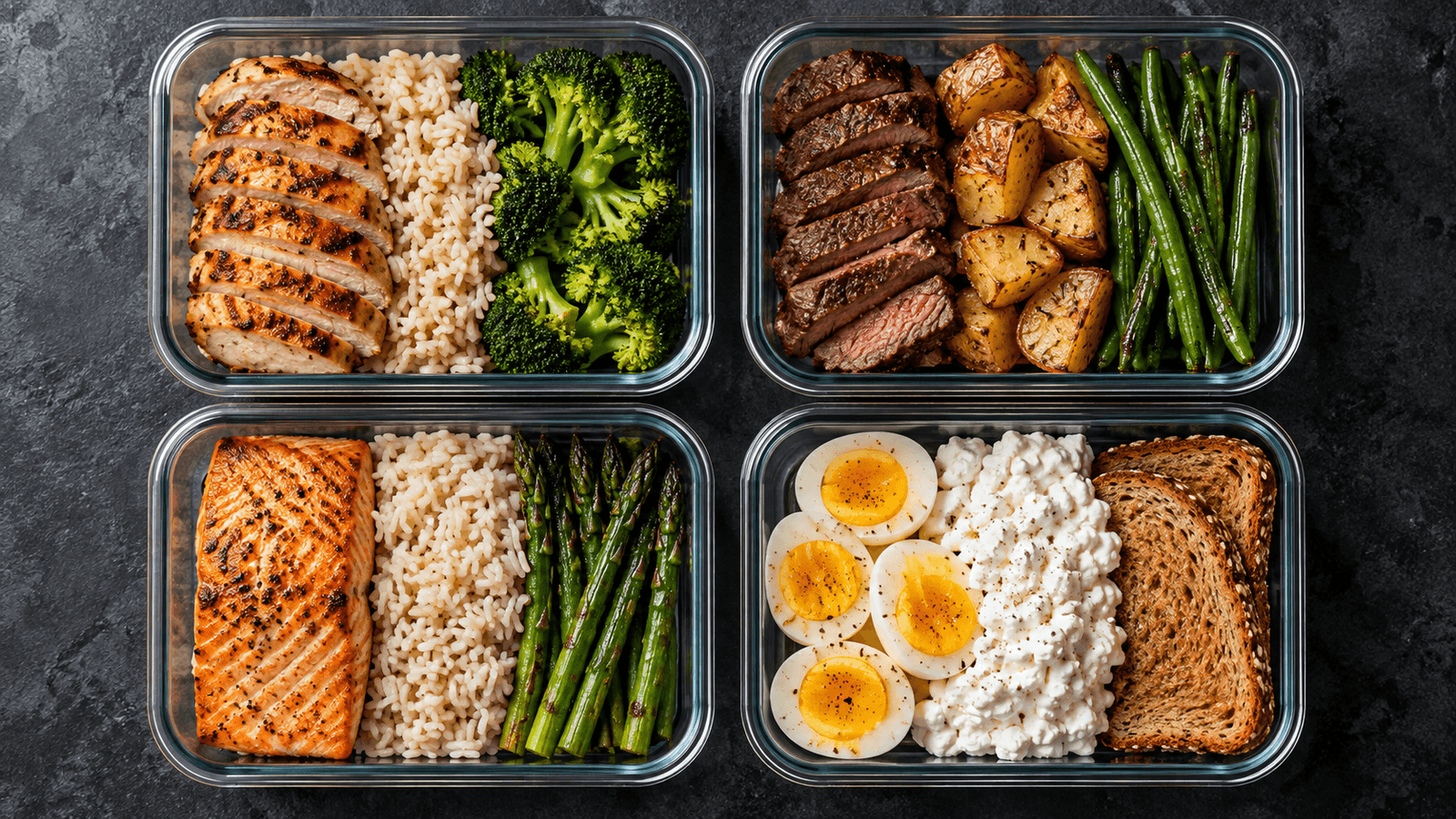
Building muscle requires more than simply eating more protein. Resistance training provides the stimulus for muscle growth, while protein supplies the amino acids your body uses to repair and build muscle tissue.
For many healthy adults who train regularly, a practical daily protein target is around 1.6–2.0 grams of protein per kilogram of body weight per day.
For many people, roughly 1.6 g/kg per day is already a strong target. Eating substantially more protein does not automatically mean more muscle growth. (EFSA)
How much protein do you need to build muscle?
A simple practical range is:
Body weight in kilograms × 1.6–2.0 = grams of protein per day
For example, someone who weighs 75 kg would get:
- 75 × 1.6 = 120 g
- 75 × 1.8 = 135 g
- 75 × 2.0 = 150 g
That gives a practical daily range of approximately 120–150 grams of protein.
You can also use the Mealisa Protein Calculator to estimate your daily protein target automatically.
Protein targets by body weight
The table below shows examples using 1.6, 1.8 and 2.0 grams of protein per kilogram of body weight.
| Body weight | 1.6 g/kg | 1.8 g/kg | 2.0 g/kg |
|---|---|---|---|
| 50 kg | 80 g | 90 g | 100 g |
| 60 kg | 96 g | 108 g | 120 g |
| 70 kg | 112 g | 126 g | 140 g |
| 80 kg | 128 g | 144 g | 160 g |
| 90 kg | 144 g | 162 g | 180 g |
| 100 kg | 160 g | 180 g | 200 g |
These numbers are useful estimates rather than exact requirements. Your ideal intake can vary with training experience, total calorie intake, age, body composition and other factors.
Why protein matters for muscle growth
Muscle tissue is constantly being broken down and rebuilt.
Resistance training creates a stimulus that encourages your body to adapt. Dietary protein provides amino acids that can be used during muscle protein synthesis, the process involved in repairing and building muscle proteins.
This is why resistance training and adequate protein work together.
Simply increasing protein intake without providing an effective training stimulus is unlikely to produce the same muscle-building effect.
Is 1.6 g of protein per kg enough to build muscle?
For many healthy adults doing resistance training, around 1.6 g/kg per day is a very reasonable target.
Research suggests that increasing protein intake during resistance training can support additional gains in lean mass, but the benefit does not appear to keep increasing indefinitely as protein intake rises.
That means someone weighing 80 kg could use approximately:
80 × 1.6 = 128 grams of protein per day
as a practical starting target.
There is usually no need to chase extremely high protein numbers simply because your goal is muscle growth.
Why use a range instead of one exact number?
Protein requirements are not identical for everyone.
Two people who both weigh 80 kg may have different training volumes, calorie intakes, ages, food preferences and body compositions.
A range such as 1.6–2.0 g/kg per day provides flexibility.
You might stay near the lower end if you are comfortably meeting your protein needs through normal meals.
You might choose a somewhat higher intake if it makes meal planning easier, you train frequently, or you simply prefer a higher-protein diet.
The important point is that more is not automatically better.
Does more protein build more muscle?
Not necessarily.
Once protein intake is already sufficient, adding increasingly large amounts of protein is unlikely to produce proportionally larger muscle gains.
Protein is only one part of the muscle-building process.
Your results also depend on factors such as:
- progressive resistance training
- sufficient total energy intake
- training consistency
- recovery
- sleep
- overall diet quality
A person consuming 200 grams of protein but training inconsistently may make less progress than someone eating an appropriate amount of protein and following a well-designed resistance-training program.
Protein and resistance training
Resistance training is the main stimulus that tells the body to adapt by becoming stronger and, under appropriate conditions, building muscle.
Protein supports that process.
Exercises can include:
- squats
- presses
- rows
- pull-ups
- deadlift variations
- machine exercises
- resistance-band exercises
- other progressively challenging resistance movements
The exact exercise selection matters less than having a consistent program that progressively challenges the muscles over time.
Do you need a calorie surplus to build muscle?
A calorie surplus can make gaining body mass easier, but simply eating as many calories as possible is not necessary.
Muscle gain depends on training status, body composition, calorie intake and other individual factors.
Beginners and some people returning to training may be able to gain muscle without a large calorie surplus.
More experienced lifters may benefit from a modest surplus when muscle gain is the priority.
A very large surplus can increase body weight faster, but more of that additional weight may be body fat rather than muscle.
Protein should therefore be considered alongside your total calorie intake rather than in isolation.
Can you build muscle while losing weight?
In some situations, yes.
People who are new to resistance training, returning after a break, or carrying more body fat may sometimes gain muscle while losing fat.
However, an energy deficit can make maximizing muscle gain more difficult.
If your main goal is fat loss, adequate protein and resistance training become particularly important for helping preserve lean mass.
For that situation, see How Much Protein Should You Eat to Lose Weight?.
Should you calculate protein using current body weight?
For many people, current body weight is the simplest starting point.
For example:
70 kg × 1.6–2.0 g/kg = 112–140 g/day
However, body-weight formulas are only estimates.
For people at very high or very low body weights, or with unusual body composition, a simple grams-per-kilogram calculation may become less useful.
The Mealisa Protein Calculator provides a quick estimate based on body weight, activity and goal.
How much protein should you eat per meal?
Your total daily protein intake matters most, but distributing protein across several meals can be practical.
Instead of eating very little protein during most of the day and then trying to consume almost everything at dinner, you can spread protein across your regular meals.
For example, someone targeting 140 grams per day could roughly divide it like this:
- Breakfast: 30–35 g
- Lunch: 35–40 g
- Snack: 25–30 g
- Dinner: 40–45 g
The meals do not need to contain exactly the same amount.
The goal is simply to make your daily target easier to reach consistently.
Is 20–40 grams of protein per meal enough?
For many adults, meals containing roughly 20–40 grams of high-quality protein can fit well into a muscle-building diet.
Larger people may naturally eat more, and smaller people may need less.
Rather than treating a single meal number as a strict limit, focus first on reaching an appropriate daily protein intake and spreading it across meals in a way that works for you.
Protein eaten above a particular amount is not simply "wasted." The body continues to digest and use dietary protein for many different functions.
Do you need protein immediately after a workout?
You do not need to panic if you cannot drink a protein shake the moment your workout ends.
Protein around resistance training can be useful, but your overall daily protein intake remains a major priority.
If you have eaten a protein-containing meal before training, there is usually no reason to treat the minutes immediately after training as a strict deadline.
A practical approach is simply to include protein in meals around your training session and consistently reach your daily target.
What are good protein foods for building muscle?
You can reach a high-protein diet using many different foods.
Common options include:
Animal-based protein sources
- chicken
- turkey
- eggs
- fish
- lean beef
- Greek yogurt
- skyr
- cottage cheese
- milk
Plant-based protein sources
- lentils
- beans
- chickpeas
- tofu
- tempeh
- edamame
- soy products
- seitan
- higher-protein grains and legumes
A varied diet can make it easier to get enough protein while also providing vitamins, minerals, fiber and other nutrients.
Do you need protein powder to build muscle?
No.
Protein powder is a convenient food supplement, not a requirement for muscle growth.
You can meet your protein target entirely through regular food.
Protein powder can simply make it easier to add protein when:
- you are short on time
- your appetite is limited
- you struggle to reach your target through meals
- you want a portable post-workout option
A typical protein shake can be useful, but it does not have special muscle-building properties that make it automatically superior to protein-rich foods.
Whey protein vs food
Whey is convenient, relatively protein-dense and easy to prepare.
Whole foods, however, can provide protein together with other nutrients and can be more filling.
You do not need to choose one or the other.
For many people, the simplest approach is to get most protein from normal meals and use a shake only when it improves convenience.
What if you eat a plant-based diet?
It is possible to build muscle on a plant-based diet.
The main challenge is making sure total protein intake is sufficient and using a varied selection of protein-rich foods.
Useful options include soy foods, tofu, tempeh, lentils, beans, peas, seitan and plant-based protein powders.
Combining different foods throughout the day can help provide a broad range of essential amino acids.
People eating exclusively plant-based diets may find that paying more attention to protein quantity and food selection makes reaching their target easier.
Example: protein target for an 80 kg person
Imagine an 80 kg adult who performs resistance training several times per week and wants to build muscle.
Using the practical range:
80 × 1.6 = 128 g
80 × 2.0 = 160 g
A reasonable daily target would therefore be around 128–160 grams of protein.
A simple day might include:
- Breakfast: eggs and skyr
- Lunch: chicken with rice and vegetables
- Snack: Greek yogurt or a protein shake
- Dinner: salmon with potatoes and vegetables
The exact foods are flexible. What matters is that the overall diet consistently provides enough protein, energy and nutrients.
Common protein mistakes when trying to build muscle
1. Thinking more protein always means more muscle
Once your protein intake is already adequate, continually adding more is unlikely to compensate for poor training or recovery.
2. Ignoring total calories
Protein matters, but muscle growth also requires enough overall energy to support training and recovery.
3. Relying entirely on supplements
Protein shakes are convenient, but they do not need to replace normal meals.
4. Eating almost all protein in one meal
Spreading protein across your regular meals can make your target easier to reach and gives you repeated opportunities to consume protein during the day.
5. Changing your target every day
Consistency matters more than trying to hit a theoretically perfect number.
Choose a sensible range and build meals around it.
How to calculate your protein target manually
Use this simple formula:
Body weight in kilograms × 1.6–2.0
For someone weighing 65 kg:
- 65 × 1.6 = 104 g
- 65 × 1.8 = 117 g
- 65 × 2.0 = 130 g
Estimated range:
104–130 grams per day
If you use pounds, first convert your weight to kilograms:
Weight in pounds ÷ 2.205 = weight in kilograms
Then apply the same formula.
Or skip the calculation and use the Mealisa Protein Calculator.
Protein for muscle gain vs general protein needs
Protein intake for someone actively trying to build muscle can be higher than the basic amount needed to avoid deficiency.
If you want a broader explanation of daily protein needs across different activity levels and goals, read How Much Protein Do You Need Per Day?.
That article explains the general picture, while this page focuses specifically on muscle gain and resistance training.
Frequently asked questions
Is 100 grams of protein enough to build muscle?
It depends on your body weight.
For a 60 kg person, 100 grams equals about 1.67 g/kg and may fit well within a practical muscle-building range.
For a 100 kg person, 100 grams equals only 1.0 g/kg, so the same absolute amount represents a very different intake.
This is why calculating protein relative to body weight is more useful than using one number for everyone.
Is 150 grams of protein enough to build muscle?
Again, body weight matters.
For a 75 kg person, 150 grams equals 2.0 g/kg.
For a 100 kg person, it equals 1.5 g/kg.
Both the total amount and the person's body weight need to be considered.
Is 200 grams of protein too much?
For some large, highly active people, 200 grams may fit naturally into their diet.
For a smaller person, it may be far more than necessary.
More protein does not automatically create more muscle. Once your intake is already sufficient, training quality, total energy intake and recovery become more important priorities.
Can you build muscle without protein shakes?
Yes.
Protein shakes are optional. Chicken, fish, eggs, dairy products, soy foods, legumes and other protein-rich foods can provide all the protein needed for a muscle-building diet.
Should you eat protein on rest days?
Yes.
Recovery and adaptation continue between training sessions, so there is generally no reason to dramatically reduce protein intake on rest days.
Keeping your intake reasonably consistent also makes meal planning easier.
Is protein more important than training?
No.
Protein supports muscle growth, but resistance training provides the primary stimulus.
Eating a high-protein diet without progressively challenging your muscles is not a substitute for resistance training.
Bottom line
For many healthy adults doing resistance training, around 1.6–2.0 grams of protein per kilogram of body weight per day is a practical range for supporting muscle growth. (Morton et al.)
Around 1.6 g/kg per day is already a strong target for many people, and consuming substantially more protein does not automatically lead to greater muscle gains.
Use protein as one part of a complete muscle-building strategy that also includes progressive resistance training, sufficient energy, recovery and consistency.
To estimate your own target, try the Mealisa Protein Calculator.
If you want to understand protein needs more broadly, read How Much Protein Do You Need Per Day?.
This article provides general nutrition information for healthy adults and is not a substitute for individualized medical or dietetic advice. People with kidney disease, other medical conditions, pregnancy, or specific dietary requirements should discuss major dietary changes with an appropriate healthcare professional.
Continue exploring protein
Sources
Evidence and authoritative guidance used for the nutrition and health information in this article: