
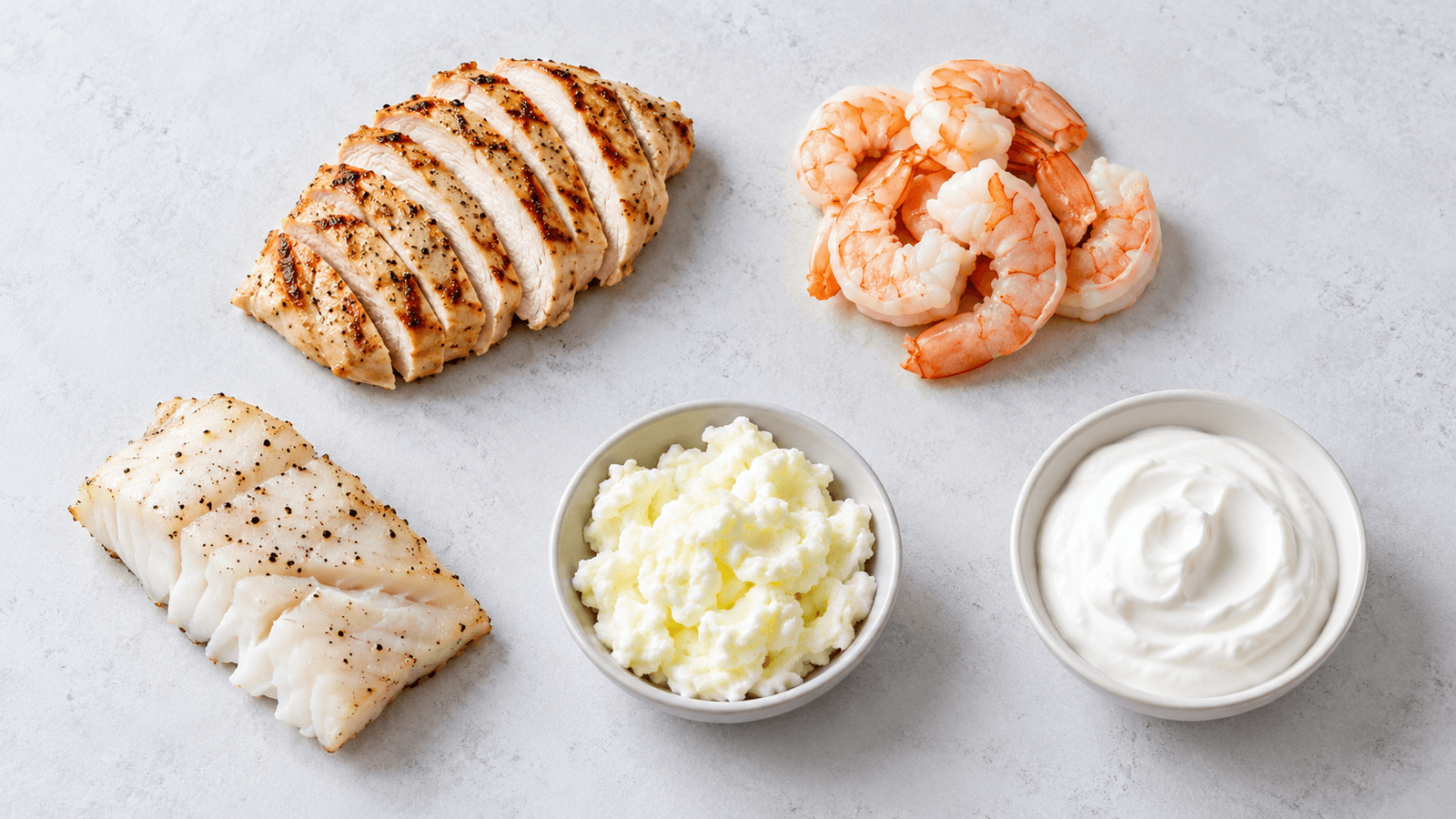
If you want to eat more protein without adding a large number of calories, the most useful foods are not simply those that contain protein. They are foods that provide a relatively large amount of protein for the calories they contain.
This can be especially useful when you are losing weight, managing calorie intake or simply trying to reach a higher protein target without making meals much larger.
Lean poultry, fish, seafood, low-fat dairy, egg whites and some plant-based foods can all make this easier.
The nutrition values in this guide are approximate. Exact calories and protein vary by brand, cut, preparation method and product. Check the nutrition label when precise tracking matters.
Low-calorie high-protein foods at a glance
| Food | Example serving | Approx. protein | Approx. calories |
|---|---|---|---|
| Chicken breast, cooked | 100 g | ~31 g | ~165 kcal |
| Turkey breast, cooked | 100 g | ~29 g | ~135–160 kcal |
| Tuna in water, drained | 100 g | ~25–29 g | ~115–135 kcal |
| Cod, cooked | 100 g | ~22–24 g | ~90–110 kcal |
| Shrimp, cooked | 100 g | ~20–24 g | ~95–120 kcal |
| White fish | 100 g | ~20–24 g | ~90–130 kcal |
| Egg whites | 200 g | ~20–22 g | ~100–110 kcal |
| Low-fat cottage cheese | 200 g | ~22–26 g | ~140–190 kcal |
| Skyr | 200 g | ~20–22 g | ~120–150 kcal |
| Low-fat Greek yogurt | 200 g | ~18–20 g | ~120–160 kcal |
| Firm tofu | 150 g | ~18–24 g | ~170–230 kcal |
| Edamame, cooked | 150 g | ~16–18 g | ~180–220 kcal |
These numbers are examples rather than fixed values. Two products with the same name can have different nutrition profiles. (USDA — FoodData Central)
For a broader list that is not focused specifically on calories, see High-Protein Foods: 30 Foods to Help You Eat More Protein.
What makes a food high in protein but low in calories?
A useful way to think about this is protein density.
Imagine two foods that each provide 20 grams of protein.
If one contains 120 calories and another contains 300 calories, both can be legitimate protein sources, but the first provides more protein relative to its calorie content.
This distinction can matter when your calorie budget is limited.
Foods that are both lean and protein-rich often perform particularly well because a large share of their calories comes from protein rather than fat or carbohydrate.
That does not make higher-calorie protein foods unhealthy. It simply makes them less calorie-efficient when protein is the specific goal.
1. Chicken breast
Skinless chicken breast is one of the most familiar examples of a lean, protein-dense food.
A 100 g cooked serving commonly provides approximately:
- 31 g protein
- 165 calories
Chicken breast can therefore contribute a substantial amount of protein without taking up a very large portion of a day's calorie intake.
It works well in salads, wraps, bowls, soups and simple meals with vegetables and grains.
Preparation matters. Breading, frying, oil-heavy sauces and creamy marinades can substantially increase the calorie content.
2. Turkey breast
Turkey breast is another lean poultry option.
A typical cooked serving can provide roughly:
- 29 g protein per 100 g
- approximately 135–160 calories, depending on preparation
Turkey can be useful in hot meals, sandwiches and salads.
Processed turkey products can differ considerably in sodium, fat and calories, so check the label rather than assuming every turkey product has the same nutrition profile.
3. Tuna in water
Tuna packed in water is convenient and highly protein-dense.
Around 100 g drained can provide approximately:
- 25–29 g protein
- 115–135 calories
It requires almost no preparation and can be added to salads, sandwiches, wraps or rice dishes.
Tuna packed in oil can contain significantly more calories because of the added oil.
4. Cod
Cod and similar lean white fish provide a large proportion of their calories from protein.
A 100 g cooked serving may provide roughly:
- 22–24 g protein
- 90–110 calories
This makes lean white fish particularly useful when you want a full protein portion while keeping the overall meal relatively light.
5. Shrimp
Shrimp is another lean seafood option.
A 100 g cooked serving can provide approximately:
- 20–24 g protein
- 95–120 calories
Shrimp can be added to salads, stir-fries, pasta and rice dishes.
As with other foods, sauces and cooking fats can change the calorie total much more than the shrimp itself.
6. Other lean white fish
Pollock, haddock, hake and other lean fish can also provide substantial protein for relatively few calories.
Depending on species and preparation, 100 g commonly provides around:
- 20–24 g protein
- approximately 90–130 calories
Rotating different fish can also make a high-protein diet less repetitive.
7. Egg whites
Whole eggs are nutritious, but most of the egg's fat and a substantial share of its calories are in the yolk.
Egg whites are therefore much more protein-dense by calorie.
Around 200 g of egg whites can provide approximately:
- 20–22 g protein
- 100–110 calories
You do not need to avoid whole eggs. One practical approach is to combine whole eggs with additional egg whites.
For example, two whole eggs plus extra egg whites can provide more protein than two eggs alone without increasing calories as much as adding several more whole eggs.
8. Low-fat cottage cheese
Cottage cheese can provide a large amount of protein in an easy-to-eat serving.
A 200 g serving of a lower-fat product may contain approximately:
- 22–26 g protein
- 140–190 calories
The exact values vary substantially between brands and fat levels.
Cottage cheese can work as breakfast, a snack or part of a savory meal.
9. Skyr
Skyr is useful when you want a convenient protein source with relatively few calories.
A 200 g serving often provides approximately:
- 20–22 g protein
- 120–150 calories
Flavored versions can contain more sugar and calories than plain versions, so compare labels if calorie efficiency is important to you.
10. Low-fat Greek yogurt
A high-protein Greek yogurt can provide approximately:
- 18–20 g protein per 200 g
- around 120–160 calories
Products marketed as Greek-style yogurt vary considerably.
Some contain much less protein or substantially more fat, so the nutrition label is more useful than the product name alone.
11. Low-fat quark
Quark is common in several European countries and can be an efficient source of protein.
Depending on the product, a 200 g serving may provide roughly 20–26 g of protein while remaining relatively low in calories.
As with yogurt and cottage cheese, fat percentage strongly affects the calorie content.
12. High-protein yogurt
Many supermarkets now sell yogurts specifically formulated with higher protein content.
Some provide 15–25 g of protein per container for a relatively modest calorie total.
These can be convenient, but check:
- serving size
- calories
- protein
- added sugar
- ingredient list
The words "high protein" alone do not tell you whether the product fits your overall diet.
13. Lean beef
Beef is generally more calorie-dense than chicken breast or white fish, but lean cuts can still provide substantial protein.
A lean cooked beef portion may provide approximately:
- 25–27 g protein per 100 g
- roughly 170–220 calories
The exact number depends heavily on the cut and fat content.
Choosing leaner cuts can significantly improve the protein-to-calorie ratio.
14. Pork tenderloin
Lean pork cuts such as tenderloin can also provide a strong protein-to-calorie ratio.
A 100 g cooked serving can provide roughly 25–27 g of protein, with calories varying according to the cut and preparation.
Visible fat, breading and sauces can substantially change the final meal.
15. Lean ham
Some lean ham products provide a useful amount of protein for relatively few calories.
However, processed meats can be high in sodium and vary considerably in ingredients.
They can contribute protein, but they do not need to be the primary protein source in your diet.
16. Crab
Crab meat is generally lean and protein-rich.
A 100 g serving can provide roughly 18–20 g of protein with a relatively modest calorie total.
Prepared crab products may contain additional ingredients, so check labels when buying packaged versions.
17. Mussels
Mussels provide protein along with micronutrients.
A practical serving can contribute a meaningful amount of protein without necessarily being very calorie-dense.
Their exact nutrition depends on serving size and preparation, particularly when served with butter, cream or oil-based sauces.
18. Scallops
Scallops are another relatively lean seafood choice.
They provide substantial protein relative to their calories and can be combined with vegetables, potatoes, rice or other foods depending on your overall calorie needs.
19. Tofu
Tofu is not as protein-dense per calorie as very lean poultry or white fish, but it can still be a useful plant-based option.
A 150 g serving of firm tofu may provide approximately:
- 18–24 g protein
- 170–230 calories
Values vary significantly because tofu products differ in water content and firmness.
20. Edamame
Edamame provides protein along with fiber and carbohydrates.
A 150 g cooked serving may contain roughly:
- 16–18 g protein
- 180–220 calories
It is more calorie-dense than lean white fish or low-fat dairy, but it provides a different nutritional profile and can be particularly useful in plant-based diets.
21. Lentils
Cooked lentils are not extremely low in calories relative to their protein, but they combine protein with fiber and complex carbohydrates.
A 200 g serving can provide roughly:
- 17–18 g protein
- around 220–250 calories
This makes lentils different from lean animal protein rather than inferior to it.
They can simultaneously contribute protein, carbohydrate and fiber to a meal.
22. Beans
Beans generally provide around 14–18 g of protein per 200 g cooked, depending on the variety.
They also provide fiber and carbohydrates.
If calorie efficiency is your only criterion, lean animal proteins and some soy foods can provide more protein per calorie. But beans can be valuable when considering the entire nutritional profile.
23. Seitan
Seitan can be particularly protein-dense for a plant-based food.
Depending on the product, 100 g may provide roughly:
- 20–25 g protein
- approximately 120–180 calories
Commercial products vary widely, so check the nutrition label.
Seitan is made from wheat gluten and is not suitable for people who need to avoid gluten.
24. Protein powder
Protein powder is not a whole food, but it can provide protein efficiently.
A typical serving may contain:
- 20–30 g protein
- approximately 100–160 calories
The exact amount depends on the product.
Protein powder is optional. It can be convenient when reaching your target through ordinary meals is difficult, but it is not required for a high-protein diet.
25. Whey isolate
Whey isolate typically contains a higher proportion of protein and less carbohydrate and fat than some other protein powders.
That can make it particularly protein-dense.
However, the practical difference may be small if your overall diet already meets your protein and calorie targets.
26. Reduced-fat cheese
Cheese is often calorie-dense because it contains both protein and fat.
Reduced-fat varieties can improve the protein-to-calorie ratio.
They can be useful in sandwiches, omelets and meals where a smaller serving contributes additional protein.
27. Light mozzarella
Lower-fat mozzarella products can provide meaningful protein with fewer calories than many full-fat cheeses.
Exact nutrition varies significantly by product, so comparing labels is worthwhile.
28. Kefir with higher protein content
Standard kefir is not necessarily extremely high in protein, but higher-protein dairy drinks can contribute protein conveniently.
They can be useful when you prefer drinking part of your protein intake rather than adding another solid meal.
29. High-protein milk
Some filtered or protein-enriched milk products contain more protein than standard milk.
They can make oats, coffee, smoothies or cereal more protein-rich without changing the meal substantially.
Again, compare nutrition labels because products differ.
30. Very lean deli poultry
Lean sliced chicken or turkey can provide protein conveniently in sandwiches and wraps.
However, processed products can contain substantial sodium and vary in additives.
Use the nutrition label to compare protein and calories rather than assuming all deli poultry is equally lean.
Which foods give you the most protein for the fewest calories?
If protein-to-calorie efficiency is the main goal, several foods stand out:
- lean white fish
- shrimp
- tuna in water
- chicken breast
- turkey breast
- egg whites
- low-fat skyr
- low-fat Greek yogurt
- low-fat cottage cheese
These foods make it relatively easy to add 20–30 grams of protein without adding several hundred calories.
That can be useful when your daily protein target is high relative to your calorie target.
High protein does not always mean low calorie
This distinction is important.
Many foods contain meaningful amounts of protein but are also calorie-dense.
Examples include:
- nuts
- nut butter
- seeds
- full-fat cheese
- fatty cuts of meat
- some protein bars
- salmon
These foods can absolutely be part of a nutritious diet.
For example, salmon provides protein along with omega-3 fatty acids. Nuts and seeds provide unsaturated fats, fiber and micronutrients.
But if your immediate goal is simply to add protein while minimizing additional calories, they may be less efficient than chicken breast, white fish, egg whites or low-fat dairy.
Low-calorie high-protein foods for weight loss
Protein can be particularly useful during a calorie deficit because it can help make meals more satisfying and support lean mass when combined with appropriate resistance training.
But protein itself does not cause fat loss.
Weight loss still depends on maintaining an appropriate energy deficit over time.
The advantage of low-calorie high-protein foods is practical: they can make it easier to reach a protein target while leaving calories available for vegetables, fruit, grains, fats and other foods.
For a detailed explanation, read How Much Protein Should You Eat to Lose Weight?.
Example: a 400-calorie high-protein meal
A high-protein meal does not need to consist only of protein foods.
For example, you could build a meal around:
- lean chicken or fish
- a large portion of vegetables
- a moderate serving of potatoes, rice or another carbohydrate
- a controlled amount of cooking oil or sauce
The exact calories depend on portions and preparation.
The important idea is that choosing a lean protein source gives you more flexibility for the rest of the meal.
Example: adding 25 grams of protein
Suppose you are near your calorie target but still need roughly 25 grams of protein.
Options could include approximately:
- a serving of lean chicken breast
- tuna in water
- a large serving of skyr
- low-fat cottage cheese
- egg whites
- a suitable protein shake
The best option depends on what you have already eaten and whether you want a meal, snack or drink.
How to compare protein foods yourself
You can compare foods using both protein per serving and calories per serving.
For example:
Food A
- 20 g protein
- 120 calories
Food B
- 20 g protein
- 280 calories
Both provide the same amount of protein, but Food A leaves 160 more calories available elsewhere in the diet.
That does not automatically make Food A healthier.
It simply makes it more calorie-efficient as a protein source.
Should you calculate protein per 100 calories?
Protein per 100 calories can be a useful comparison metric.
The calculation is:
Protein per 100 calories = protein grams ÷ calories × 100
For example, a food containing 25 g protein and 125 calories provides:
25 ÷ 125 × 100 = 20 g protein per 100 calories
This metric is especially useful when comparing foods with very different serving sizes.
However, do not use it as the only measure of food quality. Foods also provide vitamins, minerals, essential fats, fiber and other nutrients.
How much protein do you need?
Before optimizing every meal for protein density, determine whether you actually need a high protein intake.
Protein needs depend on factors including:
- body weight
- activity
- training
- calorie intake
- goals
- individual circumstances
For healthy adults, EFSA's Population Reference Intake is 0.83 g/kg of body weight per day. People who exercise regularly may use higher targets depending on their training and goals.
Read How Much Protein Do You Need per kg of Body Weight? for a detailed breakdown.
You can also use the Mealisa Protein Calculator for a practical estimate.
How to build a lower-calorie high-protein day
You do not need every food you eat to be high in protein.
Instead, make protein easy to obtain at your main meals.
For example:
Breakfast
Choose a protein base such as:
- skyr
- Greek yogurt
- cottage cheese
- eggs plus egg whites
Then add fruit, oats or other foods according to your needs.
Lunch
Build the meal around:
- chicken
- turkey
- tuna
- lean fish
- tofu
Then add vegetables and an appropriate carbohydrate source.
Snack
Simple options include:
- skyr
- cottage cheese
- high-protein yogurt
- a protein shake
Dinner
Choose another substantial protein source and build the rest of the meal around your remaining calorie and nutrient needs.
This approach is usually easier than eating low-protein meals throughout the day and trying to consume a huge amount of protein at night.
How to make high-protein meals lower in calories
The protein source is only one part of the meal.
A lean chicken breast can become a very high-calorie meal when combined with large amounts of oil, cheese and creamy sauce.
To control calories without making meals bland:
- measure cooking oil when needed
- use herbs, spices, citrus and vinegar for flavor
- choose sauces intentionally
- include plenty of vegetables
- adjust carbohydrate portions to your calorie needs
- compare lower-fat and full-fat dairy products
- use cooking methods such as grilling, baking, steaming or air frying
You do not need to eliminate fat. The goal is simply to know where the calories are coming from.
Low-calorie high-protein vegetarian foods
Vegetarian options include:
- low-fat cottage cheese
- skyr
- Greek yogurt
- egg whites
- whole eggs
- tofu
- edamame
- seitan
- lentils
- beans
- high-protein dairy products
If you eat dairy and eggs, reaching a high protein target with relatively few calories can be straightforward.
Low-calorie high-protein vegan foods
Plant-based foods often provide more carbohydrate or fat alongside their protein than very lean animal foods.
Useful options include:
- seitan
- tofu
- some tempeh products
- edamame
- lentils
- beans
- textured vegetable protein
- unsweetened soy products
- plant-based protein powders
A vegan diet can provide adequate protein, but reaching a high target within a low calorie intake may require more deliberate food selection.
Common mistakes
1. Looking only at protein grams
Thirty grams of protein tells you nothing about the total calorie content of the food.
Look at both.
2. Assuming every "protein" product is low calorie
Protein bars, shakes, desserts and snacks can vary enormously in calories.
Read the label.
3. Removing all dietary fat
Fat is an essential nutrient.
The goal is not to make your diet fat-free. It is to manage total calories while maintaining a balanced diet.
4. Eating only lean protein
Vegetables, fruit, whole grains, legumes, healthy fats and other foods remain important.
A high-protein diet should still be a varied diet.
5. Choosing a protein target that is unnecessarily high
More protein is not automatically better.
Calculate a reasonable target first rather than forcing your diet around an arbitrary number.
Frequently asked questions
What food has the most protein for the least calories?
Lean white fish, shrimp, tuna in water, chicken breast, turkey breast, egg whites and some low-fat dairy products are among the most protein-dense everyday choices.
Exact rankings vary with the specific product and preparation.
How can I get 30 grams of protein for relatively few calories?
A practical serving of chicken breast, tuna, lean fish or a larger serving of high-protein low-fat dairy can provide around 30 grams of protein without requiring a very high calorie intake.
Are eggs low calorie and high protein?
Whole eggs provide high-quality protein, but they also contain fat in the yolk.
Egg whites provide more protein relative to calories.
Combining whole eggs with additional egg whites can give you both the nutrients and flavor of the yolk while increasing total protein efficiently.
Is Greek yogurt good for a low-calorie high-protein diet?
It can be.
Choose a product with a high protein content and compare calories between brands. Low-fat high-protein Greek yogurt can provide a substantial amount of protein for relatively few calories.
Is chicken or salmon better for protein when losing weight?
Both can fit.
Chicken breast is generally leaner and usually provides more protein per calorie.
Salmon is more calorie-dense because it contains more fat, but it also provides beneficial omega-3 fatty acids.
The better choice depends on the rest of your diet rather than one nutrient alone.
Are nuts good for a low-calorie high-protein diet?
Nuts contain protein, but they are calorie-dense because they are rich in fat.
They can be nutritious, but they are not among the most efficient foods when the specific goal is maximizing protein for relatively few calories.
Can I eat high protein while staying in a calorie deficit?
Yes.
Choosing lean protein sources can make this easier because they allow you to obtain substantial protein while leaving room in your calorie budget for other foods.
Your calorie deficit should still be appropriate and sustainable.
Bottom line
Low-calorie high-protein foods are useful when you want to increase protein without consuming a large number of additional calories.
Some of the most practical choices include:
- chicken breast
- turkey breast
- tuna in water
- lean white fish
- shrimp
- egg whites
- low-fat cottage cheese
- skyr
- low-fat Greek yogurt
- selected plant-based proteins such as seitan and tofu
But calorie efficiency is not the same thing as overall nutritional quality.
Higher-calorie protein foods such as salmon, whole eggs, nuts and seeds can still provide valuable nutrients and fit into a balanced diet.
Start by determining an appropriate protein target with the Mealisa Protein Calculator, then choose a mix of foods that fits your calories, preferences, budget and overall nutritional needs.
For more options, see our complete guide to High-Protein Foods.
Nutrition values are approximate and vary by product and preparation. This article provides general nutrition information for healthy adults and is not individualized medical or dietetic advice.