
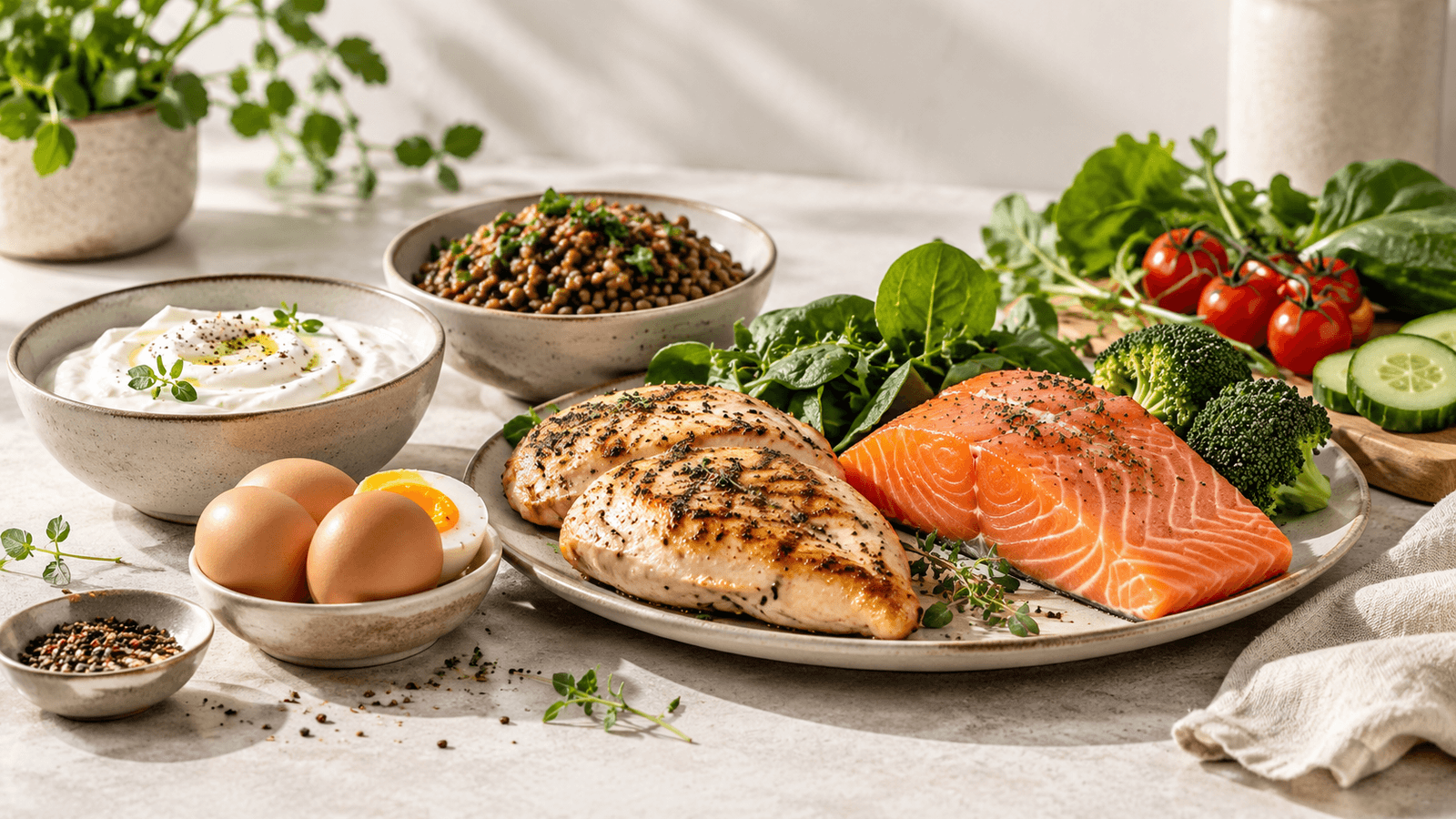
If you're trying to lose weight, protein can help you build a more satisfying diet while supporting the maintenance of muscle during a calorie deficit. (Dhillon et al.)
For many healthy adults trying to lose weight, a practical starting range is around 1.2–1.6 grams of protein per kilogram of body weight per day. People who train regularly may find the upper part of this range particularly useful. (Kohanmoo et al.)
The exact amount you need depends on your body weight, activity, training and overall diet.
How much protein should you eat to lose weight?
A simple way to estimate your daily protein intake is:
Body weight in kilograms × 1.2–1.6 = grams of protein per day
For example, a person who weighs 70 kg would get:
- 70 × 1.2 = 84 g
- 70 × 1.4 = 98 g
- 70 × 1.6 = 112 g
That gives a practical range of approximately 84–112 grams of protein per day.
Rather than treating one number as a perfect target, it is usually more useful to think in terms of a range.
Protein targets by body weight
Here are some examples using 1.2, 1.4 and 1.6 grams of protein per kilogram of body weight.
| Body weight | 1.2 g/kg | 1.4 g/kg | 1.6 g/kg |
|---|---|---|---|
| 50 kg | 60 g | 70 g | 80 g |
| 60 kg | 72 g | 84 g | 96 g |
| 70 kg | 84 g | 98 g | 112 g |
| 80 kg | 96 g | 112 g | 128 g |
| 90 kg | 108 g | 126 g | 144 g |
| 100 kg | 120 g | 140 g | 160 g |
These numbers are estimates rather than individualized medical recommendations.
Want a faster estimate? Use the free Mealisa Protein Calculator to calculate a practical range from your weight, activity level and goal.
Why protein matters when losing weight
Weight loss primarily requires an energy deficit: over time, you consume less energy than your body uses.
Protein does not replace that requirement.
Its value during weight loss comes from several other properties.
Protein helps maintain muscle
When body weight decreases, the weight lost is not necessarily all body fat.
Maintaining adequate protein intake, particularly alongside resistance training, can help support the maintenance of lean tissue while losing weight.
That matters because the goal for many people is not simply to make the number on the scale smaller. It is to reduce body fat while retaining as much useful lean mass as possible.
Protein can make meals more filling
Protein-rich meals can also contribute to satiety.
A breakfast containing eggs, Greek yogurt or another substantial protein source, for example, can feel very different from a meal consisting mainly of rapidly digested carbohydrates.
This does not mean that adding protein automatically causes weight loss. Total calorie intake still matters.
Instead, protein can make a calorie-controlled eating pattern easier for some people to follow.
Protein requires energy to digest
Your body uses energy to digest, absorb and metabolize food.
Protein generally has a higher thermic effect than carbohydrate or fat.
This is another reason protein is often emphasized in weight-management diets, although the effect should not be treated as a shortcut that overrides overall calorie balance.
Is 1.2 g/kg enough for weight loss?
For many healthy adults, 1.2 g/kg can be a reasonable starting point when losing weight, particularly if activity levels are relatively low.
For a 75 kg person:
75 × 1.2 = 90 grams per day
Someone who trains regularly may choose a higher target within the practical range.
At 1.4 g/kg, the same person would consume:
75 × 1.4 = 105 grams per day
At 1.6 g/kg:
75 × 1.6 = 120 grams per day
This is why Mealisa uses ranges instead of pretending that everyone has one exact protein requirement. (EFSA)
How much protein if you exercise while losing weight?
Exercise changes the picture because protein is involved in muscle repair and remodeling.
For people who regularly train while losing weight, a practical target around 1.4–1.6 g/kg per day can be useful.
For example, an 80 kg person would get:
- 112 g/day at 1.4 g/kg
- 128 g/day at 1.6 g/kg
Resistance training is particularly relevant when the goal is to preserve muscle while reducing body fat.
If you are highly trained, following a demanding athletic program or using a large calorie deficit, your needs may differ from these general estimates.
Should you calculate protein from current or goal weight?
This question becomes especially important at higher body weights.
Simply multiplying a high current body weight by a high protein factor can sometimes produce an unnecessarily large target.
There is no single calculation that works perfectly for every body composition.
For general use, body-weight formulas are convenient starting estimates. People with obesity, unusual body composition, intensive athletic goals or medical conditions may benefit from an individualized assessment from a qualified healthcare or nutrition professional.
The goal is not to chase the largest protein number possible.
It is to find an intake that fits your overall diet, calorie target and lifestyle.
How should you spread protein across the day?
You do not have to eat your entire protein target in one or two meals.
For many people, distributing protein across several meals is more practical.
Suppose your target is 120 g/day.
With three meals:
120 ÷ 3 = about 40 g per meal
With four eating occasions:
120 ÷ 4 = about 30 g each
Your meals do not need to contain exactly the same amount. This is simply an easy way to turn a daily target into something you can actually use.
The Mealisa Protein Calculator can also divide your estimated daily range by your usual number of meals.
High-protein foods for weight loss
You can get protein from both animal and plant foods.
Useful options include:
- chicken and turkey
- fish and seafood
- eggs
- Greek yogurt and skyr
- cottage cheese
- lean meat
- tofu and tempeh
- lentils
- beans
- peas
- soy products
Protein content is only one part of the decision.
When losing weight, it is also useful to consider calories, portion size, fiber, preparation method and the rest of the meal.
For example, frying a lean protein in a large amount of oil can substantially change the calorie content of the finished dish.
Do you need protein shakes to lose weight?
No.
Protein powder is a convenient food product, not a requirement for weight loss.
If you can comfortably reach your protein target with ordinary foods, there is no nutritional rule requiring a shake.
A protein shake can nevertheless be useful when convenience matters or when reaching your target through meals alone is difficult.
Remember that shakes still contain calories and should be included in your overall intake.
Can you eat too much protein?
More is not automatically better.
Once your diet contains enough protein for your needs, continually increasing protein does not guarantee faster fat loss.
Very high protein targets can also make a diet unnecessarily restrictive by leaving less room for vegetables, fruit, whole grains, healthy fats and other nutritious foods.
People with kidney disease or other medical conditions that affect dietary protein should discuss appropriate intake with a qualified healthcare professional rather than relying on a general online calculator.
Protein does not replace a calorie deficit
This is one of the most important points.
You can eat a high-protein diet and still gain weight if your total energy intake consistently exceeds your needs.
Likewise, simply adding a protein shake to an existing diet does not automatically make that diet suitable for weight loss.
Think of protein as one component of the plan:
calorie balance + sufficient protein + nutritious foods + activity + consistency
All of these can matter.
Common protein mistakes during weight loss
Focusing only on protein
Protein matters, but so do calories, fiber, micronutrients and overall food quality.
Choosing protein foods without considering calories
Nuts, cheese and some processed meats contain protein but can also be calorie-dense.
They can still fit into a weight-loss diet, but portions matter.
Setting an unnecessarily extreme target
If your calculated target makes every meal difficult or forces you to rely heavily on supplements, the target may not be practical.
Ignoring resistance training
If maintaining muscle is important to you, nutrition and training work together.
Protein alone cannot reproduce the stimulus provided by resistance exercise.
Trying to be perfect every day
Your diet does not become unsuccessful because one day contains slightly less protein than planned.
Consistency over time is more useful than chasing a perfect number at every meal.
Example: protein target for a 75 kg person
Imagine someone weighs 75 kg and wants to lose weight.
A general range of 1.2–1.6 g/kg gives:
- 90 g/day at 1.2 g/kg
- 105 g/day at 1.4 g/kg
- 120 g/day at 1.6 g/kg
If that person trains regularly, a practical target might fall toward the upper part of the range.
With three meals per day, 105–120 g would average approximately 35–40 g of protein per meal.
That does not mean every meal must hit exactly that amount. It simply provides an easy framework for planning the day.
How to calculate your own target
You can calculate it manually:
- Find your body weight in kilograms.
- Multiply it by a protein factor such as 1.2–1.6.
- Choose a practical point within the range based on your activity and goals.
- Divide your daily target across the number of meals you normally eat.
Or use the free Mealisa Protein Calculator, which performs the calculation automatically.
For a broader explanation of daily protein requirements, read How Much Protein Do You Need Per Day?.
Frequently asked questions
Is 100 grams of protein enough to lose weight?
It can be enough for some people and inappropriate for others because protein requirements depend partly on body weight and activity.
For a 70 kg person, 100 g/day is about 1.43 g/kg. For a 100 kg person, the same 100 g is 1.0 g/kg.
Using grams per kilogram gives the number more context.
Is 150 grams of protein too much?
That depends on the person.
For someone weighing 100 kg, 150 g is 1.5 g/kg. For someone weighing 60 kg, it is 2.5 g/kg.
This is why a fixed target such as 150 g cannot be considered universally appropriate.
Does protein burn belly fat?
Protein does not selectively burn abdominal fat.
Fat loss occurs through changes in overall energy balance, and the body determines where fat is lost.
A protein-rich diet may support a weight-loss plan, but it cannot target one part of the body.
Should I eat more protein on workout days?
For most people, it is simpler to maintain a reasonably consistent daily protein intake rather than dramatically changing the target between workout and rest days.
What is the best protein for weight loss?
There is no single best protein food.
Lean meats, fish, eggs, low-fat dairy, legumes, tofu and other protein-rich foods can all work.
The best choices are foods that fit your calorie needs, preferences, budget and overall eating pattern.
The bottom line
For many healthy adults trying to lose weight, 1.2–1.6 grams of protein per kilogram of body weight per day is a useful practical range to consider.
People who exercise regularly may prefer a target toward the upper end of that range.
But protein is only one part of weight management. Your overall calorie intake, food choices, training, activity and ability to maintain the plan over time are also important.
Use the Mealisa Protein Calculator for a quick estimate based on your weight, activity and goal.
This article provides general educational information and is not individualized medical or dietary advice.
Continue exploring protein
Sources
Evidence and authoritative guidance used for the nutrition and health information in this article: