
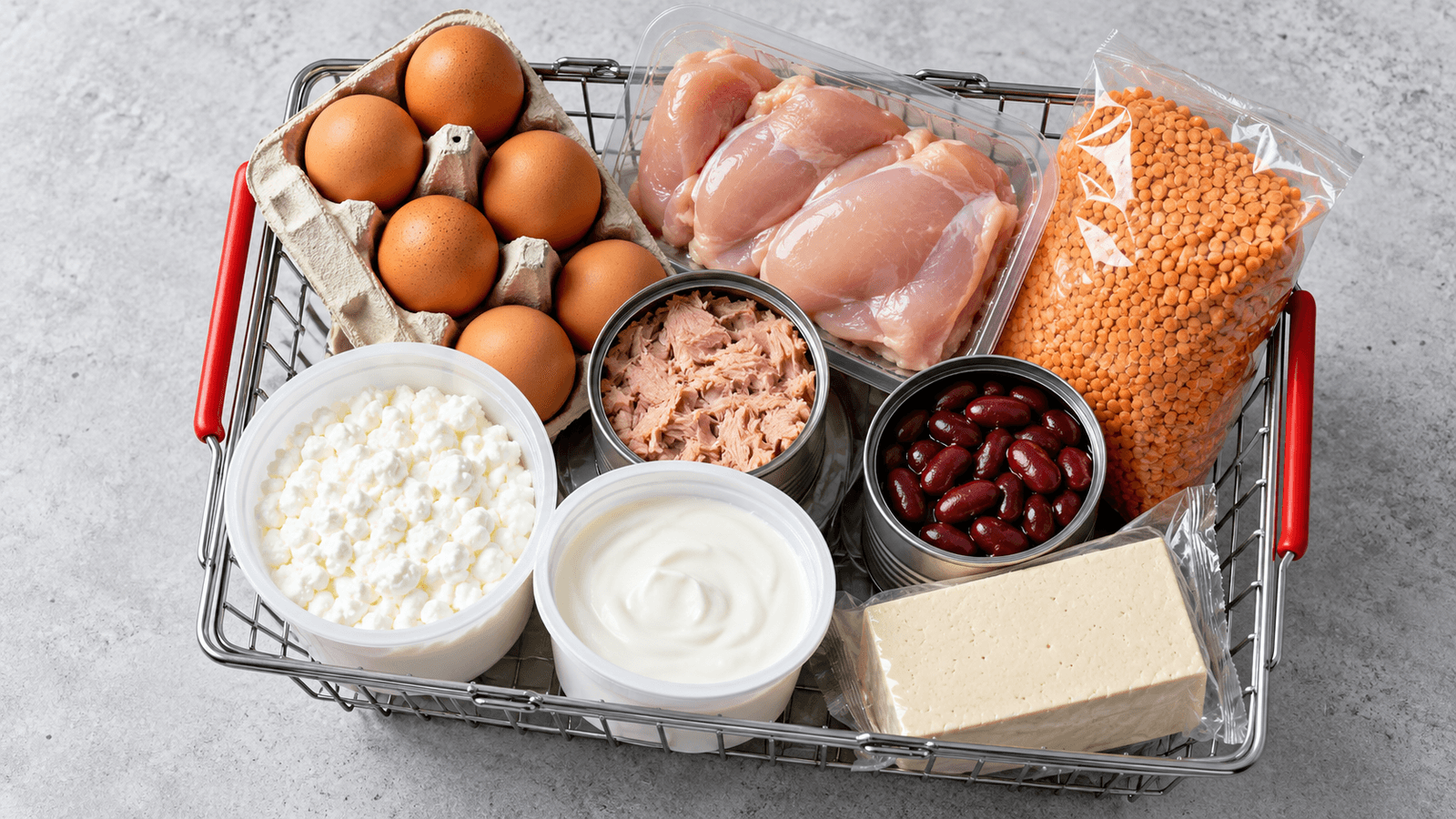
Eating more protein does not have to mean buying expensive steaks, premium fish or specialized high-protein products.
Many everyday foods can provide substantial amounts of protein at a relatively low cost. Eggs, canned tuna, cottage cheese, lentils, beans, chicken, yogurt and several other staples can all help you build a higher-protein diet while keeping grocery spending under control.
The key is to compare foods by more than the price of the package. A useful budget protein should provide a meaningful amount of protein for the money, fit easily into meals and be practical enough to use regularly.
Prices vary significantly by country, supermarket, brand, package size and promotion. This guide therefore focuses on foods that are commonly budget-friendly rather than assigning fixed prices that may quickly become outdated. Nutrition values are approximate and can also vary by product and preparation.
Cheap high-protein foods at a glance
| Food | Example serving | Approx. protein | Why it can be budget-friendly |
|---|---|---|---|
| Eggs | 3 large eggs | ~18–20 g | Versatile everyday staple |
| Chicken breast | 150 g cooked | ~45 g | High protein per portion |
| Chicken thighs | 150 g cooked | ~35–40 g | Often cheaper than breast |
| Canned tuna | 1 can, drained | ~25–30 g | Long shelf life and no cooking |
| Cottage cheese | 200 g | ~22–26 g | Large protein serving from one tub |
| Skyr | 200 g | ~20–22 g | Convenient high-protein dairy |
| Greek yogurt | 200 g | ~18–20 g | Works for breakfast or snacks |
| Quark | 200 g | ~20–26 g | Often economical in larger tubs |
| Milk | 500 ml | ~16–18 g | Easy to use across meals |
| Lentils | 200 g cooked | ~17–18 g | Very inexpensive when bought dry |
| Beans | 200 g cooked | ~14–18 g | Cheap, filling and shelf-stable |
| Chickpeas | 200 g cooked | ~16–18 g | Useful in many inexpensive meals |
| Split peas | 200 g cooked | ~16 g | Excellent for soups and stews |
| Tofu | 200 g | ~24–32 g | Affordable plant protein in many markets |
| TVP | 50 g dry | ~23–27 g | Shelf-stable and highly protein-dense |
These are approximate examples, not fixed nutrition values. USDA FoodData Central and product labels can be used when you need values for a specific food or brand.
For a broader comparison of protein sources, see High-Protein Foods: 30 Foods to Help You Eat More Protein.
What makes a protein food cheap?
The cheapest package is not necessarily the cheapest protein source.
Imagine two products:
Food A
- costs €2.00
- provides 20 g protein in the package
Food B
- costs €3.00
- provides 60 g protein in the package
Food B costs more at checkout, but it provides three times as much protein.
A useful way to compare foods is therefore:
Cost per 25 g of protein = food price ÷ total protein in the package × 25
This does not measure overall nutritional quality. It simply gives you a practical way to compare the cost of obtaining protein from different foods.
Package size, waste, cooking yield and whether you actually enjoy eating the food also matter.
1. Eggs
Eggs are one of the easiest budget protein foods to use.
Three large eggs provide roughly:
- 18–20 g protein
- around 210–240 calories
Eggs may not provide as much protein per calorie as chicken breast or lean fish, but they are inexpensive in many supermarkets and extremely versatile.
You can use them for:
- omelets
- scrambled eggs
- sandwiches
- salads
- rice dishes
- breakfast bowls
If you want more protein without adding several additional yolks, combining whole eggs with egg whites can increase the protein content efficiently.
2. Chicken breast
Chicken breast is not always the cheapest meat by package price, but its high protein content can make it economical per gram of protein.
A 150 g cooked portion can provide roughly 45 g of protein.
Buying larger packs, family packs or discounted packages and freezing individual portions can reduce the cost.
Avoid comparing only the price per package. Compare the price per kilogram as well.
3. Chicken thighs
Chicken thighs are often cheaper than chicken breast.
They generally contain more fat and therefore more calories, but they still provide substantial protein.
A cooked 150 g portion can provide approximately 35–40 g of protein, depending on whether skin and bone are included in the product.
Boneless skinless thighs are easy to use in:
- curries
- rice dishes
- wraps
- pasta
- tray bakes
- stews
If your priority is cost rather than minimizing calories, chicken thighs can be a strong option.
4. Whole chicken
A whole chicken can sometimes cost considerably less per kilogram than individually prepared cuts.
You can use different parts across several meals and use the remaining meat in sandwiches, soups or salads.
The important comparison is edible yield.
A whole chicken includes bones and sometimes skin, so its sticker price per kilogram cannot be compared directly with boneless chicken breast.
5. Ground turkey
Ground turkey can be an economical protein when purchased in larger packages or during promotions.
It works well in:
- pasta sauce
- chili
- meatballs
- burgers
- rice bowls
- wraps
Protein and fat content vary between products, so compare labels.
6. Lean ground beef on sale
Beef is often more expensive than poultry, but discounted larger packs of ground beef can occasionally provide good value.
Lean versions provide more protein relative to calories, while higher-fat versions may be cheaper.
Whether the saving is worthwhile depends on your calorie goals and local prices.
7. Canned tuna
Canned tuna is one of the most convenient inexpensive protein foods.
A typical drained can can provide roughly 25–30 g of protein, depending on its size.
Advantages include:
- long shelf life
- no cooking
- easy portioning
- frequent supermarket promotions
- useful for quick meals
Tuna packed in water is generally lower in calories than tuna packed in oil.
For dietary variety, canned tuna does not need to be your only fish source.
8. Canned sardines
Sardines can be inexpensive compared with fresh fish and provide protein along with omega-3 fats.
Because the entire product is shelf-stable, there is also little risk of buying it and losing it to spoilage.
They work well with:
- bread
- potatoes
- salads
- pasta
- rice
Calories vary depending on whether they are packed in water, tomato sauce or oil.
9. Frozen white fish
Fresh fish can be expensive, but frozen white fish is often more affordable.
Pollock, hake and similar fish can provide substantial protein while remaining relatively lean.
Frozen portions also reduce food waste because you can cook only what you need.
Compare the price per kilogram and check whether the package contains added coating or sauce.
10. Cottage cheese
Cottage cheese can provide a substantial amount of protein from a relatively inexpensive supermarket product.
A 200 g serving may provide roughly:
- 22–26 g protein
- with calories depending on fat content
Larger tubs are often cheaper per 100 g than individual snack portions.
It can be eaten sweet or savory, which makes it useful across multiple meals.
11. Quark
In countries where quark is widely available, it can be one of the most economical high-protein dairy foods.
A 200 g serving can provide approximately 20–26 g of protein, depending on the product.
Large plain tubs usually offer better value than flavored individual portions.
Quark works with:
- fruit
- oats
- potatoes
- herbs
- sandwiches
- simple desserts
12. Skyr
Skyr often provides around 10–11 g of protein per 100 g, although products vary.
A 200 g serving can therefore provide approximately 20–22 g of protein.
Plain supermarket own-brand versions may offer substantially better value than branded high-protein desserts.
Compare price per kilogram rather than price per container.
13. Greek yogurt
High-protein Greek yogurt can be another economical choice, especially in large tubs.
A 200 g serving may provide approximately 18–20 g of protein, depending on the product.
Be aware that "Greek-style" products can vary greatly in protein and fat.
Always check the nutrition label.
14. Milk
Milk is easy to overlook because it is not usually thought of as a high-protein food.
But 500 ml of cow's milk provides roughly 16–18 g of protein, depending on the product.
If you already use milk in:
- oats
- cereal
- coffee
- smoothies
- sauces
it can quietly contribute a meaningful amount of protein without requiring a separate specialty product.
15. Reduced-fat cheese
Cheese is usually more calorie-dense than yogurt or cottage cheese, but some reduced-fat varieties provide substantial protein.
It can be economical when used in smaller amounts to add both protein and flavor to meals.
Compare:
- price per 100 g
- protein per 100 g
- calories per 100 g
rather than relying on marketing claims.
16. Lentils
Dry lentils are one of the classic budget protein foods.
About 200 g cooked lentils provides roughly 17–18 g of protein.
They also provide carbohydrate and fiber, so they function differently in a meal from chicken or fish.
Dry lentils are usually cheaper per serving than pre-cooked pouches.
They work particularly well in:
- soups
- curries
- stews
- pasta sauces
- salads
- grain bowls
Cooking a large batch can provide several inexpensive meals.
17. Beans
Beans can provide approximately 14–18 g of protein per 200 g cooked, depending on the variety.
Dry beans are often the least expensive option, while canned beans save time.
If canned beans are significantly more expensive, compare the convenience with the actual saving from cooking dry beans.
Beans can stretch more expensive ingredients as well.
For example, using half ground meat and half beans in chili can reduce the cost per serving while maintaining a substantial amount of protein.
18. Chickpeas
Chickpeas are another inexpensive plant protein.
Around 200 g cooked can provide approximately 16–18 g of protein.
They can be used for:
- curries
- salads
- soups
- roasted snacks
- hummus
- wraps
Like other legumes, chickpeas provide carbohydrates and fiber alongside protein.
19. Split peas
Split peas are inexpensive, shelf-stable and well suited to batch cooking.
A large pot of split-pea soup can provide multiple meals for relatively little money.
A 200 g cooked portion provides roughly 16 g of protein, although exact values vary.
Combining split peas with other ingredients can create a filling meal at very low cost per serving.
20. Dried peas
Dried peas can be used similarly to lentils and split peas.
They are inexpensive, store for long periods and can contribute meaningful protein to soups and stews.
Shelf-stable foods also reduce the financial cost of food waste.
21. Tofu
The price of tofu varies greatly by country and supermarket.
Where inexpensive own-brand tofu is available, it can be a useful budget protein.
A 200 g portion of firm tofu may provide approximately 24–32 g of protein, depending on the product.
It works well in:
- stir-fries
- curries
- noodle dishes
- rice bowls
- scrambled tofu
Compare products because water content can significantly affect protein per 100 g.
22. Textured vegetable protein
Textured vegetable protein, often called TVP, is one of the most protein-dense shelf-stable plant foods.
A 50 g dry serving may provide approximately 23–27 g of protein, depending on the product.
Because it is sold dry, it has a long shelf life and expands after hydration.
TVP can replace some or all of the ground meat in:
- chili
- Bolognese
- tacos
- stuffed vegetables
- casseroles
Its low cost per serving can make it particularly useful for budget meal planning.
23. Soy milk
Soy milk generally contains more protein than many other plant-based drinks.
A typical 250 ml glass may provide around 7–9 g of protein, although brands differ.
Larger supermarket own-brand cartons can be relatively inexpensive.
Choose fortified versions when appropriate and compare both protein and price between brands.
24. Edamame
Frozen edamame is often cheaper than fresh specialty protein products.
It provides protein, carbohydrate and fiber and can be kept in the freezer for months.
It works as:
- a snack
- a side dish
- a salad ingredient
- an addition to rice or noodle bowls
It is generally more expensive per gram of protein than dry lentils or TVP, but it can still fit a budget-conscious diet.
25. Peanut butter
Peanut butter contains protein, but it is important to understand its role.
It is calorie-dense because much of its energy comes from fat.
That means it is not an especially efficient way to obtain protein if calories are limited.
However, it is shelf-stable, inexpensive per serving in many markets and useful when you need additional calories as well as some protein.
For foods that maximize protein while minimizing calories, see Low-Calorie High-Protein Foods: 30 Foods for More Protein With Fewer Calories.
26. Peanuts
Like peanut butter, peanuts provide protein but also substantial fat and calories.
They can still be economical and nutritious, particularly when energy intake is not tightly restricted.
Use them as a food that contributes protein rather than as your primary lean protein source.
27. Canned beans with supermarket own-brand labels
Generic or supermarket own-brand canned beans are often considerably cheaper than premium branded versions.
The nutrition difference may be small.
Compare:
- drained weight
- price per kilogram
- protein per 100 g
- sodium if relevant to you
The cheapest can is not always the cheapest after accounting for drained weight.
28. Frozen poultry
Frozen chicken or turkey can sometimes be cheaper than fresh equivalents and has the advantage of a long storage life.
This can be particularly useful if fresh meat frequently expires before you use it.
Check whether the product is:
- plain meat
- breaded
- marinated
- injected with added solution
because these differences affect both nutrition and value.
29. Leftover cooked meat
The cheapest protein is sometimes the food you already purchased.
Cooked chicken, beef or pork left from dinner can become:
- a sandwich
- a wrap
- a salad
- a soup
- a rice bowl
- an omelet filling
Planning leftovers deliberately can reduce both grocery spending and food waste.
30. Protein powder bought by serving cost
Protein powder can appear expensive because the container has a high upfront price.
But the cost per 20–25 g of protein can sometimes be competitive with ready-to-eat protein snacks.
Do the calculation before deciding.
Compare:
price per container ÷ number of servings
and then check how much protein each serving actually contains.
Protein powder is optional. Ordinary foods can provide all the protein you need.
Cheapest animal protein sources
Depending on local prices, economical animal-based protein sources commonly include:
- eggs
- chicken thighs
- chicken breast in larger packs
- canned tuna
- sardines
- cottage cheese
- quark
- large tubs of yogurt
- milk
- frozen fish
Which one is cheapest changes with supermarket pricing.
This is why comparing cost per useful protein serving is more informative than maintaining a permanent ranking.
Cheapest vegetarian protein sources
For vegetarians who consume dairy and eggs, useful budget options include:
- eggs
- cottage cheese
- quark
- skyr
- Greek yogurt
- milk
- lentils
- beans
- chickpeas
- split peas
- tofu
- TVP
Combining inexpensive dairy, eggs and legumes can make it relatively easy to reach a substantial protein intake without relying on specialty foods.
Cheapest vegan protein sources
Some of the most practical low-cost vegan protein staples are:
- dry lentils
- dry beans
- chickpeas
- split peas
- TVP
- tofu where locally inexpensive
- soy milk
- peas
Dry legumes are especially useful because they are inexpensive, shelf-stable and easy to buy in larger quantities.
Plant foods do not need to imitate meat to contribute useful protein.
Is dry or canned cheaper?
Dry legumes usually cost less per cooked serving than canned versions.
But price is not the only cost.
Dry beans may require:
- soaking
- longer cooking
- electricity or gas
- planning ahead
Canned beans require almost no preparation.
For someone with limited cooking time, paying slightly more for canned legumes may still be a sensible trade-off.
Lentils and split peas are particularly convenient because many varieties cook relatively quickly without overnight soaking.
How to compare supermarket protein prices
When shopping, use a simple four-step process.
Step 1: Check the unit price
Look at the price per kilogram or per 100 g rather than only the package price.
Step 2: Check protein per 100 g
Two foods at the same price can contain very different amounts of protein.
Step 3: Consider edible yield
Bones, skin, shells and cooking losses can change the real amount of food you receive.
Step 4: Consider waste
A slightly more expensive frozen or shelf-stable food may be cheaper in practice if you actually eat all of it.
This is particularly important when shopping for one person.
Example: comparing two protein products
Imagine:
Product A
- price: €2.50
- package: 500 g
- protein: 10 g per 100 g
The package contains approximately 50 g protein.
Cost per 25 g protein:
€2.50 ÷ 50 × 25 = €1.25
Now consider:
Product B
- price: €3.50
- package: 500 g
- protein: 20 g per 100 g
The package contains approximately 100 g protein.
Cost per 25 g protein:
€3.50 ÷ 100 × 25 = €0.88
Product B has the higher sticker price but provides protein more cheaply.
This is why package price alone can be misleading.
Cheap high-protein breakfast ideas
Eggs and toast
Eggs provide the main protein while bread adds carbohydrate and additional protein.
Add vegetables or fruit according to preference.
Quark or skyr with oats
Large tubs of plain quark or skyr can be cheaper than individual high-protein desserts.
Add oats and fruit for a complete breakfast.
Cottage cheese on toast
Cottage cheese can provide substantially more protein than many traditional spreads.
Oats made with milk
Oats are not extremely high in protein on their own, but preparing them with milk and adding yogurt or quark can increase the total considerably.
Cheap high-protein lunch ideas
Lentil soup
Dry lentils, vegetables and basic seasonings can produce several portions at low cost.
Tuna and potato bowl
Combine canned tuna with potatoes and vegetables for a simple meal built from inexpensive staples.
Chicken rice bowl
Buy chicken in a larger pack, cook several portions and combine with rice and frozen vegetables.
Bean chili
Beans, tomatoes, onions and spices create a low-cost base.
You can use beans alone or combine them with a smaller amount of ground meat.
Cheap high-protein dinner ideas
Lentil Bolognese
Replace some or all of the meat with lentils.
Chicken tray bake
Chicken thighs, potatoes and seasonal vegetables can create several portions with minimal preparation.
Tofu stir-fry
Where tofu is inexpensive, combine it with frozen vegetables and rice.
Split-pea soup
Dry split peas are cheap, shelf-stable and suited to large-batch cooking.
Cheap high-protein snacks
Budget-friendly options can include:
- boiled eggs
- cottage cheese
- plain skyr
- quark
- Greek yogurt
- milk
- homemade yogurt bowls
- leftover chicken
- a protein shake when its cost per serving is competitive
Pre-packaged protein bars and branded protein desserts are convenient, but they are often not the cheapest way to buy protein.
Buy larger packages — but only when you will use them
Large packages often have a lower unit price.
But a family-size package is not a saving if half of it ends up in the trash.
Useful strategies include:
- freeze meat in individual portions
- buy dry foods in bulk
- choose frozen vegetables
- batch-cook meals
- portion large dairy containers intentionally
- keep shelf-stable proteins available
The goal is to reduce both unit cost and waste.
Use supermarket own brands
Store-brand staples can offer very similar nutrition at a lower price than premium brands.
This is especially relevant for simple foods such as:
- canned beans
- lentils
- oats
- milk
- yogurt
- cottage cheese
- frozen vegetables
- canned fish
Compare the nutrition label rather than assuming a higher price means more protein.
Build meals around one main protein source
Trying to add several expensive protein products to every meal can make grocery spending climb quickly.
Instead, choose one primary protein source.
For example:
Breakfast: quark
Lunch: lentils
Dinner: chicken
Snack: yogurt
This keeps meal planning simple and makes shopping quantities easier to estimate.
Combine expensive and inexpensive proteins
You do not need to eliminate foods you enjoy simply because they cost more.
Instead, stretch them.
Examples:
- beef + beans
- chicken + lentils
- tuna + white beans
- eggs + cottage cheese
- tofu + edamame
A smaller portion of the more expensive ingredient can still provide flavor while the lower-cost food increases the total protein and meal volume.
Cook once, eat several times
Batch cooking can reduce both time and cost.
Good high-protein foods for batch cooking include:
- chicken
- lentils
- beans
- chili
- soups
- ground meat sauces
- tofu
- hard-boiled eggs
Store food safely and freeze portions that you will not eat within an appropriate refrigerated storage period.
Frozen foods can save money
Frozen food is not automatically lower quality.
Frozen meat, fish and vegetables can reduce waste because you use only the amount needed.
For a budget-conscious household, avoiding spoilage can matter as much as finding the lowest supermarket price.
Do you need expensive high-protein products?
Usually not.
Products marketed specifically as "protein" foods can be convenient, but you can build a high-protein diet from ordinary supermarket staples.
Compare a branded protein dessert with:
- plain skyr
- quark
- cottage cheese
- milk
- eggs
The less glamorous option may provide similar protein for less money.
Cheap does not mean nutritionally complete
A food can be an excellent low-cost source of protein without supplying everything your body needs.
For example:
- lentils also provide carbohydrate and fiber
- dairy can contribute calcium
- oily fish provides omega-3 fats
- eggs provide several micronutrients
- meat can provide iron and vitamin B12
- legumes contribute fiber and minerals
A varied diet is more useful than choosing every food solely according to protein cost.
Protein and calories both matter
Some inexpensive protein foods are also calorie-dense.
Peanuts and peanut butter are good examples.
They can be excellent value when you need both energy and protein, but less useful when you are trying to maximize protein within a restricted calorie target.
If calories are your main constraint, see Low-Calorie High-Protein Foods.
How much protein should you actually buy?
Before spending extra money on protein foods, estimate how much protein you need.
Your target depends on factors such as:
- body weight
- activity
- training
- calorie intake
- goals
You can read How Much Protein Do You Need per kg of Body Weight? or use the Mealisa Protein Calculator for a practical estimate.
There is little benefit in designing your entire grocery budget around an unnecessarily high target.
A simple budget protein shopping strategy
Start with several inexpensive protein categories rather than buying everything marketed as high protein.
For example:
| Category | Budget options |
|---|---|
| Eggs | Large multipacks |
| Poultry | Chicken thighs, larger packs, frozen chicken |
| Fish | Canned tuna, sardines, frozen white fish |
| Dairy | Quark, cottage cheese, large yogurt tubs, milk |
| Legumes | Dry lentils, beans, chickpeas, split peas |
| Plant protein | TVP, tofu, soy milk |
| Pantry backup | Canned fish, canned beans, protein powder if economical |
Then compare local unit prices.
The cheapest combination in one supermarket or country may not be the cheapest somewhere else.
Frequently asked questions
What is the cheapest high-protein food?
There is no universal cheapest high-protein food because prices vary by location and store.
Dry lentils, beans, split peas, eggs, dairy products, TVP and discounted poultry are often economical choices.
Comparing cost per 20–25 g of protein gives a more useful answer for your own supermarket.
What is the cheapest way to get 100 grams of protein a day?
Usually, the lowest-cost approach is to combine several ordinary staples rather than rely on specialty protein products.
For example, eggs or dairy at breakfast, legumes at lunch, poultry or tofu at dinner and another inexpensive dairy or legume-based food can collectively provide substantial protein.
The exact cheapest combination depends on local prices and your dietary preferences.
Are eggs a cheap source of protein?
Often yes.
Eggs are versatile, widely available and provide roughly 6–7 g of protein each.
However, their cost per gram of protein changes with local egg prices, so they may not always beat dry legumes, large dairy tubs or discounted poultry.
Are beans cheaper than meat for protein?
Dry beans are often very inexpensive, but they contain less protein per 100 g cooked than meat and also provide substantial carbohydrate and fiber.
Instead of treating them as direct nutritional equivalents, compare the cost of the amount of protein you actually need and consider the rest of the meal.
Is canned tuna a cheap protein source?
It can be, particularly when bought as a supermarket own brand or during promotions.
It is shelf-stable, requires no cooking and provides a substantial amount of protein in a small package.
Is protein powder cheaper than food?
Sometimes.
Calculate the cost per 20–25 g of protein and compare it with foods you regularly buy.
A large tub can have a high upfront price while still having a relatively low cost per serving.
Protein powder is a convenience, not a requirement.
How can I eat high protein on a tight budget?
Prioritize inexpensive staples, compare unit prices, buy larger packages only when you can use them, cook legumes from dry when practical, use frozen foods to reduce waste and limit expensive specialty protein products.
Which cheap protein foods are best for weight loss?
If you are also limiting calories, useful options can include lean poultry, tuna in water, low-fat cottage cheese, skyr, Greek yogurt, egg whites and lean fish.
Read How Much Protein Should You Eat to Lose Weight? for more context.
Bottom line
A high-protein diet does not have to be expensive.
Some of the most useful budget protein foods are ordinary staples:
- eggs
- chicken
- canned tuna and sardines
- cottage cheese
- quark
- skyr and Greek yogurt
- milk
- lentils
- beans
- chickpeas
- split peas
- tofu
- TVP
Instead of searching for one universally cheapest food, compare cost per useful protein serving in the stores where you actually shop.
Buy foods you will genuinely eat, consider waste and preparation time, and use a combination of animal or plant protein sources that fits your diet.
If you want to determine how much protein you are aiming for before planning your grocery list, use the Mealisa Protein Calculator.
Nutrition values are approximate and vary by food, brand and preparation. Grocery prices vary by location, retailer and time. This article provides general nutrition information and is not individualized medical or dietetic advice.