
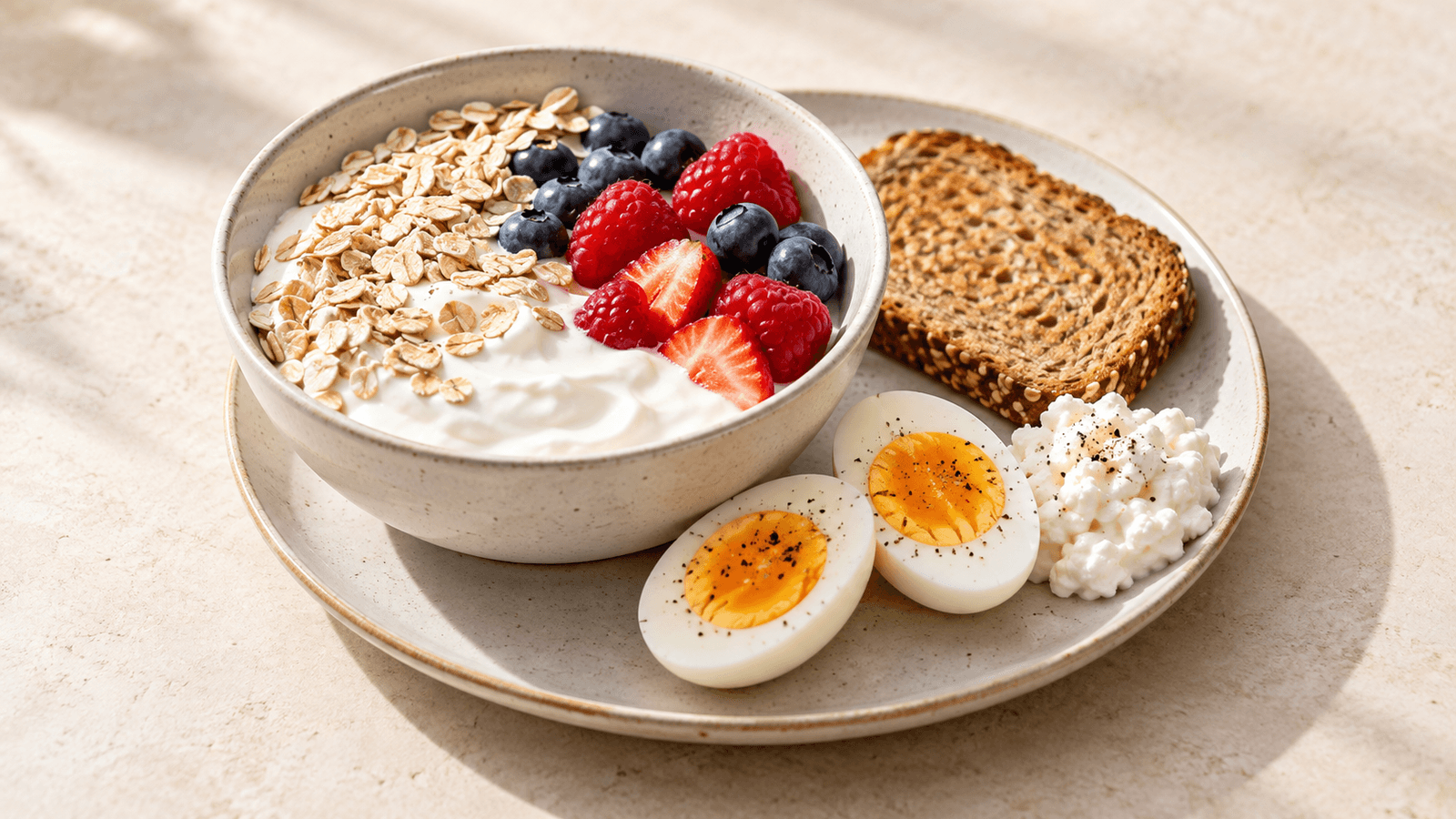
A high-protein breakfast can make it easier to reach your daily protein target without trying to catch up at dinner.
The basic idea is simple: build breakfast around a meaningful protein source first, then add fruit, whole grains, vegetables or fats according to your calorie needs and preferences.
Eggs, skyr, Greek yogurt, cottage cheese, quark, tofu and even leftovers from dinner can all work. Breakfast does not need to contain traditional "breakfast foods."
Research on breakfast protein is still developing. Higher-protein breakfasts can increase feelings of fullness in some studies, but that does not mean they automatically reduce total daily calorie intake or cause weight loss.
The nutrition values below are approximate. Exact protein and calories depend on brands, serving sizes and preparation.
15 high-protein breakfast ideas at a glance
| Breakfast | Approx. protein | Approx. calories |
|---|---|---|
| Skyr, oats and berries | ~28–32 g | ~350–420 kcal |
| Greek yogurt protein bowl | ~30–35 g | ~350–450 kcal |
| Eggs and egg whites on toast | ~30–35 g | ~350–450 kcal |
| Cottage cheese and fruit bowl | ~28–32 g | ~300–400 kcal |
| Quark, oats and banana | ~30–35 g | ~350–450 kcal |
| Protein oatmeal | ~30–35 g | ~400–500 kcal |
| Breakfast burrito | ~30–40 g | ~450–550 kcal |
| Smoked salmon and eggs | ~30–35 g | ~400–500 kcal |
| Tofu scramble | ~25–30 g | ~350–450 kcal |
| Overnight oats with skyr | ~28–35 g | ~400–500 kcal |
| High-protein smoothie | ~30–40 g | ~350–500 kcal |
| Cottage cheese toast with eggs | ~30–35 g | ~400–500 kcal |
| Turkey and egg breakfast wrap | ~35–40 g | ~450–550 kcal |
| Savory chicken breakfast bowl | ~35–45 g | ~400–550 kcal |
| High-protein yogurt with cereal | ~25–30 g | ~300–400 kcal |
These are examples rather than fixed recipes. Changing the amount of yogurt, eggs, oats, bread, oil, nuts or other ingredients can substantially change both protein and calories.
How much protein should breakfast have?
There is no universal amount of protein that every person needs at breakfast.
Your breakfast protein target should make sense in the context of your total daily protein intake.
For example, if your target is 120 g per day and you normally eat four times, you might distribute protein approximately like this:
| Meal | Example protein |
|---|---|
| Breakfast | 30 g |
| Lunch | 30 g |
| Snack | 25 g |
| Dinner | 35 g |
| Total | 120 g |
You do not need to divide protein perfectly evenly.
The practical advantage of eating a substantial amount at breakfast is that you have less protein left to fit into the rest of the day.
Research also suggests that protein intake is often lower at breakfast than later meals, while studies investigating higher morning protein intake have reported potential benefits for protein distribution and some muscle-related outcomes. However, the evidence is not strong enough to claim that a specific breakfast protein target is optimal for everyone.
If you do not know your daily target yet, use the Mealisa Protein Calculator or read How Much Protein Do You Need per kg of Body Weight?.
1. Skyr, oats and berries
Skyr makes an easy protein base because many plain varieties provide roughly 10–11 g of protein per 100 g.
A simple breakfast could include:
- 250 g plain skyr
- 40 g oats
- berries
- a small amount of nuts or seeds if desired
Depending on the products and portions, this can provide around 28–32 g of protein.
The oats add carbohydrates and fiber while fruit adds volume and flavor.
If calories are limited, use a smaller amount of nuts or skip them rather than reducing the main protein source.
2. Greek yogurt protein bowl
Start with a high-protein Greek yogurt rather than a low-protein sweetened yogurt.
For example:
- 300 g high-protein Greek yogurt
- berries or sliced fruit
- 30–40 g oats
- cinnamon
This can provide approximately 30–35 g of protein, depending on the yogurt.
Check the label because products marketed as Greek-style yogurt can differ substantially in protein and fat.
3. Eggs and egg whites on toast
Whole eggs provide protein along with fat and micronutrients. Egg whites make it possible to increase protein without adding as many calories as several additional whole eggs.
Try:
- 2 whole eggs
- 150–200 g egg whites
- 1–2 slices whole-grain toast
- tomatoes, spinach or mushrooms
This can provide roughly 30–35 g of protein.
It is a useful structure when you enjoy eggs but want a higher protein-to-calorie ratio.
For more foods that provide substantial protein for relatively few calories, see Low-Calorie High-Protein Foods.
4. Cottage cheese and fruit bowl
Cottage cheese works well for people who prefer a breakfast that requires almost no cooking.
Combine:
- 250 g cottage cheese
- berries, apple, peach or another fruit
- cinnamon
- optional oats or a small amount of nuts
Depending on the cottage cheese, this can provide approximately 28–32 g of protein.
Choose the fat percentage according to your calorie needs and preference.
5. Quark, oats and banana
Quark is especially practical in countries where it is inexpensive and widely available.
A breakfast using:
- 250 g low-fat quark
- 40 g oats
- half or one banana
- cinnamon
can provide around 30–35 g of protein, depending on the product.
If the texture is too thick, mix in a little milk or water.
This is also one of the more economical ways to build a high-protein breakfast in many European supermarkets.
6. Protein oatmeal
Plain oatmeal contains some protein, but oats alone usually do not create a particularly high-protein breakfast.
Instead, build protein into the oatmeal.
Possible additions include:
- milk
- skyr
- Greek yogurt
- quark
- protein powder
- egg whites
For example, oats cooked with milk and served with skyr can reach approximately 30 g of protein without requiring an unusually large bowl.
If using protein powder, stir it in according to the product instructions rather than assuming every powder behaves the same when heated.
7. High-protein breakfast burrito
A breakfast burrito can combine several protein sources in one meal.
Try:
- 2 eggs
- additional egg whites
- beans
- a whole-grain tortilla
- salsa
- vegetables
- optional reduced-fat cheese
Depending on portions, a burrito like this can provide roughly 30–40 g of protein.
Beans also contribute fiber and carbohydrate, making this more substantial than an egg-only breakfast.
8. Smoked salmon and eggs
For a savory breakfast, combine:
- smoked salmon
- eggs
- whole-grain bread
- cucumber, tomato or leafy vegetables
A suitable portion can provide around 30–35 g of protein.
Smoked salmon can be relatively high in sodium and may be expensive, so it does not need to be an everyday choice.
Fresh or leftover cooked fish can work as well.
9. Tofu scramble
A tofu scramble is a useful plant-based alternative to scrambled eggs.
Use:
- 200–250 g firm tofu
- vegetables
- spices
- nutritional yeast if desired
- whole-grain toast
Depending on the tofu, the meal can provide approximately 25–30 g of protein.
Tofu varies considerably in protein content because products contain different amounts of water, so check the label.
10. Overnight oats with skyr
Overnight oats are convenient when mornings are busy.
Combine the night before:
- 50 g oats
- 200–250 g skyr
- milk as needed
- berries
- cinnamon
Depending on portions, this can provide roughly 28–35 g of protein.
The meal is ready directly from the refrigerator, which can make a consistent breakfast easier when there is little time to cook.
11. High-protein smoothie
A smoothie can provide substantial protein, but it is easy to turn one into a very high-calorie drink.
A simple version could contain:
- milk or soy milk
- skyr or Greek yogurt
- fruit
- optional protein powder
A carefully portioned smoothie can provide approximately 30–40 g of protein.
Ingredients such as large amounts of peanut butter, nuts, oats and full-fat dairy can quickly increase calories.
That is not necessarily a problem, but it should match your goal.
12. Cottage cheese toast with eggs
For a savory breakfast, spread cottage cheese over whole-grain toast and serve it with eggs.
For example:
- 200 g cottage cheese
- 2 eggs
- 1–2 slices whole-grain bread
- tomatoes or cucumber
This can provide approximately 30–35 g of protein.
It is also easy to scale: reduce or increase bread and cottage cheese according to your calorie and protein needs.
13. Turkey and egg breakfast wrap
Combine:
- eggs
- sliced cooked turkey
- a tortilla
- vegetables
- salsa or another light sauce
Depending on the portions, this can provide roughly 35–40 g of protein.
Choose minimally processed turkey when practical and check sodium if you eat deli meats frequently.
Leftover cooked turkey or chicken works particularly well.
14. Savory chicken breakfast bowl
Breakfast does not have to contain breakfast foods.
If you prefer savory meals, try:
- leftover chicken
- potatoes or rice
- vegetables
- an egg if desired
A moderate chicken portion can easily bring the meal to 35–45 g of protein.
Using leftovers also reduces food waste and can make breakfast cheaper.
15. High-protein yogurt with cereal
For the simplest possible option:
- choose a high-protein yogurt
- add a moderate portion of cereal
- add fruit if desired
A large yogurt portion can provide 20–25 g of protein, while milk and cereal can increase the total to roughly 25–30 g.
Compare labels because many breakfast cereals provide relatively little protein and can vary greatly in sugar and calories.
High-protein breakfast foods
You do not need a special recipe every morning.
Start with one or two foods from this list:
| Food | Approximate protein |
|---|---|
| 250 g skyr | ~25–28 g |
| 250 g low-fat quark | ~25–32 g |
| 250 g cottage cheese | ~28–32 g |
| 250 g high-protein Greek yogurt | ~22–28 g |
| 3 large eggs | ~18–20 g |
| 200 g egg whites | ~20–22 g |
| 200 g firm tofu | ~24–32 g |
| 100 g cooked chicken breast | ~31 g |
| 100 g smoked salmon | ~18–22 g |
| 500 ml milk | ~16–18 g |
Values vary by product.
Once you have selected the protein base, build the rest of breakfast around it.
High-protein breakfast for weight loss
A high-protein breakfast can fit well into a weight-loss diet, but the breakfast still needs to fit your overall calorie intake.
Several controlled studies have found that higher-protein breakfasts can increase subjective fullness or satiety compared with lower-protein breakfasts in certain populations and settings. However, increased fullness does not always translate into lower energy intake later in the day.
That distinction matters.
Eating a 700-calorie "high-protein breakfast" does not automatically support weight loss simply because it contains protein.
If weight loss is your goal:
- prioritize a substantial lean protein source
- include fruit or vegetables for volume
- control calorie-dense toppings
- choose portions that fit your daily energy target
- consider how hungry you normally are in the morning
Useful lower-calorie protein bases include:
- skyr
- low-fat Greek yogurt
- low-fat cottage cheese
- quark
- egg whites
- eggs combined with egg whites
- lean poultry
Read How Much Protein Should You Eat to Lose Weight? for a broader explanation.
High-protein breakfast for building muscle
Resistance training and sufficient total daily protein are more important than turning breakfast into a special "muscle-building" meal.
However, breakfast can help distribute protein across the day.
If you train regularly and your target is relatively high, a breakfast containing a substantial protein serving means you do not have to consume most of your protein at lunch and dinner.
Examples include:
- eggs + egg whites + toast
- skyr + oats
- Greek yogurt + cereal
- quark + fruit + oats
- tofu scramble + bread
- chicken + potatoes + vegetables
For the broader evidence and practical protein ranges, see How Much Protein Do You Need to Build Muscle?.
High-protein breakfast without eggs
Eggs are convenient, but they are not necessary.
Egg-free options include:
- skyr with oats
- Greek yogurt bowl
- cottage cheese and fruit
- quark with oats
- overnight oats with skyr
- protein oatmeal
- tofu scramble
- high-protein smoothie
- chicken breakfast bowl
- yogurt and cereal
This can also make breakfast less repetitive if you already eat eggs frequently.
High-protein breakfast without protein powder
Protein powder is optional.
You can reach 25–35 g of breakfast protein using ordinary foods such as:
- 250–300 g skyr
- cottage cheese
- quark
- Greek yogurt
- eggs plus egg whites
- tofu
- chicken
- fish
Protein powder is primarily a convenience.
If whole foods already allow you to reach your target comfortably, there is no requirement to add it.
Vegetarian high-protein breakfast ideas
Vegetarian options can include:
- skyr + oats + fruit
- Greek yogurt + cereal
- quark + banana
- cottage cheese toast
- eggs + egg whites
- overnight oats with yogurt
- tofu scramble
- protein oatmeal
People who eat dairy and eggs have many easy breakfast protein options.
Vegan high-protein breakfast ideas
Useful vegan breakfast protein sources include:
- tofu
- soy milk
- soy yogurt with higher protein content
- TVP in savory dishes
- seitan
- legumes
- plant-based protein powder
A tofu scramble with toast and soy milk can provide a substantial amount of protein without relying on animal foods.
Check plant-based yogurt labels carefully because some products contain very little protein.
Cheap high-protein breakfast ideas
Protein does not need to make breakfast expensive.
Budget-friendly choices can include:
- eggs
- oats + milk
- quark
- large tubs of plain yogurt
- cottage cheese
- tofu
- beans
- leftover chicken
Large containers often cost less per kilogram than individual high-protein snack products.
For more options, see Cheap High-Protein Foods: 30 Budget-Friendly Protein Sources.
High-protein breakfast meal prep
If mornings are rushed, prepare the parts that take time in advance.
Overnight oats
Mix oats and skyr the night before.
Boiled eggs
Cook several eggs in advance and refrigerate them safely.
Breakfast burritos
Prepare multiple burritos and store or freeze them appropriately.
Yogurt portions
Pre-portion oats or cereal while keeping wet ingredients separate until needed.
Cooked chicken or tofu
Use leftovers from dinner as the protein base for the next morning.
The best breakfast is not necessarily the most elaborate one. A meal you can prepare consistently is often more useful than a complicated recipe you make once.
How to turn a low-protein breakfast into a high-protein breakfast
Many common breakfasts are dominated by carbohydrate and contain relatively little protein.
You do not necessarily need to replace them.
Instead, add or swap one component.
Toast
Instead of toast alone:
Toast + cottage cheese + eggs
Oatmeal
Instead of oats cooked with water:
Oats + milk + skyr
Cereal
Instead of cereal alone:
Cereal + high-protein yogurt + milk
Fruit
Instead of fruit alone:
Fruit + cottage cheese or skyr
Smoothie
Instead of fruit juice and fruit:
Fruit + milk or soy milk + Greek yogurt
One protein-focused change can make a large difference.
Common high-protein breakfast mistakes
1. Assuming "healthy" means high protein
Oatmeal, fruit, avocado toast and smoothies can all fit a nutritious diet, but they are not automatically high in protein.
Check the actual amount.
2. Adding calories faster than protein
Nuts, nut butter, seeds and granola contribute some protein but can also add calories quickly.
If your goal is protein efficiency, make dairy, eggs, egg whites, tofu or another substantial protein source the foundation.
3. Relying on marketing claims
A product labeled "protein" may contain only slightly more protein than an ordinary alternative.
Compare protein per serving and calories.
4. Making breakfast enormous
You do not need to force 50–60 g of protein into breakfast if a smaller amount allows you to reach your daily target comfortably.
5. Ignoring the rest of the day
A 30 g breakfast does not compensate for a diet that is consistently too low in total protein.
Daily intake still matters.
6. Thinking breakfast is mandatory
You do not have to eat breakfast solely because protein is important.
Some people prefer their first meal later in the day.
The practical question is whether your eating pattern allows you to meet your energy, protein and nutrient needs comfortably.
Is 30 grams of protein at breakfast enough?
For many people, 30 g can be a substantial protein serving.
Whether it is appropriate for you depends on your body weight, daily target, number of meals and goals.
For example:
If your daily target is 90 g, a 30 g breakfast already provides one-third of it.
If your target is 150 g, the same breakfast provides one-fifth.
Think in terms of your whole day rather than treating 30 g as a universal rule.
Is 40 grams of protein too much for breakfast?
Not necessarily.
The body does not simply discard all protein above an arbitrary per-meal threshold.
However, that does not mean everyone needs 40 g at breakfast.
If 25–30 g allows you to meet your daily target comfortably, adding more solely because "more is better" may not provide a practical advantage.
Your total intake and overall diet matter more.
Does a high-protein breakfast keep you full longer?
It can.
Several controlled studies have found greater subjective fullness or satiety after higher-protein breakfasts compared with lower-protein meals in specific study populations.
But responses vary, and some studies have found changes in appetite without a meaningful reduction in later calorie intake.
Protein is therefore one useful factor in breakfast satiety, not a guarantee that you will automatically eat less throughout the day.
Fiber, meal volume, total calories, food form and individual appetite also matter.
Do you need breakfast to lose weight?
No single meal is mandatory for fat loss.
Weight change is driven primarily by energy balance over time.
Some people find breakfast helps control appetite. Others prefer eating later.
If you enjoy breakfast, making it protein-rich can be a practical way to distribute protein and create a satisfying meal.
If you naturally prefer not to eat early, you do not need to add breakfast simply because it is commonly called the most important meal of the day.
A simple high-protein breakfast formula
You can build dozens of breakfasts with one simple structure:
1. Choose a protein base
Examples:
- skyr
- Greek yogurt
- quark
- cottage cheese
- eggs + egg whites
- tofu
- chicken
- fish
2. Add a carbohydrate source if desired
Examples:
- oats
- bread
- potatoes
- fruit
- cereal
- tortilla
3. Add fruit or vegetables
Choose foods you actually enjoy.
4. Add fats according to your calorie needs
Examples:
- nuts
- seeds
- avocado
- olive oil
- nut butter
This makes it easy to adjust the same breakfast for weight loss, maintenance or higher energy needs.
Frequently asked questions
What breakfast has the most protein?
Breakfasts built around large portions of lean meat, fish, high-protein dairy, egg whites or a combination of protein foods can provide very high amounts.
But maximizing protein is not necessary.
A breakfast that contributes an appropriate portion of your daily target is usually more practical.
What can I eat for 30 g of protein at breakfast?
Examples include:
- skyr with oats
- Greek yogurt bowl
- eggs plus egg whites
- cottage cheese with toast
- quark with oats
- tofu scramble
- chicken breakfast bowl
Exact portions depend on the products used.
How can I get protein at breakfast without eggs?
Use skyr, Greek yogurt, cottage cheese, quark, tofu, soy foods, chicken, fish or protein powder if desired.
What is a good high-protein breakfast for weight loss?
A useful option combines a lean protein source with fruit, vegetables or whole grains while keeping total calories appropriate for your daily target.
Skyr with fruit, eggs plus egg whites, low-fat cottage cheese or Greek yogurt are simple examples.
Is oatmeal high in protein?
Oats contain some protein but usually do not provide enough by themselves to make a meal especially high in protein.
Adding milk, skyr, Greek yogurt, quark or protein powder can increase the total.
Is Greek yogurt a high-protein breakfast?
It can be.
Some Greek yogurt products provide around 9–10 g of protein per 100 g, while others provide considerably less.
Check the label and choose a serving size that fits your target.
Are eggs enough for a high-protein breakfast?
Three eggs provide roughly 18–20 g of protein.
That may be sufficient for some people, but someone aiming for around 30 g could add egg whites, cottage cheese, yogurt or another protein source.
Can a high-protein breakfast help build muscle?
It can contribute to your total daily protein intake and help distribute protein across meals.
Muscle growth still depends on resistance training, adequate total protein, sufficient energy and recovery.
Bottom line
A high-protein breakfast does not require complicated recipes or specialty products.
Start with a substantial protein source such as:
- skyr
- Greek yogurt
- cottage cheese
- quark
- eggs and egg whites
- tofu
- chicken
- fish
Then build the rest of the meal around your calorie needs and preferences.
For many people, aiming for roughly 25–35 g of protein at breakfast can be a practical way to distribute a higher daily protein target, but it is not a universal requirement.
Your daily target matters more than hitting one exact breakfast number.
Use the Mealisa Protein Calculator to estimate a practical daily range, then divide that amount across the meals you actually enjoy eating.
For more ideas, explore High-Protein Foods: 30 Foods to Help You Eat More Protein.
Nutrition values are approximate and vary by product, serving size and preparation. This article provides general nutrition information for healthy adults and is not individualized medical or dietetic advice.