
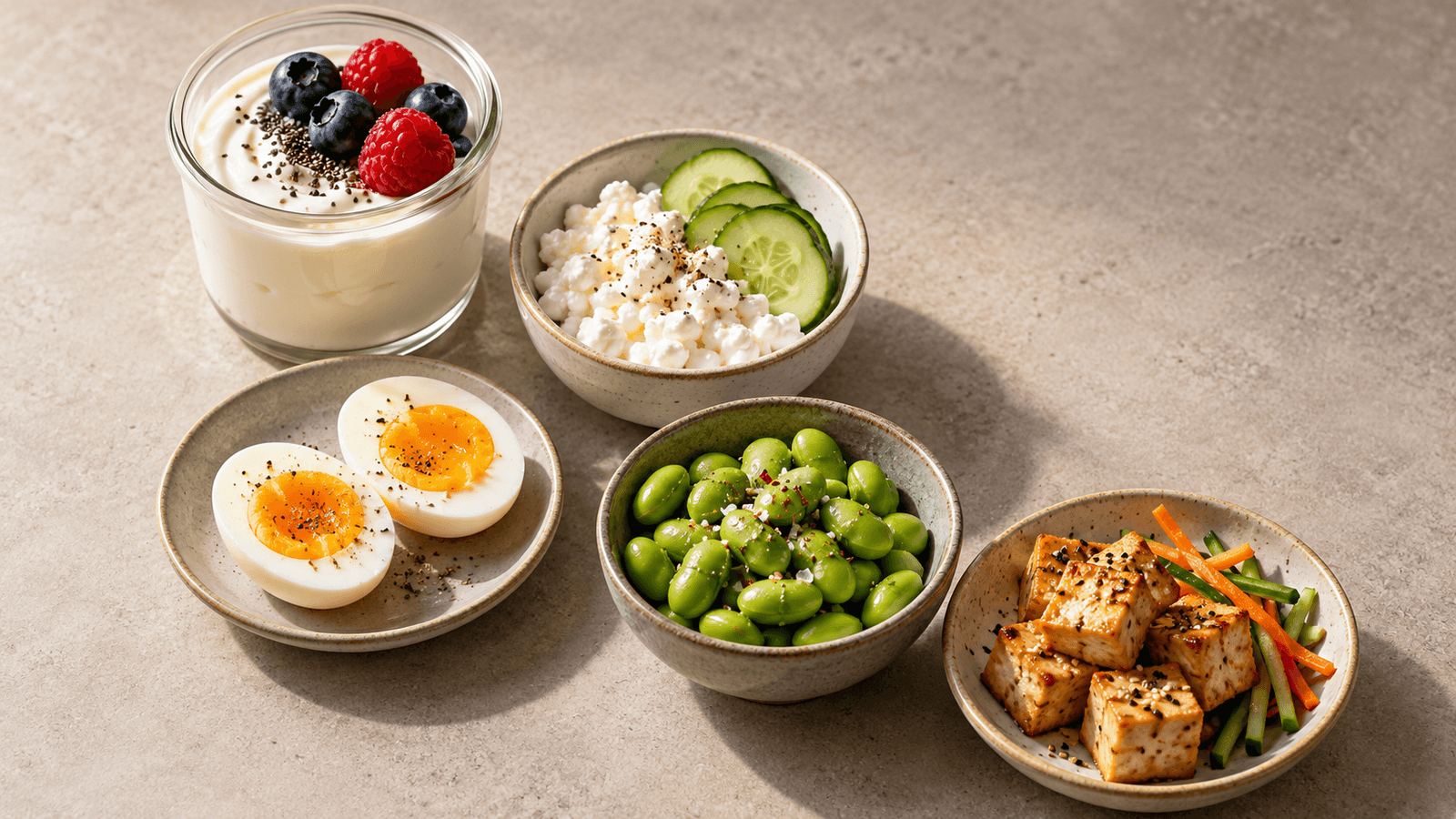
A high-protein snack can be useful when your main meals do not quite provide enough protein, when there is a long gap between meals or when you simply want a more substantial snack.
You do not need a special "protein" product. Skyr, Greek yogurt, cottage cheese, eggs, tuna, chicken, tofu, edamame and other ordinary foods can all work.
The best choice depends on what you need from the snack. Some options provide a lot of protein for relatively few calories, some are inexpensive, and others are useful because you can take them with you.
The nutrition values below are approximate. Protein and calories vary by brand, portion size and preparation, so check the nutrition label when precise tracking matters.
20 high-protein snacks at a glance
| Snack | Example serving | Approx. protein | Approx. calories |
|---|---|---|---|
| Skyr | 200 g | ~20–22 g | ~120–150 kcal |
| Greek yogurt | 200 g | ~18–20 g | ~120–180 kcal |
| Cottage cheese | 200 g | ~22–26 g | ~140–220 kcal |
| Quark | 200 g | ~20–26 g | ~130–200 kcal |
| 2 eggs + egg whites | 2 eggs + 100 g whites | ~23–25 g | ~190–210 kcal |
| Tuna and cucumber | 100 g tuna | ~25–29 g | ~120–160 kcal |
| Chicken pieces | 100 g cooked | ~30–31 g | ~160–180 kcal |
| Turkey slices | 100 g | ~20–25 g | ~100–160 kcal |
| Edamame | 150 g cooked | ~16–18 g | ~180–220 kcal |
| Tofu bites | 150 g firm tofu | ~18–24 g | ~170–230 kcal |
| High-protein milk | 300 ml | ~15–20 g | varies |
| Protein shake | 1 serving | ~20–30 g | ~100–180 kcal |
| Skyr with berries | 200 g + berries | ~20–22 g | ~150–190 kcal |
| Cottage cheese on toast | 150 g + 1 slice | ~20–24 g | ~220–300 kcal |
| Eggs and cottage cheese | 2 eggs + 100 g | ~23–26 g | ~220–280 kcal |
| Greek yogurt and oats | 200 g + 30 g | ~22–25 g | ~230–300 kcal |
| Tuna on crispbread | 100 g + crispbread | ~27–30 g | ~180–250 kcal |
| Tofu and edamame | 100 g + 100 g | ~20–25 g | ~220–300 kcal |
| Quark with fruit | 200 g + fruit | ~20–26 g | ~180–250 kcal |
| Leftover chicken wrap | small wrap | ~25–30 g | ~300–400 kcal |
The table is a starting point rather than a ranking. A snack with more calories is not automatically worse, and a lower-calorie snack is not automatically better.
What makes a snack high in protein?
There is no universal definition of a high-protein snack in everyday meal planning.
A practical approach is to choose a snack that contributes a meaningful amount toward your daily protein target.
For many people, roughly 15–25 g of protein can make a snack a substantial protein serving.
But that is not a rule.
If your daily target is 80 g, a 15 g snack represents a much larger share of your needs than it does for someone targeting 160 g.
The first step is therefore to estimate your overall intake.
Use the Mealisa Protein Calculator or read How Much Protein Do You Need per kg of Body Weight? if you do not yet have a practical target.
1. Skyr
Skyr is one of the simplest high-protein snacks because it requires no preparation.
A 200 g serving commonly provides approximately:
- 20–22 g protein
- 120–150 calories
depending on the product.
Plain skyr usually provides more flexibility than flavored versions because you can add your own fruit or other toppings.
For a sweeter snack, add:
- berries
- sliced banana
- apple
- cinnamon
If you need additional calories, oats, nuts or seeds can make the snack more substantial.
2. Greek yogurt
High-protein Greek yogurt is another convenient option.
A 200 g serving may provide roughly:
- 18–20 g protein
- 120–180 calories
Products vary considerably.
Some Greek-style yogurts contain much less protein or substantially more fat, so check the label rather than relying only on the name.
Greek yogurt works particularly well with fruit or a small serving of oats.
3. Cottage cheese
Cottage cheese can provide more than 20 g of protein in an ordinary serving.
Try:
- 200 g cottage cheese
- cucumber and pepper for a savory snack
or:
- 200 g cottage cheese
- fruit and cinnamon for a sweet snack
Depending on fat content, 200 g may provide approximately 22–26 g of protein.
It is also easy to increase or decrease the portion according to your needs.
4. Quark
Quark is especially useful in countries where it is inexpensive and widely available.
A 200 g serving can provide roughly 20–26 g of protein, depending on the product.
For a simple snack, mix it with:
- fruit
- cinnamon
- a little milk if you prefer a thinner texture
Plain low-fat quark can also be one of the more economical ways to obtain a substantial protein serving.
For more budget options, see Cheap High-Protein Foods: 30 Budget-Friendly Protein Sources.
5. Eggs and egg whites
Whole eggs are convenient and nutrient-rich, while egg whites provide additional protein for relatively few calories.
For example:
- 2 whole eggs
- 100 g egg whites
can provide roughly 23–25 g of protein.
You can prepare the eggs in advance and eat them cold, or make a quick omelet when you are at home.
If you only want a smaller snack, two boiled eggs provide approximately 12–14 g of protein.
6. Tuna and cucumber
Canned tuna requires almost no preparation and is highly protein-dense.
Combine:
- 100 g tuna in water, drained
- cucumber slices
- pepper, lemon or herbs
This can provide approximately 25–29 g of protein for relatively few calories.
If you need a more substantial snack, add whole-grain crackers, crispbread or bread.
Canned tuna is convenient, but dietary variety is still useful. It does not need to be your daily snack.
7. Cooked chicken pieces
Leftover chicken can become an easy protein snack.
Around 100 g cooked chicken breast provides roughly 30–31 g of protein.
You can eat it with:
- cherry tomatoes
- cucumber
- a yogurt-based dip
- a small wrap
Using leftovers also reduces food waste.
Make sure cooked food is stored safely and refrigerated promptly.
8. Turkey slices
Cooked turkey can provide a convenient portable protein source.
Depending on the product, 100 g can provide roughly 20–25 g of protein.
Leftover home-cooked turkey is one option.
Packaged deli turkey can also be convenient, but products differ in sodium and ingredients.
Check the label if processed meat is something you eat frequently.
9. Edamame
Edamame is a useful plant-based snack because it provides protein and fiber in the same food.
A 150 g cooked serving can provide approximately:
- 16–18 g protein
- 180–220 calories
Frozen edamame is convenient because you can prepare only the amount you need.
Season it simply with spices or a small amount of salt.
10. Tofu bites
Firm tofu can be prepared in advance and kept ready for snacks or meals.
A 150 g serving may provide roughly:
- 18–24 g protein
- 170–230 calories
depending on the tofu.
Bake or air-fry cubes with spices, then refrigerate portions for later.
Protein content differs considerably between tofu products because their water content varies.
11. High-protein milk
A protein-enriched or filtered milk can provide a convenient snack when you do not want solid food.
Depending on the product, 300 ml may provide around 15–20 g of protein.
Regular cow's milk also contributes protein, although usually less per serving than specialized high-protein versions.
Check calories and protein rather than assuming a product is better simply because it has "protein" on the packaging.
12. Protein shake
Protein powder is not necessary, but it can be convenient.
A typical serving mixed with water may provide:
- 20–30 g protein
- approximately 100–160 calories
depending on the powder.
Using milk instead of water increases both protein and calories.
A shake can be particularly practical:
- after training
- while traveling
- when you do not have access to refrigerated food
- when your meals leave you short of your protein target
Whole foods can still provide all the protein you need.
13. Skyr with berries
Adding berries turns plain skyr into a more substantial snack without dramatically increasing calories.
Try:
- 200 g skyr
- 100 g berries
This commonly provides around 20–22 g of protein.
Frozen berries can be less expensive and last longer than fresh berries.
14. Cottage cheese on whole-grain toast
For a snack that feels more like a small meal:
- 150 g cottage cheese
- 1 slice whole-grain toast
- tomato or cucumber
This can provide approximately 20–24 g of protein.
The bread adds carbohydrate and makes the snack more substantial.
15. Eggs and cottage cheese
Combining two ordinary protein foods creates an easy savory snack.
Try:
- 2 boiled eggs
- 100 g cottage cheese
Depending on the products, this can provide approximately 23–26 g of protein.
Add vegetables if you want more volume.
16. Greek yogurt and oats
If yogurt alone is not filling enough, add a moderate amount of oats.
For example:
- 200 g high-protein Greek yogurt
- 30 g oats
can provide roughly 22–25 g of protein.
The oats add carbohydrate and fiber, making this useful before or after an active part of the day.
17. Tuna on crispbread
Combine:
- 100 g tuna
- 2–3 pieces of crispbread
- cucumber or tomato
This can provide approximately 27–30 g of protein.
It is easy to adjust the carbohydrate portion by changing the amount of crispbread.
18. Tofu and edamame
Combining tofu and edamame creates a plant-based snack with a substantial amount of protein.
For example:
- 100 g firm tofu
- 100 g edamame
may provide roughly 20–25 g of protein, depending on the products.
Add soy sauce, chili or other seasonings if desired.
19. Quark with fruit
A simple combination of:
- 200 g quark
- apple, berries, peach or banana
can provide approximately 20–26 g of protein.
Choose fruit according to preference rather than trying to identify one "best" option.
If the snack needs more energy, add oats or nuts.
20. Leftover chicken wrap
A small wrap can turn leftover chicken into a portable snack or mini-meal.
Use:
- 70–90 g chicken
- small tortilla
- lettuce or cucumber
- yogurt-based sauce
This can provide roughly 25–30 g of protein.
If the portion becomes large enough, it may function more like a meal than a snack — which is perfectly fine if it fits your day.
Low-calorie high-protein snacks
If your main goal is obtaining more protein without adding many calories, prioritize foods with a high protein-to-calorie ratio.
Useful options include:
- skyr
- low-fat Greek yogurt
- low-fat cottage cheese
- low-fat quark
- egg whites
- tuna in water
- lean chicken
- lean turkey
- protein powder mixed with water
For a full comparison, read Low-Calorie High-Protein Foods: 30 Foods for More Protein With Fewer Calories.
The important distinction is that high protein does not automatically mean low calorie.
Nuts, peanut butter, cheese and some protein bars contain protein but can also provide a substantial number of calories.
That does not make them unhealthy. It simply means they serve a different purpose.
High-protein snacks for weight loss
A protein-rich snack can fit into a weight-loss diet when it helps you reach your protein target or manage hunger.
But adding snacks on top of an already adequate diet does not automatically improve weight loss.
Total energy intake still matters.
If you are managing calories, useful snack structures include:
- 200 g skyr
- low-fat cottage cheese with vegetables
- tuna and cucumber
- eggs plus egg whites
- Greek yogurt and berries
- lean chicken with vegetables
Keep calorie-dense extras proportionate to your needs.
For example, a yogurt bowl can change significantly when you add large portions of:
- granola
- nuts
- nut butter
- chocolate
- honey
These foods can fit, but their calories still count.
Read How Much Protein Should You Eat to Lose Weight? for more context.
High-protein snacks for muscle building
A snack can help people with higher protein targets distribute protein across the day.
Examples include:
- Greek yogurt and oats
- skyr and fruit
- cottage cheese and toast
- eggs and cottage cheese
- chicken wrap
- tofu and edamame
- protein shake with milk
Muscle growth does not depend on a special snack.
Resistance training, sufficient total protein, adequate energy intake and recovery are more important than whether protein comes from a snack or a main meal.
Read How Much Protein Do You Need to Build Muscle? for the broader picture.
High-protein snacks without protein powder
You can easily build protein-rich snacks without supplements.
Examples include:
- skyr
- Greek yogurt
- cottage cheese
- quark
- eggs
- egg whites
- tuna
- chicken
- turkey
- tofu
- edamame
Protein powder is primarily a convenience.
If ordinary food allows you to reach your target comfortably, there is no requirement to use it.
High-protein snacks without dairy
Dairy-free options include:
- eggs
- tuna
- chicken
- turkey
- tofu
- edamame
- soy products
- plant-based protein shakes
If you avoid dairy but eat meat and fish, there are many lean options.
If you eat a vegan diet, soy foods and other plant proteins can help.
Vegetarian high-protein snacks
Vegetarian options can include:
- skyr
- Greek yogurt
- cottage cheese
- quark
- eggs
- egg whites
- tofu
- edamame
- soy yogurt with substantial protein
- protein shakes if desired
Combining dairy or eggs with a small carbohydrate source can create a more substantial snack when needed.
Vegan high-protein snacks
Useful vegan options include:
- edamame
- tofu
- seitan
- soy yogurt with higher protein content
- roasted soybeans
- TVP-based savory snacks
- plant-based protein shakes
Check plant-based yogurt labels carefully.
Some alternatives contain only a small amount of protein even when they look nutritionally similar to dairy yogurt.
Cheap high-protein snacks
Protein snacks do not need to be branded specialty products.
Budget-friendly options can include:
- boiled eggs
- quark
- large tubs of plain yogurt
- cottage cheese
- canned tuna
- leftover chicken
- tofu
- milk
Buying larger containers and portioning them yourself is often cheaper than buying individual "high-protein" snack cups.
Compare the price per kilogram and the amount of protein per serving.
For a broader budget guide, see Cheap High-Protein Foods.
Portable high-protein snacks
Refrigerated foods are not always practical when you are away from home.
Depending on storage conditions and food-safety requirements, portable options can include:
- shelf-stable protein drinks
- protein powder carried dry and mixed later
- roasted edamame or soybeans
- tuna pouches
- appropriate protein bars
- sandwiches or wraps kept safely chilled
Do not leave foods that require refrigeration at room temperature for extended periods.
Use an insulated bag with an ice pack when necessary.
High-protein snacks before a workout
You do not need a special pre-workout protein snack.
If your previous meal was several hours earlier, a snack containing protein and carbohydrate may be convenient.
Examples include:
- Greek yogurt + banana
- skyr + oats
- cottage cheese + toast
- small chicken wrap
- soy yogurt + fruit
How much food you tolerate before exercise is individual.
Large, fatty or very high-fiber snacks may feel uncomfortable for some people when eaten close to training.
High-protein snacks after a workout
Post-workout nutrition does not need to happen within a few minutes of finishing exercise.
A normal protein-containing meal or snack can work.
Convenient options include:
- skyr
- Greek yogurt
- cottage cheese
- milk
- eggs
- chicken wrap
- tofu
- protein shake
The more important goal is reaching an appropriate total protein intake over the day.
Are protein bars good high-protein snacks?
They can be convenient, but the word "protein" does not automatically make a bar nutritionally superior.
Compare:
- protein per bar
- calories
- serving size
- added sugars
- fiber
- ingredients
- price
A bar containing 20 g of protein may be useful while traveling.
At home, yogurt, cottage cheese, eggs or ordinary food may be cheaper and equally practical.
Are nuts a high-protein snack?
Nuts contain protein, but most of their calories come from fat.
For example, a serving of nuts may provide useful protein, but obtaining 20–25 g of protein from nuts alone would require a relatively large amount of calories.
Nuts can still be nutritious and useful.
They are simply not among the most protein-dense options when calories are limited.
Is peanut butter a high-protein snack?
Peanut butter contributes protein, but it is primarily a calorie-dense source of fat.
It can be useful when you need additional energy as well as some protein.
If your goal is maximizing protein for relatively few calories, skyr, cottage cheese, tuna, lean poultry or egg whites are more efficient.
Is cheese a high-protein snack?
Cheese can provide substantial protein, but many varieties also contain significant fat and calories.
Reduced-fat cheese may offer more protein relative to calories.
Cheese can still fit a balanced diet; it simply should not be assumed to be a low-calorie protein source.
How to build a balanced high-protein snack
Start with a protein base.
Step 1: Choose protein
Examples:
- skyr
- cottage cheese
- eggs
- tuna
- chicken
- tofu
Step 2: Decide whether you need carbohydrate
Add one if useful:
- fruit
- oats
- bread
- crispbread
- tortilla
Step 3: Add volume or flavor
Examples:
- berries
- cucumber
- tomato
- herbs
- spices
Step 4: Add fat if it fits your needs
Examples:
- nuts
- seeds
- nut butter
Not every snack needs all four components.
A plain tub of skyr can be enough when you simply need a quick protein serving.
Do you actually need snacks?
No.
Snacking is optional.
If your main meals provide enough:
- protein
- calories
- nutrients
- satisfaction
you do not need to add snacks simply because a meal plan includes them.
For example, someone targeting 120 g of protein could eat:
| Meal | Protein |
|---|---|
| Breakfast | 35 g |
| Lunch | 40 g |
| Dinner | 45 g |
| Total | 120 g |
No protein snack is necessary.
Another person may prefer:
| Meal | Protein |
|---|---|
| Breakfast | 25 g |
| Lunch | 30 g |
| Snack | 25 g |
| Dinner | 40 g |
| Total | 120 g |
Both approaches can work.
How much protein should a snack contain?
There is no required number.
A useful snack might provide:
- 10–15 g if your meals already contain plenty of protein
- 15–25 g for a more substantial protein contribution
- 25–30+ g when you have a high daily target or the snack functions as a mini-meal
Instead of chasing an arbitrary snack target, look at what remains after your normal meals.
Example: when a protein snack is useful
Suppose your target is 120 g per day.
Your planned meals provide:
- breakfast: 25 g
- lunch: 30 g
- dinner: 40 g
That totals 95 g.
You have roughly 25 g remaining.
A 200–250 g serving of cottage cheese, a larger serving of skyr or another similar snack could close the gap easily.
This is more useful than adding a snack automatically without knowing whether you need it.
High-protein snacks in a meal plan
If you prefer planning your entire week, snacks can be included strategically rather than randomly.
For example:
Monday: skyr
Tuesday: cottage cheese
Wednesday: eggs
Thursday: Greek yogurt
Friday: edamame
Saturday: quark
Sunday: tofu or a protein shake
Rotating foods can make a higher-protein diet less repetitive.
See the 7-Day High-Protein Meal Plan for a complete example.
Common mistakes
1. Buying every product labeled "high protein"
Ordinary foods can often provide similar protein for less money.
2. Ignoring calories
A snack can contain protein and still be very calorie-dense.
3. Snacking when you are not hungry and do not need the protein
Protein snacks are a tool, not a requirement.
4. Choosing tiny portions
A spoonful of yogurt or a few nuts may contain some protein but not enough to meaningfully change your daily total.
5. Forgetting food safety
Dairy, meat, fish and cooked foods often require refrigeration.
6. Treating snacks as supplements instead of food
Fruit, vegetables, whole grains and other foods can be part of the snack too.
Frequently asked questions
What snacks are highest in protein?
Lean chicken, tuna, high-protein dairy, egg whites and protein shakes can provide a large amount of protein in relatively small servings.
The best choice depends on calories, convenience, dietary preferences and whether refrigeration is available.
What snack has around 20 grams of protein?
Examples can include:
- 200 g skyr
- 200 g high-protein Greek yogurt
- a suitable serving of cottage cheese
- tofu
- edamame
- a protein shake
Exact amounts vary by product.
What snack has around 30 grams of protein?
Approximately 100 g cooked chicken breast can provide around 30 g of protein.
A larger serving of cottage cheese, quark or yogurt can also approach 30 g depending on the product.
What is a good high-protein snack for weight loss?
Skyr, low-fat cottage cheese, Greek yogurt, tuna, lean chicken and eggs combined with egg whites can provide substantial protein without requiring a very large calorie intake.
What are good high-protein snacks without dairy?
Eggs, tuna, chicken, turkey, tofu, edamame, soy foods and suitable plant-based protein shakes are options.
What are good high-protein snacks without eggs?
Try skyr, Greek yogurt, cottage cheese, quark, tuna, chicken, tofu, edamame or a protein shake.
What are cheap high-protein snacks?
Eggs, quark, cottage cheese, large tubs of yogurt, canned tuna, milk and leftover chicken can all be economical depending on local prices.
Do I need a protein snack after exercise?
Not necessarily.
If you eat a protein-containing meal within a reasonable period around training and meet your daily protein target, a separate post-workout snack may not be necessary.
Can I eat a high-protein snack before bed?
You can if it fits your normal eating pattern, calorie intake and protein needs.
There is no requirement to eat before bed solely to add protein.
Bottom line
High-protein snacks can make it easier to reach your daily protein target, but they are optional.
Some of the simplest choices are:
- skyr
- Greek yogurt
- cottage cheese
- quark
- eggs
- tuna
- chicken
- turkey
- tofu
- edamame
Choose a snack according to what your day actually needs.
If calories are limited, prioritize lean protein sources. If cost matters most, use ordinary supermarket staples. If convenience matters, choose foods that require little preparation.
Start with your daily target using the Mealisa Protein Calculator, then use snacks only when they help fill the gap between your meals and that target.
For more protein options, see High-Protein Foods: 30 Foods to Help You Eat More Protein.
Nutrition values are approximate and vary by product, serving size and preparation. This article provides general nutrition information for healthy adults and is not individualized medical or dietetic advice.