
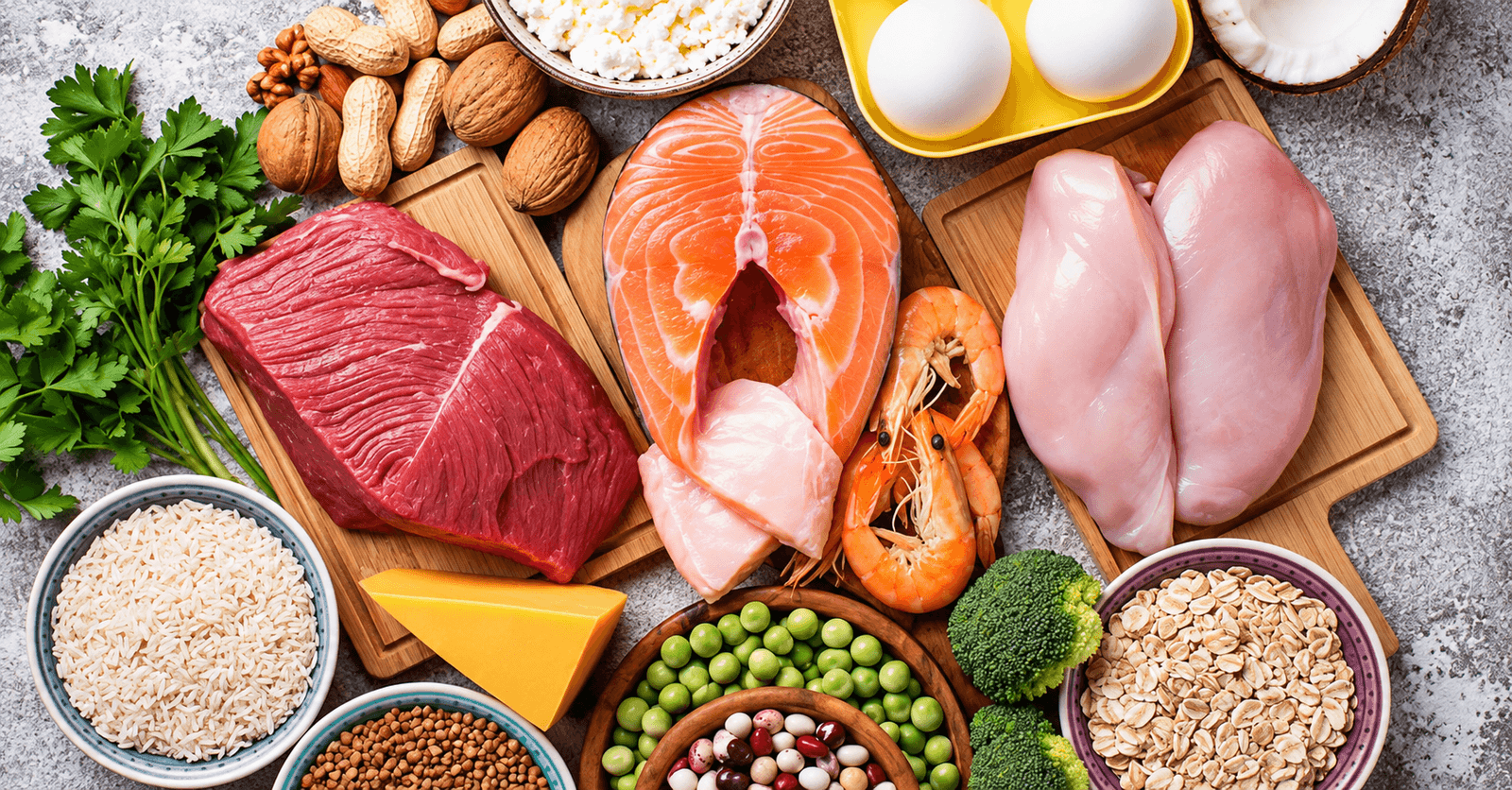
Protein is essential for maintaining and repairing body tissues, supporting muscle mass and providing the amino acids your body needs for many everyday functions.
But how much protein do you actually need per day?
For healthy adults, there is no single protein target that is ideal for everyone. Your practical intake depends on factors such as body weight, activity level, resistance training, calorie intake and your goals.
A useful way to estimate protein intake is to calculate it relative to body weight.
For many healthy adults, practical daily targets can range from around 0.8 g to 2.0 g of protein per kilogram of body weight, depending on activity and goals.
| Goal or situation | Practical daily protein range |
|---|---|
| General reference for healthy adults | ~0.8 g/kg |
| Low activity | ~0.8–1.0 g/kg |
| Moderate activity | ~1.0–1.4 g/kg |
| Regular training | ~1.4–1.6 g/kg |
| Weight loss | ~1.2–1.6 g/kg |
| Weight loss + regular training | ~1.4–1.6 g/kg |
| Muscle building + resistance training | ~1.6–2.0 g/kg |
These are practical ranges rather than precise prescriptions. Individual needs can vary.
For a quick estimate based on your weight, activity and goal, use the Mealisa Protein Calculator.
How much protein do you need per day?
A simple starting point is:
Body weight in kilograms × protein target in g/kg = grams of protein per day
For example, someone who weighs 75 kg would get:
- 75 × 0.8 = 60 g per day
- 75 × 1.2 = 90 g per day
- 75 × 1.6 = 120 g per day
- 75 × 2.0 = 150 g per day
That does not mean everyone weighing 75 kg should eat the same amount.
A person with low activity and someone performing regular resistance training may have very different practical protein targets even at the same body weight.
For a more detailed body-weight calculation, read How Much Protein Do You Need per kg of Body Weight?.
Daily protein by body weight
The table below shows example daily protein amounts at several commonly used intake levels.
| Body weight | 0.8 g/kg | 1.2 g/kg | 1.6 g/kg | 2.0 g/kg |
|---|---|---|---|---|
| 50 kg | 40 g | 60 g | 80 g | 100 g |
| 60 kg | 48 g | 72 g | 96 g | 120 g |
| 70 kg | 56 g | 84 g | 112 g | 140 g |
| 75 kg | 60 g | 90 g | 120 g | 150 g |
| 80 kg | 64 g | 96 g | 128 g | 160 g |
| 90 kg | 72 g | 108 g | 144 g | 180 g |
| 100 kg | 80 g | 120 g | 160 g | 200 g |
These numbers are examples, not individualized medical recommendations.
Protein needs for general health
For generally healthy adults with relatively low activity, around 0.8 g/kg per day is commonly used as a basic reference level.
For a 70 kg adult, that would equal approximately:
70 × 0.8 = 56 g of protein per day
This reference level is different from an optimized target for someone who exercises frequently, is dieting, or is deliberately trying to build muscle.
A higher-protein diet is therefore not automatically necessary for every person.
Protein needs if you are physically active
Physical activity can increase the usefulness of a higher protein intake, particularly when training includes resistance exercise.
A practical range for people who exercise regularly may be around:
1.2–1.6 g/kg per day
Someone weighing 75 kg would therefore consume approximately:
- 90 g at 1.2 g/kg
- 105 g at 1.4 g/kg
- 120 g at 1.6 g/kg
The appropriate point within that range depends on the type and amount of training, overall diet and goals.
How much protein do you need to build muscle?
People performing regular resistance training generally benefit from eating more protein than the basic reference intake. (EFSA)
A practical target for muscle building is approximately:
1.6–2.0 g/kg per day
For someone weighing 75 kg, this equals approximately:
120–150 g of protein per day
Protein alone does not build muscle.
Resistance training provides the main stimulus for muscle growth, while adequate protein provides amino acids that support muscle repair and muscle protein synthesis.
Eating increasingly large amounts of protein does not automatically produce increasingly large gains in muscle.
For a more detailed explanation, read How Much Protein Do You Need to Build Muscle?.
How much protein do you need for weight loss?
Protein can be particularly useful during weight loss because it can help with satiety and support the maintenance of lean mass while calories are reduced. (Dhillon et al.)
A practical range for many healthy adults losing weight is approximately:
1.2–1.6 g/kg per day
People combining a calorie deficit with regular resistance training may often aim toward the higher part of that range.
For someone weighing 75 kg:
- 1.2 g/kg = 90 g
- 1.4 g/kg = 105 g
- 1.6 g/kg = 120 g
Protein does not cause fat loss by itself.
Weight loss still depends largely on maintaining an appropriate calorie deficit over time.
Read How Much Protein Should You Eat to Lose Weight? for a more detailed explanation.
You can also explore High-Protein Foods for Weight Loss for practical food choices.
How much protein should you eat at each meal?
Your total daily intake matters more than hitting an exact amount at every meal.
However, distributing protein across several meals can make a daily target easier to reach.
For example, someone targeting 120 g per day could divide it approximately like this:
| Meals per day | Approximate protein per meal |
|---|---|
| 3 meals | ~40 g |
| 4 meals | ~30 g |
| 5 meals | ~24 g |
Real meals do not need to contain identical amounts.
A day might instead include:
- breakfast: 30 g
- lunch: 40 g
- snack: 15 g
- dinner: 35 g
Total: 120 g
This is often easier than eating very little protein earlier in the day and trying to compensate with an unusually large dinner.
What foods are high in protein?
Protein is available from both animal and plant foods.
Common protein-rich foods include:
- chicken and turkey
- fish and seafood
- eggs and egg whites
- cottage cheese
- skyr
- Greek yogurt
- quark
- lean beef
- tofu
- tempeh
- seitan
- edamame
- lentils
- beans
- textured vegetable protein
For a larger comparison, see High-Protein Foods: 30 Foods to Help You Eat More Protein.
If calories are also important, see Low-Calorie High-Protein Foods.
Animal and plant protein
Both animal and plant foods can contribute meaningfully to your daily protein intake.
Animal foods such as meat, fish, eggs and dairy are often protein-dense and can make higher targets relatively easy to reach.
Plant-based diets can also provide substantial amounts of protein when meals are built around foods such as:
- tofu
- tempeh
- seitan
- TVP
- edamame
- lentils
- beans
- soy products
People following a vegetarian diet can explore 25 High-Protein Vegetarian Foods.
For fully plant-based options, see 25 High-Protein Vegan Foods.
Do you need protein powder?
No.
Protein powder is a convenient food product, not a requirement for reaching an adequate protein intake.
Many people can reach their target entirely through ordinary foods.
Protein powder can be useful when:
- you have a relatively high protein target
- you have limited time
- you struggle to reach your target through meals
- you want a portable protein source
But it should not replace a varied diet.
How to eat more protein without changing your entire diet
You usually do not need to redesign every meal.
Small changes can substantially increase daily protein intake.
For example:
- choose skyr instead of a lower-protein yogurt
- add egg whites to whole eggs
- increase the protein portion in a lunch bowl
- add chicken, tuna or tofu to a salad
- combine tofu with edamame
- use lentil pasta instead of standard pasta
- choose cottage cheese or quark as a snack
- keep convenient protein foods available
For a complete list of practical strategies, read How to Eat More Protein: 15 Easy Ways.
Example of a 120 g protein day
A high-protein day does not need to involve bodybuilding-style meals or large quantities of protein powder.
Here is a simple example:
Breakfast
Skyr with oats and berries:
~30 g protein
Lunch
Chicken rice bowl with vegetables:
~40 g protein
Snack
Cottage cheese:
~20 g protein
Dinner
Salmon, potatoes and vegetables:
~30 g protein
Total:
~120 g protein
For more ideas, explore 25 High-Protein Meals, High-Protein Breakfast Ideas, High-Protein Lunch Ideas and High-Protein Dinner Ideas.
Does eating more protein help you feel full?
Protein-rich meals can be more satiating than meals containing relatively little protein.
This can be useful when managing appetite, particularly during a calorie deficit.
However, protein is only one part of meal quality.
Fiber-rich foods, vegetables, fruit, appropriate portions of carbohydrates and dietary fats can also contribute to satisfying meals.
Can you eat too much protein?
More protein is not automatically better.
Once you are consuming enough protein for your needs, increasing intake substantially beyond that level may provide little additional benefit while making the diet more restrictive or unnecessarily expensive.
Very high protein intake can also displace other useful foods such as:
- vegetables
- fruit
- whole grains
- legumes
- healthy fats
A balanced diet should provide more than protein alone.
People with kidney disease or other medical conditions that affect dietary protein requirements should follow individualized advice from an appropriate healthcare professional.
Is 100 grams of protein per day enough?
It depends on the person.
For someone weighing 60 kg:
100 g = approximately 1.67 g/kg
For someone weighing 100 kg:
100 g = 1.0 g/kg
The same absolute amount can therefore represent very different protein intakes relative to body weight.
This is why grams per kilogram can be more informative than asking whether a single number such as 100 g is enough for everyone.
Is 150 grams of protein per day too much?
Again, body weight and circumstances matter.
For a 100 kg person:
150 g = 1.5 g/kg
For a 50 kg person:
150 g = 3.0 g/kg
Those are very different relative intakes.
Rather than choosing a large round number because it sounds high-protein, estimate your needs according to body weight and goals.
Should you eat the same amount of protein every day?
For most people, keeping protein intake reasonably consistent from day to day is a simple approach.
You do not need to perfectly match the same number of grams every day.
If your target is around 120 g, eating 115 g one day and 125 g another is unlikely to be meaningfully different in practical terms.
Consistency over time matters more than perfect daily precision.
Do you need more protein on workout days?
You generally do not need to dramatically increase protein only on workout days.
Training adaptation and recovery continue beyond the workout itself.
A consistent daily protein intake is therefore usually simpler than alternating between very high and very low protein days.
Is protein more important than calories?
They serve different purposes.
Protein is an important nutrient, while calories describe the amount of energy supplied by food.
For weight loss, calorie balance remains important even if protein intake is high.
For muscle building, adequate protein matters, but total energy intake and resistance training also influence progress.
A diet can be high in protein and still provide more or fewer calories than you need.
How to calculate your personal protein target
You can estimate your target manually:
- Measure your body weight in kilograms.
- Choose a protein range appropriate for your activity and goal.
- Multiply body weight by the lower and upper ends of the range.
- Use the result as a practical daily range rather than a rigid requirement.
- Divide the daily amount across the number of meals you normally eat.
For example:
A 75 kg person who trains regularly might use 1.4–1.6 g/kg.
Lower end:
75 × 1.4 = 105 g
Upper end:
75 × 1.6 = 120 g
Practical target:
approximately 105–120 g per day
You can do this automatically with the Mealisa Protein Calculator.
Frequently asked questions
How much protein does the average adult need?
A commonly used basic reference for healthy adults is around 0.8 g of protein per kilogram of body weight per day. Practical targets can be higher for people who are physically active, losing weight or performing resistance training.
How much protein should I eat to gain muscle?
A practical range for many healthy adults performing regular resistance training is around 1.6–2.0 g/kg per day. Your overall training program and energy intake also matter. (Morton et al.)
How much protein should I eat to lose weight?
Many healthy adults dieting for weight loss may use approximately 1.2–1.6 g/kg per day, with active people often choosing the higher part of the range.
Is 100 g of protein enough?
It can be enough for some people and too little or more than necessary for others. Compare the amount with your body weight and goals rather than using 100 g as a universal target.
Can I get enough protein without meat?
Yes. Vegetarian and vegan diets can provide substantial protein through foods such as tofu, tempeh, seitan, TVP, lentils, beans, edamame and soy products. Vegetarian diets may also include eggs and dairy.
Do I need protein at every meal?
Not necessarily, but including a meaningful protein source in your main meals can make your daily target easier to reach.
Is more protein always better?
No. Once protein intake is sufficient for your needs, eating increasingly large amounts does not automatically produce better results.
The bottom line
There is no single daily protein number that is ideal for every person.
For healthy adults, useful starting points include:
- around 0.8–1.0 g/kg for lower activity
- around 1.0–1.4 g/kg for moderate activity
- around 1.4–1.6 g/kg for regular training
- around 1.2–1.6 g/kg during weight loss
- around 1.6–2.0 g/kg for muscle building with resistance training
Use these numbers as practical ranges rather than exact prescriptions.
Your body weight, activity, training, calorie intake and goals all influence where you may fit within those ranges.
For a personalized estimate, use the Mealisa Protein Calculator.
Then choose protein-rich foods you enjoy and distribute them across meals in a way that fits your normal routine.
This article provides general nutrition information for healthy adults and is not a substitute for individualized medical or dietetic advice. People with kidney disease, other medical conditions, pregnancy, or specific dietary requirements should discuss major dietary changes with an appropriate healthcare professional.
Sources
Evidence and authoritative guidance used for the nutrition and health information in this article: