
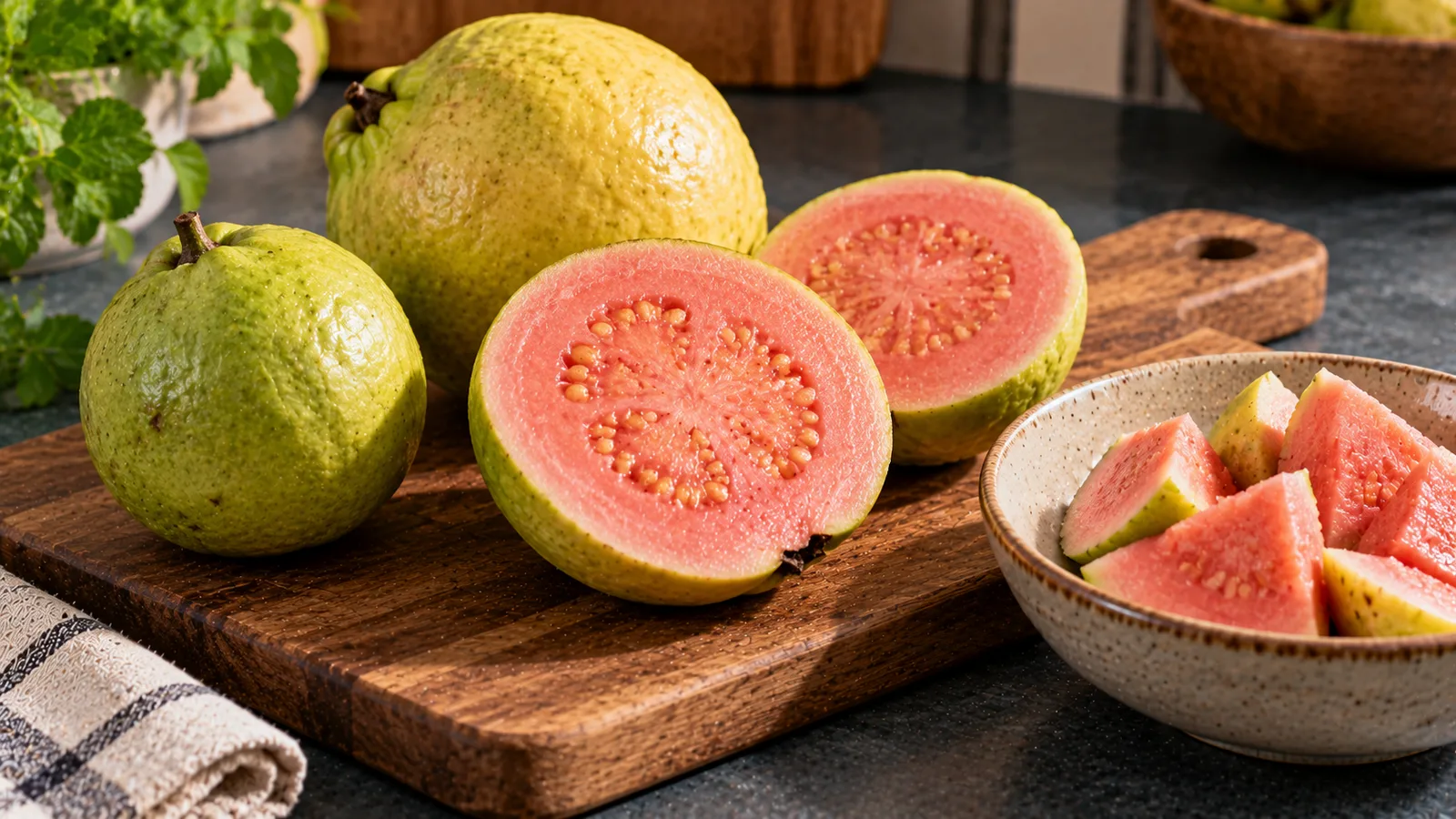
What is counted as guava?
This guide concerns common guava, raw (Psidium guajava), rather than guava nectar, paste, sweetened pulp or a different tropical fruit. Its reference is USDA FoodData Central SR Legacy “Guavas, common, raw” (FDC 173044). The composition is expressed for the edible part, not for a purchased fruit weighed together with anything that will be thrown away. Pink and pale-fleshed varieties can vary, so the reference is a sensible estimate rather than a laboratory analysis of your particular fruit. The skin is generally edible after washing; many people also eat the small seeds. Your own preparation determines the amount discarded.
USDA FoodData Central, SR Legacy, FDC 173044 identifies the raw-food entry FDC 173044.
Calories per 100 g and per portion
Raw guava provides 68 kcal per 100 g of edible fruit, equivalent to 0.68 kcal per gram. The USDA household measure of one fruit without refuse is 55 g, approximately 37 kcal. This is a database portion, not a promise that every supermarket guava weighs 55 g. A larger edible portion contains proportionately more energy.
| Edible raw guava | Calculated energy |
|---|---|
| 55 g (USDA one-fruit measure) | 37 kcal |
| 90 g | 61 kcal |
| 100 g | 68 kcal |
| 150 g | 102 kcal |
| 200 g | 136 kcal |
The 90 g and 200 g entries illustrate different weighed fruit portions; they are not standard definitions of a small or large guava. For a food diary, multiply edible grams by 0.68, then round at the end.
Nutrition in 100 g of raw guava
The USDA record lists 2.55 g protein, 0.95 g fat, 14.32 g total carbohydrate by difference, 5.4 g dietary fibre and 8.92 g naturally occurring sugars per 100 g. It also reports 417 mg potassium and 228.3 mg vitamin C. These values describe raw common guava, not juice or cooked jam.
| Nutrient | Per 100 g edible raw fruit |
|---|---|
| Energy | 68 kcal |
| Protein | 2.55 g |
| Fat | 0.95 g |
| Total carbohydrate (USDA) | 14.32 g |
| Fibre | 5.4 g |
| Total sugars | 8.92 g |
| Potassium | 417 mg |
| Vitamin C | 228.3 mg |
Do not automatically compare the USDA carbohydrate figure with the “carbohydrate” line on an EU package: the American by-difference figure includes fibre, whereas European label terminology separates it. This difference matters more than an extra decimal place in a rough fruit portion.
USDA National Nutrient Database: Guava raw, report 09139.
One small fruit versus one large fruit
A piece sold as “one guava” is not a fixed serving. As a worked weighing example, imagine one fruit weighs 110 g before trimming and you discard 20 g: its 90 g edible portion contributes roughly 61 kcal. A second fruit may weigh 250 g with 50 g discarded: 200 g edible gives 136 kcal. Those discards are illustrative, not predicted peel or seed losses. A person who eats the washed skin and seeds may discard very little. Someone who rejects hard seeds or bruised parts may have a lower yield. This is why the final edible weight is more reliable than the number of fruits.
Do skin and seeds count?
In common guava, the thin skin can be eaten and the seeds are often eaten as well, depending on ripeness and personal preference. A nutrition log should count whatever actually goes into the mouth. Wash the whole guava under running water before cutting, even if you intend to peel it, to avoid transferring dirt from the surface to the flesh. Trim damaged areas and set aside any parts you will not eat. If you weigh the entire fruit first, weigh the discarded pieces afterwards and subtract them. Do not use a universal “peeling percentage”: guavas differ in size and texture, and preparation habits vary.
Whole guava, juice and sweetened products
A weighed portion of whole guava includes the edible fibre-rich tissue used in the reference data. Strained juice can leave part of the fibre behind; bottled nectars, purées and guava paste may also contain added sugar or water. Their calorie values cannot be calculated simply by assuming they are raw fruit at 68 kcal/100 g. Use the specific product label or a relevant prepared-food entry. Likewise, guava used in a smoothie should be logged together with milk, yogurt, honey and every other ingredient, not merely under “guava”. Eating whole fruit is an easy way to retain the original edible fibre, but it is not a substitute for considering the rest of a meal.
How to record guava accurately
For a practical diary entry: identify the product as raw common guava; wash and prepare it; put a bowl on the scale and tare; weigh the pieces you will eat; then enter that number of grams against the appropriate food entry. For example, 150 g × 68 / 100 = 102 kcal, before additions. If the weighed fruit is shared equally between two people, each logs 75 g, which is 51 kcal. If the pieces differ, weigh each serving instead of dividing by headcount. With no kitchen scale, the 55 g USDA one-fruit measure provides a rough starting point, but a photograph or count of fruits is not an exact gram measurement. Note whether you logged a purchased whole fruit or its edible portion to avoid silent errors.
ideas for including fruit in everyday meals.
Washing, storing and sensible limits
Choose fruit without obvious mould or leaking damaged areas. Wash under running water, not with soap or household detergent; the FDA specifically advises against washing produce with soap. Refrigerate cut fruit promptly in a clean covered container and follow safe cold-storage practice. If the cut pieces smell unusual or show visible spoilage, discard them; appearance alone cannot guarantee safety. The USDA nutrient figures are averages, and vitamin C can vary with ripeness, cultivar and handling. No single fruit value proves a health effect, a personalised calorie target or precise sugar response. The goal here is a useful weighed estimate, with the portion and preparation clearly recorded.
FDA: Selecting and Serving Produce Safely.