
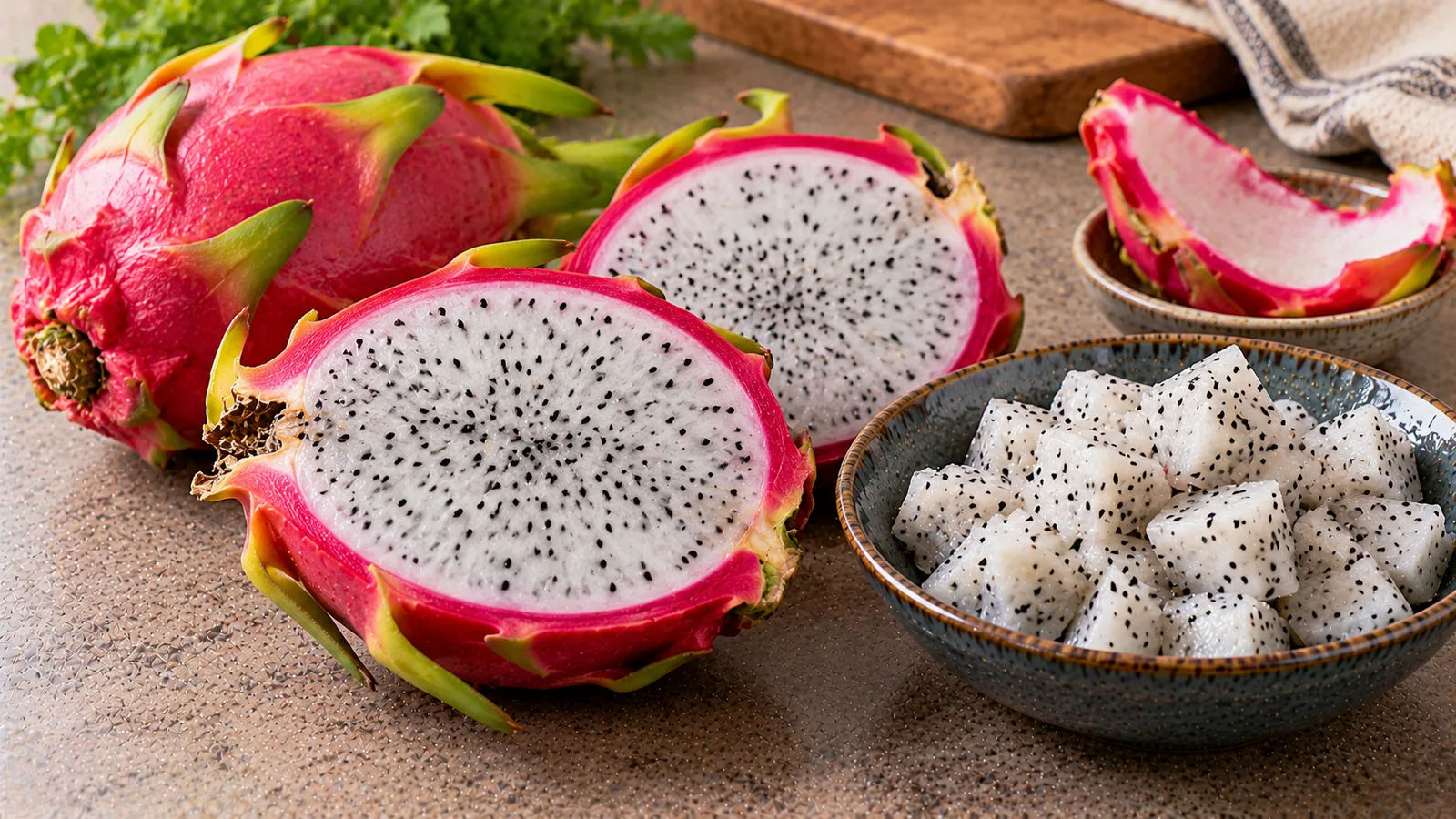
Dragon fruit, also called pitaya or pitahaya, has bright skin, pale or vivid red flesh and tiny edible black seeds. If you are counting calories, the decisive measurement is the flesh you actually eat, not the weight of the entire fruit at the supermarket. In the Japanese Standard Tables of Food Composition, raw pitaya provides 52 kcal per 100 g of edible flesh. Other reputable databases report different values. This guide keeps the reference clear and gives practical weighed examples instead of promising a universal number for every cultivar.
Calories in dragon fruit per 100 g: which reference?
The Japanese food composition database reports 52 kcal per 100 g for raw Hylocereus undatus and an illustrative 35% discarded fraction. The Brazilian TBCA table reports 58 kcal per 100 g of edible pitaya. A US FNDDS-derived dragon-fruit entry reports 68 kcal, and its FoodData Central search can be used to check which food entry your tracker selected. These are different data entries, not a range measured in one fruit. For consistent examples below we use 52 kcal/100 g and label it explicitly.
Portion table: peeled flesh only
| Edible dragon-fruit flesh | Calories at 52 kcal/100 g | What it can represent |
|---|---|---|
| 50 g | 26 kcal | Small spooned portion |
| 75 g | 39 kcal | Small bowl topping |
| 100 g | 52 kcal | Standard comparison weight |
| 120 g | 62 kcal | Half of one possible serving |
| 150 g | 78 kcal | Larger snack bowl |
| 200 g | 104 kcal | Generous fruit serving |
The table is a calculation from one reference, not a promise that every 150 g bowl has precisely 78 calories. Weight after peeling, variety and differences among food tables all matter. If your package gives nutrition information for ready-to-eat flesh, its stated basis should take priority when logging that particular product.
How many calories are in one whole dragon fruit?
A 'whole fruit' has no fixed edible mass. A large specimen can weigh much more than a small yellow pitaya, and the tough skin contributes weight without being part of the usual serving. As a worked example, imagine buying a fruit weighing 300 g with its peel. Apply the Japanese table's illustrative 35% refuse figure: 300 × 0.65 = 195 g edible flesh. Using the same Japanese energy entry, 195 × 52 / 100 ≈ 101 kcal. Half of that edible flesh is about 97.5 g and approximately 51 kcal.
These are modelled values, not a guarantee about your own fruit. An especially thick peel or a different cultivar changes the yield. The most reliable method is to put a bowl on the scale, tare it, scoop out the flesh and weigh the amount eaten. That also avoids accidentally counting decorative skin left on the plate.
Peel, seeds and edible yield
Cut the fruit lengthwise, scoop with a spoon or peel away the skin, and keep only edible flesh in your tracking weight. The small black seeds are normally eaten with the flesh; there is no need to remove them to use the nutrient value for whole pulp. The peel should not be counted as fruit flesh. If you are preparing fruit for several people, record the combined edible yield once and divide by the portions you actually serve, rather than assuming that each half is exactly the same size.
A practical kitchen example: weigh two whole fruits together, then weigh the empty skins after preparation. The difference is an estimate of the flesh taken out, provided you did not discard edible pieces or spill juice. If those conditions are unclear, placing the scooped flesh directly on a tared plate is simpler and more accurate. Avoid treating a percentage from a food composition table as a fixed physical law.
Why nutrition labels can disagree
Three things can be different even when every label says 'dragon fruit'. First, botanical species and cultivars differ: white, red and yellow fruits have different growing conditions and composition. Second, databases may use distinct sampling and analytical or calculation methods. Third, the listed food might be raw flesh, sweetened purée, dried fruit or a prepared drink. The peer-reviewed comparison of pitaya species describes meaningful compositional differences between red-purple and white-fleshed types. Colour alone, however, is not a dependable calculator of calories for an individual fruit.
If one app shows 52 and another 68 kcal per 100 g, that is a difference in chosen reference, not proof that a fruit becomes more caloric when scanned. Use a single documented food entry for a consistent diary, and switch it when a more appropriate variety-specific or product label becomes available.
Carbohydrates, fibre and the meaning of the numbers
The Japanese reference lists about 11.8 g total carbohydrate, 1.9 g dietary fibre, 1.4 g protein, and 0.3 g fat per 100 g. Its available-carbohydrate value by difference is 9.9 g; total carbohydrate and available carbohydrate are not interchangeable. Other datasets may use different definitions of total versus available carbohydrate. Read the column heading before comparing an American database with an EU label. Dragon fruit is primarily a fruit, not a significant protein source; a small amount of fibre does not make every recipe a high-fibre meal.
For a 150 g serving from that same source, multiplying by 1.5 gives approximately 17.7 g total carbohydrate, 2.9 g fibre, 2.1 g protein and 0.45 g fat. These are reference-based estimates for raw pulp. They should not be transferred to a sweetened smoothie bowl without adding the other ingredients.
Fresh flesh versus smoothie, dried pieces and frozen cubes
Freezing plain fruit does not add sugar or oil. If you weigh 150 g frozen plain flesh, you can usually start with the same reference as 150 g fresh flesh, while checking whether the pack contains syrup. A smoothie made from 150 g pitaya, 100 g yoghurt and 20 g granola contains those foods' calories in addition to the pitaya's estimated 78 kcal. Do not log the entire bowl as '150 g dragon fruit'. Dried fruit contains less water per 100 g, so fresh-fruit figures cannot simply be applied to a bag of dried pieces.
For purée or bottled drinks, check whether the listed weight and nutrition refer to unsweetened fruit only or to the finished product. Added juices and syrups can make the comparison misleading. A bright colour is not evidence of either a low- or high-energy recipe.
How to use this in a food diary
Choose a raw pitaya entry whose energy and macro definitions you understand; then weigh the edible flesh. Enter 100 g as 52 kcal when following the Japanese table, or use another named source consistently. Do not weigh peel, and do not estimate a half-fruit portion by taking half a retailer's whole-fruit weight without accounting for refuse. For a shared platter, measure the total edible amount before serving and the portion you keep. A one-time check of your typical bowls can make later quick estimates more realistic.
For related practical context, see how to eat more fruit in everyday meals.