
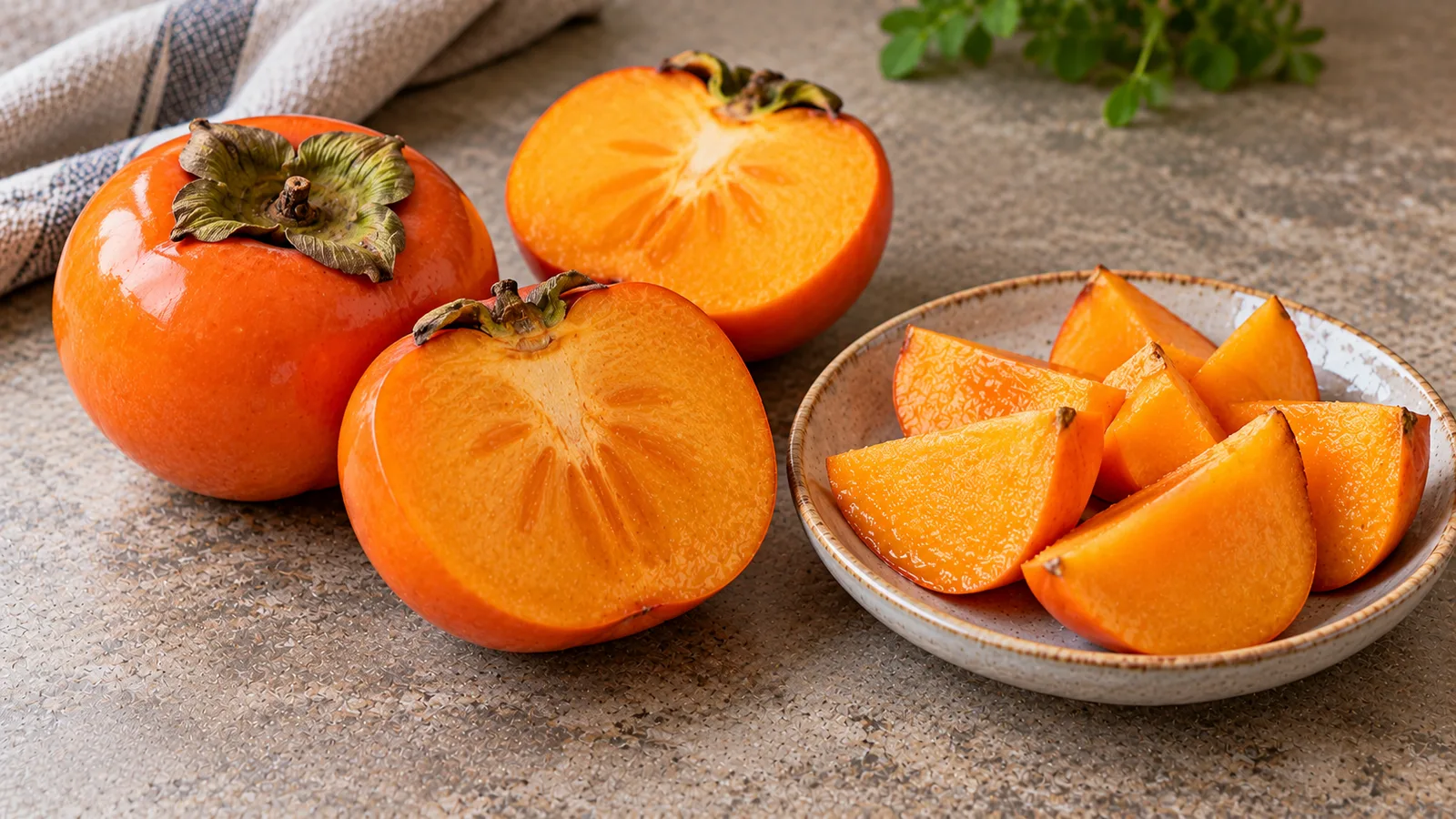
How many calories are in a persimmon?
A fresh Japanese persimmon supplies 70 kcal per 100 g of edible fruit in the USDA SR Legacy entry FDC 169941. The reference serving called one fruit weighs 168 g of edible portion and gives about 118 kcal. These are two ways of expressing the same nutrition record, not two alternative fruit types or a guarantee that your purchase weighs exactly 168 g. The most useful answer for an individual persimmon starts with its edible weight. This page covers raw Japanese persimmon and straightforward household calculations; it does not claim that every persimmon variety, dried slice or processed dessert has this composition.
Calories by edible portion
Multiply grams of edible fruit by 70 ÷ 100. That means every additional 10 g adds roughly 7 kcal. The table uses the same Japanese-persimmon reference throughout, with calories rounded to whole numbers. The 168 g row represents the USDA household serving; other rows are illustrative weights you can measure. If you record 150 g on a kitchen scale, enter 150 g, not “one fruit”. If you share a fruit, weigh the part you eat or estimate its fraction only when weighing is impractical.
| Edible persimmon | Estimated energy |
|---|---|
| 50 g | 35 kcal |
| 80 g | 56 kcal |
| 100 g | 70 kcal |
| 120 g | 84 kcal |
| 150 g | 105 kcal |
| 168 g | 118 kcal |
| 180 g | 126 kcal |
| 200 g | 140 kcal |
Why one whole fruit is not always 118 kcal
The USDA serving of 168 g refers to edible material. It is not a universal weight for a fruit in a shop with the leafy cap, any discarded peel and bruised sections included. Size differs across harvests and shops, and people's preparation differs too. For a practical example, a whole persimmon may weigh 200 g, and you might discard 30 g of cap or other material: 170 g edible × 70/100 = 119 kcal. The 30 g is an illustrative kitchen measurement, not an official waste percentage. A different fruit could have 135 g edible or 210 g edible. Your scale determines the better estimate.
What counts as edible flesh?
Remove the firm leafy calyx and any areas you will not eat. Wash the fruit. The peel of many commercially sold non-astringent persimmons can be eaten, but you can remove it if you prefer; the weight you count should match what reaches your plate. Place a bowl on a scale, press tare, then add the flesh or edible slices. If peeling, weigh after peeling; if keeping the peel, keep it in the weighed edible portion. Do not take an already peeled weight and subtract a generic peel allowance again. Seeds, if present and not eaten, are outside the measured portion.
Fuyu, Hachiya and other persimmons
Fuyu is typically a squat, non-astringent type commonly eaten firm or soft. Hachiya is an astringent type generally eaten very soft, when its drying, puckering sensation has eased. These practical differences matter for choosing a fruit and preparing it; they do not establish a reliable numerical calorie difference between cultivars. The USDA Japanese raw reference is a useful starting point for familiar supermarket kaki, but it does not claim to provide laboratory values for every cultivar. For an unfamiliar product or a packaged preparation, inspect its declared product description and nutrition data before substituting values.
Japanese and native persimmons are not the same database entry
FoodData Central separately lists Japanese persimmons, raw (FDC 169941: 70 kcal/100 g) and native persimmons, raw (FDC 169943: 127 kcal/100 g). The latter is a different reference food, not a “ripe” or “peeled” version of Japanese kaki. Do not average 70 and 127 or assign 127 kcal to a common supermarket Fuyu merely because both foods are called persimmons in English. Similarly, USDA has a separate dried-persimmon record; drying removes water and makes 100 g of the finished food very different from 100 g fresh.
Carbohydrates, fibre and other nutrients
Per 100 g of Japanese persimmon, the cited USDA entry lists approximately 18.6 g carbohydrate by difference, 12.5 g total sugars, 3.6 g dietary fibre, 0.58 g protein and 0.19 g fat. At the reference 168 g edible serving, these scale to around 31.2 g carbohydrate, 21.0 g sugars, 6.0 g fibre, 1.0 g protein and 0.3 g fat. These are composition values, not evidence that the fruit prevents disease or has special weight-loss effects. US carbohydrate-by-difference and European label carbohydrate can use different fibre conventions, so compare products and nutrient labels on compatible bases.
Small fruit, large fruit and a sliced bowl
Suppose you cut a ripe fruit into slices and the scale reads 120 g of flesh. Its estimated energy is 84 kcal. If a very large edible serving is 200 g, the same reference gives 140 kcal. A small bowl with 80 g yields 56 kcal. These differences are portion differences, not evidence that one fruit is better or worse. Keep the base weight consistent: 100 g edible fresh material is a different comparison from 100 g of peel, juice or dried fruit. Use the fruit's actual gram weight whenever precision matters for a meal diary.
Fresh slices, smoothies and cooked fruit
Fresh sliced persimmon without added ingredients retains the same starting energy as the edible fruit. Blending a weighed amount into a smoothie does not remove its calories, but a smoothie also includes milk, yogurt, juice or sweetener that need separate entries. Heating persimmon changes water content; a cooked 100 g portion can differ in concentration from a fresh 100 g portion. If you cook 200 g of weighed edible fruit with nothing added, track approximately 140 kcal for that starting fruit in the entire recipe, then add any butter, sugar or other ingredients. Divide by the finished yield only after deciding the portion size.
A straightforward meal-log method
First select a record explicitly describing Japanese persimmons, raw, not dried persimmon or an unrelated persimmon species. Second, remove what you do not eat and weigh the rest. Third, use edible grams × 0.70 kcal/g, rounding at the end. Fourth, include toppings separately: nuts, chocolate, honey or full-fat yogurt can add substantial energy even when the fruit itself has not changed. Finally, keep a note if your weight was an estimate rather than a measurement. This produces a repeatable log without implying that one item must fit a particular personal calorie target.
How to choose and handle a ripe persimmon
Choose fruit suited to the intended use. Firm non-astringent types work in slices or fruit salads; astringent types should be allowed to soften appropriately before eating. Wash before cutting and discard damaged or spoiled sections. Store fruit according to its ripeness and seller guidance, and refrigerate cut pieces promptly rather than leaving them exposed for extended periods. Texture and sweetness may change as a fruit ripens, but the USDA entry cannot predict the exact sugar or calorie value of a specific fruit based on colour alone. A careful portion estimate is usually more useful than guessing ripeness-related calorie changes.
What to remember when comparing fruit portions
A 100 g line is a standardized comparison, while “one fruit” is a household description that varies enormously. A reference persimmon gives 118 kcal at 168 g edible, but if your portion weighs 150 g, the same method gives 105 kcal. Do not use the weight on a retail sticker as the eaten weight after trimming. Nor should you mistake an edible-weight example for medical advice about how much fruit to eat. Mealisa's purpose here is to make an energy estimate transparent, practical and easy to reproduce at home.
For related but distinct questions, see mango calories · pomegranate calories.
Sources
- USDA FoodData Central, SR Legacy, Persimmons, japanese, raw (FDC 169941) and Persimmons, native, raw (FDC 169943): search source records.
- USDA FoodData Central: documentation of edible-portion weights and database types.