
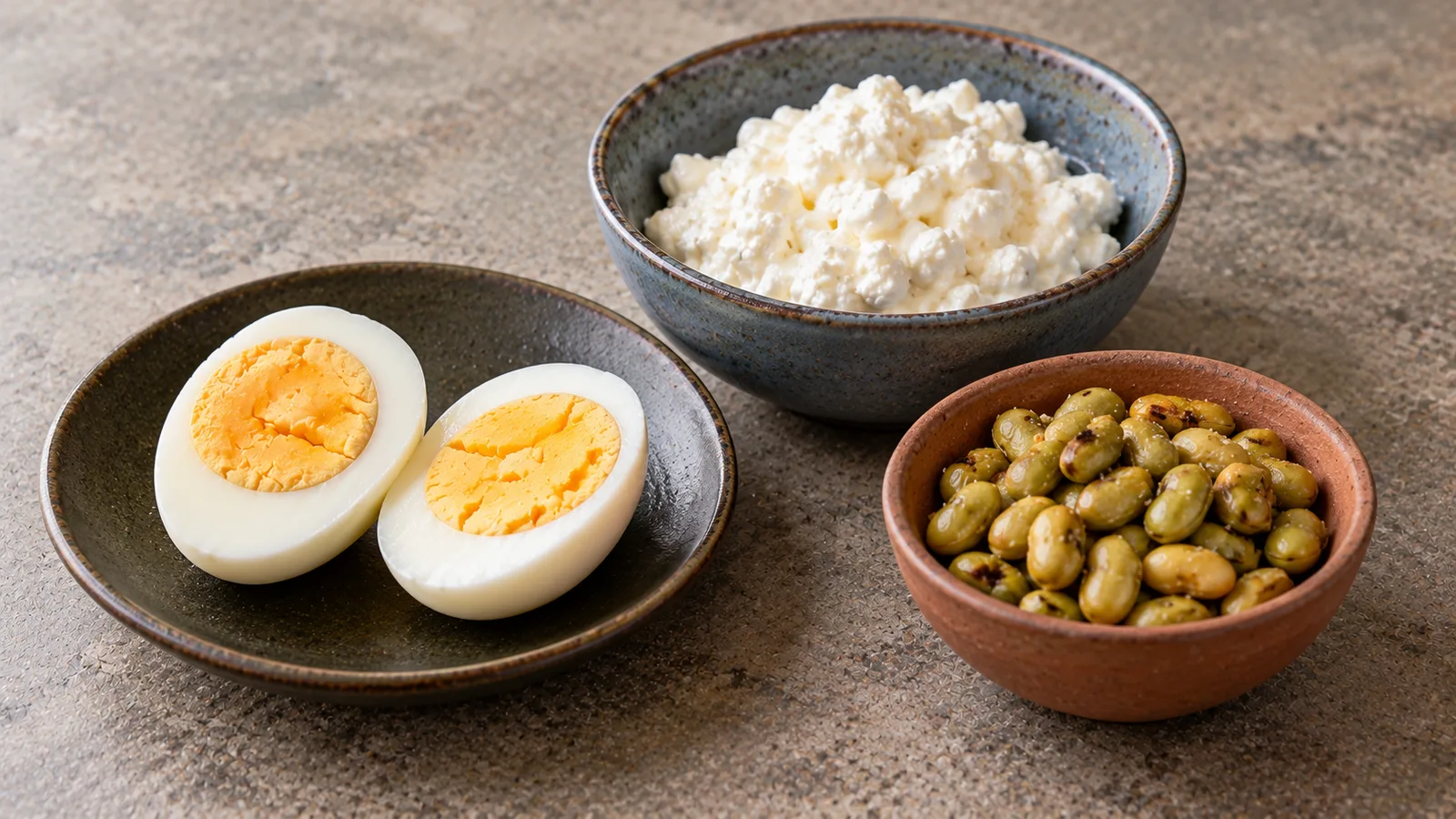
Cheap high-protein snacks do not have to come in a wrapper labelled “protein.” Eggs, plain dairy, canned fish and soybeans can supply substantial protein for a modest amount of money. But a supermarket shelf price says surprisingly little about the cost of a useful snack. The more relevant question is: how many grams of protein will I actually eat, for how many calories and how much of the package price?
This comparison builds six snack combinations of approximately 150–250 kcal from familiar supermarket staples. Every ingredient is weighed in its edible state; every protein figure can be traced to a per-100-g input; and every price is an illustrative German grocery scenario, not a current retail quote. The purpose is to provide a repeatable method, not a claim that one named shop will sell this exact basket for these amounts. A product's actual nutrition label, purchase price, available package sizes and your appetite take priority.
What counts as a useful budget protein snack?
A snack should fit the gap between your meals, rather than pass an arbitrary protein test. In this guide, a protein-containing snack means an easy, reasonably portable combination in the 150–250 kcal range with a clearly measurable amount of protein. Several examples supply more than 20 g; others provide around 14–15 g with different benefits, such as more fibre, less preparation or greater convenience. None is a complete nutritional plan by itself.
Protein supports the body's tissues and many everyday functions. The German Nutrition Society's protein reference explains why needs depend on age and context. It does not follow that everyone needs protein supplements or an unusually large protein dose between meals. It is reasonable to consider fibre, fruit and vegetable intake, sodium, calcium, variety, and whether your next meal is soon. A plain egg with a tomato and edamame with carrots can both make sense, even though their amino-acid profiles and prices differ.
This is specifically a portion-and-cost comparison. For a broader collection of ideas without this purchasing model, Mealisa already has a general high-protein snack guide. Here we focus on how to build, weigh, price and adapt six particular combinations rather than compiling another long unpriced list.
The reference values: weigh the food you actually eat
The following per-100-g values are working inputs: reference food composition for prepared eggs, drained tuna, cooked shelled edamame and produce, and example package labels for dairy foods. These are not guarantees for every brand. The USDA FoodData Central search is the starting point for the generic foods; the Omira Magerquark label gives 67 kcal and 12 g protein per 100 g, while a plain Skyr listing lists 62 kcal and 11 g protein per 100 g.
| Food and state | kcal per 100 g | Protein per 100 g |
|---|---|---|
| Hard-boiled egg, edible, without shell | 155 | 12.6 g |
| Low-fat quark, plain, example label | 67 | 12.0 g |
| Tuna, water-packed, drained, reference profile | 116 | 25.5 g |
| Cottage cheese, plain, illustrative profile | 95 | 11.5 g |
| Edamame, cooked shelled beans | 121 | 11.9 g |
| Skyr, plain, example label | 62 | 11.0 g |
The composition of cottage cheese, tuna and other foods can change with brine, fat content and manufacturer. These rounded figures are for arithmetic, not personal medical advice. In particular, 100 g of shelled cooked edamame does not mean 100 g of pods; canned tuna should be weighed after draining; eggs should be weighed without shells. Read the pack rather than assigning the same number to every variety of quark or cottage cheese.
For the supporting ingredients, our calculations use these explicit per-100-g inputs: tomato 18 kcal, 0.9 g protein; strawberries 32 kcal, 0.7 g; canned drained chickpeas 100 kcal, 6.5 g; cucumber 15 kcal, 0.65 g; rye crispbread 350 kcal, 10 g; cooked carrot 41 kcal, 0.9 g; pumpkin seed kernels 559 kcal, 30.2 g; and blueberries 57 kcal, 0.74 g. These are reference or hypothetical label values, not one uniform branded grocery list. Brand-specific crisps, seeds and canned legumes can differ significantly.
Six supermarket snacks: calories, protein and assumed cost
Each row is one whole snack, not a per-100-g ranking. The hypothetical costs are for the ingredients used at the assumed purchase prices explained below. Calories and protein are rounded only after multiplying by the edible portions.
| Snack and edible ingredient weights | Energy / protein | Illustrative used-ingredient cost |
|---|---|---|
| 2 hard-boiled eggs (100 g edible) + tomato (120 g) | 177 kcal / 13.7 g | €0.80 |
| Plain low-fat quark (200 g) + strawberries (100 g) | 166 kcal / 24.7 g | €1.30 |
| Drained tuna (100 g) + drained chickpeas (75 g) | 191 kcal / 30.4 g | €1.62 |
| Cottage cheese (150 g) + cucumber (100 g) + rye crispbread (15 g) | 210 kcal / 19.4 g | €1.40 |
| Cooked shelled edamame (120 g) + carrots (100 g) | 186 kcal / 15.2 g | €1.00 |
| Plain skyr (170 g) + pumpkin seeds (15 g) + blueberries (50 g) | 218 kcal / 23.6 g | €1.26 |
There is no universal winner. Quark offers a lot of protein per euro in this assumed basket, but it requires refrigeration. Tuna and chickpeas provide the largest protein amount in this particular set, yet canned fish is less convenient in workplaces where odour or disposal matters. The egg snack is cheapest in total euros here, but gives less protein. Edamame provides meaningful fibre alongside protein, while pumpkin seeds improve texture and contribute fat and energy as well as protein.
Notice that calorie targets refer to the whole combination. A generous splash of oil, a sweetened yogurt, a large portion of nuts or another slice of crispbread changes the calculation. You can adjust quantities to your needs; the 150–250 kcal window is an article comparison choice, not a recommended limit for everyone.
How each snack is assembled, without hidden portions
Eggs and tomato. Boil eggs fully, cool them promptly, peel and weigh approximately 100 g total edible egg, then add 120 g sliced tomato. The calculation is 155 + (1.2 × 18) = 176.6 kcal and 12.6 + (1.2 × 0.9) = 13.68 g protein. If your two eggs weigh only 85 g without the shells, the snack is smaller than our row. Salt, mayonnaise and butter are not included. Hard-boiled eggs are an accessible home-prep option, although not everyone wants two eggs as an everyday snack.
Quark and strawberries. Measure 200 g of unsweetened low-fat quark and 100 g strawberries. The dairy contributes 24 g protein in our selected label model; the fruit adds approximately 0.7 g. Stir in a little water if a looser texture is preferred, or use cinnamon rather than assuming flavoured quark has identical sugar content. If dairy is unsuitable, do not assume a generic plant yogurt can provide the same 24 g protein—check its label.
Tuna and chickpeas. Drain both tins and weigh the actual solids: 100 g tuna plus 75 g chickpeas. A fork, lemon juice and pepper are enough to serve it cold. The working total is 116 + 75 = 191 kcal, with 25.5 + 4.875 = 30.375 g protein. A fish packed in oil, heavily salted chickpeas or a spoonful of mayonnaise changes the result. Opened canned fish should be transferred to a clean covered container and refrigerated promptly; do not save an unrefrigerated remainder.
Cottage cheese, cucumber and crispbread. Serve 150 g cottage cheese with 100 g cucumber and weigh the rye crispbread at 15 g rather than counting an arbitrary number of slices. For this model, the snack supplies 142.5 + 15 + 52.5 = 210 kcal and 19.4 g protein. Crispbread varies in thickness and formula, so the package label is particularly important. Cottage cheese may also contain notable salt; compare labels if sodium matters to you.
Edamame and carrots. Heat frozen shelled edamame according to the package, then weigh 120 g cooked, shelled edible beans, alongside 100 g carrots. The result is approximately 186 kcal and 15.2 g protein. Do not count the empty pods as food weight. The DGE recommendations for legumes support a varied diet including pulses, while making clear that legumes require suitable preparation: do not eat soybeans raw. Edamame also contains soy, an allergen.
Skyr, seeds and blueberries. Mix 170 g unsweetened plain skyr, 15 g pumpkin seed kernels and 50 g blueberries. The 15 g seed portion is deliberate: seeds are nutrient-dense, but a larger handful quickly raises calories. The arithmetic is about 218 kcal and 23.6 g protein. If using a skyr-style dessert or sweetened fruit pot, its values may differ from plain skyr. For a different breakfast-style version, Mealisa's Greek yogurt and berry bowl recipe uses oats and chia as well and therefore answers a different meal-building question.
What the price calculation really means
The following prices are fictional, rounded German supermarket examples used solely to show the method. They were not collected as current offers and cannot be used as a quotation from REWE, dm or any other seller. The price per ingredient used is: pack price × edible grams used ÷ edible grams available in the pack. Two eggs out of ten use one-fifth of the pack price. For foods packed in liquid, the denominator is the declared drained edible weight, not the total can weight. Waste, spoilage, transport and energy costs are excluded unless you choose to add them.
| Snack | Assumed package basis | Approx. cost / 10 g protein |
|---|---|---|
| Eggs + tomato | 10 eggs €2.50; tomatoes €2.50/kg | €0.58 |
| Quark + strawberries | 500 g quark €1.49; 500 g berries €3.49 | €0.53 |
| Tuna + chickpeas | 100 g drained tuna €1.35; 240 g drained chickpeas €0.85 | €0.53 |
| Cottage cheese + cucumber + crispbread | 200 g cottage cheese €1.39; 350 g cucumber €0.89; 200 g crispbread €1.49 | €0.72 |
| Edamame + carrots | 400 g shelled edamame €2.99; 1 kg carrots €0.99 | €0.66 |
| Skyr + seeds + blueberries | 500 g skyr €1.79; 200 g seeds €1.99; 250 g blueberries €2.49 | €0.53 |
For example, the quark portion costs 200/500 × €1.49 = €0.596, which rounds to €0.60. Strawberries cost 100/500 × €3.49 = €0.698, or €0.70. Adding the display-rounded component costs gives €1.30. Dividing €1.30 by 24.7 g protein, then multiplying by 10, gives roughly €0.53 per 10 g protein. This helps compare portions with different protein amounts, but it does not establish protein digestibility, food quality or how filling a snack will feel.
Likewise, the egg example is €0.50 for two eggs plus €0.30 for tomato. The edamame example is €0.90 for the beans plus €0.10 for carrots. For the tuna example, one €1.35 can and 75/240 of a €0.85 chickpea can produce about €1.62 of ingredients used. You still pay €0.85 at checkout for the whole chickpea can; the remainder has value only if it is safely eaten later. For more analysis of grams of protein relative to price, see Mealisa's protein and fibre per euro comparison.
Shelf checkout, ingredient use and leftovers are three different costs
A cheap snack on paper can require expensive first-time shopping. If you have no eggs, quark, tuna, chickpeas, cottage cheese, edamame, skyr or seeds at home, buying every distinct package in this six-row exercise would cost far more than the sum of six portions. That first basket contains enough ingredients for additional snacks, perhaps several days' worth of vegetables, and leftovers that must be used before spoiling. The used-ingredient costs are not a cash-register total.
You can make this realistic by shopping for two or three snack types at a time. For example, quark plus strawberries on Monday and Wednesday makes better use of a large quark tub; cooked edamame can be portioned from a frozen bag as required. A tin of chickpeas left after the tuna snack can become part of a meal rather than being discarded. If you throw away half a pack of berries, that loss belongs in your actual snack budget; your effective used price is higher than this ideal allocation.
A short spreadsheet works: columns for package size, edible or drained content, checkout price, grams used, and grams remaining. That is more informative than dividing the price by the labelled 100 g figure without checking which part you actually consume. Mealisa's portion size versus serving size guide explains why one manufacturer's labelled serving may not match the amount on your plate.
Different protein foods also bring different trade-offs
Dairy. Quark and skyr are relatively protein-dense in this particular set and provide calcium, but contain milk protein and generally lactose. DGE's dairy guidance puts these foods within dietary variety, not as a demand to eat a specific snack every day. Check plain versus flavoured variants, fat level, and allergies. A lactose-free version can have a similar protein level, but verify the exact product.
Eggs and fish. Eggs are convenient when pre-cooked; tuna is very protein-dense, but sodium, fish choice, mercury guidance for pregnant people and sustainable sourcing are separate considerations. Tuna is not a sensible default every day just because a calculation looks favourable. Use a wider set of protein sources and follow applicable local fish-consumption advice. The egg row contains almost no fibre; combining it with vegetables helps variety but does not convert it into a fibre-rich food.
Soybeans and legumes. Edamame and chickpeas add fibre, but their water content and edible form change comparisons. A 120 g cooked edamame snack is not equivalent to 120 g dried soybeans. The chickpeas in the tuna row add some protein but also carbohydrates and fibre. Those are not flaws: a snack can be judged on more than one macro. People new to legumes may prefer to increase portions gradually, depending on personal digestive tolerance.
Seeds and crispbread. Pumpkin seeds can add crunch and some protein, yet a serving is not comparable to a lean dairy portion gram-for-gram. Crispbread acts mainly as a carrier in the cottage-cheese snack; a slice can contribute more or less energy depending on size. If the goal is better overall eating rather than maximizing a single macro, include produce and account for the rest of the day's meals.
Time, refrigeration and portability change the best choice
A ten-minute snack at home is not automatically suitable for a long train commute. Quark, cottage cheese, skyr, cooked eggs and opened canned fish are perishable; transport chilled and follow the product's storage instructions. The FDA egg safety guidance says hard-cooked eggs should be eaten within one week after cooking when correctly refrigerated. That is not permission to keep peeled eggs warm all day or to ignore the earlier use-by date of another ingredient.
Frozen edamame is flexible for portioning before cooking; cooked beans then need appropriate cooling and refrigeration. Tuna cans are shelf-stable while unopened when the label says so, but their contents are not shelf-stable after opening. A crispbread packet can travel easily, whereas a yogurt tub calls for a cooler bag when the trip is long. Your cheapest theoretical option may be less useful if it spoils or requires equipment you do not have.
Make snack choices fit the setting: eat dairy in a fridge-equipped office; keep unopened shelf-stable components until needed; use an insulated lunch bag for cooked egg or fish snacks; or select a different food where chilled storage is impossible. Never trade food safety for a few extra cents of protein value.
How to repeat the calculation with your own receipt
First, choose the quantity you would really eat—not the one that looks best in a ranking. Second, record its edible weight: peeled egg, drained canned contents, shelled cooked edamame and yoghurt as served. Third, copy calories and protein per 100 g from that precise item's label or an appropriately matched food-composition entry. Fourth, multiply by portion grams ÷ 100 and add all ingredients. Fifth, divide checkout price by usable pack grams to obtain the cost of ingredients used, while keeping a separate record of how much cash you spent at the till.
Finally, calculate cost per 10 g protein = snack cost ÷ snack protein × 10, if that metric helps your decision. Compare it with total calories, fibre, allergens, salt, storage demands and preference. A score based solely on protein per euro can overvalue foods you do not want to eat or cannot safely store. If your meal already contains plenty of protein, a fruit-based or vegetable-based snack may be more useful than chasing a high number.
There is no requirement to keep every snack under 250 kcal. That range makes the examples broadly comparable; hunger, activity and the rest of your diet determine whether you want more or less. The practical takeaway is to buy ordinary food in pack sizes you will use, calculate from realistic portions and avoid conflating the receipt with the portion used. Those three habits are more durable than any claim printed on a premium protein bar.
Sources
- German Nutrition Society: Protein reference values.
- German Nutrition Society: Pulses and nuts.
- German Nutrition Society: Milk and dairy foods.
- USDA FoodData Central: Food composition search.
- Example manufacturer/retailer label: Omira Magerquark.
- Example dairy listing: natural Skyr.
- US FDA: Egg safety, handling and storage.