
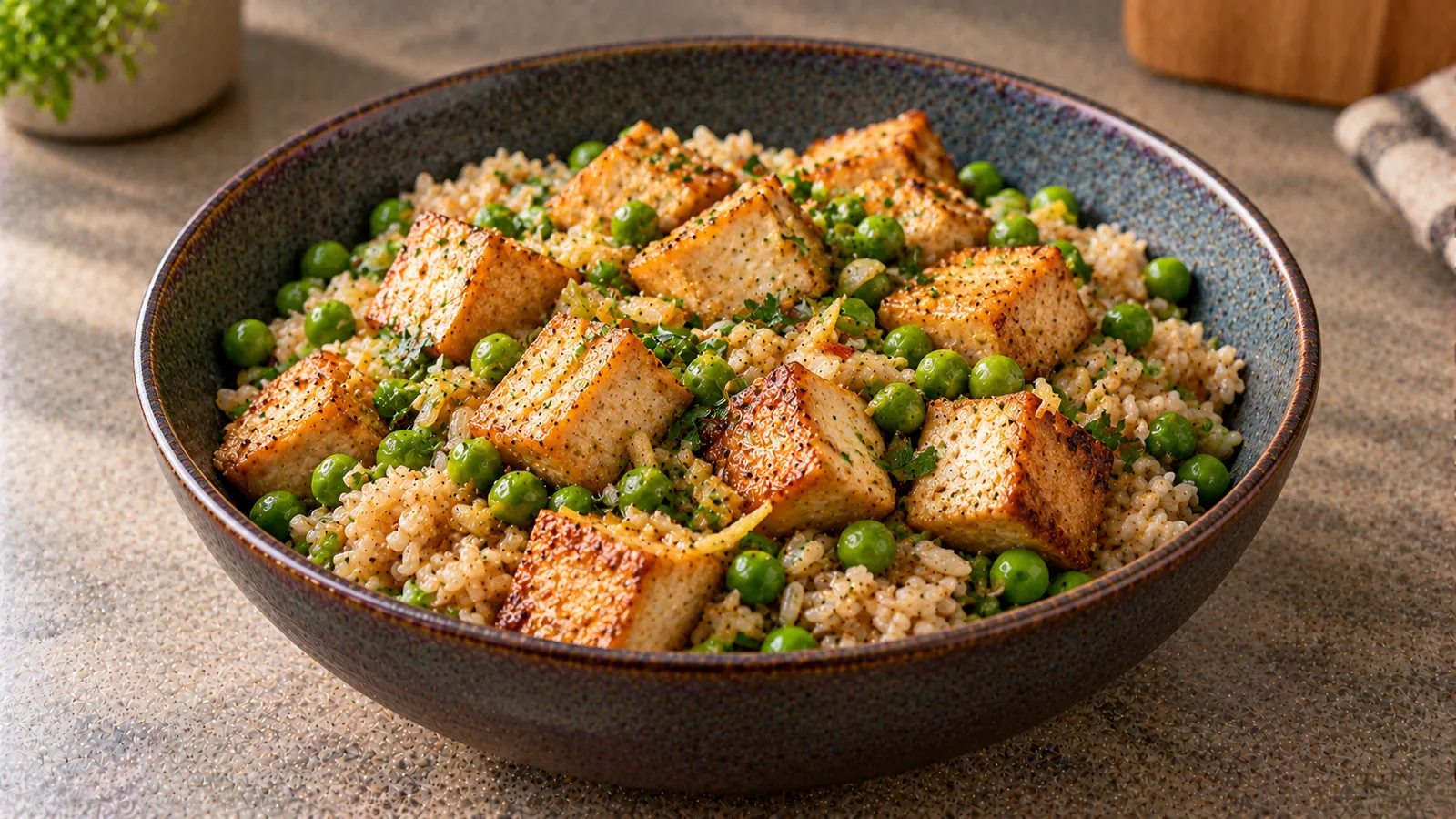
Ginger tofu with frozen peas and brown rice is a practical four-serving dinner built around three everyday supermarket staples. The point is not to disguise tofu under a thick sweet glaze: it is to keep the tofu golden, the peas tender and the rice distinct, while fresh ginger and a modest amount of soy sauce give the bowl a savory finish. You need one pot, one wide skillet and about 45 minutes, most of which is rice cooking time.
This recipe uses 400 g plain firm tofu, 450 g frozen peas and 240 g dry brown rice. It makes four satisfying bowls. The nutrition and cost examples below describe these exact starting amounts—not a generic tofu bowl—and show why cooked rice must never be counted as if it were still dry.
What the finished bowl tastes like
Expect lightly browned tofu cubes with a savory ginger-soy coating, a generous portion of green peas and gently nutty brown rice. The sauce is a thin seasoning that clings to the tofu, rather than a glossy restaurant-style teriyaki sauce. Fresh ginger supplies sharp warmth; garlic gives depth; a small squeeze of lime brightens the whole dish at the end. You can taste the rice, peas and tofu separately.
The most important texture contrast is between tofu that has had time to brown and peas that are warmed just until tender. If the pan is crowded, the tofu steams and stays pale. If the peas simmer for too long in sauce, they lose their fresh texture. Those two avoidable problems are why the recipe staggers the steps instead of cooking everything together from the beginning.
Although every bowl contains protein, carbohydrates and vegetables, no single dinner automatically meets everyone's needs. A larger, more active person may want another portion of rice, while someone wanting a lighter meal can use less rice and more non-starchy vegetables. The serving calculation remains tied to the baseline recipe.
Ingredients and exact starting weights
The amounts below yield four portions. Use firm plain tofu rather than silken tofu; the latter is not intended for turning into browned cubes. Weigh the rice before adding water, weigh the peas frozen and use the actual net edible weight of the tofu. If your tofu package contains significant liquid, drain it and check whether the declared 200 g is the weight of tofu itself.
| Ingredient | Amount for four | Measurement rule | Role |
|---|---|---|---|
| Plain firm tofu | 400 g | Drained edible tofu | Main protein ingredient |
| Frozen green peas | 450 g | Frozen weight, no thawing | Vegetables, fiber, protein |
| Brown rice | 240 g | Dry uncooked weight | Wholegrain base |
| Regular soy sauce | 30 ml | Measure with spoon or jug | Savory seasoning |
| Neutral cooking oil | 20 ml | Measure before frying | Helps browning |
| Fresh ginger | 24 g | Peeled edible weight | Warm, fresh aroma |
| Garlic | 12 g | Peeled edible weight | Savory depth |
| Lime juice | 30 ml | Squeezed juice | Finish and balance |
Keep water for cooking the rice and, if needed, a splash for loosening the pan sauce nearby. Water is not assigned calories. If you add sesame oil, sugar, honey, nuts or extra sauce, count those separately; they are not hidden in the nutrient totals. This is a deliberately short ingredient list, not a compulsory shopping list of specialist seasonings.
The product examples are dmBio plain tofu, dmBio wholegrain long-grain rice and REWE Bio frozen young peas. Their labels provide the reproducible core values used later. Substitute another brand freely, but redo the figures from its packaging.
Equipment and timing
Set out a saucepan with a lid, a large nonstick or well-seasoned skillet, a knife, a board, a sieve and a measuring spoon. A clean kitchen towel or kitchen paper helps dry the tofu. Plan roughly 5–10 minutes for preparation, about 35–45 minutes for brown rice and about 15 minutes for the skillet work. You can perform the latter while the rice is finishing.
Rice varieties do not all absorb water at identical rates. For the chosen dmBio long-grain wholegrain rice, the manufacturer suggests approximately twice as much water and around 40 minutes of cooking. Treat those as a starting point and follow the actual pack if yours differs. Let the rice rest covered for a few minutes; resting often improves separation without adding oil.
Try not to cut the tofu so small that it breaks into crumbs. Pieces around 2 cm are easier to turn and have enough surface to brown. Have ginger and garlic minced before heating the pan: garlic can burn quickly if you are still chopping when it goes in.
Step 1: cook the brown rice
Rinse 240 g of dry rice if its package recommends it. Transfer it to the saucepan and add the water indicated on the pack; the reference product suggests a 1:2 rice-to-water ratio. Bring to a simmer, reduce the heat, cover and cook until the rice is tender and the water has been absorbed. Do not keep lifting the lid every minute; that disrupts steaming and may require more water.
After cooking, rest the saucepan covered for about five minutes, then fluff with a fork. A useful planning estimate is 240 g dry rice becoming roughly 600–720 g cooked rice, but the final mass depends on water absorption and evaporation. That range is not a nutrient yield promise. The entire saucepan still started with 240 g dry rice, regardless of whether it weighs 620 g or 700 g on your scale.
For individual portions, divide the finished pot into four equal shares. If you require a particularly accurate serving, weigh the cooked batch and divide by four. Do not use the calories for 240 g dry rice again when weighing a single cooked portion; that would count the whole batch several times.
Step 2: dry and brown the tofu
Drain 400 g firm tofu and press it gently between layers of clean kitchen paper or a towel. A ten-minute press is helpful when the tofu is wet, but no specialist tofu press is required. Cut into even cubes. Preheat a wide skillet over medium-high heat and add the measured 20 ml oil. Place the cubes in a single layer; cook in batches if necessary.
Leave them undisturbed until one face has browned, then turn carefully. Browning usually takes about 7–10 minutes, depending on pan material and how much moisture remains. The aim is golden edges, not deep-fried tofu. If the cubes stick, wait briefly before trying to lift them; a surface that has browned often releases more easily.
Avoid pouring soy sauce in immediately. Liquid added at the beginning encourages steaming and prevents the dry surface from developing. Once the tofu is mostly browned, lower the heat, move the cubes to one side and add the grated ginger and chopped garlic. Stir aromatics for roughly 30–60 seconds—just until fragrant, not dark. Keep them moving so the garlic does not burn.
Step 3: heat the frozen peas and make a light glaze
Add 450 g peas straight from the freezer. Stir, then cover the pan briefly with a spoonful or two of water if needed. Heat until the peas are thoroughly hot and tender; check the instructions on your specific bag, since commercial products have different recommended times. The peas are vegetables to be heated through, not raw garnish sprinkled onto an already finished bowl.
Pour in 30 ml soy sauce and a small splash of water. Toss so the seasoning reaches the tofu and peas, and simmer just long enough to coat them. The glaze should be thin. Turn off the heat, add 30 ml lime juice and taste. Extra soy sauce will add a substantial amount of salt, so try more lime or ginger first if the dish tastes flat.
The Kikkoman naturally brewed soy sauce label gives approximately 16.9 g salt per 100 ml, equivalent to 5.07 g salt in 30 ml before counting the other ingredients. That is roughly 1.27 g salt per quarter of this recipe from sauce alone. Reduced-salt soy sauce will change the figure, so use the bottle in your own kitchen as the final authority.
Step 4: assemble and serve
Divide the rice among four warm bowls. Add a quarter of the tofu-pea mixture to each, including any ginger-soy juices in the pan. Serve immediately while the tofu retains some contrast between a browned exterior and soft center. If desired, serve an additional lime wedge on the side; extra juice should be counted if precision matters, although its energy contribution is small.
There is no need to press the rice into neat shapes, hide the vegetables or arrange the tofu theatrically. The recipe is meant to be repeated on a normal weekday. A broad bowl makes it easy to distribute peas through the rice and get some tofu in each forkful.
For more context about the main ingredient, see our guide to [calories and portions of tofu](tofu nutrition guide). If you are changing the grain, the [brown rice versus white rice comparison](brown versus white rice comparison) explains how the dry products differ; in this recipe, texture and cooking time may matter as much as a small difference in labels.
Nutrition: what is actually counted
The model uses label values for the three main foods: tofu 122 kcal and 12 g protein per 100 g, peas 81 kcal and 5.9 g protein per 100 g frozen, rice 363 kcal and 7.8 g protein per 100 g dry. Soy sauce is based on the selected manufacturer's label. Ginger, garlic, lime and oil use rounded reference assumptions, so the final totals are estimates rather than lab results.
| Ingredient | Energy in recipe | Protein in recipe | Fiber in recipe |
|---|---|---|---|
| Firm tofu, 400 g | 488 kcal | 48.00 g | 7.60 g |
| Frozen peas, 450 g | 364.5 kcal | 26.55 g | 22.50 g |
| Brown rice, 240 g dry | 871.2 kcal | 18.72 g | 9.60 g |
| Soy sauce, 30 ml | 23.1 kcal | 3.00 g | 0 g |
| Oil, ginger, garlic, lime | 209.4 kcal | 1.32 g | 0.73 g |
| Whole recipe | 1,956.2 kcal | 97.59 g | 40.43 g |
| One of four portions | 489.0 kcal | 24.40 g | 10.11 g |
On these inputs, estimated carbohydrate is 241.45 g for the entire pan and rice pot, or 60.36 g per serving; fat is around 56.18 g total, or 14.05 g per serving. The figures are rounded and do not imply that energy can be reconstructed perfectly from rounded macros. Nutrition labels use permitted rounding and separate methods for dietary fiber.
Peas make a meaningful contribution: the full 450 g bag provides 26.55 g protein and 22.5 g fiber by the chosen label. Tofu contributes more protein than the rice, but rice provides most of the meal's energy and carbohydrate. This is why the three ingredients work together rather than acting as interchangeable protein sources.
Dry rice, cooked rice and water weight
Suppose the 240 g of dry rice absorbs water and weighs 660 g after cooking. A quarter of that pot weighs 165 g. It represents 60 g of dry rice, not 165 g of dry rice. On the selected package, that quarter contributes 217.8 kcal, 4.68 g protein and 2.4 g fiber. Counting 165 g against the dry 363-kcal-per-100-g label would produce an inflated estimate.
The same logic applies in reverse if your saucepan finishes at 600 g: one quarter is then 150 g cooked, but the nutrient contribution from the measured dry grain remains approximately the same. Water changes concentration per 100 g of finished rice, not the total nutrients originally supplied by the grain. Some nutrients may be lost through draining or cooking, so the label-based recipe remains a practical approximation.
If you routinely log meals, save the batch as a four-serving recipe based on raw and dry quantities. Weighing leftovers is useful, but divide the original batch nutrients in proportion to the fraction consumed. Our [portion size versus serving size guide](serving-size guide) explains why a package serving and a dinner bowl do not always match.
Grocery cost: portions are not whole packages
Two 200 g tofu packs cost €1.90 at the checked dm price and 240 g of €2.55/kg rice costs about €0.61. The price of frozen peas varies by store; for this worked example, assign €1.69 to the 450 g bag. The remaining ingredient prices are explicit illustrative assumptions, not live quotations. They are useful for showing the method, not for promising a fixed checkout total.
| Ingredient | Used in four bowls | Cost assigned | Basis |
|---|---|---|---|
| dmBio tofu | 400 g | €1.90 | Two €0.95 packs |
| dmBio brown rice | 240 g dry | €0.61 | €2.55 per kg |
| Frozen peas | 450 g | €1.69 | Assumed bag price |
| Soy sauce | 30 ml | €0.56 | Assumed €2.79/150 ml |
| Oil | 20 ml | €0.16 | Assumed €8 per liter |
| Ginger | 24 g | €0.19 | Assumed €8 per kg |
| Garlic | 12 g | €0.06 | Assumed €5 per kg |
| Lime juice | 30 ml | €0.49 | Assumed one lime |
| Total / one portion | Four bowls | €5.66 / €1.42 | Rounded |
The €5.66 figure is an ingredient-use allocation, not the cost of buying every unopened bottle and package. If you need to buy rice, soy sauce, oil and ginger from scratch, your checkout will be higher, with useful ingredients left for future meals. If you already own them, the incremental cash outlay may be lower. For building realistic shopping totals, see our [budget grocery list guide](budget grocery list).
Adjustments that still keep the recipe recognizable
For a lighter bowl, reduce dry rice from 60 g to 45 g per person while leaving tofu and peas unchanged; that saves about 54 kcal per portion using the rice label. It also reduces carbohydrate and fiber a little. For a larger portion, add 15 g extra dry rice per person; this adds about 54 kcal. Do not adjust the recorded cooked rice weight by 15 g—the change refers to dry weight before cooking.
For more protein without adding a new ingredient, increase tofu from 400 g to 600 g over the whole recipe. At the selected label values, that adds 24 g protein and 244 kcal to the batch, or 6 g protein and 61 kcal per person. More tofu also needs a larger skillet or another cooking batch to brown well.
To cut salt, use 15 ml regular soy sauce with a little more water, ginger and lime; this approximately halves the sauce-derived salt before other changes. A reduced-salt product is another possibility, but read its actual label. If you want more vegetables, add carrots, sliced bell pepper or green beans separately and measure their quantities. Keep the soy-ginger seasoning relatively light so the peas remain apparent.
For different texture, you can pan-sear tofu in the oven or air fryer, but the oil absorption and time may differ. Frozen peas should still be heated according to their packaging. If brown rice is replaced by a quick-cooking grain, recheck its dry nutrition panel and water instructions. The [tofu versus tempeh comparison](tofu versus tempeh comparison) can help if you prefer a firmer fermented soy ingredient, but it describes a different food rather than a silent substitution in this recipe.
Allergens and safe handling
The tofu contains soy. Conventional Kikkoman soy sauce contains soy and wheat, so this exact version is not suitable for everyone avoiding gluten. If necessary, choose a clearly labeled gluten-free tamari and recalculate the salt and energy from its bottle. Do not assume every tamari is identical. Check tofu packaging too, as flavored tofu often includes additional allergens.
Rice deserves more storage care than its plain appearance suggests. The UK Food Standards Agency explains that Bacillus cereus spores can survive cooking and that slow cooling can make rice unsafe; later reheating cannot reliably reverse toxin formation. Cool cooked rice quickly, ideally within one hour; refrigerate promptly; eat within 24 hours; and reheat only once until steaming hot. The same precautions are explained in the NHS rice-and-grain advice. If you cannot cool a large pan promptly, portion it into shallow containers first.
For the rest of the dish, keep tofu and peas refrigerated as directed on their packaging and follow normal leftover hygiene. The USDA leftovers guidance gives general advice for rapid cooling and safe reheating; use the stricter rice handling limit for a mixed bowl containing rice. Never leave cooked rice on the counter overnight and treat subsequent heating as a way to make old rice safe again.
Troubleshooting and practical serving notes
If the tofu looks pale, the pan may be too wet or crowded. Drain, blot and sear in two rounds. If it feels tough, the cubes may be very small or cooked for too long after browning; allow only a short glaze stage. If the ginger tastes bitter, check whether the garlic was darkened in hot oil. Add aromatics near the end, and lower the heat first.
If the peas are mushy, reduce their time in the skillet. If the rice is hard at the center, add a small quantity of water and continue cooking with the lid on; brown rice brands vary in cooking time. If the whole bowl tastes too salty, do not fix it with more soy sauce. Add plain cooked rice, a squeeze of lime or some extra hot vegetables to dilute the seasoning.
For meal planning, pack the rice and tofu-pea mixture separately where convenient, cool promptly and observe the 24-hour chilled rice guideline above. Reheat until steaming hot throughout. This four-bowl version offers a dependable base recipe; its particular energy and protein numbers are estimates derived from the stated labels, not guarantees for every tofu or brand of peas.
Sources
- dmBio plain tofu: label, allergens and pack price.
- dmBio wholegrain long-grain rice: dry-label nutrients, price and cooking instructions.
- REWE Bio frozen peas: nutrition per 100 g frozen.
- Kikkoman naturally brewed soy sauce: nutrients, salt and wheat ingredients.
- NHS: rice cooling, refrigeration and reheating.
- USDA FSIS: safe cooling and reheating of leftovers.