
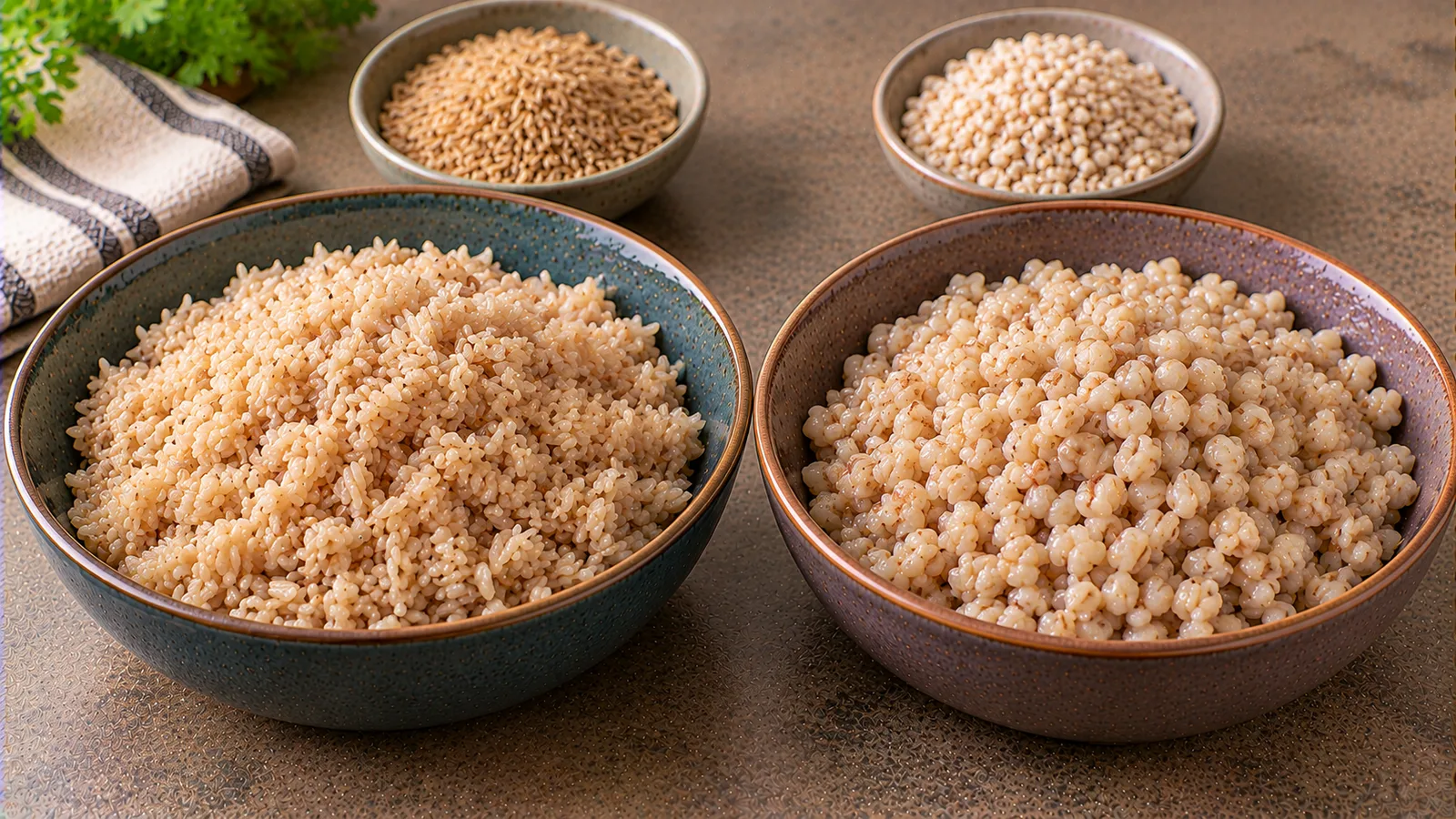
Brown rice and pearl barley can fill the same space on a dinner plate, but they are not identical sources of dietary fibre. The practical question is not which grain looks darker or which dry bag advertises more fibre. It is how much fibre you get in a portion you actually eat, after cooking and draining the grain.
Using two clearly named USDA FoodData Central reference foods, 150 g cooked brown long-grain rice supplies 2.4 g fibre; 150 g cooked pearl barley supplies 5.7 g. Pearl barley therefore supplies 3.3 g more fibre in this equal cooked-weight comparison. Both reference foods contain about 185 kcal per 150 g before oil, sauce or salt is added. These are reference averages, not guaranteed values for every brand or cooking method.
Brown rice vs pearl barley: 150 g cooked
| Nutrient / measure | Brown rice, cooked | Pearl barley, cooked |
|---|---|---|
| Portion on the plate | 150 g | 150 g |
| Dietary fibre | 2.4 g | 5.7 g |
| Energy | 185 kcal | 185 kcal |
| Protein | 4.1 g | 3.4 g |
| Carbohydrate, by difference | 38.4 g | 42.3 g |
| Fat | 1.5 g | 0.7 g |
| Naturally contains barley gluten | No | Yes |
The reference entries are USDA SR Legacy brown long-grain rice, cooked, FDC 169704 and USDA SR Legacy pearl barley, cooked, FDC 170285. You can also inspect the numeric brown-rice record and barley record displayed from USDA data. The values above are scaled from the recorded nutrients per 100 g, then rounded. Both grains are plain, cooked products; neither includes butter, stock or toppings.
This is deliberately not a brown-rice-versus-white-rice comparison. If that is your question, see brown rice versus white rice. And this is not a rice-cooker tutorial: our pearl barley rice-cooker guide addresses cooking pearl barley in that appliance.
How the fibre comparison is calculated
The same USDA records give 1.6 g fibre per 100 g cooked brown rice and 3.8 g per 100 g cooked pearl barley. Multiplying each value by 1.5 gives a cooked portion of 150 g:
- Brown rice: 1.6 × 1.5 = 2.4 g fibre.
- Pearl barley: 3.8 × 1.5 = 5.7 g fibre.
- Difference: 5.7 − 2.4 = 3.3 g.
The pearl-barley reference is about 2.4 times as fibre-dense by cooked weight as the brown-rice reference (5.7 ÷ 2.4 = 2.375). This ratio applies to the chosen entries and cooked-weight basis, not to every pearl barley or rice product sold worldwide.
The energy estimate also follows a transparent calculation. Both selected reference entries list 123 kcal per 100 g cooked, so each 150 g side supplies 123 × 1.5 = 184.5 kcal, reported as approximately 185 kcal. Fibre and energy are different questions: greater fibre here does not automatically mean a lower calorie value for the same cooked weight.
Why cooked weight is the only fair denominator here
Dry rice and dry pearl barley absorb water during cooking. The resulting cooked weight can vary with grain variety, soaking, simmering time, draining and how much water remains in the pot. Water adds weight without adding dietary fibre or calories. That is why a dry-bag nutrition label and a cooked-food USDA entry should not be compared as though the values had the same denominator.
Suppose you start with 60 g dry grain, cook it in plain water and drain it. If the cooked batch weighs 180 g, the cooked-to-dry weight factor is 180 ÷ 60 = 3.0. A 150 g cooked serving from that hypothetical batch would correspond to 150 ÷ 3.0 = 50 g dry grain. If a different batch yielded 150 g cooked from the same 60 g dry, a 150 g cooked serving would contain the entire 60 g dry starting amount. These are arithmetic examples, not claimed typical yields for either grain.
| Example starting amount | Measured cooked yield | Dry-equivalent amount in 150 g cooked |
|---|---|---|
| 60 g dry | 150 g cooked | 60 g dry |
| 60 g dry | 180 g cooked | 50 g dry |
| 60 g dry | 210 g cooked | 42.9 g dry |
For a repeatable home comparison, weigh both uncooked portions, cook them separately in plain water according to their package instructions, drain where applicable, then weigh the cooked results. Serve 150 g of each finished grain. Record the dry and cooked batch weights if you also want to compare the cost or nutrients per gram of dry ingredient. Do not invent a universal dry-to-cooked conversion factor.
A simple kitchen test with both grains
- Label two bowls or containers: brown long-grain rice and pearl barley. Record each grain's dry weight before rinsing or soaking. Use separate pans so cooking water and texture are not confused.
- Follow the preparation instructions on each package. Brown rice and pearl barley may require different cooking times and water amounts. Cook the grains until suitable for eating; do not assume they finish together.
- For barley, distinguish pearl barley from unpearled or hulled barley. Their fibre values and cooking behaviour need not match the chosen USDA pearl-barley record.
- After cooking, let excess water drain where appropriate. Weigh the entire cooked batch without the pan. Write down the real yield instead of using an assumed absorption multiplier.
- Place exactly 150 g cooked of each grain on separate dishes. Compare texture, taste and how they work with the same vegetables and protein accompaniment.
- Use the reference fibre figures only if your preparation reasonably resembles the plain cooked foods described in the data. Check the actual product label for branded or pre-seasoned ready-to-eat pouches.
One reason to measure cooked weight instead of scoops is that grain shape changes how densely a measuring cup packs. A level cup of one grain need not contain the same grams as a cup of another. A kitchen scale gives a more consistent serving basis.
Does pearling remove fibre from barley?
Pearling removes outer layers from barley, so pearled barley is not interchangeable with hulled barley. A plausible assumption that all barley is a fully intact whole grain would be misleading in a buying guide. Nevertheless, the specific USDA cooked pearl-barley entry used here still lists 3.8 g fibre per 100 g, versus 1.6 g for the selected cooked brown rice. The comparison survives without pretending that pearling has no effect.
Brown rice retains its bran compared with white rice; that is one reason consumers choose it. But it does not follow that brown rice must contain more fibre than every other grain. Fibre depends on the species, processing, food state and measurement basis. Different cooking water uptake can also change measured nutrients per 100 g cooked.
No health outcome can be predicted from the 3.3 g difference alone. A meal includes other foods, and a person's tolerance of a grain, overall fibre intake and medical needs can matter more than a single side-dish ranking.
Gluten and grain allergies: the decisive difference
Pearl barley contains gluten because it is made from barley. It is not an appropriate substitute for rice for someone who needs a strict gluten-free diet, including people with coeliac disease. The FDA gluten-free labelling guidance specifically identifies barley, wheat and rye as gluten-containing grains that are not permitted as unprocessed ingredients in foods labelled gluten-free.
Plain rice is naturally gluten-free, but packaged rice mixes, sauces, shared preparation equipment and manufacturing cross-contact can change what is suitable for a person with coeliac disease. Read the complete label and check relevant gluten-free assurances where needed. An absence of a wheat ingredient alone does not mean a product made with barley is gluten-free.
Gluten-related restrictions are separate from other food allergies and intolerances. If a person has a diagnosed allergy or requires a medically restricted diet, check specific ingredients rather than relying on a general fibre table. The pearl-barley advantage in fibre does not override a safety restriction.
Which grain works better at lunch or dinner?
Choose pearl barley when: you want a chewier, slightly nutty side and the extra reference fibre matters to your meal, and you can safely eat gluten. Barley works well in warm bowls, vegetable soups and dishes where separate grains with some bite are welcome. The 5.7 g fibre per 150 g figure describes the plain cooked USDA reference, not a sauce-based barley dish.
Choose brown rice when: you need a naturally gluten-free grain base after checking any cross-contact risks, prefer the familiar rice texture, or are cooking something where barley's chew would be out of place. A 150 g cooked serving still contributes 2.4 g fibre in the selected reference. Brown rice is not a zero-fibre food.
When the goal is the whole meal: add vegetables and an appropriate source of protein to either grain. For example, 150 g cooked grain could be served alongside beans and roasted vegetables. Count any oil, nuts, dressing or cheese separately if you calculate the finished plate's nutrients; the table above contains grain only.
Storage matters, especially for cooked rice
Cooked rice and other starchy foods should not sit cooling slowly at room temperature. Germany's Federal Institute for Risk Assessment (BfR) explains that Bacillus cereus spores may survive heating and that rapid chilling or hot holding reduces the opportunity for bacterial growth. A toxin produced during unsafe storage may not be made harmless simply by reheating the food.
If you are not eating the grains immediately, divide them into shallow containers and chill promptly. USDA leftover guidance advises refrigeration within 2 hours and generally using safely refrigerated leftovers within 3–4 days. For cooked rice, use a more conservative practical approach: cool it especially quickly, keep it cold, and plan to eat refrigerated rice by the following day rather than treating the longest general-leftover window as a target. Discard grain left at room temperature too long; heating it again is not a reliable rescue method.
How to use a different brand's label
If your bag lists fibre per 100 g dry, multiply that number by the dry-equivalent weight actually present in your portion, not by 1.5. For example, 8 g fibre per 100 g dry and a measured dry equivalent of 50 g would give 4.0 g fibre for that cooked serving, before accounting for any preparation-specific changes. This is a generic arithmetic illustration, not a fibre claim for either grain above.
If a ready-cooked pouch lists fibre per 100 g ready to eat, use 1.5 for a 150 g portion, provided that the pouch's declared food state matches what you serve. Check added salt and sauces as separate product features.
The buying decision: for the two selected plain cooked USDA references, pearl barley supplies more fibre (5.7 vs 2.4 g per 150 g) at a similar energy estimate (about 185 kcal). Brown rice remains the practical choice when barley's gluten is unsuitable or rice better fits the dish. Weigh the cooked serving, and never silently substitute dry-label values for cooked-food data.
Sources
- USDA FoodData Central — brown long-grain rice, cooked; SR Legacy FDC 169704.
- USDA FoodData Central — pearl barley, cooked; SR Legacy FDC 170285.
- FDA — questions and answers on gluten-free food labelling.
- German BfR — Bacillus cereus in starchy foods.
- USDA FSIS — leftovers and food safety.
Reference nutrient data are averages of specifically described foods, not analyses of two purchased brands. Cooked-weight values were calculated from the source records and rounded; hypothetical dry-to-cooked yields are clearly marked as arithmetic examples.