
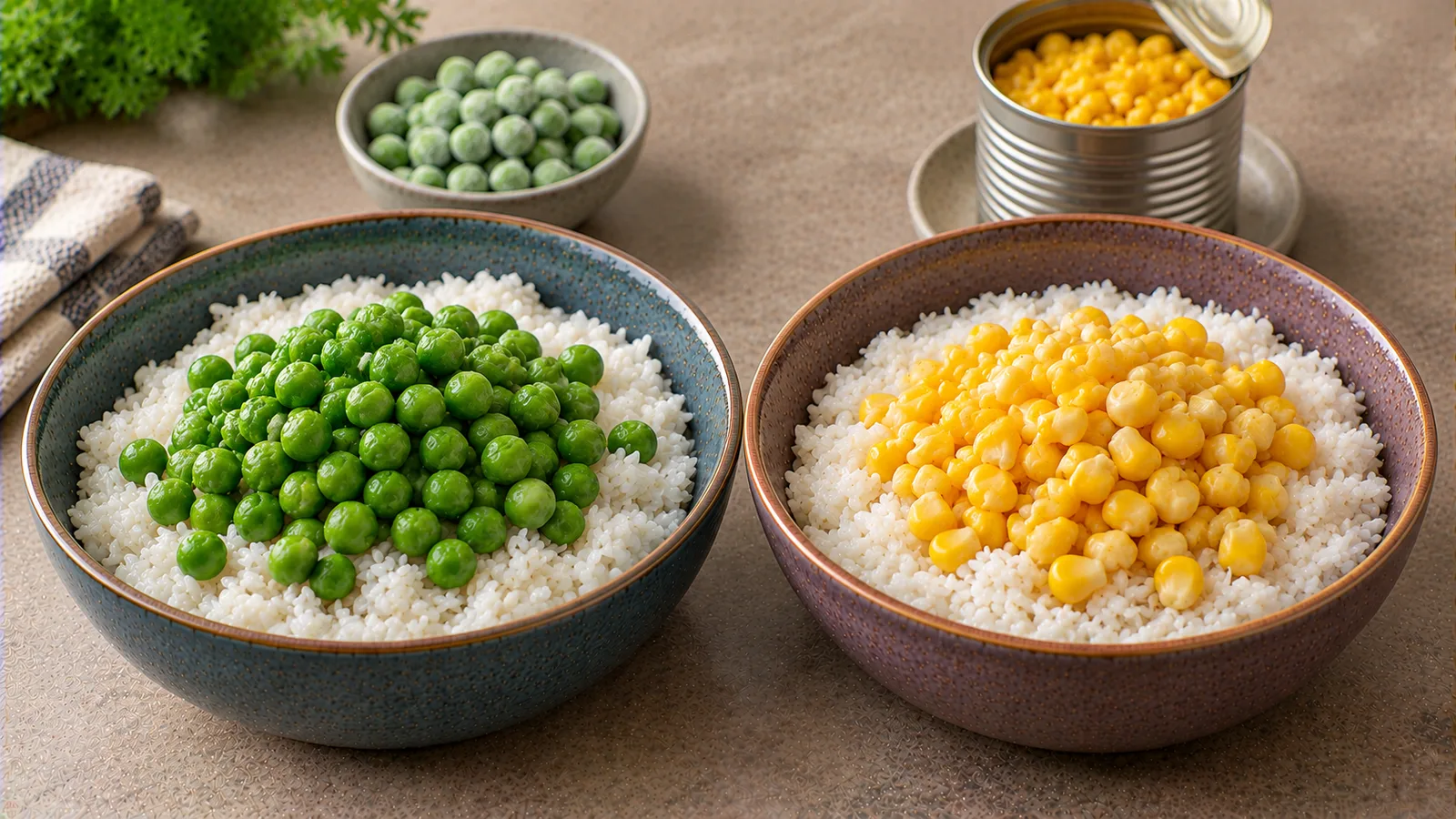
Frozen peas and canned sweetcorn are both easy additions to a rice bowl, but their nutritional profiles and usable weights are not identical. Peas can be cooked from frozen without a complicated recipe. Sweetcorn is usually ready to drain and add. The best answer depends on what you want from a 100 g edible vegetable topping: more fibre, less salt, shorter preparation or a lower cost.
This comparison uses a specified USDA record for frozen green peas, boiled and drained without added salt, and the published label for KING'S CROWN Sonnenmais from Aldi Süd. For price, we use Aldi Süd BIO Junge Erbsen, 750 g at €2.69, and KING'S CROWN Sonnenmais, a 340 g can with 285 g drained weight at €0.89. The pea nutrient record describes the cooked state, whereas the retailer's frozen-pea package price concerns the uncooked frozen weight. That difference matters when calculating euros per cooked portion.
What 100 g of ready-to-eat topping provides
| Per 100 g edible topping | Frozen green peas, cooked and drained | KING'S CROWN canned sweetcorn, drained |
|---|---|---|
| Energy | 78 kcal | 89 kcal |
| Fibre | 4.5 g | 2.4 g |
| Protein | 5.15 g | 2.4 g |
| Sugars | 4.4 g | 7.3 g |
| Salt equivalent | 0.18 g | 0.28 g |
| Vegetable condition | Boiled, drained, no added cooking salt | Drained canned kernels |
The peas are described by USDA FoodData Central SR Legacy, ID 170017. The source reports 72 mg sodium per 100 g; converting sodium to salt equivalent uses 72 × 2.5 / 1,000 = 0.18 g, as used in EU food-labelling practice. The sweetcorn figures come from Aldi Süd's KING'S CROWN label. These are two separately sourced food profiles, not a laboratory analysis of the exact peas and corn sold in one store. Recipes, varieties and added cooking salt can change actual results.
Fibre: cooked peas provide 2.1 g more
On these sources, 100 g cooked peas provide 4.5 g fibre, compared with 2.4 g for the canned sweetcorn. The arithmetic difference is 4.5 − 2.4 = 2.1 g fibre for the vegetable part of one rice bowl. That is a meaningful ingredient-level distinction, but it says nothing about the fibre in the rice, sauce or extra vegetables unless those components are also counted.
For two bowls, one topped with 100 g of peas and the other with 100 g of corn, the pea version gets 2.1 g more fibre from its topping. A mixed topping of 50 g peas and 50 g sweetcorn would supply approximately 3.45 g fibre using these numbers: 4.5 × 0.5 + 2.4 × 0.5. Mixing the two is a practical compromise if you prefer the colour or sweetness of corn but want some of the fibre contribution of peas.
Do not copy 5.3 g fibre per 100 g from the Aldi frozen-pea package into a table headed 100 g cooked. The retailer's frozen-pea listing states 5.3 g per 100 g of its product, whereas the USDA entry specifically describes a boiled and drained product. Moisture changes and product differences explain why the two figures are not directly interchangeable. Check the measurement basis before comparing labels.
Salt: preparation matters as much as the vegetable
The USDA cooked-pea entry reports 72 mg sodium, equivalent to approximately 0.18 g salt per 100 g. The selected canned sweetcorn declares 0.28 g salt per 100 g. On this specific comparison the canned corn has about 0.10 g more salt per 100 g than the cooked peas. That does not make every canned corn product high in salt or every frozen pea product salt-free.
The Aldi sweetcorn ingredients and product details identify an unsweetened supersweet type; the published nutrition panel still lists salt and naturally occurring sugar. There are also canned products prepared with more or less added salt. Read the salt line on the exact can rather than assuming its sodium content from the words 'sweetcorn' or 'without added sugar'.
Peas themselves can be cooked without adding salt. If you boil them in heavily salted water, then add a salty dressing, the finished bowl may have much more salt than this USDA reference serving. Conversely, draining and, if desired, rinsing the corn changes the conditions relative to the original product listing; you should not invent a precise percentage of salt removed without a measured result. Count soy sauce, feta, seasoning blends and stock separately.
Cost: the drained can versus the frozen bag
For a reproducible German retail example, these are the non-promotional prices shown on the consulted Aldi Süd product pages, checked 22 October 2026. They are not a claim that we verified the cheapest available product in every German shop.
| Item | Published pack price | Basis | Cost of 100 g at labelled weight |
|---|---|---|---|
| BIO Junge Erbsen, frozen | €2.69 | 750 g frozen | €0.36 |
| KING'S CROWN Sonnenmais | €0.89 | 285 g drained | €0.31 |
Frozen peas: €2.69 ÷ 750 × 100 = €0.3587, displayed as €0.36 per 100 g of frozen input. Corn: €0.89 ÷ 285 × 100 = €0.3123, displayed as €0.31 per 100 g drained. The 340 g can's total contents include liquid, so dividing by 340 g would artificially understate the cost of edible drained corn.
The remaining problem is cooking yield. A 100 g portion of boiled and drained peas might start with a different frozen weight. Because this particular retailer listing does not provide a measured cooked yield, €0.36 is not a verified cost for 100 g cooked peas. As an explicitly illustrative scenario, assume 90% yield by weight. Then 100 g cooked needs 100 ÷ 0.90 = 111.1 g frozen, costing €0.40 per 100 g cooked peas. A different actual yield gives a different price.
Under that 90% example, corn is about €0.09 cheaper per 100 g edible (€0.40 versus €0.31), but the result is conditional. To obtain a real household number, weigh the peas after boiling and draining, then use pack price × frozen grams used ÷ total pack grams ÷ cooked grams obtained × 100. For other shops, compare ordinary shelf prices and check pack sizes on the same date; online availability and branch pricing change.
Which one works better in a rice bowl?
Choose peas when fibre and plant protein from the topping are the priority. Their cooked USDA profile here gives 4.5 g fibre and 5.15 g protein per 100 g. They also add a softer, less sweet flavour that pairs with rice, lemon, mushrooms, herbs, curry spices or a mild yogurt dressing. They do require cooking according to the package; do not treat an uncooked frozen vegetable as a ready-to-eat canned one.
Choose canned sweetcorn for convenience and sweetness. It is already heat-processed and can be drained and incorporated into many bowls without a separate cooking step. The selected product provides 2.4 g fibre, 2.4 g protein and 7.3 g sugar per 100 g. These sugars are part of the declared product composition, not proof that the manufacturer added table sugar. The Aldi product page explicitly says no added sugar.
Choose both if you want a colourful bowl with different textures. For example, combine 50 g cooked peas with 50 g drained corn, cooked rice, shredded carrot and a dressing. The resulting vegetable topping can be calculated from the ingredient numbers, but the complete meal must include its rice and dressing to obtain total macros and cost. Our comparison of frozen edamame versus frozen peas addresses a different question: edamame versus frozen peas for protein and price.
How to assemble a consistent 100 g topping
- For peas, heat from frozen following the package's instructions. Avoid adding salt when you specifically want to use the no-added-salt nutrition reference.
- Drain peas well, then weigh 100 g cooked, rather than measuring 100 g before cooking and assuming the same final portion.
- For sweetcorn, open the can, pour off the liquid and weigh 100 g drained kernels. Keep the remaining kernels refrigerated in a suitable covered container according to the label.
- Put either topping onto the same cooked rice weight if you are running a fair home comparison. Add sauce only after noting the topping's separate nutrient and cost contribution.
- If calculating a repeatable price, record the shelf price, pack size, cooked yield and date, and repeat the calculation if you change brands.
Neither choice makes the entire bowl nutritionally balanced by itself. Rice quantity, additional protein, vegetables and sauce may contribute more energy, protein or salt than either 100 g topping. If rice bowls are a regular meal, using a consistent portion scale is often more helpful than guessing from ladle size.
What the comparison does not claim
The figures do not compare frozen peas with canned peas; that is a separate preparation and product comparison. They also do not compare canned versus frozen corn. The intended choice here is between two different vegetables used as rice-bowl toppings, matched to a 100 g edible cooked/drained serving.
The values are reference and retail-label averages. Actual moisture, variety, packing liquid and seasoning cause variation. Prices are a dated, verifiable German example, not a national cheapest-price guarantee. In particular, the 90% cooked-pea yield is a transparent model assumption, not a tested yield for the specific Aldi bag.
Sources and method
- USDA FoodData Central, SR Legacy ID 170017: frozen green peas, cooked, boiled, drained, without salt; 78 kcal, 4.5 g fibre, 5.15 g protein, 4.4 g sugar and 72 mg sodium per 100 g.
- Aldi Süd BIO Junge Erbsen, 750 g: published €2.69 pack price and frozen product label (5.3 g fibre per 100 g of packaged product; not substituted into the cooked-pea nutrient row).
- Aldi Süd KING'S CROWN Sonnenmais, 340 g can, 285 g drained: published €0.89 price, drained weight, 89 kcal, 2.4 g fibre, 2.4 g protein, 7.3 g sugar and 0.28 g salt per 100 g.
- European Commission, nutrition labelling: standard comparison of declared nutrients per 100 g and distinction between mandatory and voluntary declarations.
Method and date: nutrient comparison on 100 g cooked/drained edible food, with a USDA cooked-pea reference and a branded drained-corn label; no salted cooking water or sauces included. Prices checked 22 October 2026. The €0.40 cooked-pea price assumes 90% yield; it is not an independently measured retail fact.