
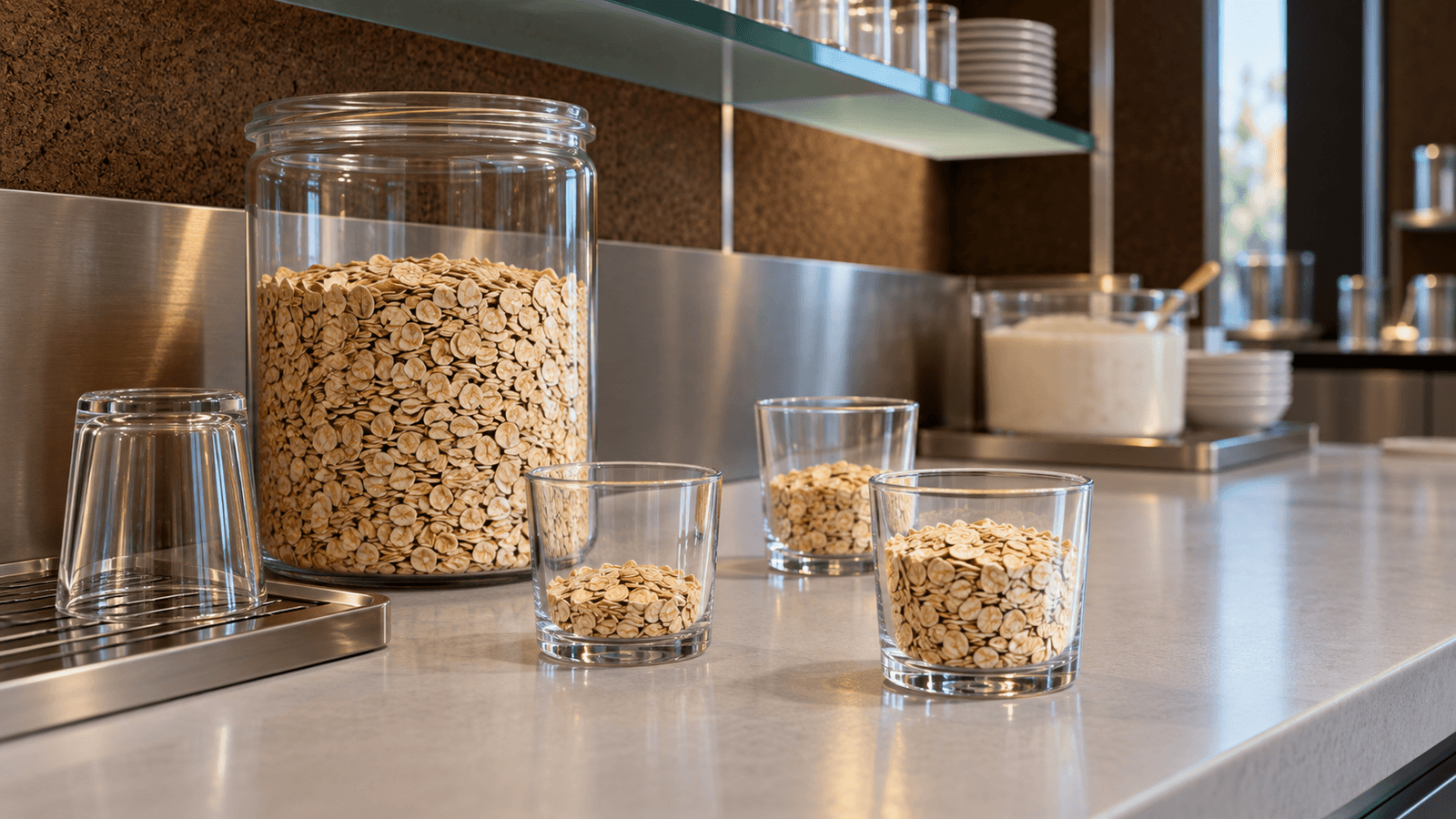
Portion size and serving size sound like the same thing, but they describe different concepts.
A serving size is usually a standardized reference amount used on a nutrition label, in dietary guidance or in a food database.
A portion size is the amount you actually choose to eat at one time.
Those amounts can be identical, but they do not have to be.
Understanding the difference can make nutrition labels easier to interpret and can help you track food more realistically.
Portion size vs serving size: the simple difference
The easiest way to remember the distinction is:
Serving size = reference amount.
Portion size = amount actually eaten.
For example, a package might list nutrition information for a 30 g serving.
If you eat 45 g, your portion is 45 g even though the listed serving size is 30 g.
If you eat 20 g, your portion is 20 g.
The serving size does not automatically tell you how much you personally should eat.
What is a serving size?
A serving size is a defined amount used to communicate nutritional information.
Depending on the context, it may appear:
- on a food package
- in a nutrition database
- in dietary guidance
- in a recipe
- in a food-tracking app
It creates a reference point.
If a label says that one serving contains a certain amount of calories, protein, carbohydrates and fat, those values apply to the stated serving amount.
What is a portion size?
A portion is the amount of food you actually put into your meal or snack.
It may be:
- smaller than the labeled serving
- equal to the labeled serving
- larger than the labeled serving
Your portion depends on the situation.
It can vary with:
- appetite
- energy needs
- the rest of the meal
- activity
- personal preferences
- goals
- how often you eat
- the type of food
That flexibility is normal.
A serving size is not automatically a recommendation
This is one of the most important distinctions.
People sometimes see a serving size on a package and assume:
“This is the amount I am supposed to eat.”
That is not necessarily what the label means.
The serving amount primarily gives you a reference for interpreting the nutritional values.
Your appropriate portion may be different.
Example: breakfast cereal
Imagine a cereal label gives nutrition information for 40 g.
If you pour 60 g into your bowl, your portion is 1.5 times the listed serving.
If the label says 150 kcal per 40 g, then:
150 × 1.5 = 225 kcal.
The important step is matching the amount you actually eat to the reference amount on the label.
Example: yogurt
Suppose a large container of yogurt lists values per 100 g.
You eat 180 g.
If the yogurt contains 70 kcal per 100 g:
180 ÷ 100 = 1.8
70 × 1.8 = 126 kcal.
Here, 100 g is the nutritional reference amount.
Your actual portion is 180 g.
Example: bread
Bread may be listed per 100 g, per slice or both.
Suppose one slice weighs approximately 45 g.
If you eat two slices, your portion is approximately 90 g.
The most useful reference depends on the information available.
If the package provides reliable values per slice, tracking by slice can be convenient.
If slice sizes vary substantially, weight may be more accurate.
Example: nuts
Nuts are a useful example because relatively small changes in portion size can noticeably change calories.
A label might use a 30 g reference.
Your actual handful might be:
- 20 g
- 30 g
- 45 g
- 60 g
The word “handful” is convenient, but different hands and different foods create different amounts.
You do not necessarily need to weigh nuts forever.
Weighing your usual handful once or twice can help you understand what your normal portion looks like.
Why serving sizes can be confusing
Several things can create confusion.
The package may contain multiple servings
A small-looking package is not always one serving.
Values may be shown per 100 g
In many European contexts, nutrition information is commonly presented per 100 g or 100 ml.
That is useful for comparing foods but may not match the amount you actually eat.
A suggested serving may be smaller than your normal portion
That does not automatically make your portion wrong.
It simply means you need to adjust the nutritional values.
Household units can vary
A tablespoon, cup, slice, scoop or handful may not always represent the same amount.
Per 100 g versus per serving
Both systems can be useful.
Per 100 g
This makes products easier to compare.
If two yogurts list values per 100 g, you can compare their energy and nutrients using the same reference quantity.
Per serving
This may be more intuitive when the serving corresponds to a realistic unit.
For example:
- one yogurt cup
- one bar
- one slice
- one individual package
But you still need to check whether you actually eat that amount.
How to calculate nutrition for your portion
Use this simple formula:
Your amount ÷ reference amount × listed nutrition value
For example:
Reference amount: 100 g
Calories: 240 kcal
Your portion: 75 g
75 ÷ 100 × 240 = 180 kcal.
The same calculation can be used for protein, carbohydrates, fat and other nutrients.
What if the package lists several servings?
Suppose a package contains 300 g and the serving size is 50 g.
That means the package contains six reference servings.
If you eat 100 g, you ate two listed servings.
If you eat the entire 300 g package, you ate six listed servings.
The package size and serving size are separate pieces of information.
Portion size depends on the whole meal
A portion should not always be considered in isolation.
Imagine potatoes are one component of a meal containing:
- fish
- vegetables
- potatoes
- olive oil
The appropriate amount of potatoes may depend partly on the amounts of the other components.
If the meal already contains another substantial carbohydrate source, the potato portion might be smaller.
If potatoes are the main carbohydrate source, it might be larger.
This is one reason rigid serving rules are often less useful than looking at the complete meal.
Portion size and calorie needs
People have different energy needs.
Someone who is larger or more active may need different portions from someone who is smaller or less active.
Portions can also change from day to day.
For example, a long cycling day may create different energy needs from a sedentary day.
This does not mean every meal must be recalculated.
It simply means portion size is naturally flexible.
For more context, see How Many Calories Should You Eat Per Day?.
Portion size and weight loss
During weight loss, portion awareness can help manage total energy intake.
But portion control does not have to mean eating tiny amounts of food.
A more useful strategy may involve adjusting the composition of meals.
For example:
- keep a useful protein source
- include vegetables or fruit
- use a carbohydrate portion that fits your needs
- include dietary fat in a practical amount
- pay attention to energy-dense extras
This can create satisfying meals without relying on extremely small portions.
See How to Lose Weight Sustainably.
Energy density changes what a portion looks like
Different foods provide very different amounts of energy for the same weight or volume.
For example, a relatively small amount of oil contains much more energy than the same weight of many vegetables.
This does not make oil “bad.”
It simply means portion size has different implications depending on the food.
Energy-dense foods often require more portion awareness when calories matter.
Foods where small portion differences can matter more
Examples include:
- oils
- butter
- nuts
- nut butter
- cheese
- chocolate
- creamy sauces
- dressings
These foods can fit into a balanced diet.
However, a visually small difference can sometimes represent a meaningful difference in calories.
Foods where larger visual portions may fit more easily
Foods with lower energy density can often occupy more physical space.
Examples may include:
- many vegetables
- fruit
- broth-based soups
- potatoes prepared with moderate added fat
- some lean protein sources
- some lower-fat dairy products
Preparation matters.
A vegetable cooked with a large amount of oil will have a different energy density from the same vegetable steamed or roasted with a smaller amount.
Do you need to weigh every portion?
No.
A food scale can be useful for learning.
It does not need to become a permanent requirement.
You might weigh certain foods a few times to understand:
- what 30 g of nuts looks like
- what 80 g of dry pasta looks like
- what your usual cereal portion weighs
- how much oil you normally pour
- how large your usual rice portion is
Once you have useful visual references, everyday tracking can become faster.
See How to Track Calories Without Weighing Everything.
Use unit-based portions when appropriate
Some foods are naturally easy to count.
Examples:
- eggs
- slices of bread
- individual yogurt cups
- bananas
- apples
- tortillas
- packaged bars
If the units are reasonably consistent and nutrition information is available per unit, counting can be simpler than weighing.
Use visual references
Visual references can make portion estimation easier.
You can learn what your usual:
- bowl of oats
- rice serving
- pasta serving
- piece of chicken
- yogurt portion
- handful of nuts
looks like.
The goal is not perfect visual accuracy.
The goal is to reduce large, repeated estimation errors.
Household measures can help
Cups, tablespoons and teaspoons can sometimes provide useful approximate portions.
They are particularly convenient for foods you use repeatedly.
However, household measures have limitations.
A tablespoon of oil is relatively consistent if measured properly.
A cup of chopped vegetables can vary depending on how the food is cut and packed.
Use household measures as practical tools rather than exact laboratory measurements.
Package portions can be convenient
Some packaged foods make tracking simple.
For example:
- one yogurt container
- one individual cheese portion
- one bar
- one frozen portion
- one can
If you consume the entire unit and the package provides nutrition for the unit, you may not need additional measurement.
Always check whether the nutrition values refer to the whole package or only part of it.
Restaurant portions are less standardized
Restaurant meals often do not provide a precise serving reference.
Portions can vary between:
- restaurants
- chefs
- days
- locations
- menu items
When exact information is unavailable, estimation is often necessary.
A useful estimate can consider:
- visible amount of protein
- carbohydrate portion
- sauces
- oils
- cheese
- side dishes
- beverages
Precision is limited, but a reasonable estimate can still be useful.
Homemade mixed dishes
Mixed dishes can make portions more difficult to estimate.
Examples:
- lasagna
- casseroles
- curries
- stews
- pasta dishes
- soups
A practical approach is:
- estimate or record the ingredients used
- calculate the total recipe
- divide the finished dish into approximate portions
- save the recipe for future use
The portions do not have to be perfectly identical.
Serving size in recipes
A recipe may say “serves four.”
That usually means the recipe creator has divided the total recipe into four reference portions.
It does not mean every person must eat exactly one quarter.
One person may eat a smaller portion.
Another may eat a larger portion.
If you track the recipe, adjust the nutritional values according to the amount actually eaten.
Portion sizes can change over time
Your normal portions are not fixed forever.
They may change when:
- activity changes
- body weight changes
- goals change
- meal frequency changes
- appetite changes
- your schedule changes
That is normal.
A useful portion is contextual.
Do larger plates automatically make you eat more?
Plate and bowl size can influence how portions look, but real eating behavior is more complicated than one simple visual rule.
Rather than relying on plate size alone, focus on the amount of food and the structure of the meal.
The goal is not to manipulate yourself with special dishes.
It is to understand what you are eating.
Portion control does not mean tiny meals
“Portion control” sometimes sounds like deliberately making every meal small.
That is not necessary.
You can create substantial meals while managing calories by combining foods with different energy densities.
For example, a meal can include:
- a useful protein portion
- plenty of vegetables
- a practical carbohydrate portion
- a moderate amount of dietary fat
This is more flexible than simply reducing everything.
Portion awareness without obsession
Portion awareness should make eating easier to understand, not create constant anxiety.
You do not need to know the exact gram weight of every ingredient.
For many people, the most useful strategy is to be more precise with foods where estimation errors matter most and more flexible elsewhere.
For example:
More attention:
- oils
- nuts
- nut butter
- cheese
- calorie-dense sauces
Less need for precision:
- leafy vegetables
- many non-starchy vegetables
- low-calorie flavoring ingredients
The exact approach depends on your goals.
Portion size and hunger
If portions are consistently too small for your needs, hunger can make the plan difficult to maintain.
Before reducing portions further, review:
- total calorie target
- protein
- fiber
- food volume
- meal timing
- activity
- sleep
See Why Am I Hungry in a Calorie Deficit?.
Portion size and macros
Portion size directly changes macro intake.
If you double a food portion, you approximately double its calories and macronutrients, assuming the food composition stays the same.
This is why portion estimation matters when tracking protein, carbohydrates and fat.
If you are setting macro targets, see How to Calculate Your Macros.
Common portion-size mistakes
Assuming the serving size is a personal recommendation
It is usually a reference amount, not a rule.
Assuming the whole package is one serving
Always check the package quantity and nutrition reference.
Tracking a restaurant portion as a standard database serving
Restaurant portions may differ substantially.
Ignoring cooking fats
The food portion may look correct while oil or sauce changes total calories significantly.
Using vague units without calibration
A “handful” or “scoop” can vary considerably.
Trying to estimate everything perfectly
The goal is useful consistency, not laboratory precision.
A practical portion system
You can use three levels of precision.
Level 1: count the unit
Useful for:
- eggs
- slices
- individual packages
- pieces of fruit
Level 2: estimate visually
Useful for familiar foods and repeated meals.
Level 3: weigh when useful
Useful for:
- calorie-dense ingredients
- unfamiliar foods
- recipe calibration
- foods where your visual estimate is uncertain
You can move between these levels depending on the situation.
How Mealisa can help with portions
Mealisa is designed to reduce the amount of manual food entry needed for everyday tracking.
Food photos can provide a starting estimate of what is on the plate or in the bowl.
Barcode and nutrition-label information can help with packaged foods.
Saved meals and recipes can reduce repeated calculations.
The useful question is not whether every portion can be identified with perfect precision.
It is whether the tracking process is consistent enough to reveal meaningful patterns over time.
Mealisa can combine portion estimates with your calorie and macro targets so that later meals can be adjusted according to what has already been logged.
A simple everyday workflow
Step 1
Check what reference the nutrition information uses.
Is it per 100 g, per serving or per package?
Step 2
Estimate how much you actually ate.
Step 3
Adjust the nutrition values to your portion.
Step 4
Use unit counts or visual estimates for familiar foods.
Step 5
Weigh unfamiliar or calorie-dense foods occasionally when useful.
Step 6
Save repeated meals and recipes.
Step 7
Focus on consistency rather than perfect precision.
Frequently asked questions
What is the difference between serving size and portion size?
Serving size is a reference amount used for nutrition information or guidance. Portion size is the amount you actually choose to eat.
Is a serving size the amount I should eat?
Not necessarily. It primarily provides a reference for interpreting nutritional information.
Can my portion be larger than one serving?
Yes. If you eat more than the listed serving, adjust the calories and nutrients accordingly.
Can my portion be smaller than one serving?
Yes. Your actual portion can be smaller, equal to or larger than the reference serving.
What does “per 100 g” mean?
It means the listed nutrition values correspond to 100 grams of the food. You can calculate your actual intake according to the amount you eat.
Do I need to weigh food to know my portion size?
Not always. Counting units, using package information, visual estimation and occasional calibration can all be useful.
Are restaurant serving sizes standardized?
Usually not. Restaurant portions can vary substantially.
Does portion control mean eating small meals?
No. Portion awareness means understanding quantities. A meal can still be large in physical volume while fitting your energy needs.
Why does portion size matter for calorie tracking?
Calories and macronutrients change with the amount of food consumed. If the actual portion differs from the reference amount, the nutrition values need to be adjusted.
The bottom line
Serving size and portion size are not the same thing.
A serving size is a reference.
A portion size is what you actually eat.
Nutrition labels become much easier to use once you separate those two ideas.
Check the reference amount, estimate your real portion and adjust the nutrition values when necessary.
You do not need perfect measurement at every meal.
The goal is to understand your usual portions well enough to make food tracking and meal planning more useful.
This article provides general nutrition information and is not individualized medical or dietary advice.