
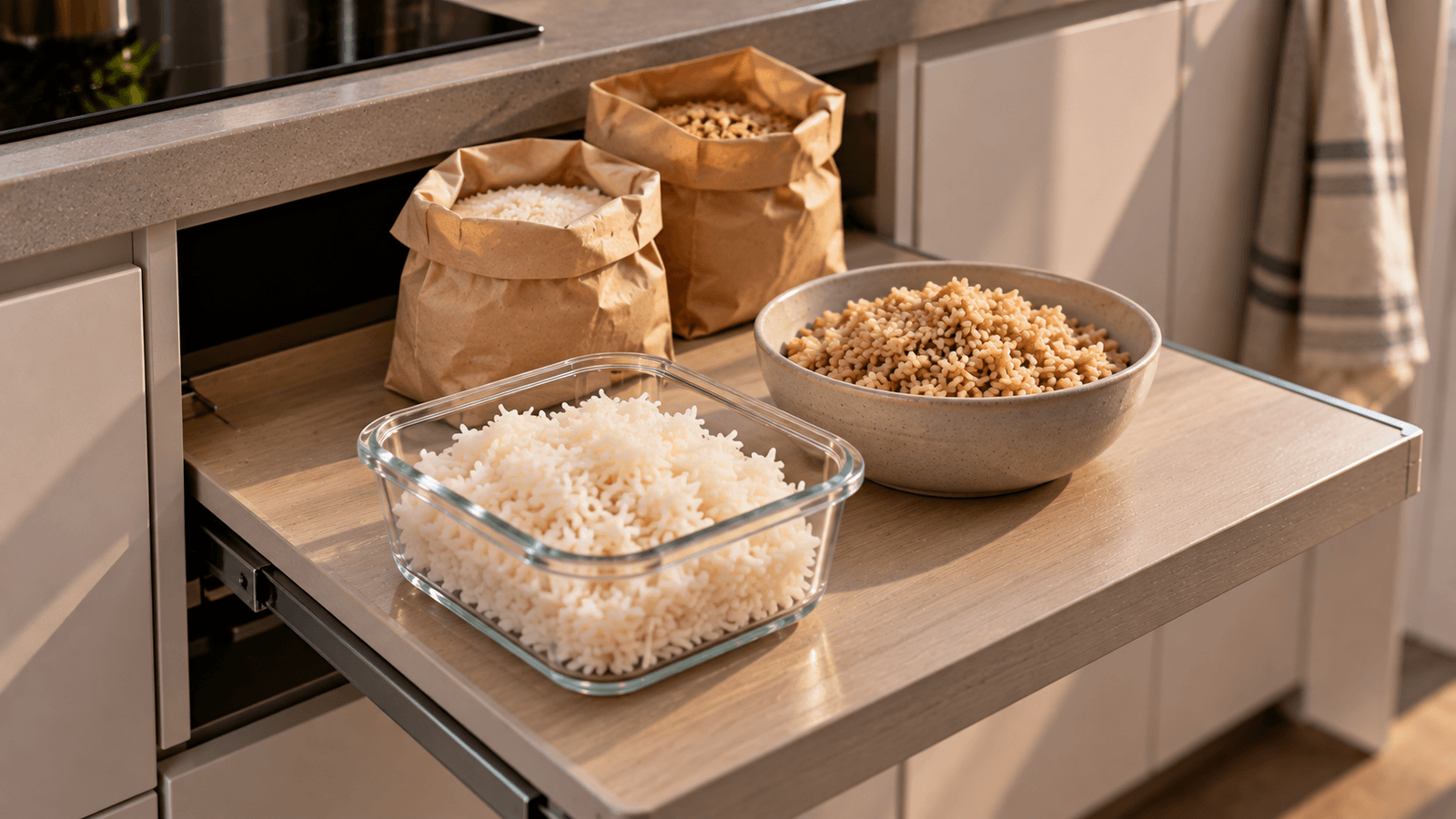
Brown rice and white rice come from the same grain, but they are processed differently.
Brown rice retains the bran and germ. White rice is milled further, removing those layers and leaving mainly the starchy endosperm.
That difference changes fiber, some micronutrients, texture, cooking time and how the rice behaves in a meal.
The calorie difference, however, is usually smaller than many people expect.
Brown rice vs white rice at a glance
| Brown rice | White rice | |
|---|---|---|
| Grain type | Whole grain | Refined grain |
| Cooked calories | Similar to white rice | Similar to brown rice |
| Carbohydrate | High | High |
| Fiber | Higher | Lower |
| Protein | Small amount | Small amount |
| Natural micronutrients | More retained from bran and germ | Some removed during milling |
| Texture | Chewier, nuttier | Softer, more neutral |
| Cooking time | Usually longer | Usually shorter |
| Shelf life | Generally shorter | Generally longer |
The exact nutrition values vary by rice variety, enrichment and cooking method.
Calories: the difference is small
Using common reference values for cooked long-grain rice:
- brown rice: roughly 123 kcal per 100 g
- white rice: roughly 130 kcal per 100 g
For a 200 g cooked portion, that would be approximately:
- brown rice: 246 kcal
- white rice: 260 kcal
That is only a small difference.
Water absorption also changes calories per 100 g, so two cooked batches can differ even when they started with similar dry rice.
For calorie tracking, portion size and whether you are weighing rice dry or cooked often matter more than the small calorie difference between brown and white rice.
Why brown rice is a whole grain
A grain kernel contains three main edible parts:
- bran
- germ
- endosperm
Brown rice retains all three after the inedible outer hull is removed.
The bran contains fiber and various nutrients, while the germ also contains nutrients and naturally occurring fats.
White rice is processed further to remove the bran and germ.
The remaining grain is primarily the starchy endosperm.
This is why brown rice is classified as a whole grain and white rice as a refined grain.
Fiber: brown rice contains more
Fiber is one of the clearest nutritional differences.
Because the bran remains intact, brown rice generally provides more fiber than white rice.
A common cooked long-grain brown-rice reference provides around 1.6 g fiber per 100 g.
Cooked white rice generally contains substantially less.
The difference can become more noticeable across larger portions or when rice is eaten regularly.
Still, rice does not have to provide all the fiber in a meal.
You can also combine either rice with:
- beans
- lentils
- vegetables
- peas
- nuts
- seeds
The overall meal matters.
Carbohydrates
Both brown and white rice are primarily carbohydrate-rich foods.
The difference in total carbohydrate between equivalent cooked portions is generally modest.
If you are tracking carbohydrate intake, the amount of rice you eat usually has a larger effect than simply changing from one color of rice to the other.
For example, reducing a 300 g rice portion to 150 g changes the carbohydrate amount much more than switching between two similar 150 g portions.
Protein and fat
Neither brown nor white rice is typically a major protein source.
Both contain a small amount of protein.
Plain white rice is usually very low in fat.
Brown rice contains slightly more naturally occurring fat because the germ remains in the grain, but it is still relatively low in fat when prepared without added oil or butter.
For a meal with more protein, rice can be paired with foods such as:
- beans or lentils
- tofu or tempeh
- eggs
- fish
- chicken
- yogurt-based sauces or other protein-rich foods
Micronutrients
Processing removes part of the naturally occurring nutrients found in the bran and germ.
Brown rice therefore retains more of several naturally occurring nutrients associated with the whole grain.
These can include:
- magnesium
- manganese
- phosphorus
- B vitamins
White rice may be enriched in some countries, meaning certain nutrients such as iron and B vitamins are added after processing.
Enrichment practices vary by country and product.
The label is therefore more useful than assuming every white rice product has the same micronutrient profile.
Does brown rice affect blood sugar differently?
Brown rice retains its fibrous bran layer and is less refined than white rice.
Whole grains generally produce a different glycemic response than refined grains, although the response to rice varies considerably.
Factors include:
- rice variety
- cooking method
- cooking time
- portion size
- what else is eaten with the rice
- individual response
This means "brown" or "white" alone cannot predict exactly what will happen after a particular meal.
The composition of the complete meal also matters.
Which is more filling?
Brown rice's higher fiber content and chewier texture may make it more satisfying for some people.
But fullness is not determined by rice type alone.
A meal containing rice plus:
- protein
- vegetables
- legumes
- other fiber-rich foods
may be substantially more filling than a bowl of rice by itself.
Portion size, total energy, eating speed and personal preference also affect satiety.
Brown rice vs white rice for weight loss
Neither type automatically causes or prevents weight loss.
If two portions provide similar calories, switching from white rice to brown rice does not create a large calorie deficit by itself. For a practical dish using brown rice together with tofu and peas, see ginger tofu with brown rice.
Brown rice may contribute more fiber, while white rice may still fit comfortably into a balanced eating pattern.
For calorie management, more influential variables can include:
- portion size
- cooking oil
- sauces
- other foods in the meal
- total daily intake
A 150 g serving of rice with vegetables and a protein source is very different from a much larger serving combined with substantial oil and a calorie-dense sauce.
The portion can matter more than the rice type
Using approximate cooked values:
| Portion | Brown rice | White rice |
|---|---|---|
| 100 g | ~123 kcal | ~130 kcal |
| 150 g | ~185 kcal | ~195 kcal |
| 200 g | ~246 kcal | ~260 kcal |
| 250 g | ~308 kcal | ~325 kcal |
| 300 g | ~369 kcal | ~390 kcal |
These values are illustrative.
Notice that changing the portion by 100–150 g has a much larger effect than the small difference between the two rice types at the same weight.
Dry vs cooked weight matters even more
Comparing 100 g of dry rice with 100 g of cooked rice creates a misleading comparison.
Dry rice is much more calorie-dense because cooked rice contains a large amount of absorbed water.
For example, dry rice may provide roughly 350–370 kcal per 100 g, while cooked rice often falls around 120–140 kcal per 100 g.
When comparing brown and white rice, make sure both values refer to the same state:
dry vs dry
or
cooked vs cooked.
Never compare a dry value for one rice with a cooked value for the other.
Example: equal cooked portions
Suppose a meal contains 180 g of rice.
Using approximate values:
Brown rice:
180 × 123 ÷ 100 = about 221 kcal
White rice:
180 × 130 ÷ 100 = about 234 kcal
Difference:
about 13 kcal
In practice, a spoonful of oil or a larger serving can easily create a much bigger difference than the rice choice itself.
Texture and taste
Brown rice usually has:
- a nuttier flavor
- a firmer texture
- more chew
White rice generally has:
- a softer texture
- a milder flavor
- a lighter consistency
These characteristics can affect which rice works better in a particular dish.
Personal preference matters because a nutritionally useful food is only practical if you actually want to eat it.
Cooking time
Brown rice generally takes longer to cook because the bran layer remains.
White rice cooks faster because the bran and germ have been removed.
Exact cooking times vary by variety and method.
Quick-cooking and precooked products can shorten the difference substantially.
Storage differences
The germ in brown rice contains naturally occurring oils.
Because these remain in brown rice, it generally has a shorter shelf life than white rice.
White rice stores longer under appropriate dry conditions.
If you buy brown rice in large quantities but use it slowly, storage conditions become more important.
Follow the product's storage instructions and check it before use.
Which works better for meal prep?
Both can work.
Brown rice can be useful when you prefer:
- a firmer texture
- whole grains
- more fiber
White rice can be useful when you prefer:
- faster cooking
- a softer texture
- a neutral base for other foods
For batch tracking, the same principle applies to both.
Record the dry amount, cook the batch, weigh the finished rice if useful, and divide it by portions.
Example: the rest of the meal changes the comparison
Consider two meals.
Meal A
- 200 g brown rice
- fried protein
- creamy sauce
- little vegetable content
Meal B
- 200 g white rice
- beans
- grilled protein
- large vegetable portion
- lighter sauce
It would be misleading to judge the complete meals only from the type of rice.
Rice is one component.
The ingredients around it can change the meal's calories, protein, fiber, fat and overall nutrient profile much more substantially.
What about enriched white rice?
Some white rice is enriched after milling.
Depending on the country and product, nutrients such as:
- iron
- folic acid
- thiamin
- niacin
may be added.
This does not recreate the original grain exactly, and fiber is not restored to the same level as in brown rice.
Check the nutrition label and ingredient information when comparing specific products.
What about basmati and jasmine rice?
"Basmati" and "jasmine" describe rice varieties, while "brown" and "white" describe the degree of processing.
That means you can find:
- white basmati rice
- brown basmati rice
- white jasmine rice
- brown jasmine rice
Variety and processing are separate characteristics.
A brown basmati product should therefore be compared with the actual white basmati product if you want a precise product-level comparison.
Brown rice and arsenic
Rice can take up inorganic arsenic from the environment.
Because arsenic can accumulate in the outer layers of the grain, brown rice can contain more arsenic than white rice.
This does not mean that everyone needs to avoid brown rice.
Practical ways to reduce reliance on one source include varying the grains you eat, such as using:
- oats
- barley
- bulgur
- quinoa
- other whole grains
Cooking rice in excess water and draining it can also reduce arsenic, although this may reduce some water-soluble nutrients.
How to choose between brown and white rice
Instead of treating one rice as universally correct, consider the job it needs to do in your diet.
Choose brown rice more often when you specifically want:
- a whole grain
- more fiber
- a firmer, nuttier rice
White rice may be practical when you want:
- a softer texture
- shorter cooking time
- a neutral base
- a rice you personally digest or enjoy better
You can also eat both.
The choice does not need to be permanent or all-or-nothing.
For calorie tracking, use the correct entry
If you eat brown rice, use a brown-rice entry.
If you eat white rice, use a white-rice entry.
More importantly:
- match dry weight with dry nutrition data
- match cooked weight with cooked nutrition data
- include oils and butter
- track calorie-containing sauces separately
- calculate mixed dishes as recipes when possible
These steps usually improve accuracy more than focusing on a small calorie difference between brown and white rice.