
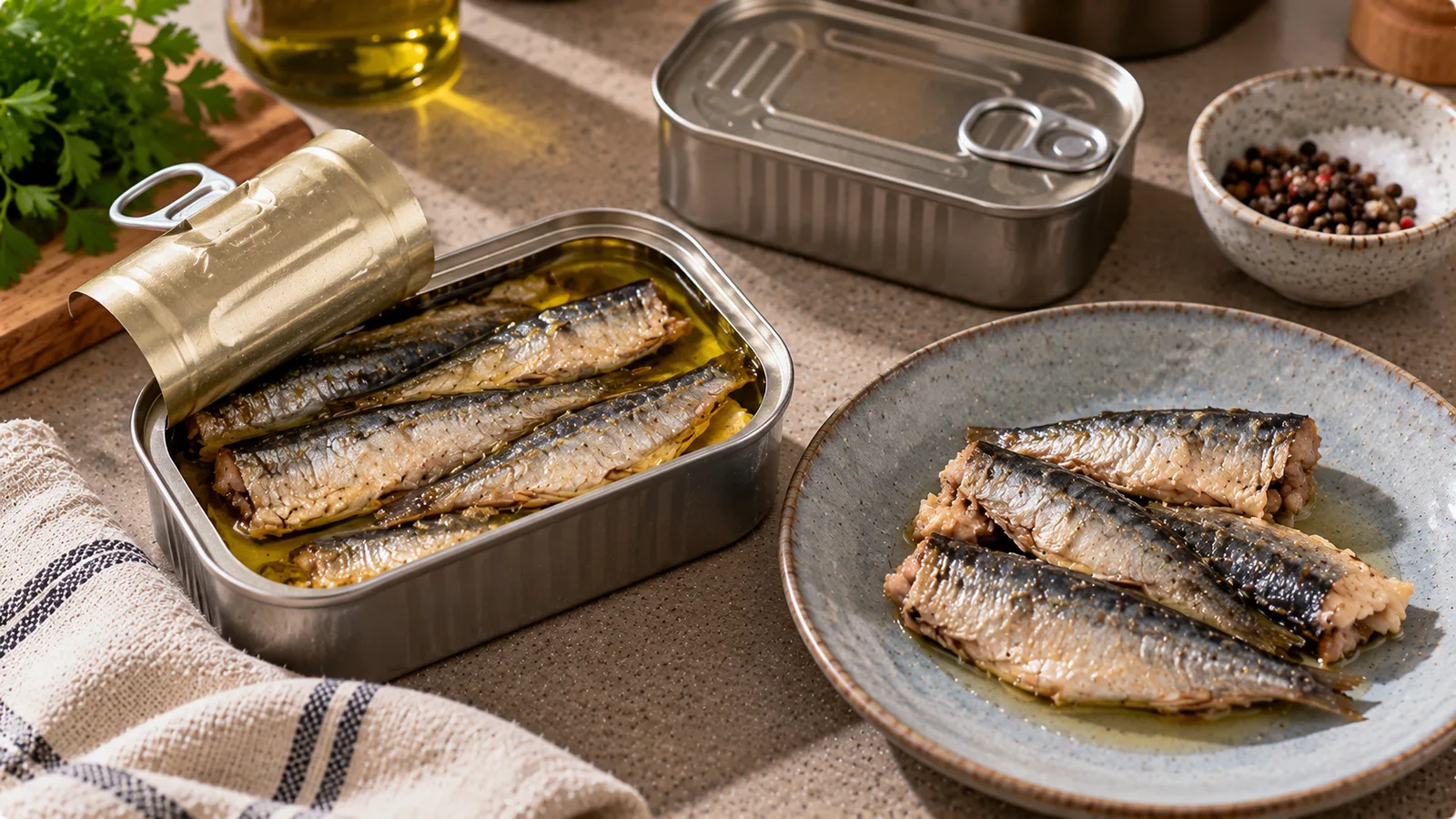
Sardines are small oily fish that provide protein, fat and several important micronutrients. Their calorie content varies considerably depending on whether they are fresh, canned in water, packed in oil or served with sauce.
For nutrition tracking, the most useful number is the calorie content of the edible portion you actually eat.
How many calories are in sardines?
A practical starting point is:
- Fresh raw sardines: approximately 150–210 kcal per 100 g.
- Canned sardines in water or brine: approximately 140–200 kcal per 100 g drained.
- Canned sardines in oil: approximately 190–260 kcal per 100 g drained.
- Grilled sardines without much added oil: approximately 180–240 kcal per 100 g edible cooked fish.
These are broad reference ranges, not guaranteed values for every product.
Species, season, fat content, cooking losses and the amount of oil retained after draining can all change the result.
For a packaged product, the nutrition declaration on the specific can is generally more useful than a generic estimate.
Sardine calories by preparation
| Sardine type | Approximate calories per 100 g |
|---|---|
| Fresh sardines, raw | 150–210 kcal |
| Sardines canned in water or brine, drained | 140–200 kcal |
| Sardines canned in oil, drained | 190–260 kcal |
| Sardines in tomato sauce | 140–220 kcal |
| Grilled sardines, edible cooked portion | 180–240 kcal |
The ranges are illustrative and overlap because products differ.
Do not treat a table value as an exact measurement.
A sardine packed in oil may contain less fat than another oil-packed product if it is drained more thoroughly.
Likewise, tomato sauce may contain added oil or sugar.
Calories in a can of sardines
Cans vary in total weight and drained weight.
That distinction matters.
A can labelled 120 g may contain only 90 g of drained fish.
If the nutrition label lists 210 kcal per 100 g and you eat 90 g:
210 × 90 ÷ 100 = 189 kcal
If you also eat the packing oil, the total may be higher.
Example serving calculations
| Edible amount | At 170 kcal/100 g | At 220 kcal/100 g |
|---|---|---|
| 50 g | 85 kcal | 110 kcal |
| 75 g | 128 kcal | 165 kcal |
| 90 g | 153 kcal | 198 kcal |
| 100 g | 170 kcal | 220 kcal |
| 125 g | 213 kcal | 275 kcal |
| 150 g | 255 kcal | 330 kcal |
| 200 g | 340 kcal | 440 kcal |
These examples show how to calculate portions. They are not values for a particular brand.
Sardines nutrition per 100 g
Sardines are valued for their protein and omega-3 fatty acids.
A representative cooked or canned edible portion may provide approximately:
| Nutrient | Approximate amount per 100 g |
|---|---|
| Calories | 170–230 kcal |
| Protein | 20–25 g |
| Fat | 9–15 g |
| Carbohydrates | Usually 0–2 g |
| Omega-3 fatty acids | Amount varies by species and product |
The exact composition depends on the sardine species and preparation.
For detailed food-specific data, consult USDA FoodData Central.
Protein in sardines
A 100 g edible serving commonly provides around 20–25 g protein.
For example, if a product lists 23 g protein per 100 g, a 90 g portion contains:
23 × 90 ÷ 100 = 20.7 g protein
Protein values should be calculated using the same drained or prepared weight used for calories.
Are sardines high in fat?
Sardines are oily fish, so they naturally contain more fat than many lean white fish.
That does not make them nutritionally undesirable.
Their fat includes marine omega-3 fatty acids, especially EPA and DHA.
The amount varies with species, season and processing.
Oil-packed sardines may contain additional fat from the packing liquid.
When comparing products, check both total fat and calories per 100 g.
Sardines and omega-3 fatty acids
Sardines are among the fish that can contribute EPA and DHA to the diet.
These fatty acids are found naturally in marine foods.
However, the amount in an individual serving cannot be inferred reliably from calories alone.
Two cans with similar calorie values may have different omega-3 contents.
For broader guidance on eating fish, see the FDA and EPA advice about eating fish.
Calcium in canned sardines
Some canned sardines are eaten with their softened bones.
When the bones are included, sardines can provide a meaningful amount of calcium.
Boneless sardines generally contain less calcium.
This is one reason two sardine products can have different mineral profiles despite similar calories.
If calcium is important to your tracking, choose a database entry that matches whether the bones are included.
Vitamin B12 and vitamin D
Sardines can contribute vitamin B12 and vitamin D.
The exact amounts depend on the product and the food composition reference.
Avoid assuming that every sardine product provides identical percentages of daily requirements.
Check the nutrition database or label when you need a specific figure.
Fresh sardines versus canned sardines
Both can be useful foods, but they are not identical for calorie tracking.
Fresh sardines are usually weighed before or after cooking. Whole fish may include the head, bones and other parts that are not eaten.
Canned sardines are typically ready to eat. The relevant weight may be the drained fish rather than the total contents of the can.
When comparing the two, use edible portions and consistent preparation states.
Raw versus cooked weight
Cooking removes water and changes the weight of the fish.
As a result, calories per 100 g cooked fish may be higher than calories per 100 g raw fish, even without adding oil.
This does not mean cooking creates calories.
It means the remaining portion contains less water.
For accurate tracking, do not mix raw weight with cooked nutrition values.
Sardines in oil versus water
Oil-packed sardines are not automatically much higher in calories than water-packed sardines, but they often are.
The difference depends on:
- How much oil remains on the fish.
- Whether the oil is consumed.
- The fat content of the fish itself.
- The brand's stated nutrition values.
- Whether the label refers to drained or undrained contents.
Example: oil makes a difference
Suppose you eat 100 g sardines containing 190 kcal.
If you also consume 10 g olive oil from the can, that adds approximately 90 kcal.
The meal would then contain approximately:
190 + 90 = 280 kcal
This is an illustration, not a universal estimate of oil remaining in a can.
If you drain the oil, do not automatically count the entire packing liquid as consumed.
Sardines in tomato sauce
Sardines in tomato sauce can be a convenient alternative.
Their calorie content depends on the amount and composition of the sauce.
A tomato-based sauce without much oil may add relatively little energy.
A sauce containing substantial oil or sugar can change the result.
Use the label for the product as sold and record the amount you actually eat.
How many sardines make one serving?
There is no single universal serving size.
Practical portions might include:
- 75–100 g drained canned sardines for a sandwich or snack.
- 100–150 g edible sardines for a main meal.
- 150–200 g edible fish for a larger protein-focused meal.
The appropriate amount depends on your overall meal, appetite and dietary needs.
A whole fresh sardine includes parts that may not be eaten, so the purchase weight can be greater than the edible weight.
Are sardines good for weight loss?
Sardines can fit into a calorie-controlled eating pattern.
They provide protein and fat, which can help make a meal substantial.
However, sardines are not a weight-loss food by themselves.
Weight change depends on overall energy intake and expenditure over time.
A meal with sardines, vegetables and a moderate portion of bread or potatoes can be easier to track than one with large amounts of unmeasured oil or sauce.
The useful strategy is to measure the actual portion and account for additions.
Are sardines suitable for a high-protein diet?
Yes, sardines can be a convenient protein source.
A typical 100 g portion often contains approximately 20–25 g protein.
For comparison, a 150 g portion at 23 g protein per 100 g provides:
23 × 1.5 = 34.5 g protein
The meal's total protein will also depend on side dishes.
If you need a precise intake, use the values for the specific product.
What about mercury?
Fish species differ in mercury exposure.
Sardines are generally classified among lower-mercury fish choices in FDA and EPA consumer advice.
That does not mean every fish should be eaten without limits.
Pregnant people, children and others following specific fish-consumption advice should use current guidance relevant to their situation.
See the FDA/EPA fish advice.
Sodium in canned sardines
Canned sardines may contain added salt.
The sodium content varies by brand, brine and sauce.
If you monitor sodium or salt intake, compare labels rather than assuming all canned sardines are equivalent.
In EU nutrition labelling, salt is generally displayed directly.
In databases listing sodium, an approximate conversion is:
Salt (g) = sodium (g) × 2.5
For example, 400 mg sodium is 0.4 g sodium, equivalent to approximately 1.0 g salt.
How to log sardines in a nutrition app
For accurate calorie and macro tracking:
- Identify whether the sardines are fresh, canned in water, oil or sauce.
- Check whether the database values refer to raw, cooked or drained fish.
- Weigh the edible amount.
- Use the product label when available.
- Add any oil, bread, mayonnaise or other ingredients eaten with the fish.
- Save the correct product as a favourite if you use it frequently.
Example: sardines on toast
Suppose your meal contains:
| Ingredient | Example calories |
|---|---|
| 90 g drained sardines at 210 kcal/100 g | 189 kcal |
| 80 g wholegrain bread at 250 kcal/100 g | 200 kcal |
| 100 g tomatoes at 20 kcal/100 g | 20 kcal |
| 5 g olive oil | 45 kcal |
| Total | 454 kcal |
These are example inputs for demonstrating the calculation, not guaranteed nutrition values.
Actual calories depend on the products and quantities used.
Common tracking mistakes
Counting the entire can as fish
The total can weight may include oil, brine or sauce.
Use the correct nutrition reference and the actual edible quantity.
Selecting a water-packed entry for oil-packed sardines
This can underestimate calories if the products have different fat contents.
Logging raw sardines using cooked values
Water loss changes calorie density per 100 g.
Forgetting bread, oil or sauces
These additions can contribute a substantial part of the meal's energy.
Treating every sardine product as identical
Species, brand, packing medium and preparation can all affect nutrition values.
Sources
- USDA FoodData Central — food composition data for sardines and other fish.
- FDA and EPA: Advice About Eating Fish — fish choices and mercury guidance.
- European Commission: Food Information to Consumers Legislation — EU nutrition labelling framework.
Summary
Sardines typically provide approximately 150–260 kcal per 100 g, depending on preparation and packing medium.
They are a source of protein and marine omega-3 fats, and canned sardines eaten with their bones may also contribute calcium.
For the most accurate result, use the nutrition values for your specific product, check the drained or edible weight and include any oil or sauce you consume.