
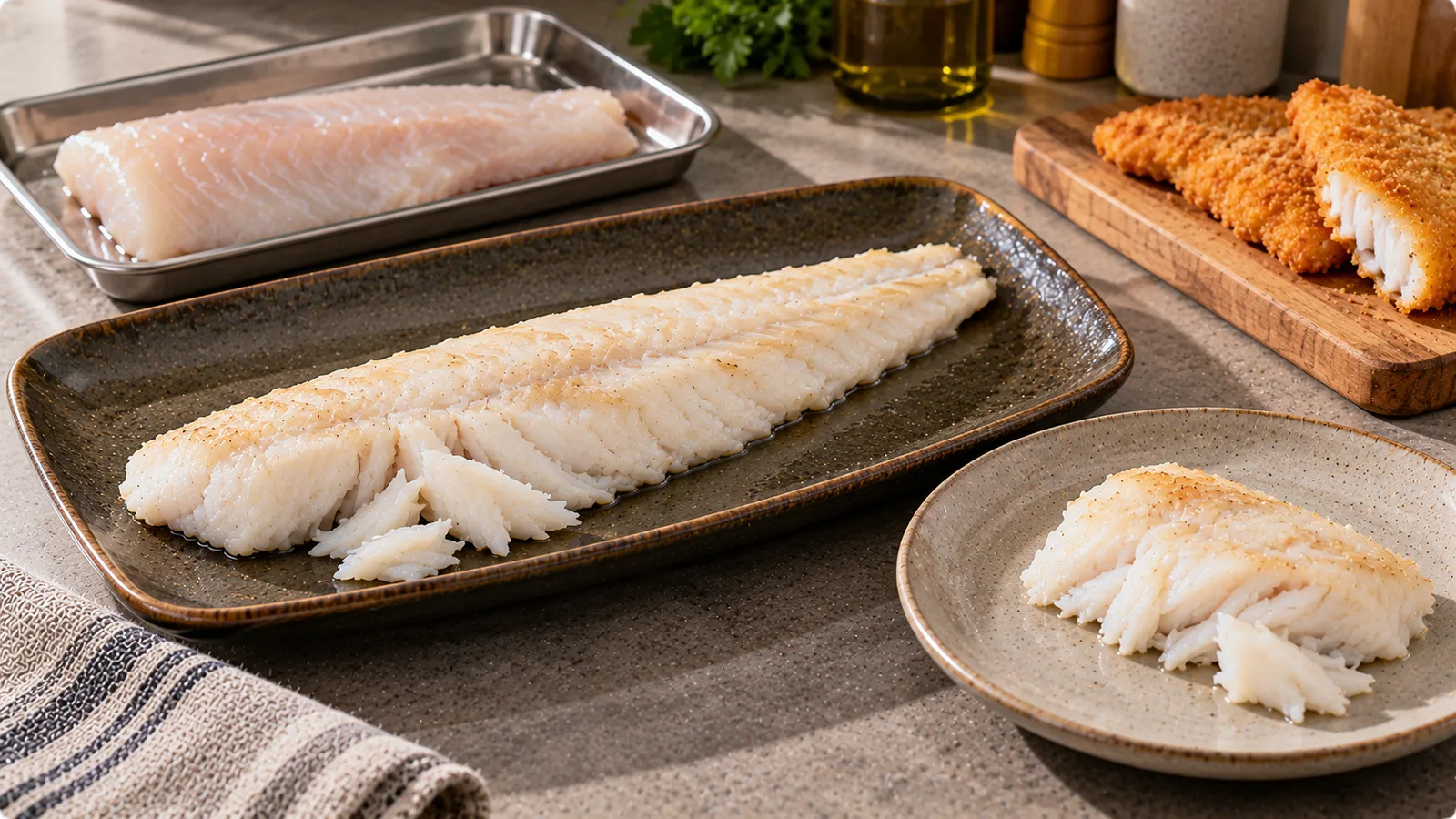
Pollock is a lean white fish that provides substantial protein without much fat. It is commonly sold as frozen fillets, fresh fish, breaded portions and processed fish products.
If you are tracking calories, the most important distinction is between plain pollock and a prepared product containing breading, oil or sauce.
A plain fillet is relatively low in calories. The same fish served as a breaded, fried portion can have a very different nutritional profile.
How many calories are in pollock?
For plain Alaska pollock, a practical reference is approximately 80–95 kcal per 100 g of raw edible fish.
Cooked pollock often contains more calories per 100 g because water is lost during cooking, making the remaining nutrients more concentrated.
The following figures are indicative ranges rather than exact values for every species and product.
| Pollock preparation | Calories per 100 g | Protein per 100 g |
|---|---|---|
| Raw Alaska pollock | Approximately 80–95 kcal | Approximately 17–20 g |
| Cooked plain pollock | Approximately 95–120 kcal | Approximately 20–25 g |
| Breaded pollock fillet | Often 170–250 kcal | Varies by product |
| Fried pollock with added oil | Depends on oil absorbed | Depends on preparation |
For an accurate calculation, use the nutrition information for the particular fish or packaged product you are eating.
These estimates are intended as a starting point, not a replacement for a food label.
Pollock calories by serving size
A typical serving can be anywhere from 100 g to 200 g or more, depending on the meal.
Using an illustrative value of 85 kcal per 100 g of raw Alaska pollock:
| Raw edible portion | Estimated calories |
|---|---|
| 75 g | 64 kcal |
| 100 g | 85 kcal |
| 125 g | 106 kcal |
| 150 g | 128 kcal |
| 175 g | 149 kcal |
| 200 g | 170 kcal |
| 250 g | 213 kcal |
These figures apply to the fish itself, before adding oil, flour, breadcrumbs, butter or sauce.
If the fish is weighed after cooking, use an appropriate cooked-food entry rather than automatically applying raw values to the cooked weight.
Example: a 150 g raw fillet
A plain 150 g fillet containing approximately 85 kcal per 100 g provides around 128 kcal before cooking.
If you bake it without added fat, the total calories in that piece of fish remain broadly similar, although the final weight may decrease as water evaporates.
If you add 10 g of olive oil and consume all of it, that adds approximately 90 kcal.
The meal component would then contain roughly 218 kcal before including any sides.
Nutritional values of pollock
Pollock is valued mainly for its protein content and low fat content.
A representative nutritional profile for 100 g of raw Alaska pollock is:
| Nutrient | Approximate amount |
|---|---|
| Energy | 80–95 kcal |
| Protein | 17–20 g |
| Total fat | 0.5–1.5 g |
| Carbohydrates | 0 g |
| Fibre | 0 g |
Actual figures depend on the species, catch, processing, moisture content and database entry.
Pollock also provides several micronutrients, including vitamin B12, selenium and phosphorus.
The exact quantities vary, so use a recognised food-composition database or product information when precise micronutrient tracking is important.
Is pollock high in protein?
Yes, pollock is a protein-rich food relative to its calorie content.
For example, a 150 g raw portion containing 18 g of protein per 100 g would provide approximately 27 g of protein.
A 200 g portion at the same protein density would provide approximately 36 g.
These are useful planning estimates, not guarantees for every fillet.
Is pollock low in fat?
Plain pollock is generally a lean fish.
It contains much less fat than oily fish such as salmon or mackerel.
However, that does not mean all pollock dishes are low in fat.
Breading, deep-frying, butter and creamy sauces can substantially increase the total fat and calorie content.
Alaska pollock and Atlantic pollock are not identical
The name pollock can refer to different fish species.
Alaska pollock is widely used in frozen fillets and processed seafood products.
Atlantic pollock, sometimes called pollack, is another species with a different nutritional profile.
Even when two products are both labelled pollock, their calorie and protein values may not be identical.
When tracking nutrition, check:
- The species named on the packaging, if available.
- Whether the product is raw or cooked.
- Whether the nutrition values refer to the edible portion.
- Whether ingredients such as oil or breadcrumbs have been added.
Do not assume that one generic database entry describes every product sold as pollock.
Raw versus cooked pollock calories
Cooking changes the amount of water in fish.
This can make calorie comparisons confusing.
Imagine a raw fillet weighing 200 g.
After baking, it might weigh less because moisture has evaporated.
The fish has not gained calories merely because its cooked weight is lower.
Instead, the calories are distributed across fewer grams.
Example of water loss
Suppose a 200 g raw fillet contains approximately 170 kcal.
If it weighs 160 g after cooking without added fat, the same approximately 170 kcal are now present in 160 g of cooked fish.
That corresponds to approximately 106 kcal per 100 g cooked.
This is an illustration. Actual cooking losses vary with temperature, time and preparation.
How to log pollock accurately
If you weigh the fish raw, select a raw pollock entry.
If you weigh it after cooking, select an appropriate cooked pollock entry.
Avoid weighing cooked fish and entering it as raw without accounting for the difference in water content.
This is particularly important when comparing several meals over time.
How cooking methods affect calories
Plain pollock can be prepared in several ways.
The fish itself remains lean, but additional ingredients may change the final energy content.
| Cooking method | Main calorie consideration |
|---|---|
| Steaming | Usually little or no added fat |
| Poaching | Calories depend on the liquid and additions |
| Baking | Added oil, butter or sauce matters |
| Air-frying | Breading and oil still contribute calories |
| Pan-frying | Some cooking fat may be absorbed |
| Deep-frying | Breading and absorbed oil can increase calories substantially |
Cooking method alone does not determine the final calories.
A baked fillet covered in butter may contain more calories than a lightly pan-cooked fillet prepared with minimal oil.
Baked pollock
For a simple preparation, place the fillet in a baking dish with lemon, pepper and herbs.
If no caloric ingredients are added, the total energy of the edible fish changes little.
The weight may still decrease through moisture loss.
Pan-fried pollock
If you use 10 g of oil, that oil contains approximately 90 kcal.
Not all of it necessarily ends up in the portion you eat.
For precise tracking, consider how much remains in the pan and how the food was prepared.
When uncertain, record a reasonable estimate rather than assuming no oil was consumed.
Breaded pollock
Breadcrumbs, flour, batter and oil can increase energy density.
A breaded pollock product may contain considerably more calories per 100 g than plain fish.
Its exact values depend on the fish percentage, coating, fat content and cooking instructions.
Use the package label whenever possible.
Is frozen pollock different from fresh pollock?
Plain frozen pollock can have a nutritional profile similar to fresh pollock.
Freezing itself does not add calories.
However, some frozen products contain glazing, added water, salt or other ingredients.
A product's declared net weight may include an ice glaze, depending on the labelling and market rules.
When comparing portions, use the edible fish weight and follow the product's stated nutritional basis.
Frozen breaded fillets and fish fingers are separate products with different ingredient lists.
They should not be logged as plain pollock.
Pollock versus other common fish
The following comparisons describe broad nutritional characteristics of plain fish.
| Fish | General nutritional characteristic |
|---|---|
| Pollock | Lean, protein-rich white fish |
| Cod | Lean white fish with substantial protein |
| Haddock | Lean white fish with a similar culinary role |
| Salmon | Typically higher in fat and calories |
| Mackerel | Oily fish with a substantially higher fat content |
| Tuna in water | Protein-rich, with values depending on species and product |
The exact calorie ranking depends on species, preparation and whether values refer to raw or cooked fish.
For a meaningful comparison, use the same measurement basis: for example, 100 g of raw edible fish without added ingredients.
What makes a pollock meal higher in calories?
Pollock is often served with potatoes, rice, pasta, vegetables or sauces.
The complete meal can contain much more energy than the fish alone.
Consider this illustrative plate:
| Component | Quantity | Estimated calories |
|---|---|---|
| Raw pollock fillet | 180 g | 153 kcal |
| Boiled potatoes | 250 g | 190 kcal |
| Steamed vegetables | 200 g | 70 kcal |
| Olive oil | 10 g | 90 kcal |
| Total | — | Approximately 503 kcal |
The estimates depend on the ingredients and preparation.
A similar plate with a creamy sauce, butter or breaded fish could contain more calories.
If you are logging a meal, record the side dishes and cooking fats rather than counting only the fish.
Can pollock fit into a weight-loss diet?
Pollock can be useful in a calorie-controlled eating pattern because it provides protein with relatively little fat.
Protein can help support satiety, and including a variety of protein sources can make meal planning easier.
However, no single food causes weight loss.
Long-term weight change depends on overall energy intake, expenditure and other individual factors.
A balanced pollock meal might include:
- A portion of plain fish.
- Potatoes, rice or another carbohydrate source.
- Vegetables.
- An appropriate amount of oil or another fat source.
There is no need to avoid carbohydrates simply because the fish itself contains almost none.
The useful approach is to consider the whole meal and its role in your daily eating pattern.
Pollock and omega-3 fats
Pollock contains some omega-3 fatty acids, but it is generally much leaner than oily fish.
It should not automatically be treated as nutritionally equivalent to salmon, sardines or mackerel for omega-3 intake.
If omega-3 intake is a particular dietary priority, consider the wider variety of fish and other foods in your diet.
The specific amounts depend on species and composition data.
Mercury and fish-consumption advice
Pollock is commonly included among lower-mercury fish choices in official US consumer guidance.
Nevertheless, fish-consumption recommendations vary by species and population.
Pregnant people, those planning pregnancy, breastfeeding people and children should follow relevant national advice on fish selection and portions.
The FDA and EPA advice about eating fish provides species-specific guidance.
Pollock is also a fish allergen and is unsuitable for people with a relevant fish allergy.
How much pollock should you serve?
There is no single correct portion for everyone.
A smaller portion may work when fish is part of a meal with beans, dairy or another protein source.
A larger portion may be appropriate when pollock is the main protein source.
As practical examples:
- 100 g raw pollock: approximately 85 kcal and 18 g protein.
- 150 g raw pollock: approximately 128 kcal and 27 g protein.
- 200 g raw pollock: approximately 170 kcal and 36 g protein.
These examples use 85 kcal and 18 g protein per 100 g.
Your actual product may differ.
Common tracking mistakes
Using breaded fish values for plain fish
Breaded fillets include ingredients that plain fish does not.
Choose the correct product entry.
Confusing raw and cooked weights
Water loss changes the energy density per 100 g.
Match the food entry to the state in which you weighed the fish.
Ignoring cooking oil
A tablespoon-sized amount of oil can add a meaningful number of calories.
Record cooking fats when they are consumed.
Counting frozen glaze as edible fish
Ice coating can affect the weight of a frozen product.
Check the package information and use the appropriate edible portion.
Treating every pollock species as identical
Species and processing differences affect nutritional values.
Use a product-specific label when available.
A practical way to record pollock in a food diary
For the most consistent results:
- Identify whether the product is plain, seasoned, breaded or prepared.
- Check whether the label describes raw, frozen or cooked food.
- Weigh the edible portion.
- Select a matching food entry.
- Record oil, sauces, breading and side dishes separately when appropriate.
- Use the same method consistently across meals.
If you cook several fillets together, you can weigh the raw fish and calculate the total recipe before dividing it into servings.
This is often more reliable than estimating the weight of an individual cooked piece.