
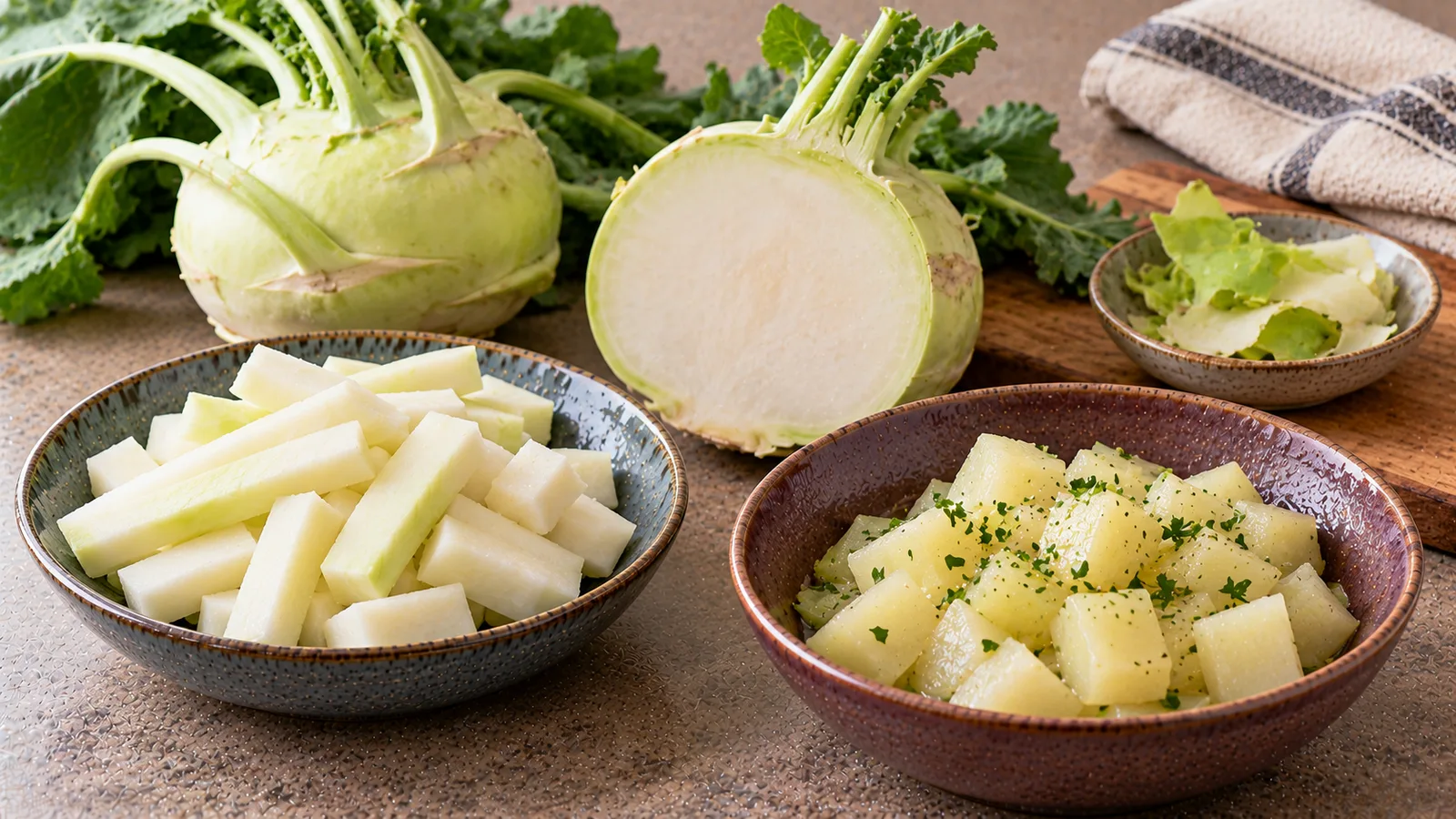
Kohlrabi is the swollen stem of a cabbage-family plant. Its crisp, pale flesh can be eaten raw, steamed or boiled. If you want to estimate calories, first separate the weight you bought from the amount you actually ate. The USDA records are for the edible vegetable, not for a whole bulb with discarded tough skin and stems. This guide uses two precisely identified USDA SR Legacy entries and shows how to turn them into realistic portions.
How many calories are in kohlrabi?
The USDA SR Legacy entry Kohlrabi, raw (FDC 168424) reports 27 kcal per 100 g. The separate entry Kohlrabi, cooked, boiled, drained, without salt (FDC 168425) reports 29 kcal per 100 g. These are reference averages, not nutrition claims for every farm, batch or cooking method. Keep the preparation state attached to each number. Kohlrabi is not celeriac, turnip, regular cabbage or celery stalk; a similarly named vegetable may have quite different values.
Portion calculator: raw and cooked
A kitchen scale is more reliable than describing the vegetable as small or large. For a plain 150 g portion, multiply 27 or 29 by 1.5: 40.5 kcal, approximately 41 kcal raw, and 43.5 kcal, approximately 44 kcal boiled and drained. A 200 g serving corresponds to 54 kcal raw or 58 kcal boiled. These numbers exclude butter, oil, creamy sauces, breadcrumbs and other additions. Use the raw reference when you weighed the edible vegetable raw, or the cooked reference when weighing a plainly boiled, drained portion.
| Edible portion | Raw (27 kcal/100 g) | Boiled and drained (29 kcal/100 g) |
|---|---|---|
| 100 g | 27 kcal | 29 kcal |
| 150 g | 40.5 kcal | 43.5 kcal |
| 200 g | 54 kcal | 58 kcal |
| 400 g | 108 kcal | 116 kcal |
Nutrition beyond calories
Per 100 g raw, the USDA profile lists approximately 1.7 g protein, 0.1 g fat, 6.2 g carbohydrate and 3.6 g fibre. The boiled, drained record lists about 1.8 g protein, 0.11 g fat, 6.69 g carbohydrate and 1.1 g fibre. The two records are separate reference samples, so do not read the fibre difference as a guaranteed loss from boiling the same kohlrabi. Fibre measurement and preparation details matter. The raw record also lists about 350 mg potassium per 100 g. This food contributes vegetables and texture rather than large quantities of protein or fat.
Whole bulb versus edible weight
The trimmed bulb is not the same as its shop weight. Remove leaves if they are not used, trim woody stem ends and peel thick, fibrous skin if needed. Imagine a bulb weighing 500 g before trimming and 400 g after: its edible yield is 80%, and the peel and trimmings account for 100 g. If all 400 g are eaten raw, the ingredient contributes 108 kcal. The 80% is a worked assumption, not a universal yield factor. Small tender kohlrabi may need little trimming; large woody bulbs can produce more waste. Weigh the result whenever possible.
Two worked examples
Example A, crunchy raw salad: use 180 g peeled raw kohlrabi. At 27 kcal per 100 g, that is 48.6 kcal, about 49 kcal before the dressing. Add 10 g oil and, using the USDA oil reference of about 884 kcal per 100 g, the oil supplies roughly 88 kcal; together they are about 137 kcal, excluding any additional ingredients. Example B, a plain cooked side: weigh 160 g kohlrabi after boiling and draining. At 29 kcal per 100 g, that is 46.4 kcal, about 46 kcal before seasoning. You must not automatically add oil where none was used.
Does cooking change the calorie count?
A difference between 27 and 29 kcal per 100 g does not show that cooking creates calories. Heating changes moisture, mass and sometimes nutrient retention; comparing two foods on an equal-weight basis is not the same as following one bulb through a pot. If you weighed 300 g raw, then cooked that exact batch with only water, it does not become a different total-calorie food just because its final weight changes. To calculate the cooked serving from a batch, track the original edible raw mass and the final edible portions, together with any added ingredients. If you use the separate USDA cooked entry, label the number as an estimate from that preparation, not a physical energy-balance experiment.
For a broader explanation of weighing food, see how to track raw versus cooked food weight · calories in cauliflower.
Choosing, peeling and cooking
Choose firm, undamaged bulbs. The University of Alaska Cooperative Extension advises that smaller bulbs are generally tender, whereas larger ones may be woody and benefit from peeling. Germany's Federal Centre for Nutrition (BZfE) explains that kohlrabi can be eaten raw in sticks, simmered in broth or cooked in soups; tender leaves are also edible. Wash the bulb before cutting, remove tough parts and slice evenly for consistent cooking. The stem swelling, not an underground root, is the part normally eaten. Store the bulb chilled and follow freshness rather than relying on a single calendar duration.
Oil, sauces and mixed dishes
Kohlrabi alone has little fat. If sautéed with oil, count the oil separately: 5 g oil add about 44 kcal, while 10 g add about 88 kcal. A rich cheese sauce or butter changes the plate more than the small raw-versus-boiled difference. For a casserole or soup, multiply each ingredient's nutrition per 100 g by its used weight, add all ingredients, and divide by the actual number or weight of servings. If a packaged dish provides a trustworthy label for the exact prepared product, prefer that label to the plain-vegetable value.
Tracking kohlrabi accurately
To log a meal accurately: weigh the edible kohlrabi, choose the raw or boiled USDA entry that matches the weighing state, note drained water when relevant, add oils and sauces, then divide shared dishes by measured portions. If you only know the original whole-bulb weight, state the estimated peeling yield. For example 600 g bought × 80% assumed yield = 480 g edible, and 480 × 27 / 100 = about 130 kcal raw. This estimate improves considerably once you actually weigh the peel. There is no need to invent precision to the decimal for an irregular vegetable.