
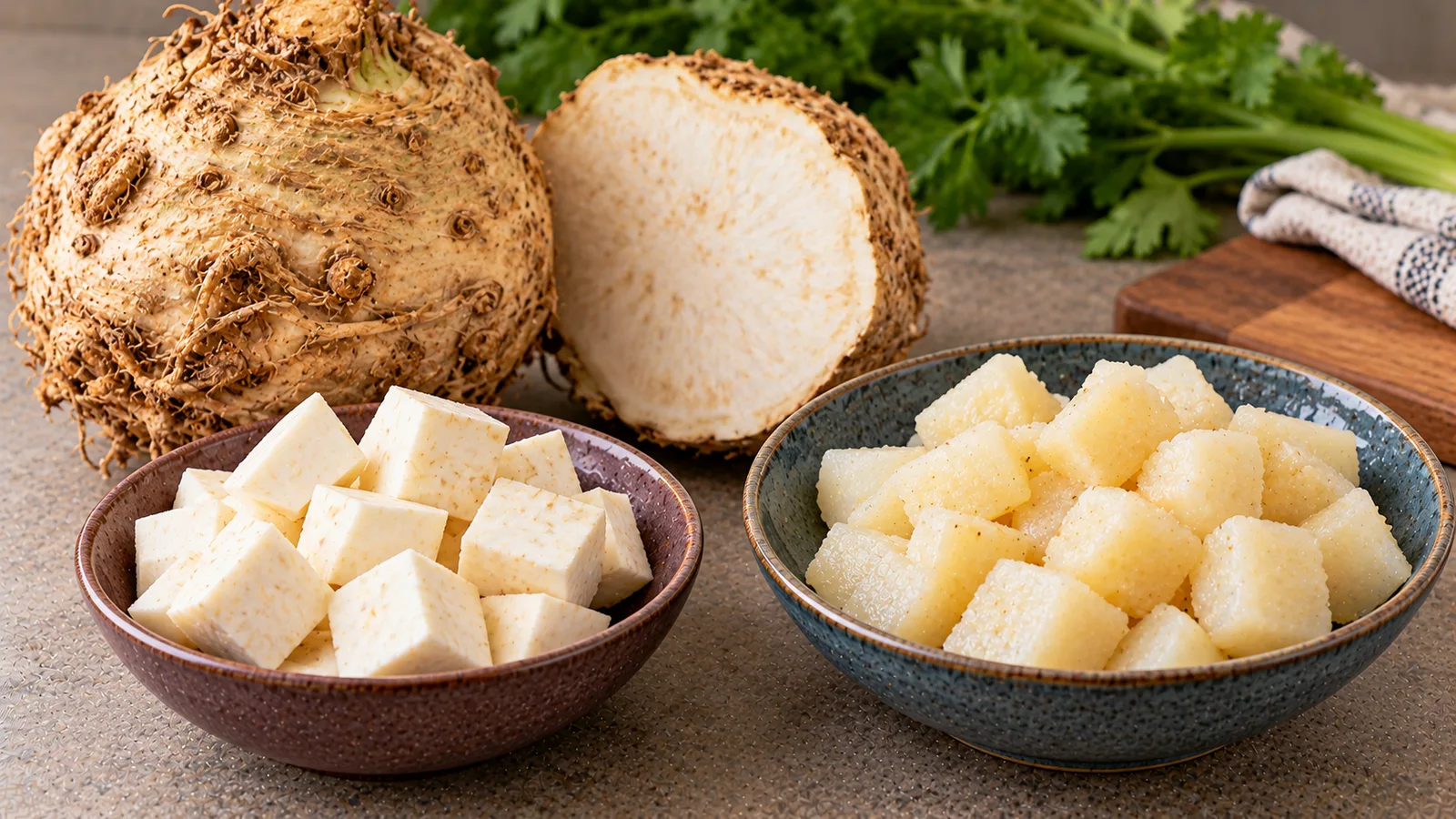
Celeriac calories: the direct answer
Celeriac (celery root) provides about 42 kcal per 100 g raw edible portion in USDA SR Legacy data. The separate entry for boiled, drained celeriac without salt lists 27 kcal per 100 g. Both numbers describe the food itself, not a creamy mash, a buttery purée or a roasted tray with oil. Celeriac is the knobbly root vegetable sold as celery root, Knollensellerie or céleri-rave; it is not the green celery stalk. That distinction matters because nutrition databases have separate entries for the two foods.
The most useful number is often not calories per whole root but calories per weighed, edible portion. Dirt, woody skin and tough root ends can add substantially to the weight you paid for, yet do not belong in the edible calculation.
Reference values: raw versus boiled
| State, edible portion | 100 g | 150 g | 200 g |
|---|---|---|---|
| Celeriac, raw | 42 kcal | 63 kcal | 84 kcal |
| Celeriac, boiled and drained, no salt | 27 kcal | 41 kcal | 54 kcal |
The table multiplies each USDA reference by the weight in that same state; 150 g cooked is not automatically the yield from 150 g raw. Round final portions to the nearest whole kcal. Boiling and draining do not make all celeriac dishes contain precisely 27 kcal per 100 g: cooking time, water exchange and recipe ingredients change the result. These are reference entries, not before-and-after measurements of one identical root.
What is included in the raw nutrition entry?
For 100 g of edible raw celeriac, USDA SR Legacy reports 42 kcal, 9.2 g carbohydrate, 1.5 g protein, 0.3 g fat and 1.8 g fibre. The US carbohydrate-by-difference field can include fibre; a European package may present digestible carbohydrate and fibre separately. Do not add both figures together as if they were identical definitions. The boiled, drained, unsalted entry lists 27 kcal, 5.9 g carbohydrate, about 1.0 g protein and 1.2 g fibre per 100 g. These are typical database estimates and should not be treated as laboratory measurements of your own meal.
The cooking entry also reports 61 mg sodium per 100 g, compared with 100 mg for the raw entry. That difference should not be interpreted as a guaranteed sodium reduction in each pot. Salting the cooking water, adding broth or buying a seasoned prepared product changes the sodium of the finished dish.
Edible yield: count what remains after peeling
A kitchen scale can turn a rough assumption into a useful calculation. Weigh the whole celeriac first. Cut away the soil-covered exterior, root hairs and any damaged or very fibrous areas, then weigh the cleaned edible flesh. Divide the clean weight by the purchased weight for your personal yield. There is no universal peeling-loss percentage: a knobbly, small root and a large smooth root can give very different results.
Worked example, not a standard yield: one purchased root weighs 800 g. After peeling and trimming, the discard is 160 g and the edible raw flesh weighs 640 g. The yield is 640 ÷ 800 × 100 = 80%. At 42 kcal per 100 g, that clean raw amount represents approximately 269 kcal before oil, sauce or other additions. Four equal raw portions of 160 g represent about 67 kcal each. If your own loss is 10% or 30%, replace the sample numbers with your measured values rather than copying 80%.
For context, see how to track raw and cooked food weights · an example of edible-yield calculations.
How many calories in a realistic side portion?
For a raw salad, 125 g of cleaned celeriac is roughly 53 kcal using the raw reference. For a plain boiled side, 150 g weighed after boiling and draining is roughly 41 kcal using the cooked reference. A cooked 200 g serving is about 54 kcal. These portions are examples, not serving-size rules, and they exclude dressing. A spoon of mayonnaise or a generous amount of oil may contribute more energy than the root itself.
When a recipe says 'one celeriac', it has not defined an edible weight. If you need reliable calories or food costs, convert that instruction into cleaned grams. For a shared meal, weigh the final plain batch and divide it by the actual number of servings instead of assuming every bowl weighs the same.
Why can cooked celeriac show fewer calories per 100 g?
The raw and boiled USDA entries use different food conditions and analytical profiles. Cooking can move water and soluble material into or out of food; draining removes liquid, while purée may keep cooking water or add other ingredients. The 27 versus 42 difference is therefore a comparison of reference foods, not proof that an individual root loses 36% of its calories merely by boiling. It would be misleading to multiply the raw batch by 42, multiply its cooked weight by 27, and call the difference an exact measured energy loss.
Use the record that matches how the food was weighed. If you logged clean raw ingredients before cooking, keep your recipe ledger on the raw basis and add all fats or sauces. If you weigh an already cooked, plain portion, the cooked reference is more relevant. Use one consistent method for the whole dish.
Roasted cubes, soup and mashed celeriac
Celeriac can be roasted, pan-fried, blended into soup or mashed with potatoes. None of those preparations is identical to 'boiled, drained, without salt'. For roasting, document the raw edible weight and add the oil actually used; moisture loss can raise energy per 100 g of the finished roasted pieces even though water itself has no calories. 5 g of oil contributes approximately 45 kcal and 10 g contributes approximately 90 kcal, using the usual 9 kcal per gram of fat as an estimate.
In soup, broth increases total weight and can lower energy per 100 g, while cream, butter and cheese increase the total energy. For a mash, record each ingredient once, then divide total recipe calories by the number of weighed servings. A ready-made product should be taken from its own label where available.
A four-step method for accurate logging
First, choose the exact product: celeriac root, not celery stalk. Second, weigh only edible flesh after peeling or weigh the boiled portion after draining. Third, select the corresponding raw or cooked nutrition entry rather than mixing both. Fourth, add oils, sauces, cream and other ingredients separately. This procedure is more reproducible than choosing a generic bowl size or estimating calories from a photograph alone.
To estimate shopping yield, keep both purchased weight and edible weight in your notes. To estimate a soup or mash, record the final total weight before serving. A small amount of precision in these two steps usually matters more than debating a one-kilocalorie rounding difference.
Storage, identification and allergen note
Choose a firm root without major soft spots. Wash off dirt and remove damaged areas before cutting; follow suitable refrigeration and storage guidance for prepared vegetables. Celeriac and stalk celery are botanically related but culinary nutrition entries and recipes should not be swapped without checking. In the European Union, celery and its products are among the allergens that must be declared when present as ingredients. People with celery allergy should not assume celeriac is a safe alternative merely because it is a different edible part.
Sources
- USDA SR Legacy raw celeriac, FDC 170400, nutrient record.
- USDA SR Legacy boiled and drained celeriac without salt, FDC 169987, nutrient record.
- European Commission: food allergens and celery declaration.
All values are approximate reference figures per 100 g edible portion. The 800 g root and trimming quantities are clearly identified worked examples, not measured population averages.