
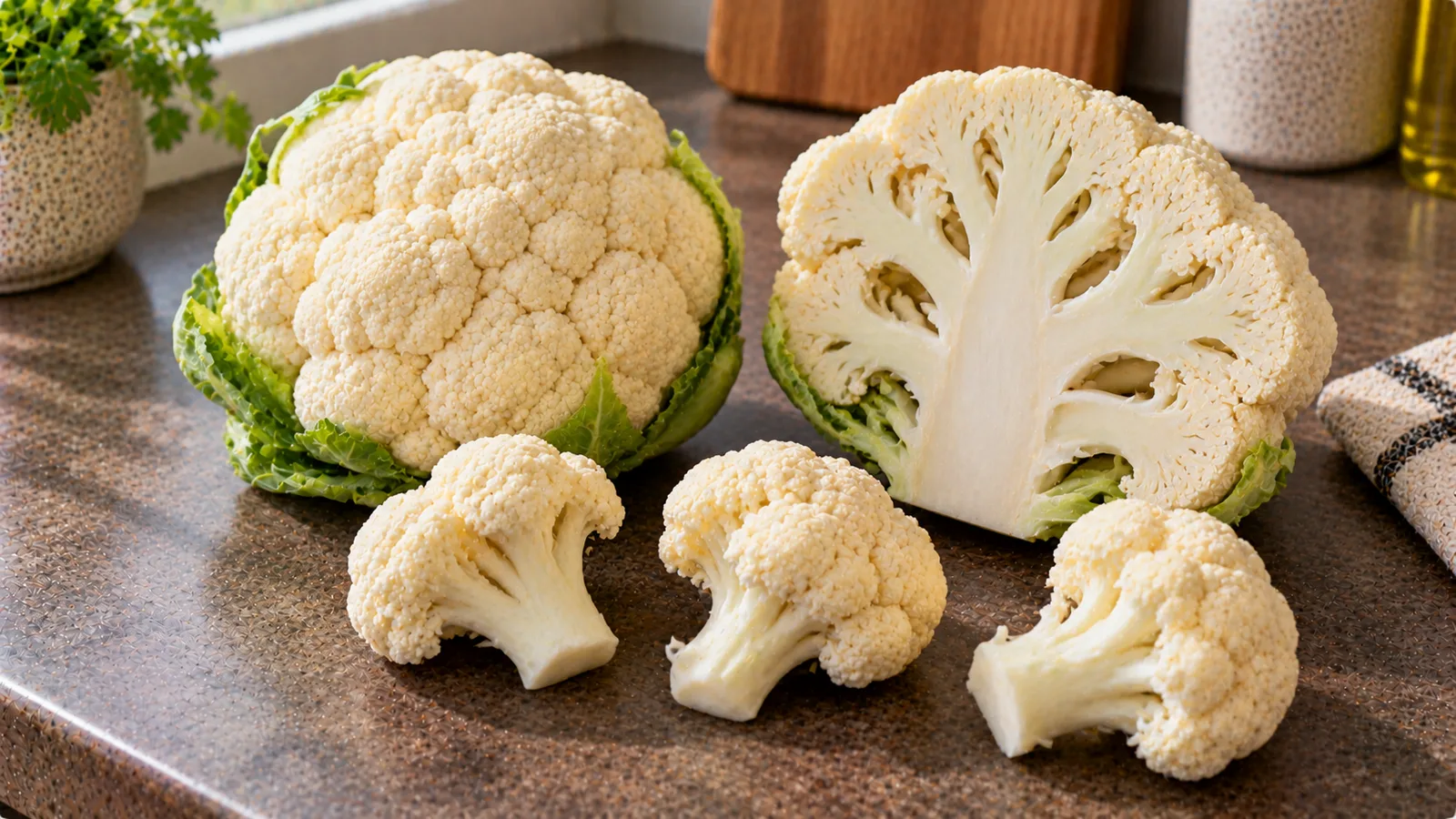
Cauliflower is a versatile vegetable used in salads, soups, roasted dishes, curries, cauliflower rice and vegetable side dishes. It has a relatively low energy density, but the calories in a finished cauliflower dish can differ greatly from those in the vegetable itself.
Raw cauliflower contains approximately 25 kcal per 100 g, using a commonly cited USDA food composition reference.
That means a 200 g edible portion provides about 50 kcal before adding oil, butter, cream, cheese or other ingredients.
The important distinction is between the weight of the plain vegetable and the ingredients used to prepare it.
Cauliflower calories by weight
The following estimates use 25 kcal per 100 g of raw cauliflower.
| Raw cauliflower, edible weight | Approximate calories |
|---|---|
| 50 g | 13 kcal |
| 75 g | 19 kcal |
| 100 g | 25 kcal |
| 150 g | 38 kcal |
| 200 g | 50 kcal |
| 250 g | 63 kcal |
| 300 g | 75 kcal |
| 400 g | 100 kcal |
| 500 g | 125 kcal |
The numbers are rounded and refer to the edible vegetable, not a complete prepared recipe.
To calculate another portion:
Calories = edible weight in grams × 25 ÷ 100
For example, 350 g of raw cauliflower provides approximately 88 kcal.
These figures are reference estimates rather than laboratory measurements of a particular cauliflower.
Source: USDA FoodData Central.
Cauliflower nutrition per 100 g
A commonly used USDA reference for raw cauliflower provides approximately:
| Nutrient | Per 100 g raw cauliflower |
|---|---|
| Energy | 25 kcal |
| Protein | 1.92 g |
| Total fat | 0.28 g |
| Total carbohydrate, US definition | 4.97 g |
| Dietary fiber | 2.0 g |
| Total sugars | 1.91 g |
| Water | 92.1 g |
| Potassium | 299 mg |
| Vitamin C | 48.2 mg |
| Folate | 57 µg |
Composition varies with cultivar, maturity, storage and analytical method.
The table describes raw cauliflower. Cooking can change its water content and the concentration or retention of some nutrients.
Understanding carbohydrate values
The USDA total carbohydrate figure generally includes dietary fiber. European nutrition labels report available carbohydrate separately from fiber.
A simplified calculation using the reference figures is:
4.97 g total carbohydrate − 2.0 g fiber = approximately 3.0 g available carbohydrate per 100 g.
This is an illustrative comparison between labeling systems, not a guaranteed analytical conversion.
When using a nutrition tracker, check whether carbohydrate values include fiber to avoid counting it twice.
References: USDA FoodData Central and Regulation (EU) No 1169/2011.
How many calories are in one cup of cauliflower?
Cup measurements are less precise than weighing because chopped pieces, florets and cauliflower rice occupy different amounts of space.
A commonly used reference for one cup of chopped raw cauliflower is approximately 107 g, or about 27 kcal.
| Example portion | Approximate edible weight | Calories |
|---|---|---|
| Half cup chopped raw | 54 g | 13 kcal |
| One cup chopped raw | 107 g | 27 kcal |
| Two cups chopped raw | 214 g | 54 kcal |
| One weighed portion | 200 g | 50 kcal |
These cup weights are reference approximations. They should not be applied automatically to tightly packed cauliflower rice or cooked florets.
For consistent food logging, a kitchen scale is more reliable.
Calories in a whole cauliflower
A whole cauliflower includes leaves, a central stalk and florets. The amount actually eaten depends on trimming and preparation.
The head's purchase weight is therefore not always the edible weight.
Here are illustrative edible weights:
| Edible cauliflower | Approximate calories |
|---|---|
| 300 g | 75 kcal |
| 500 g | 125 kcal |
| 700 g | 175 kcal |
| 900 g | 225 kcal |
| 1,000 g | 250 kcal |
These are example weights, not official size classifications.
Some people use tender leaves and parts of the stalk in cooking, while others discard them.
For a recipe, weigh the parts that will actually be consumed.
Raw versus cooked cauliflower
Cooking does not create calories in cauliflower, but it can change its weight.
Cauliflower may lose water during roasting or absorb water during boiling. Some solids can also be lost into cooking water.
Consequently, 100 g of cooked cauliflower does not necessarily have the same composition as 100 g raw.
Consider 300 g raw cauliflower:
300 × 25 ÷ 100 = 75 kcal.
If it is roasted without oil and weighs 240 g afterward, the estimated 75 kcal are distributed across a smaller finished weight, assuming negligible loss of energy-containing material.
75 ÷ 240 × 100 = approximately 31 kcal per 100 g cooked.
That is a mass-balance illustration, not a universal database value for roasted cauliflower.
The original portion has not gained energy merely because its water content decreased.
Calories in steamed cauliflower
Steaming usually requires no additional fat.
The total calories in a plain steamed portion remain close to those in the original cauliflower, subject to normal cooking losses.
For example:
- Raw cauliflower: 200 g.
- Starting energy: approximately 50 kcal.
- Finished steamed portion: perhaps 190 g.
- Approximate total energy: still close to 50 kcal if losses are small.
The exact finished weight depends on the cooking method and duration.
For a food diary, either record the raw ingredient weight or use a suitable steamed-cauliflower entry with the finished weight.
Avoid mixing raw weights with cooked reference values.
Boiled cauliflower calories
Boiling cauliflower in water adds no energy by itself.
However, water uptake and the loss of soluble compounds can change the finished composition.
For a simple meal containing boiled cauliflower and salt, most of the calories come from the vegetable.
Butter, oil, cheese sauce or cream added afterward must be recorded separately.
If a recipe starts with 400 g raw cauliflower, its starting energy is approximately 100 kcal.
The total for the edible boiled portion may differ slightly because of cooking losses.
A preparation-specific food database entry is preferable when precise cooked values are needed.
Roasted cauliflower: the effect of oil
Roasting cauliflower can produce browned edges and a different texture. The calorie calculation depends strongly on added fat.
Example: 300 g cauliflower without oil
300 × 25 ÷ 100 = 75 kcal.
The finished weight may decrease through water loss, but the starting vegetable provides approximately 75 kcal.
Example: 300 g cauliflower with 10 g olive oil
Using approximately 884 kcal per 100 g olive oil:
- Cauliflower: 75 kcal.
- Olive oil: 88 kcal.
- Combined: approximately 163 kcal.
Example: 300 g cauliflower with 20 g olive oil
- Cauliflower: 75 kcal.
- Olive oil: 177 kcal.
- Combined: approximately 252 kcal.
These calculations assume all the oil is consumed.
If oil remains on the roasting tray, the actual consumed amount may be lower.
For food logging, measuring the oil is more useful than guessing from the finished appearance.
Cauliflower cheese: why calories vary so much
Cauliflower cheese is not nutritionally equivalent to plain cauliflower.
Recipes may contain cheddar or another cheese, butter, milk, flour, cream and breadcrumbs.
The amount of each ingredient determines the total.
Consider this illustrative recipe:
| Ingredient | Amount | Estimated calories |
|---|---|---|
| Raw cauliflower | 500 g | 125 kcal |
| Cheddar cheese | 100 g | 403 kcal |
| Whole milk | 250 ml | 153 kcal |
| Butter | 20 g | 143 kcal |
| Wheat flour | 20 g | 73 kcal |
| Total | 897 kcal |
Ingredient values are rounded examples; exact brands and products may differ.
If the recipe makes four equal servings:
897 ÷ 4 = approximately 224 kcal per serving.
If the recipe is divided into two large servings, each contains approximately 449 kcal.
The cauliflower itself accounts for only 125 kcal of the entire recipe.
That is why selecting a generic entry for plain cauliflower would substantially underestimate this dish.
Cauliflower rice calories
Cauliflower rice is finely chopped or grated cauliflower prepared to resemble rice grains.
If it contains only raw cauliflower, its energy remains approximately 25 kcal per 100 g.
| Cauliflower rice | Calories before additions |
|---|---|
| 100 g | 25 kcal |
| 150 g | 38 kcal |
| 200 g | 50 kcal |
| 250 g | 63 kcal |
Cooking cauliflower rice in oil increases the calories.
For example, 200 g cauliflower rice plus 10 g olive oil provides approximately:
50 + 88 = 138 kcal.
This assumes all the oil is consumed.
Packaged cauliflower rice may contain other ingredients, so check the label.
Cauliflower rice versus cooked white rice
The two foods have very different water and carbohydrate profiles.
As an illustrative comparison:
- 200 g raw cauliflower rice: approximately 50 kcal.
- 200 g cooked white rice: often around 260 kcal, depending on variety and preparation.
These are not nutritionally identical foods.
Replacing rice with cauliflower changes carbohydrate, protein and fiber intake, as well as calories.
For an accurate comparison, use the same edible portion weight and suitable database entries.
Cauliflower mash versus mashed potatoes
Cauliflower mash can be made from plain cooked cauliflower, but many recipes contain butter, milk, cream or cheese.
The finished energy therefore depends on the ingredients.
For example, 300 g raw cauliflower provides approximately 75 kcal.
Adding 15 g butter contributes roughly another 108 kcal.
The combined estimate is approximately 183 kcal, before any milk or cheese.
A plain cauliflower mash and a rich cauliflower-and-cheese purée should not share one calorie value.
Likewise, mashed potatoes vary according to their butter and milk content.
The most reliable comparison is between complete recipes with known quantities.
Calories in cauliflower soup
Cauliflower soup can range from a light vegetable broth to a creamy soup with substantial added fat.
A simple soup containing cauliflower, water, onion and herbs will have a different energy content from a soup made with cream, cheese or coconut milk.
When calculating soup calories:
- Weigh the cauliflower and other vegetables.
- Record oil, butter, cream or other calorie-containing ingredients.
- Add the ingredient calories.
- Divide by the number of servings or the fraction actually consumed.
Adding water increases soup volume but does not add calories.
Evaporation reduces volume without automatically increasing the total energy.
This distinction matters when comparing calories per 100 ml of soups with different thicknesses.
Breaded and fried cauliflower
Breaded cauliflower may contain flour, eggs, breadcrumbs and frying oil.
Those ingredients can contribute considerably more energy than the vegetable.
A plain 200 g cauliflower portion provides approximately 50 kcal.
But the same portion coated in breadcrumbs and fried in oil can be substantially more calorie-dense.
There is no reliable universal oil absorption amount for every frying method.
The result depends on batter, temperature, cooking time, surface area and the oil retained in the finished food.
For homemade fried cauliflower, calculate the coating ingredients and estimate the amount of oil actually consumed.
For packaged products, use the manufacturer's nutrition label.
How much protein does cauliflower contain?
Raw cauliflower contains approximately 1.92 g protein per 100 g.
Therefore:
| Raw cauliflower | Approximate protein |
|---|---|
| 100 g | 1.9 g |
| 200 g | 3.8 g |
| 300 g | 5.8 g |
| 400 g | 7.7 g |
Cauliflower contributes protein, but it is not a concentrated protein source.
A meal can combine cauliflower with beans, lentils, eggs, tofu, fish or other suitable protein foods.
The complete recipe determines whether the meal is protein-rich.
Carbohydrates and fiber in cauliflower
Using the cited USDA raw reference, 100 g cauliflower provides approximately 4.97 g US total carbohydrate and 2.0 g fiber.
For 250 g, that becomes approximately:
- 12.4 g US total carbohydrate.
- 5.0 g fiber.
- 7.4 g available carbohydrate by simplified subtraction.
These are approximate values.
If a nutrition app reports lower carbohydrate figures than a US database, the difference may reflect whether fiber is included.
Always check the definitions before comparing entries.
Cauliflower and weight management
Plain cauliflower has a low energy density because it contains substantial water.
It can add volume to soups, roasted vegetable dishes and mixed meals without providing many calories by itself.
However, cauliflower does not directly cause weight loss.
Weight management depends on overall energy intake, dietary patterns, activity and individual circumstances.
A large serving of cauliflower cheese or deep-fried cauliflower can contain substantially more calories than plain steamed cauliflower.
The useful practice is to track the complete dish rather than assuming every cauliflower-based meal is low in calories.
Practical calorie calculations for homemade meals
Suppose a roasted cauliflower recipe contains:
| Ingredient | Amount | Approximate calories |
|---|---|---|
| Raw cauliflower | 600 g | 150 kcal |
| Olive oil | 15 g | 133 kcal |
| Garlic | 10 g | 15 kcal |
| Lemon juice | 20 g | 4 kcal |
| Total | 302 kcal |
The non-cauliflower values are rounded reference estimates.
If the dish makes three equal servings:
302 ÷ 3 = approximately 101 kcal per serving.
If one person eats half the recipe:
302 × 0.5 = 151 kcal.
This approach works even when the vegetable loses substantial water during roasting.
The recipe's total energy is based on its ingredients, with adjustments where ingredients or cooking juices are discarded.
Quick answers
How many calories are in 100 g cauliflower?
Approximately 25 kcal for raw cauliflower using the cited USDA reference.
How many calories are in 200 g?
Approximately 50 kcal before additional ingredients.
How many calories are in one cup?
One reference cup of chopped raw cauliflower weighing about 107 g contains approximately 27 kcal.
Is cooked cauliflower higher in calories?
Cooking without caloric additions does not create energy. Changes in water content can change the value per 100 g.
Why is cauliflower cheese much higher in calories?
Cheese, butter, milk, flour and other ingredients add energy.
Does cauliflower contain protein?
Yes, approximately 1.92 g per 100 g raw, but it is not a concentrated protein source.
Sources
- USDA FoodData Central — raw cauliflower composition and reference values for recipe ingredients.
- Regulation (EU) No 1169/2011 — European nutrition labeling definitions.
- USDA MyPlate — general information about vegetables in a varied diet.
All values are approximate. Actual energy depends on edible weight, cooking method, moisture changes and added ingredients.