
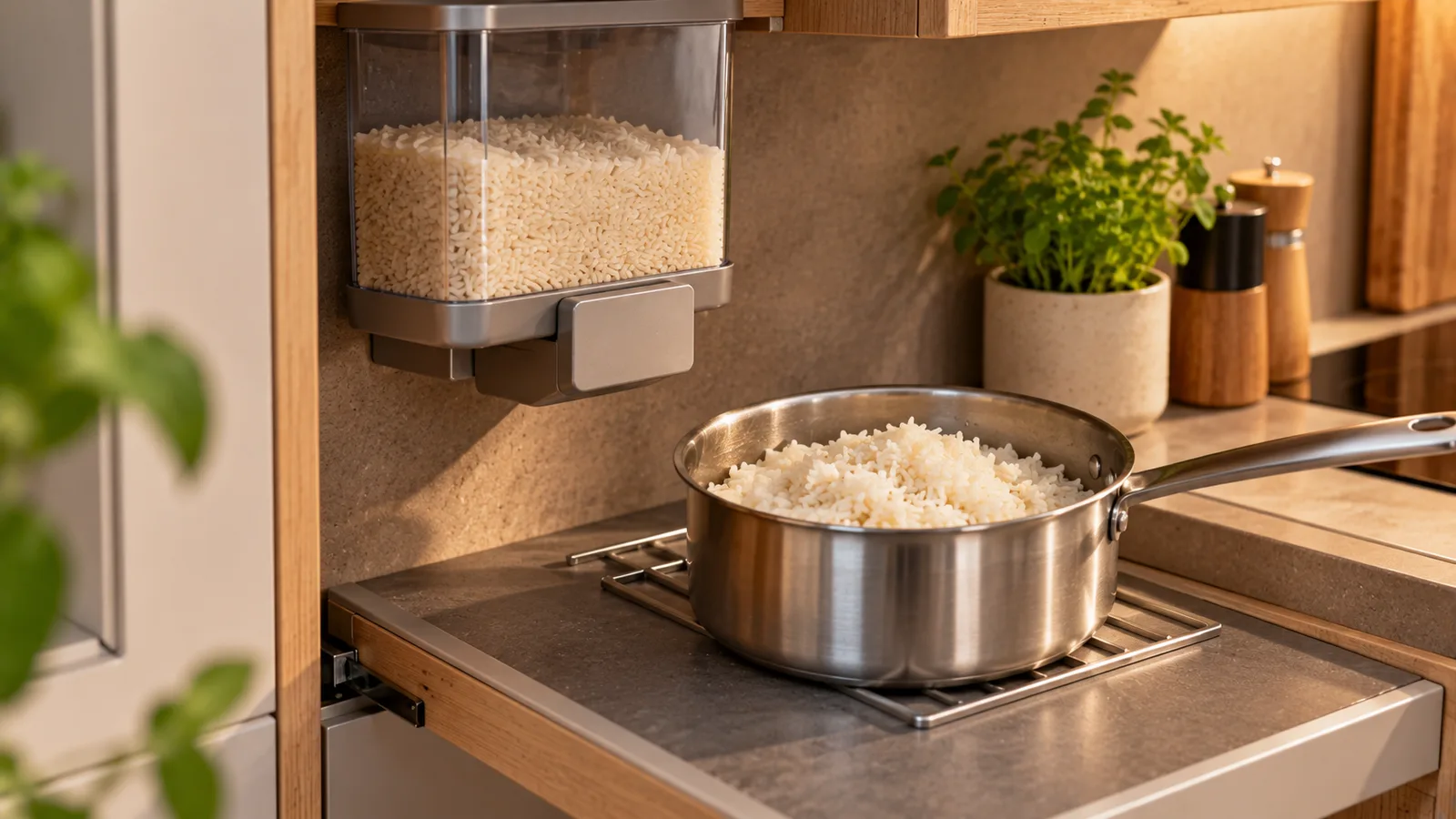
Raw and cooked weights are not interchangeable when tracking calories.
Cooking can make food lose water or absorb water. That changes its weight and therefore changes the number of calories per 100 g, even when the total calories in the original food have changed little.
The most important rule is simple:
Match the state of the food you weigh with the state described by the nutrition entry.
If you weigh food raw, use a raw entry.
If you weigh it cooked, use a cooked entry.
Why does food weight change during cooking?
The biggest reason is usually water.
Some foods lose water during cooking:
- meat;
- poultry;
- fish;
- potatoes and vegetables when roasted;
- foods baked for a long time.
Other foods absorb water:
- rice;
- pasta;
- oats;
- dried legumes.
This can make the calorie value per 100 g look very different before and after cooking.
Cooking does not create calories from water
Consider 100 g of dry rice.
Suppose it contains 360 kcal.
After cooking, it absorbs water and might weigh around 280–300 g depending on the rice and cooking method.
The water adds weight but essentially no calories.
So the same original 360 kcal is now distributed across a much heavier cooked portion.
If the final cooked weight is 300 g:
360 ÷ 300 × 100 = 120 kcal per 100 g cooked
The dry rice was:
360 kcal per 100 g
The cooked rice is:
120 kcal per 100 g
The rice did not lose two-thirds of its calories. It absorbed water.
The opposite happens when food loses water
Suppose 300 g of raw chicken contains 360 kcal before cooking.
After cooking, it weighs 225 g because water has been lost.
If no meaningful calories were added or removed:
360 ÷ 225 × 100 = 160 kcal per 100 g cooked
Before cooking:
360 ÷ 300 × 100 = 120 kcal per 100 g raw
The cooked chicken appears more calorie-dense per 100 g because the same food energy is concentrated into less weight.
The core tracking rule
Use these combinations:
| Weight measured | Nutrition entry to use |
|---|---|
| Raw weight | Raw food entry |
| Cooked weight | Cooked food entry |
| Dry rice/pasta weight | Dry/uncooked entry |
| Cooked rice/pasta weight | Cooked entry |
The common error is mixing the two.
For example:
200 g cooked rice + dry rice calories per 100 g
will greatly overestimate calories.
And:
100 g dry rice + cooked rice calories per 100 g
will greatly underestimate them.
Example: dry vs cooked rice
Suppose:
100 g dry rice = 360 kcal
You cook 200 g dry rice.
Calories before cooking:
200 × 360 ÷ 100 = 720 kcal
After cooking, the batch weighs 600 g.
The whole batch still represents approximately those 720 kcal, assuming only water was added.
Cooked calorie density:
720 ÷ 600 × 100 = 120 kcal per 100 g
If you eat 250 g cooked rice:
250 × 120 ÷ 100 = 300 kcal
Another way to calculate it:
250 ÷ 600 = 41.7% of the batch
720 × 0.417 ≈ 300 kcal
Both methods lead to the same result.
Example: dry vs cooked pasta
Suppose 100 g dry pasta contains 355 kcal.
You cook 250 g dry pasta.
Total before cooking:
250 × 355 ÷ 100 = 887.5 kcal
After cooking, the pasta weighs 600 g.
Cooked calorie density:
887.5 ÷ 600 × 100 = 148 kcal per 100 g
A 180 g cooked portion:
180 × 148 ÷ 100 ≈ 266 kcal
The exact cooked weight varies because different pasta shapes, cooking times and methods absorb different amounts of water.
That is why a universal dry-to-cooked conversion is less reliable than weighing your own batch.
Example: chicken losing water
Suppose 500 g raw chicken contains 600 kcal in total.
After cooking, it weighs 375 g.
The total food energy remains approximately 600 kcal if no caloric ingredients were added and losses are ignored for this practical example.
Cooked calorie density:
600 ÷ 375 × 100 = 160 kcal per 100 g
If you eat 150 g cooked:
150 × 160 ÷ 100 = 240 kcal
The same chicken was less calorie-dense per 100 g when raw because it contained more water.
Does cooking change the actual calories?
It can, but the weight change itself is often mostly about water.
Total calories can also change when:
- oil or butter is added;
- sugar, sauces or other caloric ingredients are added;
- fat renders out of meat and is discarded;
- cooking liquid containing nutrients is discarded;
- part of the food is left behind.
So the statement "total calories never change during cooking" is too simplistic.
For practical tracking, distinguish between:
weight change caused by water
and
actual addition or removal of energy-containing material.
Added oil must be counted
Suppose 800 g of raw potatoes contain 616 kcal.
You roast them with 25 g oil.
If the oil provides about 9 kcal per gram:
25 × 9 = 225 kcal
Approximate total before cooking:
616 + 225 = 841 kcal
After roasting, the finished potatoes weigh 650 g.
Approximate calorie density:
841 ÷ 650 × 100 = 129 kcal per 100 g
If you only use a generic cooked-potato entry and ignore the oil, you may substantially underestimate the meal.
What about oil left in the pan?
Not every gram of cooking oil necessarily ends up in the food.
Some may remain:
- in the pan;
- on baking paper;
- in a serving dish.
Without measuring the residue, the exact absorbed amount is difficult to know.
For consistent everyday tracking, one practical approach is to count the oil added to the recipe unless you have a reliable reason to adjust it.
Consistency is usually more useful than trying to guess an exact absorption percentage.
Meat can lose fat as well as water
Meat is more complicated than rice or pasta.
During cooking, meat may lose:
- water;
- rendered fat;
- juices containing other solids.
If rendered fat is discarded, total calories in the food you actually eat can decrease.
This is why converting raw meat to cooked meat using only a water-loss formula is not always exact.
When available, a reliable cooked entry for the specific cut and cooking method can be useful if you weigh the meat after cooking.
Rice, pasta and grains: dry weight is often easiest
If you cook for yourself and know the dry amount, tracking the dry ingredient before cooking is often straightforward.
Example:
Dry rice used: 180 g
Nutrition: 360 kcal/100 g
180 × 360 ÷ 100 = 648 kcal
You already know the total calories in the rice batch before it absorbs water.
If you eat the whole batch, no cooked conversion is needed.
If you divide it into portions, weigh the final cooked batch and calculate each portion's share.
How to divide a cooked batch accurately
Suppose:
Dry pasta calories: 900 kcal total
Cooked batch weight: 650 g
Your serving: 230 g
Fraction eaten:
230 ÷ 650 = 0.354
Calories:
900 × 0.354 = 319 kcal
This method is useful because it automatically accounts for the amount of water absorbed by your particular batch.
Meal-prep example
You cook:
- 300 g dry rice;
- 600 g raw chicken;
- 20 g oil.
Instead of trying to convert each cooked ingredient using generic factors, you can calculate the calories of the raw ingredients first.
Example totals:
Rice: 1,080 kcal
Chicken: 720 kcal
Oil: 180 kcal
Recipe total:
1,980 kcal
After cooking, suppose the complete mixed meal weighs 1,500 g.
Calories per gram:
1,980 ÷ 1,500 = 1.32 kcal/g
Calories per 100 g:
132 kcal
A 400 g portion:
400 × 1.32 = 528 kcal
This is often the cleanest way to track a homemade batch.
What if the recipe has several ingredients?
For a mixed recipe:
- Record each ingredient before cooking.
- Calculate the calories for each ingredient.
- Add them to get the recipe total.
- Cook the meal.
- Weigh the final edible batch.
- Divide total calories by final cooked weight.
- Use that value for your serving.
Formula:
Calories per gram = total recipe calories ÷ final cooked weight
Then:
Serving calories = serving weight × calories per gram
This method works for:
- casseroles;
- soups;
- stews;
- pasta dishes;
- rice dishes;
- meal-prep recipes.
For larger recipe calculations, you can also use the Recipe Nutrition Calculator.
Soups and stews behave differently
Water can be added during cooking rather than lost.
Suppose a soup contains 1,200 kcal from all ingredients.
The final pot weighs 3,000 g.
Calories per 100 g:
1,200 ÷ 3,000 × 100 = 40 kcal
If the soup simmers longer and finishes at 2,500 g while the same ingredients remain:
1,200 ÷ 2,500 × 100 = 48 kcal per 100 g
The total recipe calories are similar, but evaporation changes calories per 100 g.
Why generic cooked weights can be misleading
You may see statements such as:
"100 g dry rice becomes 300 g cooked."
That can be useful as a rough estimate, but the real ratio depends on:
- variety;
- cooking time;
- water amount;
- draining;
- resting;
- cooking method.
The same is true for pasta, meat and many other foods.
If precision matters, weigh your own food rather than relying on a universal conversion factor.
Should you always weigh food raw?
No.
Either raw or cooked weight can work.
What matters is consistency and matching the database entry.
Raw weighing works well when:
- you cook from scratch;
- you know the amount before cooking;
- you are calculating a recipe;
- the package gives nutrition for the uncooked product.
Cooked weighing works well when:
- the food is already prepared;
- you are serving from a cooked batch;
- you have an appropriate cooked nutrition entry;
- raw weight is no longer available.
Neither method is inherently correct in every situation.
Package labels and raw vs cooked values
Check what the package nutrition information refers to.
For products such as dry pasta or rice, the label may describe the product as sold, meaning dry.
Some products may also provide prepared values.
Do not assume that a value per 100 g refers to the cooked food simply because that is how you eat it.
Read the measurement basis carefully.
Example: a label for dry pasta
Package:
350 kcal per 100 g
Net weight:
500 g
If those values describe the dry product, the entire package contains approximately:
350 × 5 = 1,750 kcal
After cooking, the pasta might weigh much more because of absorbed water.
The total calories do not become 1,750 kcal per cooked 500 g. Instead, those calories are spread across the final cooked weight.
What if you forgot to weigh the food raw?
You still have several options.
Option 1: use a cooked database entry
If you have the cooked weight and a suitable entry for that food and preparation method, use it.
Option 2: use the package and batch information
If you know how much dry food went into the pot, calculate total calories from that amount and divide by final cooked weight.
Option 3: estimate
If neither raw weight nor reliable batch information exists, use an appropriate cooked entry and treat the result as an estimate.
Avoid pretending that an uncertain conversion is exact.
What if you forgot to weigh the final cooked batch?
If you know the raw ingredients and eat the entire recipe yourself over known equal portions, you can divide the total recipe calories by the number of portions.
Example:
Recipe total: 1,600 kcal
Four equal portions:
1,600 ÷ 4 = 400 kcal each
But if portions differ substantially in size, weighing the cooked batch would have been more accurate.
Cooked leftovers
Leftovers can be tracked using the calculated calorie density of the finished recipe.
Example:
Recipe total: 2,100 kcal
Finished weight: 1,750 g
2,100 ÷ 1,750 = 1.2 kcal/g
The next day you eat 325 g:
325 × 1.2 = 390 kcal
You do not need to reconstruct the raw ingredients again for each serving.
Reheating does not reset the calculation
Reheating can cause additional water loss.
If the change is small, the practical difference may be minor.
If a food loses a substantial amount of water during reheating, its weight changes while the remaining food becomes more energy-dense per gram.
For highly precise batch tracking, the most consistent approach is to base portions on the weight of the finished batch at the point when portions are divided.
Drained foods
Water changes can also matter without cooking.
Examples include:
- canned beans;
- tuna in water;
- vegetables in brine.
A nutrition entry may refer to:
- the full contents;
- drained food;
- edible portion.
Match the weight you measure to the basis of the nutrition data.
The same principle applies:
measurement state and database state must match.
The most common raw-vs-cooked tracking error
The biggest mistake is not choosing raw or cooked.
It is using:
a weight from one state + nutrition data from another state.
Examples:
- cooked rice weight with dry rice calories;
- cooked pasta weight with dry pasta calories;
- raw chicken weight with a cooked chicken entry;
- drained food weight with nutrition data for undrained contents.
These combinations can create large errors even when both numbers are individually correct.
A practical decision system
Ask two questions.
1. What did I weigh?
Raw, dry, cooked, drained or prepared?
2. What does my nutrition entry describe?
Raw, dry, cooked, drained or prepared?
If the answers match, you can usually use the entry directly.
If they do not match, either:
- choose a matching database entry; or
- calculate the batch using known ingredient calories and final weight.
Quick reference
| Situation | Practical method |
|---|---|
| Raw chicken weighed before cooking | Use raw chicken entry |
| Cooked chicken weighed after cooking | Use matching cooked entry |
| Dry rice weighed before cooking | Use dry rice entry |
| Cooked rice portion from known batch | Calculate batch calories ÷ cooked batch weight |
| Cooked pasta with no raw weight known | Use suitable cooked pasta entry |
| Homemade mixed dish | Total ingredient calories ÷ final cooked weight |
| Soup or stew | Total ingredient calories ÷ final finished weight |
| Oil added during cooking | Include oil in recipe calories |
| Food drained before eating | Use drained weight with matching data |
The rule to remember
You do not need to choose between "always weigh raw" and "always weigh cooked."
Both methods can work.
The important rule is:
weigh and log the food in the same state.
If the food was weighed raw, use raw nutrition data.
If it was weighed cooked, use cooked nutrition data.
For homemade batches, calculating total ingredient calories and dividing by the final cooked weight is often the most reliable practical method.