
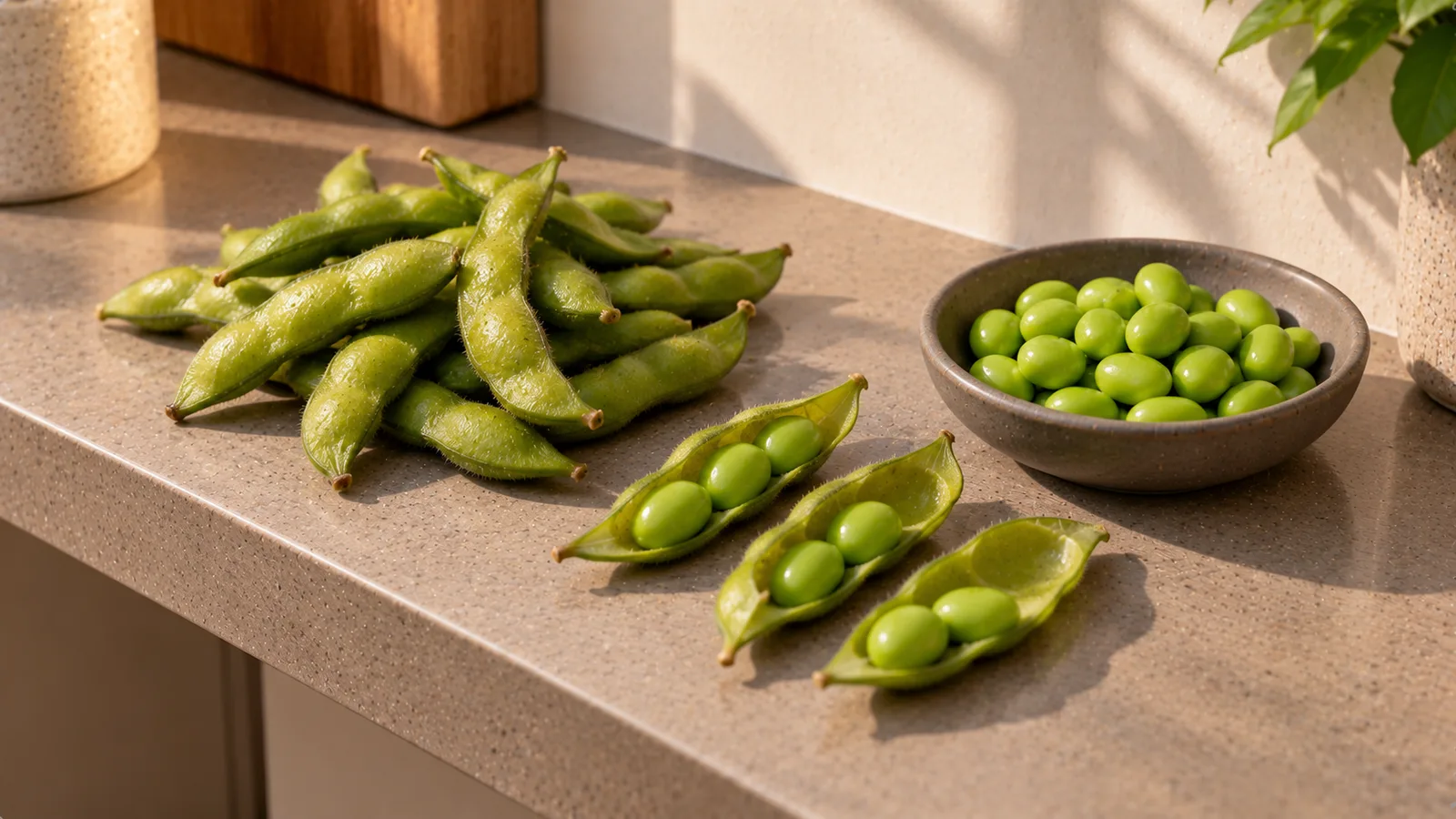
Cooked shelled edamame contains roughly 120–125 calories per 100 g.
A practical reference is about 121 kcal per 100 g, with approximately 11.9 g protein, 8.9 g carbohydrate, 5.2 g fiber and 5.2 g fat.
The exact nutrition values can vary with the product, variety and preparation. Frozen edamame, restaurant edamame and packaged ready-to-eat products may therefore differ from a generic reference.
The most important tracking detail is whether you are weighing the edible beans or whole pods.
Edamame nutrition per 100 g
For cooked shelled edamame, a useful approximate reference is:
| Nutrient | Per 100 g |
|---|---|
| Calories | ~121 kcal |
| Protein | ~11.9 g |
| Carbohydrates | ~8.9 g |
| Fiber | ~5.2 g |
| Fat | ~5.2 g |
Edamame is unusual among many green vegetables because it provides a substantial amount of protein as well as carbohydrate, fiber and fat.
Calories by portion size
Using approximately 121 kcal per 100 g:
| Shelled edamame | Approx. calories |
|---|---|
| 50 g | 61 kcal |
| 75 g | 91 kcal |
| 100 g | 121 kcal |
| 125 g | 151 kcal |
| 150 g | 182 kcal |
| 200 g | 242 kcal |
| 250 g | 303 kcal |
| 300 g | 363 kcal |
For another portion size:
portion weight in grams × 121 ÷ 100
For example:
180 g × 121 ÷ 100 = about 218 kcal.
Shelled edamame vs edamame in pods
This distinction can create a large tracking error.
The pod is normally not eaten.
If you place 200 g of whole edamame pods on a scale, you do not consume 200 g of edible beans.
Therefore, do not automatically apply a nutrition value for 100 g of shelled edamame to 100 g of whole pods.
The best approach depends on the information available.
If the package gives nutrition for the edible portion, weigh the shelled beans.
If the package explicitly provides nutrition for the product as sold, follow the package instructions and serving definition.
How to weigh edamame accurately
For shelled edamame, tracking is simple:
- weigh the edible beans;
- use a nutrition entry for shelled edamame;
- multiply the value by the amount eaten.
For edamame served in pods, you can improve the estimate by weighing:
- the full portion before eating;
- the discarded empty pods afterward.
The difference gives an approximate edible weight.
For example:
Full serving with pods: 300 g
Empty pods after eating: 165 g
Estimated edible beans:
300 − 165 = 135 g
At 121 kcal per 100 g:
135 × 121 ÷ 100 = about 163 kcal
This is usually more useful than logging the entire 300 g as edible edamame.
How many calories are in one cup of edamame?
Cup measurements can vary depending on how tightly the beans are packed.
If a cup of shelled cooked edamame weighs around 150–160 g, using 121 kcal per 100 g gives approximately:
- 150 g: ~182 kcal;
- 160 g: ~194 kcal.
For calorie tracking, grams are more reliable because a cup is a volume measurement rather than a fixed weight.
Protein in edamame
Using approximately 11.9 g protein per 100 g:
| Portion | Approx. protein |
|---|---|
| 50 g | 6.0 g |
| 100 g | 11.9 g |
| 150 g | 17.9 g |
| 200 g | 23.8 g |
| 250 g | 29.8 g |
This makes edamame a useful plant-based protein source.
Unlike foods that are almost entirely protein, however, edamame also provides carbohydrate and fat. For a direct comparison of edible portions, protein and costs, see frozen edamame versus canned chickpeas.
That matters when calculating the calories and macros of a full meal.
Carbohydrates, fiber and fat
Per 100 g, the reference used here provides approximately:
- 8.9 g carbohydrate;
- 5.2 g fiber;
- 5.2 g fat.
For 150 g, that becomes approximately:
- 13.4 g carbohydrate;
- 7.8 g fiber;
- 7.8 g fat;
- 17.9 g protein;
- 182 kcal.
Exact numbers vary between products and databases.
Frozen edamame
Frozen edamame is commonly sold either:
- shelled;
- in pods.
Plain frozen edamame is often nutritionally similar to cooked edamame once prepared, but the package label should be preferred when available.
Check whether the listed values refer to:
- frozen product;
- prepared product;
- shelled beans;
- beans in pods;
- a defined serving.
This prevents mismatching the weight you measure with the nutrition data.
Does cooking change the calories?
Boiling or steaming plain edamame does not create a large amount of additional energy.
However, cooking can change water content and therefore the calories per 100 g.
The bigger changes usually come from added ingredients.
Examples include:
- oil;
- butter;
- sesame oil;
- sauces;
- sugary glazes.
If you weigh the edamame after cooking, use a value that represents the prepared food when possible.
For a broader explanation of this issue, see Raw vs Cooked Weight: Which Should You Use for Calories?.
Salt does not add calories
Salt can substantially change sodium content, but it does not add meaningful calories.
A bowl of plain salted edamame therefore has approximately the same energy as the same amount without salt.
Oil-based or sweet sauces are different because they add energy.
Edamame with oil
Suppose you prepare:
- 200 g shelled edamame;
- 10 g sesame oil.
Edamame:
200 × 121 ÷ 100 = 242 kcal
Oil at roughly 9 kcal per gram contributes approximately:
10 × 9 = 90 kcal
Total:
242 + 90 = approximately 332 kcal
The oil changes the total much more than a small difference between two generic edamame database entries.
Edamame as a snack
Edamame can be used as a snack because it provides protein and fiber in addition to energy.
For example:
100 g shelled edamame = about 121 kcal and 11.9 g protein.
150 g = about 182 kcal and 17.9 g protein.
Whether that amount fits your day depends on your overall energy needs, meals and other snacks.
There is no universal portion that everyone needs to use.
Edamame in salads
When edamame is added to a salad, calculate it as one component of the complete meal.
For example:
- 100 g edamame: ~121 kcal;
- vegetables: 80 kcal;
- avocado: 120 kcal;
- dressing: 150 kcal.
Total:
121 + 80 + 120 + 150 = 471 kcal
In this example, focusing only on the edamame would miss most of the meal's calories.
Edamame in a rice bowl
Suppose a bowl contains:
- 150 g edamame: ~182 kcal;
- 180 g cooked rice at 130 kcal per 100 g: ~234 kcal;
- vegetables: 70 kcal;
- sauce: 90 kcal.
Estimated total:
182 + 234 + 70 + 90 = 576 kcal
Changing the sauce or rice portion can affect the meal more than a small difference in the edamame estimate.
Edamame vs tofu
Both foods come from soybeans, but their nutrition per 100 g can differ substantially depending on the type of tofu and how it is prepared.
Edamame is the immature soybean eaten as a bean.
Tofu is produced from soy milk that is coagulated and pressed.
Because tofu can contain very different amounts of water, a universal calorie comparison is less useful than comparing the actual tofu product you eat with the edamame portion you use.
Edamame vs chickpeas
Using the approximate reference values used in Mealisa:
| Per 100 g cooked | Edamame | Chickpeas |
|---|---|---|
| Calories | ~121 kcal | ~164 kcal |
| Protein | ~11.9 g | ~8.9 g |
| Carbohydrates | ~8.9 g | ~27.4 g |
| Fiber | ~5.2 g | ~7.6 g |
| Fat | ~5.2 g | ~2.6 g |
The comparison is based on equal weights.
A real meal may use very different portion sizes.
For a detailed chickpea guide, see Calories in Chickpeas: Nutrition, Portions and Common Serving Sizes.
Edamame vs kidney beans
Using approximate cooked values:
| Per 100 g | Edamame | Kidney beans |
|---|---|---|
| Calories | ~121 kcal | ~127 kcal |
| Protein | ~11.9 g | ~8.7 g |
| Carbohydrates | ~8.9 g | ~22.8 g |
| Fiber | ~5.2 g | ~6.4 g |
| Fat | ~5.2 g | ~0.5 g |
Their calorie density is relatively similar in this comparison, but the macronutrient profiles differ.
For more detail, see Calories in Kidney Beans: Nutrition, Portions and Common Serving Sizes.
Edamame vs lentils
Approximate values per 100 g cooked:
- edamame: ~121 kcal;
- lentils: ~116 kcal.
The calorie difference is small, but edamame generally contains more fat and can provide more protein per 100 g, while the exact comparison depends on the specific reference data.
See Calories in Lentils: Nutrition, Portions and Common Serving Sizes for the lentil breakdown.
Is edamame good for weight loss?
Edamame can fit into an eating pattern designed for weight management.
Its combination of protein and fiber can make it a useful component of meals or snacks.
But edamame does not cause weight loss by itself.
Overall energy intake over time remains important.
A 100 g serving of plain edamame and a large bowl covered in oil-based sauce may have very different calorie totals.
The complete meal matters.
Common calorie-tracking mistakes
Weighing the pods as edible food
The pods are normally discarded, so using their full weight with a shelled-edamame nutrition entry can substantially overestimate intake.
Using a vague serving entry
“One serving” may represent a different weight in different databases.
Use grams when possible.
Ignoring sauces and oil
Plain edamame may be relatively straightforward to track, while restaurant seasoning can add meaningful calories.
Mixing raw, frozen and cooked entries
Use an entry that matches the state in which the food was measured.
Assuming every product is identical
Packaged edamame can have different serving definitions and nutrition values.
Use the label for the specific product when available.
A simple tracking workflow
For accurate everyday tracking:
- Determine whether the edamame is shelled or in pods.
- Identify whether your nutrition value refers to the edible portion.
- Weigh the edible beans whenever practical.
- Use the package label for a specific product.
- Add oils and calorie-containing sauces separately.
- For mixed dishes, track the complete meal rather than only the edamame.
Perfect precision is not necessary.
Matching the measured food to the correct nutrition entry is usually more important than small differences between databases.
Quick reference
For plain cooked shelled edamame, using approximately 121 kcal per 100 g:
- 50 g: ~61 kcal;
- 100 g: ~121 kcal;
- 150 g: ~182 kcal;
- 200 g: ~242 kcal;
- 250 g: ~303 kcal;
- 300 g: ~363 kcal.
If the edamame is served in pods, remember that the pod weight is not the same as the edible bean weight.
When a package label is available, use it as the primary reference for that specific product.
Nutrition data sources
Reference values below are per 100 g of the specified food. Product varieties and preparation methods can differ.
- USDA FoodData Central — Edamame, frozen, prepared (FDC 168411; 121 kcal/100 g).