
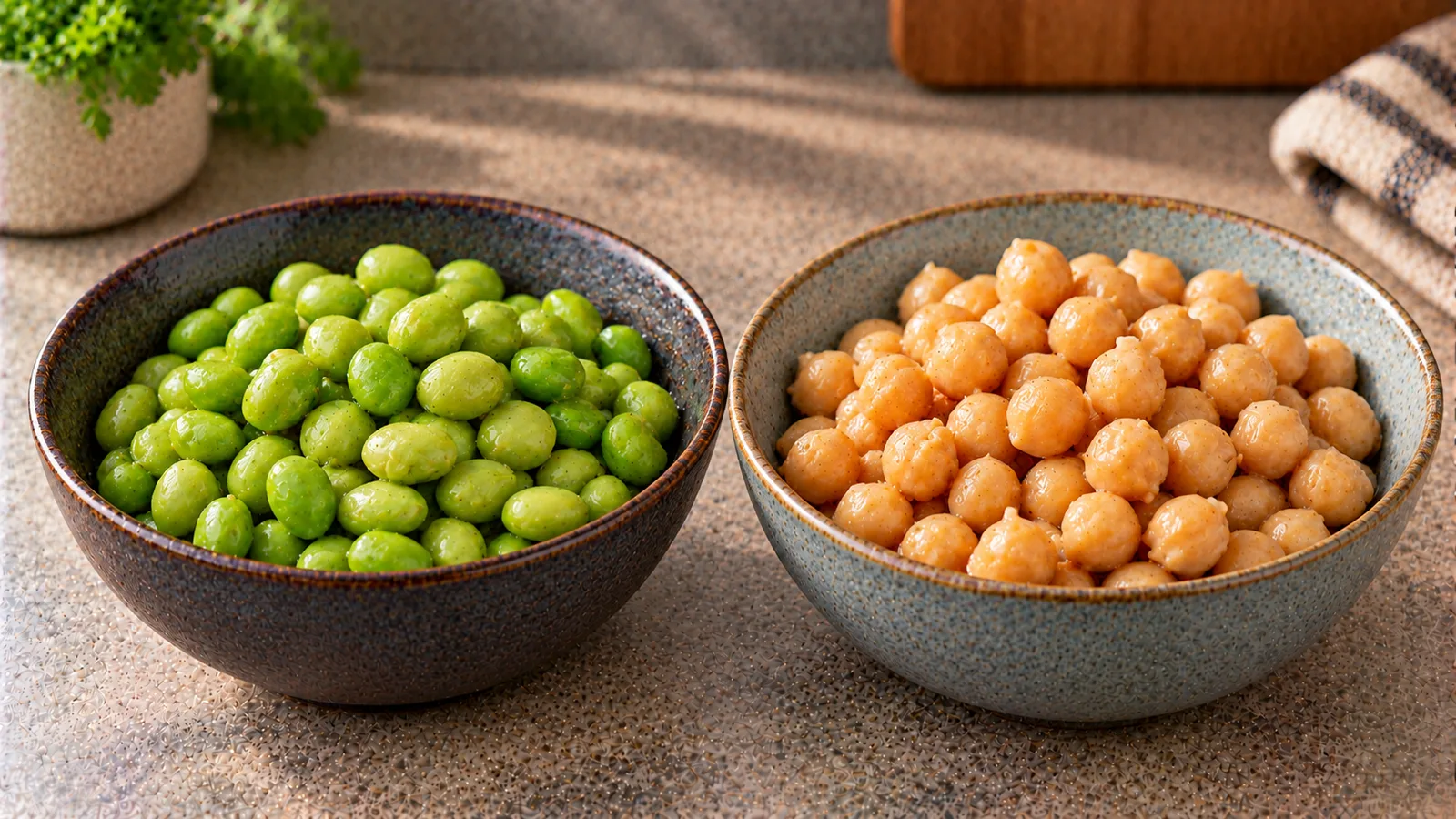
Frozen edamame and canned chickpeas are both convenient legumes, but they solve slightly different grocery problems. Shelled edamame arrives frozen, generally needs a short cook and supplies substantial protein for its weight. Canned chickpeas are already cooked, offer more fibre in the two products compared here and usually require only draining. Which is better depends on whether you are buying protein, building a filling lunch, watching salt or keeping a food budget. The comparison below uses real retail labels and separates observed nutrition from illustrative prices.
The short answer: what actually changes?
For equal 100 g edible portions, the selected REWE Bio edamame supplies 10.3 g protein; REWE Bio canned chickpeas supply 6.5 g. The chickpeas provide 7 g fibre against 4.8 g for edamame. Energy is close: 128 versus 120 kcal. Most striking is labelled salt: 0.01 versus 0.35 g. These are facts about these two products, not every bag of soybeans and every can of chickpeas. Both contribute useful nutrients, and neither is automatically the healthier choice. If protein density matters most, edamame leads in this pair; if fibre and a ready-to-eat ingredient matter more, chickpeas may fit better. For a broader view of nutrients and realistic portions, see our Calories in Edamame: Nutrition, Portions and Common Serving Sizes and Calories in Chickpeas: Nutrition, Portions and Common Serving Sizes.
Which packages are being compared?
The edamame is REWE Bio Edamame ohne Schote, 300 g: blanched, frozen, shelled green soybeans. Its stated 300 g is a package of beans without the inedible pods. The comparison product is REWE Bio Kichererbsen, 215 g drained, a can holding chickpeas, water and salt. The can's reported net volume is not the same as its 215 g drained weight. For a meaningful meal comparison, use the edible beans after the liquid has been removed, not the can-plus-liquid weight. The product pages were checked in October 2026; formulations and availability can change. The nutrition panels are used on the basis shown by each retailer, and cooking or rinsing may introduce some variation in the final prepared food.
Nutrition comparison per 100 g edible product
The table is based on each retailer's declared nutrition profile. Edamame values refer to its stated product; after boiling and draining, water uptake can slightly change the nutritional concentration per 100 g. Chickpea figures refer to the canned food as labelled, with the drained amount used to plan portions. Do not use the uncooked nutritional profile of dry soybeans or dry chickpeas here: that would be a different denominator.
| Per 100 g | Frozen shelled edamame | Canned chickpeas | Practical implication |
|---|---|---|---|
| Calories | 128 kcal | 120 kcal | Similar on an equal weight basis |
| Protein | 10.3 g | 6.5 g | Edamame provides 3.8 g more |
| Fibre | 4.8 g | 7.0 g | Chickpeas provide 2.2 g more |
| Fat | 4.7 g | 2.7 g | Natural composition differs |
| Carbohydrates | 8.6 g | 14 g | Chickpeas contain more on these labels |
| Salt | 0.01 g | 0.35 g | Brine makes a practical difference |
The difference in fat does not establish that the more fatty product is undesirable. Likewise, protein figures do not determine a whole diet. The German Nutrition Society's guidance on legumes supports including a variety of pulses; it does not rank these branded packages.
What does a realistic 150 g portion provide?
Most people eat a portion rather than exactly 100 g. Multiplying each label figure by 1.5 gives a transparent 150 g example. We are not claiming that a frozen 150 g scoop invariably weighs 150 g after cooking; weigh the finished drained beans if precision matters. Likewise, 150 g chickpeas is less than one whole 215 g drained can.
| Edible serving | Protein | Calories |
|---|---|---|
| 150 g shelled edamame | 15.45 g | 192 kcal |
| 150 g drained chickpeas | 9.75 g | 180 kcal |
| 200 g shelled edamame | 20.60 g | 256 kcal |
| 200 g drained chickpeas | 13.00 g | 240 kcal |
At 150 g, the fibre arithmetic is 7.2 g for edamame and 10.5 g for chickpeas; labelled salt is 0.015 g and 0.525 g respectively. These figures should be rounded in everyday use, not treated as laboratory measurements. You can use Portion Size vs Serving Size: What’s the Difference? to distinguish a label's reference amount from the amount you actually dish out. The key idea is that a meaningful comparison keeps the same edible weight, preparation state and included seasonings.
A fairer protein target: 20 g from the legume alone
Another way to compare is to ask how much of each ingredient supplies 20 g protein. Divide 20 by protein grams per 100 g and multiply by 100. At the selected label values, you need approximately 194 g edamame or 308 g chickpeas. That is nearly two small servings of chickpeas rather than one. The estimated energy supplied is about 249 versus 369 kcal; this says something about protein concentration, not which food belongs on your plate. The corresponding fibre is roughly 9.3 versus 21.5 g. Some people appreciate that much fibre, while others prefer smaller portions or a gradual increase. Water used to cook either ingredient does not add protein, but can dilute a per-100-g reading if you weigh a wetter finished food.
Fibre, fullness and the bigger meal
Chickpeas win the fibre column in this two-label comparison. Fibre matters in a varied diet, but it is misleading to turn that one number into a guaranteed result for appetite, digestion or weight change. How you eat the food matters. A vegetable-and-chickpea lunch may include greens, grains and dressing; edamame may be added to rice, noodles or a stir-fry. Both combinations change the overall calorie and protein totals. A plain serving of legumes is also different from a salted snack mix, creamy hummus or soybeans fried in oil. To keep the comparison useful, weigh sauces and additional oil separately instead of attributing their nutrients to the legumes. The DGE overview of legumes and nuts is a useful general starting point.
Salt: the biggest label difference here
REWE Bio's frozen edamame panel lists 0.01 g salt per 100 g. Its canned chickpeas list 0.35 g. At 150 g, that is approximately 0.02 g versus 0.53 g before you add cooking salt, dressing or sauce. The edamame advantage is only maintained if you do not cook them in heavily salted water. You may rinse canned chickpeas to remove some surface brine, but without a controlled test you cannot calculate an exact post-rinsing reduction. If limiting salt is important, choose a no-added-salt can where available, check the actual label and consider what goes into the complete meal. Salt is listed as salt on EU packs, while other countries may print sodium. Consult the EU food information regulation for the overall labeling framework.
Price: per 100 g, per portion and per 10 g protein
REWE does not show a single location-independent price for both selected products. Therefore €2.49 per 300 g edamame and €0.99 per 215 g drained chickpeas are hypothetical price assumptions, not verified current shop offers. A simple cost model makes the method reusable when your local price changes.
| Illustrative cost unit | Frozen edamame | Canned chickpeas |
|---|---|---|
| Assumed purchase price | €2.49 / 300 g | €0.99 / 215 g drained |
| Ingredient cost per 100 g | €0.83 | €0.46 |
| Ingredient cost per 150 g | €1.25 | €0.69 |
| Ingredient cost per 10 g protein | €0.81 | €0.71 |
To calculate the last line, divide the price per 100 g by the protein in that 100 g and multiply by 10. Edamame: €0.83 ÷ 10.3 × 10 = approximately €0.81. Chickpeas: €0.99 ÷ 215 × 100 ÷ 6.5 × 10 = approximately €0.71. Under these assumptions, the chickpeas are cheaper both per edible gram and per 10 g protein. Change the price and the ranking can change: use actual shelf prices when shopping. The entire 300 g frozen bag costs €2.49, whereas buying enough canned chickpeas to obtain 300 g drained requires two 215 g cans, costing €1.98, with some chickpeas left. Do not mistake the €0.69 used-portion cost for the amount payable at the checkout.
Does shell weight or cooking water change the answer?
Yes, comparing unlike weights can completely distort the result. The selected edamame are sold without pods. Edamame in pods is a different retail format: the pod weight is not edible and must be excluded from a price per edible 100 g calculation. When frozen shelled edamame are cooked, the product may gain or lose water; weigh the cooked, drained portion if that is how you log it. The selected canned chickpeas contain liquid, but only 215 g is declared as drained food. Buying a 330 ml can does not give 330 g of chickpeas. If your product has seasonings or sauce, the label may describe the whole mixture; check exactly what the nutrition values refer to before assigning them to plain drained beans. The true yield after rinsing or simmering should be measured for your own batch, not borrowed from a generic conversion.
Convenience, freezer space and planning
Canned chickpeas win on immediate convenience: they are already cooked and can be rinsed and added to a cold salad. Shelled frozen edamame usually require a brief cook; the REWE preparation instructions describe roughly three to five minutes in boiling water. Follow the packet, including instructions for frozen food, rather than assuming blanching means ready to eat. In exchange, the frozen bag is easy to portion in smaller amounts while it remains frozen. Cans are shelf-stable unopened, but leftovers need prompt refrigeration after opening. The FoodSafety.gov cold-storage chart is a useful general reference; product-specific storage wording takes priority when stricter. Avoid repeated thawing and refreezing against the pack's instructions.
Allergens, uses and choosing for your plate
Edamame is soy, one of the major declared allergens. Chickpeas are a different legume, though anyone with a known legume allergy should follow individual clinical advice instead of assuming a substitute is safe. The FDA explanation of food allergens helps distinguish ingredient names and advisory labeling. For lunch, edamame suits a rice-and-vegetable bowl when you want more protein per spoonful; chickpeas suit hummus, warm stews or a quick salad when you want a pantry ingredient and more fibre in this comparison. Texture also matters: edamame stay relatively firm and bright, while cooked chickpeas are creamier. See Edamame Noodle Salad for a meal example using edamame and other ingredients rather than treating a single food as a complete diet.
A practical shopping decision and sources
Buy based on the need you actually have. For maximum protein in a fixed 150 g edible portion, this particular frozen edamame leads by 5.7 g protein. For fibre in the same portion, this canned chickpea leads by 3.3 g fibre. For a lower-salt starting ingredient, the plain unsalted edamame looks favourable, but cooking salt can erase that advantage. For value, price both choices per edible 100 g and per 10 g protein, using the shelf price and the drained weight on the can. Keep one or both around depending on freezer space, cooking time and the meals you enjoy. Neither winner should be generalized to every brand, especially seasoned edamame or canned chickpeas with a different salt level.
Sources and label basis: REWE Bio shelled edamame nutrition and cooking instructions; REWE Bio canned chickpeas, 215 g drained, nutrition; DGE legumes guidance; DGE food circle, legumes; EU Regulation 1169/2011; FoodSafety.gov cold storage; FDA food allergies. Prices are hypothetical worked examples, not current offers. Product data and applicable labeling can change; verify the pack you purchase.