
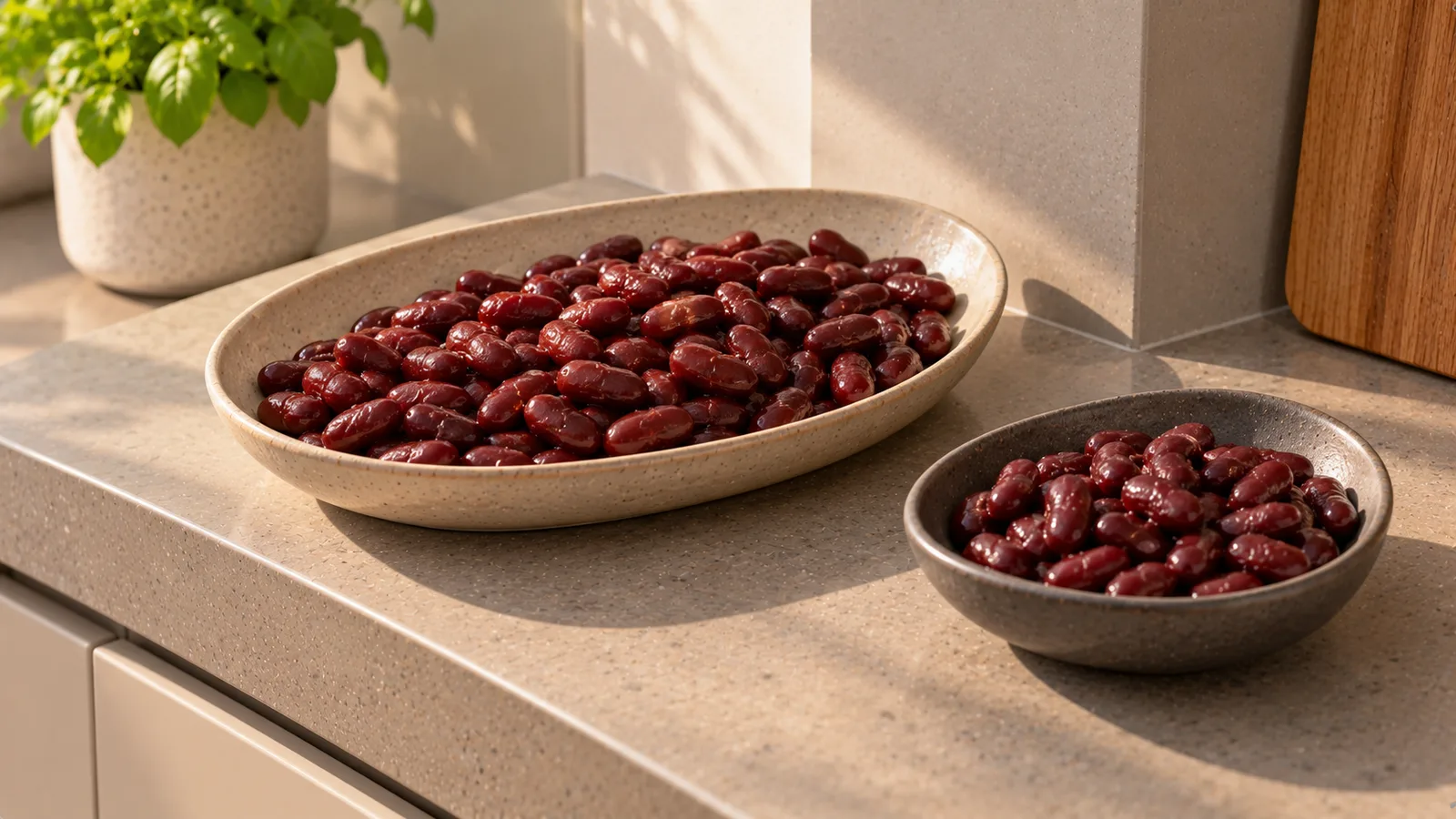
Cooked kidney beans provide roughly 125–130 calories per 100 g when prepared without added fat.
The exact number varies with the variety, product, cooking method and water content. Canned kidney beans can also differ between brands, especially depending on whether the nutrition information refers to the product as sold or to the drained beans.
For calorie tracking, the most useful rule is simple: match the state of the beans you weigh with the nutrition entry you use.
Kidney bean calories per 100 g
A practical reference for cooked kidney beans is approximately:
| Nutrient | Per 100 g cooked |
|---|---|
| Calories | ~127 kcal |
| Protein | ~8.7 g |
| Carbohydrates | ~22.8 g |
| Fiber | ~6.4 g |
| Fat | ~0.5 g |
These are approximate reference values. A specific package or database entry may differ.
Kidney beans are naturally low in fat when cooked without oil and provide both protein and fiber.
Calories by portion size
Using approximately 127 kcal per 100 g:
| Cooked kidney beans | Approx. calories |
|---|---|
| 50 g | 64 kcal |
| 75 g | 95 kcal |
| 100 g | 127 kcal |
| 125 g | 159 kcal |
| 150 g | 191 kcal |
| 200 g | 254 kcal |
| 250 g | 318 kcal |
| 300 g | 381 kcal |
For any other portion:
portion weight in grams × 127 ÷ 100
For example:
180 g × 127 ÷ 100 = about 229 kcal.
How many calories are in a cup of kidney beans?
Cup measurements are less precise than grams because the weight depends on how the beans are packed and how much moisture remains.
If one cup of cooked kidney beans weighs around 175–180 g, it would contain roughly 220–230 kcal using the reference value above.
For consistent calorie tracking, weighing the portion in grams is usually more reliable.
Dry vs cooked kidney beans
Dry and cooked kidney beans have very different calorie values per 100 g.
This is mainly because beans absorb a substantial amount of water during soaking and cooking.
Dry beans are concentrated.
Cooked beans contain much more water.
The total energy in the original beans does not disappear when they absorb water, but it becomes distributed across a heavier finished batch.
That is why 100 g of dry kidney beans can contain far more calories than 100 g of cooked kidney beans.
If you weigh cooked beans, use a cooked-food entry.
If you weigh them dry, use a dry-food entry.
For more detail, see Raw vs Cooked Weight: Which Should You Use for Calories?.
Example: calculating your own cooked batch
Suppose you start with 400 g of dry kidney beans.
Imagine the package lists 335 kcal per 100 g.
Total calories in the dry batch:
400 × 335 ÷ 100 = 1,340 kcal
After soaking and cooking, suppose the finished beans weigh 1,000 g.
The cooked batch then contains:
1,340 ÷ 1,000 × 100 = 134 kcal per 100 g
A 180 g portion would contain:
180 × 134 ÷ 100 = about 241 kcal
This approach is useful when your own cooking yield differs from a generic database value.
Calories in canned kidney beans
Canned kidney beans are already cooked, but their nutrition values can vary.
When reading the label, check whether the values refer to:
- 100 g of the product as sold;
- 100 g drained;
- a specific serving size;
- beans together with the packing liquid.
If you drain the beans, a nutrition value specifically for drained beans is the best match when available.
For a branded product, the package label is usually more relevant than a generic kidney-bean value.
Does rinsing canned kidney beans reduce calories?
Rinsing removes some of the liquid surrounding the beans.
It does not remove most of the energy contained in the beans themselves.
The calorie difference is therefore usually much less important than correctly matching the weight you measure to the nutrition value you use.
If the label gives nutrition for drained beans and you weigh the beans after draining, the comparison is straightforward.
Protein in kidney beans
Using the reference value of about 8.7 g protein per 100 g:
| Portion | Approx. protein |
|---|---|
| 100 g | 8.7 g |
| 150 g | 13.1 g |
| 200 g | 17.4 g |
| 250 g | 21.8 g |
Kidney beans can make a meaningful contribution to the protein content of a meal.
At the same time, they are also a substantial source of carbohydrate and fiber, so it is more accurate to think of them as a mixed macronutrient food rather than as pure protein.
Carbohydrates and fiber
Cooked kidney beans provide approximately 22.8 g of carbohydrate and 6.4 g of fiber per 100 g using the reference values above.
A 150 g portion would provide roughly:
- 34.2 g carbohydrate;
- 9.6 g fiber;
- 13.1 g protein;
- 191 kcal.
The actual numbers can vary with the product and cooking method.
Kidney beans in chili
Kidney beans are commonly used in chili, but the calorie content of chili cannot be estimated from the beans alone.
A chili may also contain:
- meat or meat alternatives;
- tomatoes;
- corn;
- onions;
- oil;
- cheese;
- sour cream;
- rice or bread served alongside it.
For a homemade chili, calculate the complete recipe.
If the finished pot contains 2,400 kcal and weighs 3,000 g, for example:
2,400 ÷ 3,000 × 100 = 80 kcal per 100 g
A 450 g serving would then contain:
450 × 80 ÷ 100 = 360 kcal
This is more accurate than logging 450 g as kidney beans.
Kidney bean salad
A kidney bean salad can range from relatively light to quite energy-dense.
A basic version might contain:
- kidney beans;
- tomatoes;
- cucumber;
- onion;
- herbs.
Additions such as olive oil, avocado, cheese, nuts or creamy dressing can substantially increase the total calories.
If you track the meal, include those additions rather than focusing only on the beans.
Kidney beans with rice
Beans and rice can form the base of a substantial meal.
For example:
200 g cooked kidney beans at ~127 kcal per 100 g = 254 kcal
150 g cooked rice at about 130 kcal per 100 g = 195 kcal
Together: approximately 449 kcal
That is before oil, sauces, cheese, avocado or other additions.
The final meal can therefore differ substantially depending on preparation.
Kidney beans in soups and stews
Soup and stew portions should not be logged as if their entire weight were beans.
Water, broth, vegetables and other ingredients change the weight and calorie density of the finished dish.
A 400 g bean soup might contain only a fraction of that weight as kidney beans.
For homemade dishes, calculate the recipe from all ingredients and divide by the finished weight or number of servings.
Are kidney beans good for weight loss?
Kidney beans can fit into a diet intended for weight management.
They provide protein and fiber and can be combined with vegetables and other foods to create substantial meals.
But no individual food guarantees weight loss.
Total energy intake over time remains important, and calorie-dense additions can significantly change a bean-based meal.
A bowl containing beans, vegetables and a moderate amount of dressing can have a very different calorie total from a bowl containing the same beans plus large amounts of oil, cheese and avocado.
Kidney beans vs black beans
Kidney beans and black beans are nutritionally similar in several ways.
Using the approximate reference values used in Mealisa:
| Per 100 g cooked | Kidney beans | Black beans |
|---|---|---|
| Calories | ~127 kcal | ~132 kcal |
| Protein | ~8.7 g | ~8.9 g |
| Carbohydrates | ~22.8 g | ~23.7 g |
| Fiber | ~6.4 g | ~8.7 g |
| Fat | ~0.5 g | ~0.5 g |
The exact values vary between references and products.
For most meals, the difference between the two is small enough that taste, texture, recipe and portion size may matter more than a few calories per 100 g.
Kidney beans vs chickpeas
Cooked chickpeas are typically more calorie-dense than cooked kidney beans.
Using approximate reference values:
- kidney beans: ~127 kcal per 100 g;
- chickpeas: ~164 kcal per 100 g.
Chickpeas also tend to contain more fat.
This does not make kidney beans inherently better.
It simply means that equal weights of the two foods can provide different amounts of energy.
See Calories in Chickpeas: Nutrition, Portions and Common Serving Sizes for a detailed chickpea breakdown.
Kidney beans vs lentils
Cooked lentils and kidney beans are closer in calorie density.
A practical comparison might be:
- cooked lentils: ~116 kcal per 100 g;
- cooked kidney beans: ~127 kcal per 100 g.
Both provide protein, carbohydrate and fiber.
For more detail on lentils, see Calories in Lentils: Nutrition, Portions and Common Serving Sizes.
What changes the calorie count most?
For plain kidney beans, water content and product differences can change the value per 100 g.
For prepared meals, larger calorie changes usually come from ingredients such as:
- oil;
- cheese;
- avocado;
- meat;
- rice;
- tortillas;
- creamy sauces.
If you are tracking calories, accurately recording 15 g of oil can matter more than choosing between two generic kidney-bean entries that differ by a few calories per 100 g.
Common tracking mistakes
Using a dry value for cooked beans
This can produce a very large error because dry beans are much more calorie-dense by weight.
Logging the whole dish as beans
A chili, soup or salad contains other ingredients and should be tracked as a recipe when accuracy matters.
Ignoring oil
Oil used for frying or dressing can contribute substantial energy.
Assuming every can is identical
Brands can differ in ingredients, liquid and nutrition values.
Using “one serving” without checking grams
A serving defined by one database may not match the amount you actually ate.
How to track kidney beans accurately
A simple workflow is:
- Identify whether the beans are dry, cooked or canned.
- Weigh the portion.
- Choose a nutrition entry representing the same state.
- Prefer the package label for a specific branded product.
- Include oils, sauces and other significant ingredients.
- For mixed dishes, calculate the complete recipe.
You do not need perfect laboratory precision.
Consistency and choosing the correct food state usually matter more than tiny differences between nutrition databases.
Quick reference
For plain cooked kidney beans, a useful estimate is:
- 100 g: ~127 kcal;
- 150 g: ~191 kcal;
- 200 g: ~254 kcal;
- 250 g: ~318 kcal;
- 300 g: ~381 kcal.
Use the product label when you have it, especially for canned beans.
And when tracking beans prepared from dry, make sure the nutrition value corresponds to whether you weighed them before or after cooking.
Nutrition data sources
Reference values below are per 100 g of the specified food. Product varieties and preparation methods can differ.
- USDA FoodData Central — Beans, kidney, red, mature seeds, cooked, boiled, with salt (FDC 175242; 127 kcal/100 g).