
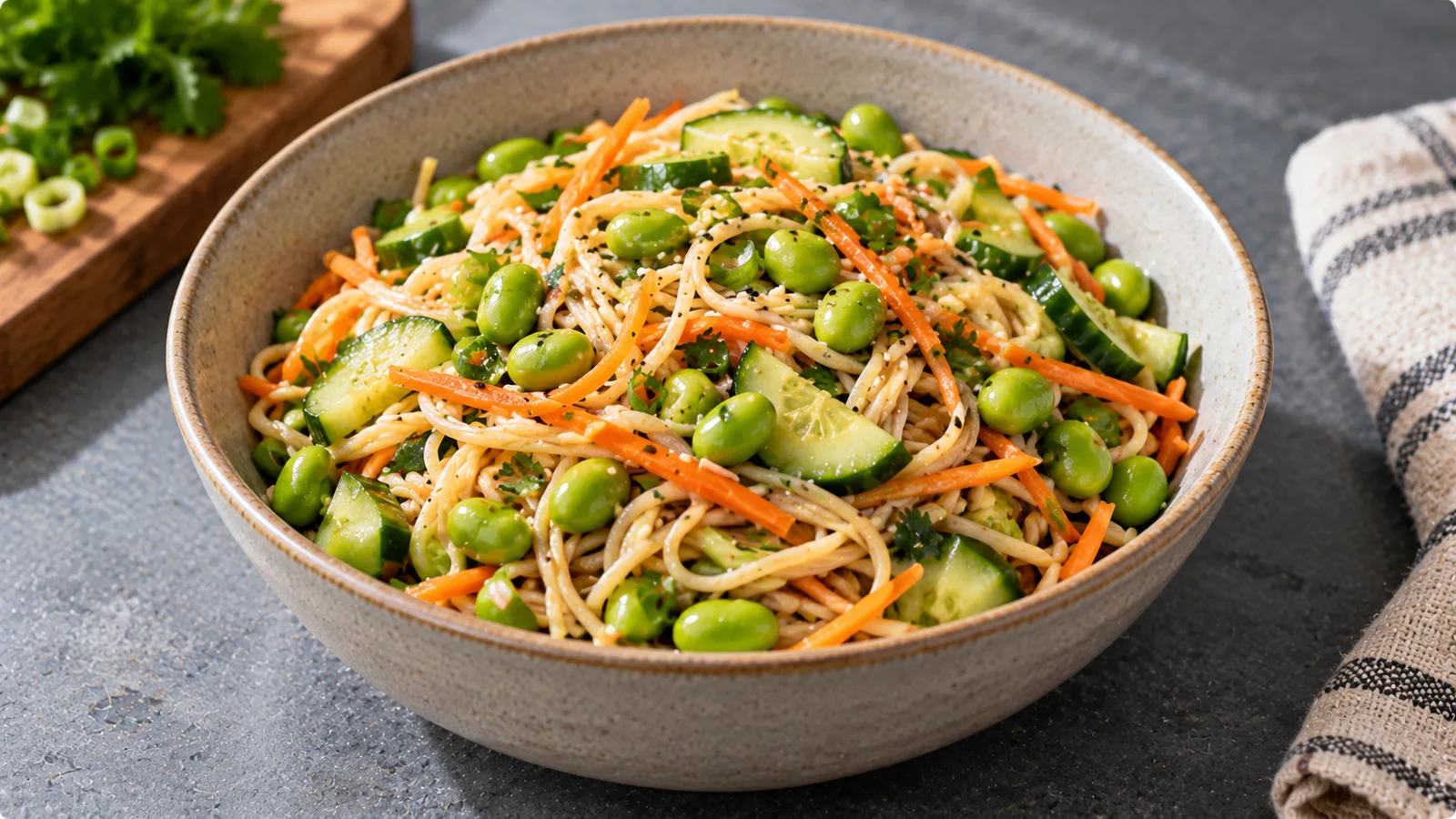
Edamame noodle salad combines tender noodles, green soybeans, crunchy vegetables and a bright sesame-lime dressing. It works as a light main meal, a packed lunch or a make-ahead dish for several people. For a different sesame-dressed noodle salad with tofu and red cabbage, see sesame tofu and red cabbage noodles.
The contrast between the ingredients is what makes this salad satisfying: soft rice noodles, firm edamame, crisp cucumber, sweet carrots and a dressing that balances acidity, saltiness and a small amount of sweetness.
Unlike a hot noodle dish, this recipe is intended to be served cool or at room temperature shortly after preparation. The vegetables remain fresh, while the noodles absorb enough dressing to become flavorful without turning soggy.
This version makes four portions and takes approximately 25 minutes.
Recipe overview
| Detail | Amount |
|---|---|
| Servings | 4 |
| Preparation time | 15 minutes |
| Cooking time | 10 minutes |
| Total time | Approximately 25 minutes |
| Main ingredients | Rice noodles, edamame, cucumber, carrots |
| Dressing | Sesame, lime and soy sauce |
| Dietary style | Plant-based |
| Approximate energy | 470 kcal per serving |
| Approximate protein | 18 g per serving |
The nutritional figures are estimates. Actual values depend on the noodle brand, edamame product, dressing ingredients and final portion sizes.
Ingredients for four servings
Noodle salad
| Ingredient | Quantity |
|---|---|
| Dry rice noodles | 240 g |
| Shelled edamame, frozen | 400 g |
| Cucumber | 250 g |
| Carrots | 200 g |
| Red bell pepper | 180 g |
| Spring onions | 60 g |
| Fresh coriander or parsley | 20 g |
| Sesame seeds | 15 g |
Sesame-lime dressing
| Ingredient | Quantity |
|---|---|
| Soy sauce | 40 g |
| Fresh lime juice | 45 g |
| Toasted sesame oil | 20 g |
| Smooth peanut butter | 25 g |
| Maple syrup or sugar | 10 g |
| Fresh ginger | 12 g |
| Garlic | 6 g |
| Water | 30–50 ml |
Use shelled edamame, meaning the beans have already been removed from their pods.
If you buy edamame in pods, the package weight includes the inedible shells. You will need a larger total quantity to obtain 400 g of beans.
For the noodles, measure the dry weight before cooking. Cooked noodles absorb water, so their weight increases substantially.
Step 1: Cook the rice noodles
Bring a pot of water to a boil or prepare hot water according to the noodle package instructions.
Cook or soak the rice noodles until tender but still slightly firm.
Cooking times vary by noodle thickness. Thin vermicelli may need only a few minutes, while wider noodles can take longer.
Avoid overcooking. Noodles that are already very soft may break apart when mixed with the vegetables and dressing.
Drain the noodles and rinse briefly with cool water to stop the cooking process.
Let them drain thoroughly.
If the noodles are particularly long, cut them once or twice with kitchen scissors to make the finished salad easier to serve.
Step 2: Cook the edamame
Cook the frozen shelled edamame according to the package instructions.
For many products, this involves boiling them in water for several minutes, but the exact time depends on the product.
Do not assume frozen edamame is ready to eat without heating. Follow the preparation instructions on the packaging.
Once cooked, drain the beans and cool them promptly.
Edamame should be tender with a slight bite, rather than mushy.
Set them aside while preparing the vegetables.
Step 3: Prepare the vegetables
Cut the cucumber into thin matchsticks or small half-moons.
Peel the carrots if desired, then grate them coarsely or cut them into thin strips.
Remove the seeds and stem from the red bell pepper and slice it into narrow strips.
Finely slice the spring onions.
Roughly chop the coriander or parsley.
Try to keep the vegetables similar in size so they distribute evenly through the noodles.
If the cucumber is very watery, pat the cut pieces dry before adding them to the salad.
This prevents excess water from diluting the dressing.
Step 4: Mix the sesame-lime dressing
In a bowl, combine the soy sauce, lime juice, sesame oil, peanut butter and maple syrup.
Add the finely grated ginger and crushed garlic.
Whisk until the mixture becomes smooth.
Add water gradually, starting with 30 ml.
The dressing should be fluid enough to coat the noodles but not so thin that it collects at the bottom of the bowl.
Taste before adding any extra salt. Soy sauce already contributes sodium.
For a sharper dressing, add a little more lime juice.
For a milder dressing, use a small amount of additional water.
Avoid adding extra sweetener before tasting the complete salad, since carrots and bell pepper contribute natural sweetness.
Step 5: Assemble the salad
Place the drained noodles in a large mixing bowl.
Add the cooked edamame, cucumber, carrots, bell pepper and spring onions.
Pour approximately three-quarters of the dressing over the mixture.
Toss gently using two large spoons or salad servers.
Add the remaining dressing gradually until the noodles and vegetables are evenly coated.
Fold in the chopped herbs.
Sprinkle the sesame seeds over the salad just before serving.
If the noodles have absorbed much of the dressing, add a small splash of water or lime juice and toss again.
The finished salad should be lightly coated, not swimming in sauce.
Approximate nutrition per serving
The following estimate divides the complete recipe into four equal portions.
| Nutrient | Approximate amount |
|---|---|
| Energy | 470 kcal |
| Protein | 18 g |
| Fat | 15 g |
| Carbohydrates | 65 g |
| Fiber | 9 g |
These values are rounded estimates, not laboratory-tested results.
Edamame products can vary in protein content, and rice noodles differ in energy density. The dressing also contributes meaningful calories through sesame oil and peanut butter.
For precise tracking, use the nutrition labels of the ingredients you actually purchase.
Reference ingredient data can be checked through USDA FoodData Central.
Where the calories come from
The rice noodles provide a large share of the carbohydrates and energy.
Edamame contributes protein, carbohydrates, fat and fiber.
Sesame oil, peanut butter and sesame seeds increase the fat content and provide much of the dressing's richness.
Vegetables contribute volume, texture and additional nutrients while accounting for a smaller share of the recipe's total calories.
An illustrative energy breakdown is:
| Component | Approximate energy for entire recipe |
|---|---|
| Dry rice noodles, 240 g | 860 kcal |
| Shelled edamame, 400 g | 480 kcal |
| Vegetables and herbs | 190 kcal |
| Sesame oil, 20 g | 180 kcal |
| Peanut butter, 25 g | 150 kcal |
| Sesame seeds, 15 g | 85 kcal |
| Soy sauce, lime, sweetener and aromatics | 80 kcal |
| Total | 2,025 kcal |
This example produces approximately 506 kcal per serving.
The difference from the headline estimate of approximately 470 kcal illustrates the variation between reference products and calculation methods. For consistent tracking, use one complete calculation based on your actual ingredient labels.
Why edamame works well in noodle salad
Edamame are immature soybeans, commonly sold frozen in their pods or already shelled.
They have a firmer texture than many cooked beans and retain their shape when mixed with noodles and vegetables.
Their relatively substantial protein content makes them useful in a plant-based meal.
Unlike a salad made mainly from noodles and raw vegetables, this recipe includes a meaningful legume component.
Edamame also contributes fiber.
The exact nutritional contribution depends on the amount used and the product's nutrition values.
Because soy is a recognized food allergen, people with soy allergies should not use edamame as an ingredient.
Choosing the right noodles
Rice noodles are convenient because they cook quickly and work well with Asian-inspired dressings.
However, you can use other noodle types.
Soba noodles
Buckwheat-based soba can provide a different flavor and texture.
Many soba products also contain wheat, so check the ingredient list if gluten avoidance is necessary.
Whole-wheat noodles
Whole-wheat noodles create a firmer, more substantial salad.
They may require longer cooking and can have different fiber values.
Wheat-free alternatives
Certified gluten-free noodles can be suitable for people who need to avoid gluten.
Check both the noodle packaging and the soy sauce, since ordinary soy sauce often contains wheat.
Protein-enriched noodles
Some noodles made from legumes contain more protein than standard rice noodles.
However, they may have a different texture and may become fragile when overcooked.
Whichever type you choose, calculate nutrition using the dry quantity and the relevant package information.
How to prevent sticky noodles
Rice noodles can clump together after cooking.
Three techniques help.
First, avoid overcooking.
Second, rinse the noodles briefly with cool water after draining when appropriate for the product.
Third, combine them with part of the dressing before they sit for too long.
If the noodles have already clumped, gently separate them with clean hands or utensils and a small splash of water.
Avoid adding large amounts of extra oil solely to prevent sticking, since that changes the recipe's calorie content.
How to make the dressing less salty
Soy sauce is one of the main sources of sodium in this recipe.
To reduce the saltiness, choose a reduced-sodium soy sauce and adjust the amount to taste.
You can also increase the lime juice or water slightly.
Do not automatically replace all the soy sauce with water, because that removes much of the savory flavor.
Instead, reduce it gradually and taste the complete dressing.
Remember that reduced-sodium soy sauce is not necessarily sodium-free.
Check the label if sodium intake is important for your dietary needs.
Peanut-free variation
The dressing contains peanut butter.
For someone with a peanut allergy, simply removing visible peanuts is not sufficient if the dressing still contains peanut butter.
A possible alternative is a sesame-based dressing using tahini instead of peanut butter, provided sesame is safe for the person eating it.
This substitution changes the flavor and nutritional values.
Sesame is also an allergen.
Always check ingredient labels and avoid substitutions involving allergens that are unsafe for the intended eater.
Gluten-free variation
Rice noodles are often made without wheat, but the complete recipe is not automatically gluten-free.
Standard soy sauce may contain wheat.
For a gluten-free version, use noodles labeled gluten-free and a suitable gluten-free tamari or soy sauce alternative.
Check the peanut butter, seasonings and other packaged ingredients as appropriate.
Cross-contact may also matter for people with celiac disease.
The exact nutrition estimate changes if you replace ingredients with products of different composition.
Increasing the protein
The recipe already contains a substantial quantity of edamame.
To increase protein further, you could add cooked tofu or use a higher-protein noodle product.
For example, adding 200 g of firm tofu to the full recipe would increase its protein content, but the exact amount depends on the tofu brand.
It would also increase total calories and potentially fat.
Another option is to increase the edamame and reduce the noodles slightly.
This changes the balance of protein and carbohydrates without requiring a completely different dish.
Recalculate the final recipe rather than relying on the original estimates after making these changes.
Making a lighter version
If you want a lower-energy version, start with the noodle and dressing quantities.
You could reduce the dry rice noodles from 240 g to 200 g while keeping the vegetables and edamame unchanged.
This would lower the recipe's total energy and carbohydrate content.
Alternatively, reduce the sesame oil from 20 g to 10 g.
That change removes approximately 90 kcal from the entire recipe, or about 23 kcal per serving.
You may need a little additional water or lime juice to maintain a coating consistency.
Avoid removing all sources of richness without tasting the result, since the dressing is important to the finished dish.
Meal-prep and storage
Edamame noodle salad can be prepared in advance, but its texture changes during storage.
The noodles gradually absorb dressing.
Cucumber may release moisture.
Fresh herbs can lose some of their aroma.
For the best texture, store the cooked noodles, edamame and vegetables separately from the dressing when practical.
Combine shortly before serving.
Refrigerate prepared ingredients promptly in clean, covered containers.
As a conservative general target, consume refrigerated prepared leftovers within three to four days when kept continuously at 4°C or below, unless product instructions require a shorter period.
Food-storage guidance: FoodSafety.gov cold food storage charts.
Do not leave a prepared noodle salad containing cooked ingredients at room temperature for extended periods.
Packing the salad for lunch
For a packed lunch, place the noodles, edamame and vegetables in a leak-resistant container.
Carry the dressing separately in a small sealed container.
Keep the meal chilled during transport.
Add the dressing shortly before eating.
If you prefer to dress the salad in advance, reserve a small amount of dressing to refresh the noodles at lunchtime.
A few drops of lime juice can also help brighten the flavor after refrigeration.
Use a suitable insulated bag and cold packs if refrigeration is unavailable.
Serving ideas
This salad can be served on its own as a plant-based main meal.
It also works as part of a larger spread with other dishes.
For a lighter lunch, divide the recipe into smaller portions and add a separate side if needed.
For a more substantial dinner, pair it with another protein-containing dish or increase the edamame portion.
When serving a group, place extra herbs, lime wedges and chili flakes on the table so everyone can adjust the flavor.
Avoid adding all optional toppings before calculating nutrition if you are tracking the meal closely.
Flavor variations
Spicy sesame-lime salad
Add chili flakes, fresh chili or a small amount of chili sauce to the dressing.
Taste before increasing the amount.
Ginger-forward dressing
Increase the fresh ginger slightly and reduce the sweetener if desired.
This creates a sharper, more aromatic sauce.
Extra-crunchy vegetables
Add thinly sliced radishes or shredded red cabbage.
Keep the vegetable pieces small enough to mix evenly with the noodles.
Citrus variation
Replace part of the lime juice with lemon juice.
The flavor will be different but still bright and suitable for the sesame dressing.
Common preparation problems
The noodles are mushy. They were probably cooked too long. Follow the package timing and cool them promptly.
The noodles stick together. Rinse and separate them gently, then toss with a little dressing.
The salad tastes watery. Drain the noodles and vegetables more thoroughly.
The dressing is too thick. Add water in small increments and whisk again.
The dressing is too salty. Dilute slightly with lime juice or water and use less soy sauce next time.
The salad seems dry after refrigeration. Add a small splash of water or reserved dressing before serving.
These adjustments usually solve the problem without changing the basic recipe.
Scaling the recipe
For two servings, halve all ingredients.
For eight servings, double them.
When preparing a larger quantity, use a sufficiently large mixing bowl so the noodles can be tossed without breaking.
Cook the noodles in batches if necessary to avoid overcrowding.
Remember that the 240 g noodle quantity refers to dry noodles.
Do not substitute 240 g of cooked noodles and expect the same yield or nutrition.
Similarly, the 400 g edamame quantity refers to shelled beans, not pods.
These weight distinctions are important for both the recipe's balance and its nutritional calculation.
A practical plant-based noodle meal
Edamame noodle salad works because it combines contrasting textures and a flavorful dressing with ingredients that are easy to prepare.
The most important details are to cook the noodles correctly, use shelled edamame, drain everything well and add the dressing gradually.
Prepared fresh, the salad is colorful and crisp. With its components stored separately, it can also become a convenient lunch for the following day.