
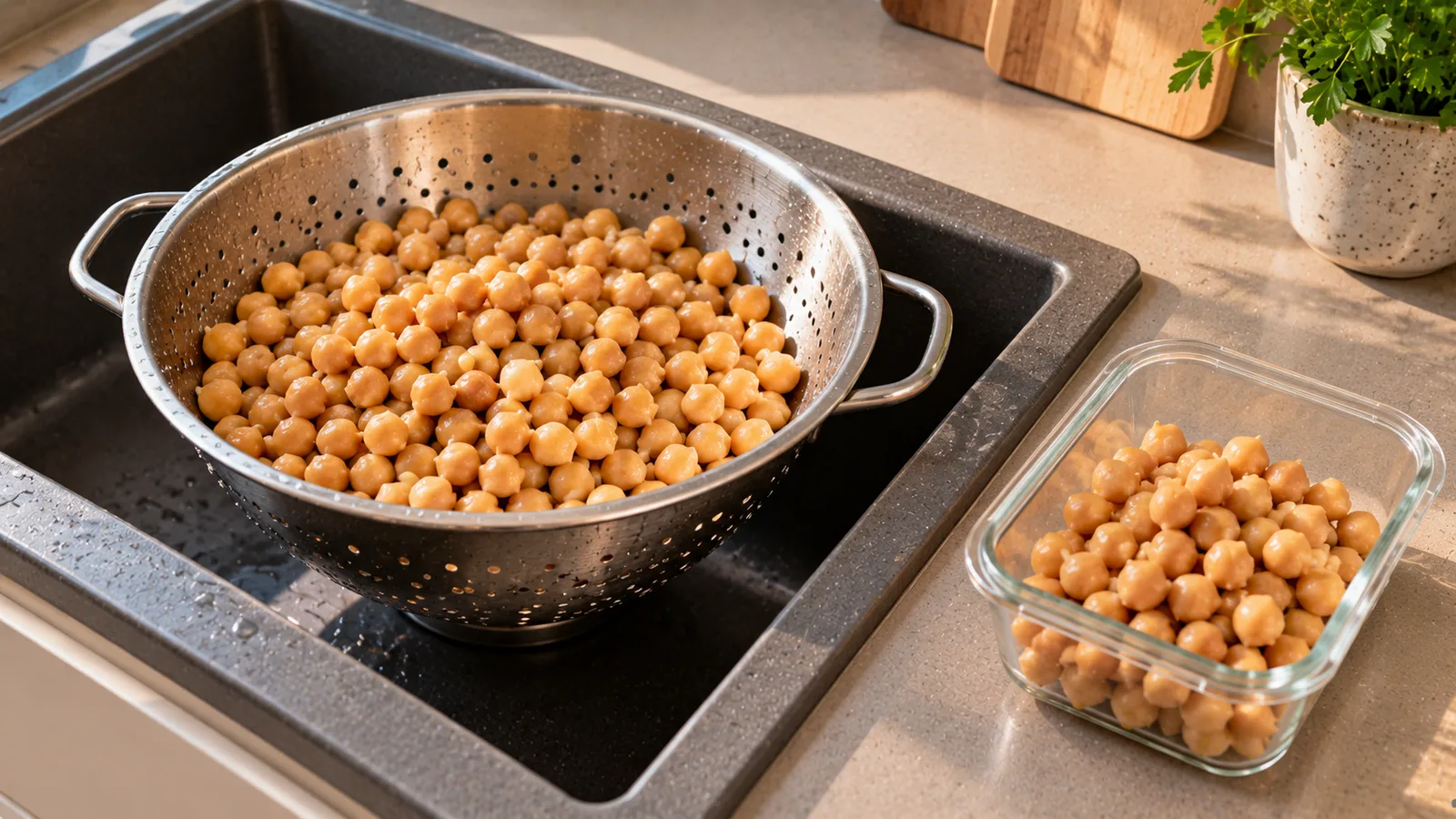
Chickpeas, also called garbanzo beans, are legumes that provide carbohydrates, plant protein and fiber.
A useful reference for plain cooked chickpeas is about 164 kcal per 100 g.
However, the number can change depending on whether the chickpeas are weighed dry, cooked or canned, and whether ingredients such as oil or sauce have been added.
Calories in cooked chickpeas
Approximate values for plain cooked chickpeas:
| Amount | Calories |
|---|---|
| 50 g | 82 kcal |
| 100 g | 164 kcal |
| 150 g | 246 kcal |
| 200 g | 328 kcal |
| 250 g | 410 kcal |
| 300 g | 492 kcal |
These are practical estimates rather than exact values for every chickpea product.
Nutrition per 100 g of cooked chickpeas
A typical 100 g portion of cooked chickpeas provides approximately:
| Nutrient | Per 100 g |
|---|---|
| Calories | 164 kcal |
| Protein | 8.9 g |
| Carbohydrates | 27.4 g |
| Fiber | 7.6 g |
| Fat | 2.6 g |
Exact values vary with the chickpea variety, cooking method and nutrition database.
Calories in 150 g of chickpeas
Using 164 kcal per 100 g:
150 × 164 ÷ 100 = 246 kcal
A 150 g portion of cooked chickpeas therefore contains approximately 246 kcal.
It also provides roughly:
- 13 g protein;
- 41 g carbohydrates;
- 11 g fiber;
- 4 g fat.
Calories in 200 g of chickpeas
Calculation:
200 × 164 ÷ 100 = 328 kcal
A 200 g serving of plain cooked chickpeas is therefore approximately 328 kcal.
Any oil, dressing, sauce or other ingredients should be counted separately.
Calories in one cup of cooked chickpeas
A cup measurement is less precise than weighing because the exact amount depends on how the chickpeas fill the cup.
One cup of cooked chickpeas is commonly around 160–165 g.
Using 164 kcal per 100 g gives approximately:
260–270 kcal per cup
If accurate tracking matters, use the actual weight rather than relying only on volume.
Dry vs cooked chickpeas
Dry chickpeas contain much less water than cooked chickpeas.
For that reason, 100 g of dry chickpeas has a much higher calorie concentration than 100 g of cooked chickpeas.
A simplified comparison:
| Chickpeas | Approx. calories per 100 g |
|---|---|
| Dry | ~360–380 kcal |
| Cooked | ~164 kcal |
Cooking does not remove most of the energy.
The chickpeas absorb water, increasing their weight.
The same calories are therefore distributed across a larger cooked mass.
Match the nutrition entry to the weight
This is one of the most important rules when tracking chickpeas.
If you weigh chickpeas dry, use nutrition data for dry chickpeas.
If you weigh chickpeas after cooking, use nutrition data for cooked chickpeas.
Using dry nutrition values with cooked weight can substantially overestimate calories.
Using cooked values with dry weight can substantially underestimate them.
For a deeper explanation, see Raw vs Cooked Weight: How It Changes Calorie Tracking.
Protein in chickpeas
Cooked chickpeas provide about 8.9 g of protein per 100 g.
Approximate amounts:
| Cooked chickpeas | Protein |
|---|---|
| 100 g | 8.9 g |
| 150 g | 13.4 g |
| 200 g | 17.8 g |
| 250 g | 22.3 g |
Chickpeas can therefore contribute meaningfully to daily protein intake, especially in plant-based meals.
They also contain substantial carbohydrate, so they are not nutritionally equivalent to a concentrated protein source.
Carbohydrates in chickpeas
Cooked chickpeas provide approximately 27 g of carbohydrate per 100 g.
| Cooked chickpeas | Carbohydrates |
|---|---|
| 100 g | ~27 g |
| 150 g | ~41 g |
| 200 g | ~55 g |
| 250 g | ~69 g |
Their carbohydrate content is accompanied by fiber.
Fiber in chickpeas
Cooked chickpeas provide roughly 7–8 g of fiber per 100 g.
Approximate amounts:
| Cooked chickpeas | Fiber |
|---|---|
| 100 g | ~7.6 g |
| 150 g | ~11.4 g |
| 200 g | ~15.2 g |
| 250 g | ~19 g |
Values vary somewhat between products and databases.
Fat in chickpeas
Plain cooked chickpeas contain some naturally occurring fat, but they are not especially high-fat compared with foods such as nuts, seeds or oils.
A typical value is around 2.5–3 g of fat per 100 g cooked.
The fat content of a finished chickpea dish can be much higher if oil, tahini or other fat-rich ingredients are added.
Canned chickpeas
Canned chickpeas are already cooked and stored in liquid.
Their nutrition can differ from generic cooked-chickpea values because of:
- variety;
- processing;
- water content;
- whether the label refers to drained or undrained weight.
Check the package carefully.
The label may list nutrition:
- per 100 g as sold;
- per 100 g drained;
- per serving.
If you drain the chickpeas and weigh the drained portion, use drained-weight nutrition data when the package provides it.
Does rinsing canned chickpeas change the calories?
Rinsing mainly removes some of the packing liquid and substances dissolved in it.
For calorie tracking, the most useful approach is usually to use the nutrition information that matches the state you actually weigh.
If the label provides values for drained chickpeas and you weigh them after draining, use those values.
Do not assume that rinsing creates a large predictable calorie reduction unless the product information specifically supports that calculation.
Chickpeas cooked from dry
If you cook chickpeas yourself, the final cooked weight depends on water absorption.
A reliable batch method is to start with the calories in the dry chickpeas.
Example:
You cook 300 g of dry chickpeas.
The package states:
370 kcal per 100 g dry
Total calories:
300 × 370 ÷ 100 = 1,110 kcal
After soaking and cooking, the chickpeas weigh 720 g.
Assuming no calorie-containing ingredients were added or discarded, the batch still represents approximately 1,110 kcal.
Calories per 100 g cooked:
1,110 ÷ 720 × 100 ≈ 154 kcal
If you eat 200 g:
200 × 154 ÷ 100 ≈ 308 kcal
This method accounts for the actual amount of water absorbed by your batch.
What about soaking?
Soaking changes the weight because dry chickpeas absorb water before cooking.
Water does not add calories.
This means a soaked chickpea weighs more than the same chickpea when dry, while its energy has not increased simply because it absorbed water.
For accurate batch tracking, using the original dry amount and the final cooked weight is often the simplest method.
Chickpeas with oil
Oil can significantly change the calorie density of a chickpea dish.
For example:
200 g cooked chickpeas ≈ 328 kcal
Add 10 g of oil:
10 g oil ≈ 90 kcal
Combined total:
328 + 90 ≈ 418 kcal
Additional ingredients should also be included.
Roasted chickpeas
Roasted chickpeas often appear more calorie-dense per 100 g than boiled chickpeas.
There are two main reasons:
- roasting removes water;
- oil may be added.
As water is lost, the food becomes lighter without losing the same proportion of calories.
This concentrates calories per 100 g.
If oil is added, the calorie total rises further.
For packaged roasted chickpeas, use the product label rather than a generic cooked-chickpea entry.
Chickpeas in salad
A chickpea salad may include:
- chickpeas;
- vegetables;
- olive oil;
- cheese;
- avocado;
- nuts or seeds;
- dressing.
The chickpeas may be easy to estimate, but the entire salad can contain substantially more calories.
Oil-based dressing, cheese, avocado, nuts and seeds can make a particularly noticeable difference.
Chickpeas in curry
A chickpea curry may contain:
- chickpeas;
- oil;
- onions;
- tomatoes;
- coconut milk;
- cream;
- vegetables;
- rice or bread served alongside it.
Two chickpea curries of the same weight can therefore have very different calorie values.
For homemade curry, calculating the complete recipe is usually more accurate than logging the dish as plain chickpeas.
Chickpea soup and stew
Soups and stews contain additional water and often several other ingredients.
A 300 g bowl of chickpea soup is not equivalent to 300 g of cooked chickpeas.
Depending on the recipe, it may contain much less actual chickpea by weight.
Track the whole recipe when possible.
Hummus is not the same as chickpeas
Hummus is made from chickpeas but usually also contains ingredients such as:
- tahini;
- oil;
- lemon juice;
- seasonings.
Tahini and oil increase its calorie density.
For that reason, do not use plain cooked-chickpea nutrition data to estimate an equal weight of hummus.
Use a hummus-specific nutrition entry or calculate the recipe.
Chickpea flour
Chickpea flour is another concentrated form.
It contains very little water compared with cooked chickpeas.
As a result, its calories per 100 g are much higher than those of boiled chickpeas.
Use the nutrition label for chickpea flour rather than a cooked-chickpea value.
How to calculate calories from chickpea weight
If the cooked chickpeas you use contain 164 kcal per 100 g:
Calories = weight in grams × 164 ÷ 100
Examples:
125 g
125 × 164 ÷ 100 = 205 kcal
175 g
175 × 164 ÷ 100 = 287 kcal
225 g
225 × 164 ÷ 100 = 369 kcal
300 g
300 × 164 ÷ 100 = 492 kcal
If your package gives a different value, substitute that number in the formula.
Calculating a complete chickpea recipe
Suppose a recipe contains:
- 500 g cooked chickpeas: 820 kcal;
- 20 g olive oil: ~180 kcal;
- vegetables: 180 kcal;
- sauce: 120 kcal.
Total:
820 + 180 + 180 + 120 = 1,300 kcal
Suppose the finished dish weighs 1,250 g.
Calories per 100 g:
1,300 ÷ 1,250 × 100 = 104 kcal
A 350 g serving would contain:
350 × 104 ÷ 100 = 364 kcal
This method is more reliable than assuming the finished recipe has the same calorie density as plain chickpeas.
Chickpeas and portion size
Because chickpeas provide both energy and useful nutrients, the appropriate portion depends on the rest of the meal.
For example, a meal containing chickpeas plus rice, bread, oil and avocado has a different overall energy profile from chickpeas served mainly with vegetables.
Instead of deciding that one chickpea portion is universally correct, consider:
- total meal size;
- other carbohydrate sources;
- other protein sources;
- added fats;
- your overall calorie and nutrition goals.
Are chickpeas good for weight management?
Chickpeas can fit into a weight-management diet.
They provide protein and fiber and can be used in satisfying meals.
However, no individual food causes weight loss.
Overall calorie intake, portion sizes and the broader eating pattern remain important.
Preparation also matters.
Plain cooked chickpeas and chickpeas roasted generously with oil can have very different calorie densities.
Chickpeas in a balanced meal
Chickpeas can serve as both a plant-protein source and a carbohydrate-containing food.
A meal might combine them with:
- vegetables;
- herbs and spices;
- another protein source if needed;
- grains or bread depending on the meal;
- a measured amount of oil or dressing.
There is no requirement to use exactly the same portion in every meal.
Common calorie-tracking mistakes with chickpeas
Using dry values for cooked chickpeas
The absorbed water makes cooked chickpeas much heavier.
Using cooked values for dry chickpeas
This produces the opposite error.
Ignoring oil
Oil used for roasting, frying or dressing can substantially increase calories.
Logging hummus as plain chickpeas
Hummus usually contains tahini and other ingredients.
Treating canned and dry weights as interchangeable
Check whether the nutrition label refers to drained, undrained or dry weight.
Logging an entire curry as chickpeas
A mixed dish needs the other ingredients included.
Assuming every 100 g serving is identical
Water content and preparation can change calorie density.
Quick reference
| Cooked chickpeas | Approx. calories | Approx. protein |
|---|---|---|
| 50 g | 82 kcal | 4.5 g |
| 100 g | 164 kcal | 8.9 g |
| 150 g | 246 kcal | 13.4 g |
| 200 g | 328 kcal | 17.8 g |
| 250 g | 410 kcal | 22.3 g |
| 300 g | 492 kcal | 26.7 g |
These figures work as general estimates for plain cooked chickpeas.
For packaged products, the nutrition label for the specific product is usually the better source.
Nutrition data sources
Reference values below are per 100 g of the specified food. Product varieties and preparation methods can differ.
- USDA FoodData Central — Chickpeas (garbanzo beans, bengal gram), mature seeds, cooked, boiled, without salt (FDC 173757; 164 kcal/100 g).
- USDA FoodData Central — Chickpeas, (garbanzo beans, bengal gram), dry (FDC 2644282; 371.99 kcal/100 g).