
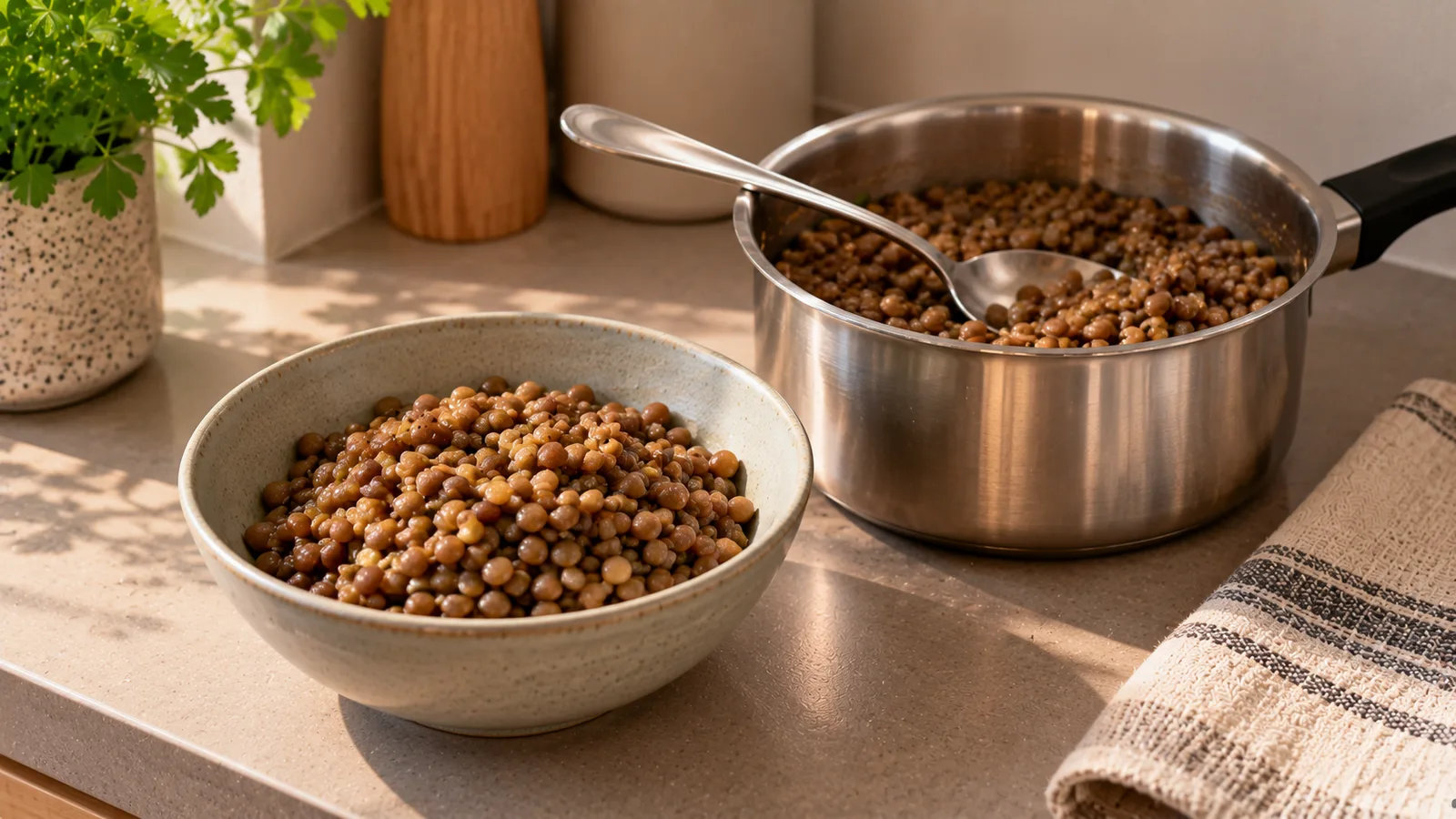
Lentils are a nutrient-dense legume that provides carbohydrates, plant protein and fiber.
The calorie value you see for lentils can vary substantially depending on whether the weight refers to dry or cooked lentils.
That distinction matters when tracking them.
Calories in cooked lentils
Cooked lentils provide approximately:
| Amount | Calories |
|---|---|
| 50 g | 58 kcal |
| 100 g | 116 kcal |
| 150 g | 174 kcal |
| 200 g | 232 kcal |
| 250 g | 290 kcal |
These are practical estimates for plain boiled lentils without added oil, butter or sauce.
Exact values vary somewhat by lentil variety, cooking method and nutrition database.
Nutrition per 100 g of cooked lentils
A typical 100 g portion of boiled lentils contains approximately:
| Nutrient | Per 100 g |
|---|---|
| Calories | 116 kcal |
| Protein | 9.0 g |
| Carbohydrates | 20.1 g |
| Fiber | 7.9 g |
| Fat | 0.4 g |
Lentils are therefore relatively low in fat while providing both protein and fiber.
Why dry lentils have more calories per 100 g
Dry lentils and cooked lentils are not nutritionally different simply because they have been boiled.
The major difference is water.
During cooking, lentils absorb water and become heavier.
This spreads roughly the same energy across a larger cooked weight.
For example, 100 g of dry lentils may contain roughly 350 kcal, while 100 g of cooked lentils may contain around 116 kcal.
That does not mean cooking removed most of the calories.
It means the cooked lentils contain much more water.
Dry vs cooked lentils
A simplified comparison looks like this:
| Lentils | Approx. calories per 100 g |
|---|---|
| Dry | ~350 kcal |
| Cooked | ~116 kcal |
The exact relationship depends on how much water the lentils absorb.
This is why you should always match the state of the food you weighed to the nutrition entry you use.
If you weigh cooked lentils, use a cooked-lentil entry.
If you weigh them dry, use a dry-lentil entry.
For a detailed explanation, see Raw vs Cooked Weight: How It Changes Calorie Tracking.
Calories in 150 g of cooked lentils
Using 116 kcal per 100 g:
150 g × 116 ÷ 100 = 174 kcal
A 150 g cooked portion therefore contains approximately 174 kcal.
It also provides roughly:
- 13.5 g protein;
- 30 g carbohydrates;
- 11.9 g fiber;
- less than 1 g fat.
Calories in 200 g of cooked lentils
Calculation:
200 g × 116 ÷ 100 = 232 kcal
A 200 g serving is therefore approximately 232 kcal before additional ingredients are included.
Calories in one cup of lentils
A cup is less precise than weighing because cup volume can vary with the lentil type, cooking level and how densely the lentils are packed.
A cup of cooked lentils is commonly around 190–200 g.
At approximately 116 kcal per 100 g, that gives roughly:
220–230 kcal per cup
If accuracy matters, weighing the cooked portion is more reliable.
Protein in lentils
Cooked lentils provide about 9 g of protein per 100 g.
Approximate amounts:
| Cooked lentils | Protein |
|---|---|
| 100 g | 9 g |
| 150 g | 13.5 g |
| 200 g | 18 g |
| 250 g | 22.5 g |
This makes lentils a useful plant-based protein source.
However, lentils also contain a meaningful amount of carbohydrate, so they should not be treated nutritionally as if they were equivalent to a very lean meat or isolated protein product.
Carbohydrates in lentils
Cooked lentils contain roughly 20 g of total carbohydrate per 100 g.
That means approximately:
| Cooked lentils | Carbohydrates |
|---|---|
| 100 g | 20 g |
| 150 g | 30 g |
| 200 g | 40 g |
| 250 g | 50 g |
A substantial portion of their carbohydrate content is accompanied by fiber.
Fiber in lentils
Cooked lentils can provide around 8 g of fiber per 100 g.
For example:
| Cooked lentils | Fiber |
|---|---|
| 100 g | ~8 g |
| 150 g | ~12 g |
| 200 g | ~16 g |
Actual values depend on variety and database.
This combination of fiber and protein is one reason lentils can make a substantial component of a meal.
Green, brown and red lentils
Different lentil varieties can have slightly different nutrition values, but preparation often creates a larger practical difference in calorie tracking than color alone.
Green lentils
They usually retain their shape relatively well after cooking and are often used in salads and side dishes.
Brown lentils
Common in soups, stews and everyday lentil dishes.
Red lentils
They soften and break down more readily, making them common in soups, dals and purées.
If a package provides nutrition information for a specific product, use that information when appropriate.
Do red lentils have more calories?
Not necessarily in a practically meaningful way.
Differences between varieties are usually small compared with the difference between:
- dry and cooked weight;
- plain lentils and lentils cooked with added fat;
- different portion sizes.
When tracking calories, matching the preparation state is generally more important than assuming one lentil color has a dramatically different calorie value.
Canned lentils
Canned lentils are already cooked and contain water.
Their nutrition can differ somewhat from home-boiled lentils.
The label may give values:
- per 100 g as sold;
- per 100 g drained;
- per serving.
Check the wording carefully.
If you drain the lentils and weigh the drained portion, a nutrition value based on drained weight is preferable when available.
Lentil soup is not the same as plain lentils
A bowl of lentil soup cannot be estimated accurately from the weight of lentils alone.
Soup may contain:
- vegetables;
- potatoes;
- meat;
- oil;
- cream;
- coconut milk;
- stock;
- noodles or grains.
For example, 300 g of plain cooked lentils and 300 g of lentil soup can have very different calorie values.
For homemade soup, calculate the ingredients for the entire recipe and divide by the final yield or number of portions.
Added oil can change the total quickly
Plain cooked lentils are relatively low in fat.
But many lentil dishes include oil.
For example, if a lentil dish contains 10 g of oil, the oil itself contributes roughly 90 kcal.
So:
200 g plain cooked lentils ≈ 232 kcal
If the portion also contains the equivalent of 10 g oil:
232 + 90 ≈ 322 kcal
Other ingredients must be included separately.
Lentils with rice
Lentils and rice are often eaten together.
The calorie total depends on the amount of each.
Example:
- 150 g cooked lentils: ~174 kcal;
- 150 g cooked rice: calorie value depends on the rice type and preparation;
- oil or sauce: additional calories.
Do not log the entire bowl as lentils.
Track the major components separately when a more accurate estimate is needed.
Lentil curry and dal
Dal and lentil curries may include:
- lentils;
- oil or ghee;
- onions;
- tomatoes;
- coconut milk or cream;
- vegetables;
- spices.
The lentils themselves may represent only part of the dish's total calories.
Two servings of the same weight can differ substantially depending on the recipe.
For homemade dishes, recipe-level calculation is usually more reliable.
Lentil salad
A lentil salad might contain:
- cooked lentils;
- vegetables;
- cheese;
- nuts or seeds;
- olive oil;
- dressing.
Vegetables may add relatively little energy, while oil, cheese, nuts and seeds can make a larger difference.
If you are estimating a lentil salad, pay particular attention to the dressing and other energy-dense additions.
How to calculate calories from the weight
If your cooked lentils contain 116 kcal per 100 g:
Calories = weight in grams × 116 ÷ 100
Examples:
175 g
175 × 116 ÷ 100 = 203 kcal
225 g
225 × 116 ÷ 100 = 261 kcal
300 g
300 × 116 ÷ 100 = 348 kcal
The same method works with the exact nutrition value printed on your package.
How to track a whole batch
Suppose you cook 300 g of dry lentils.
The package says:
350 kcal per 100 g dry
Total calories before cooking:
300 × 350 ÷ 100 = 1,050 kcal
After cooking, the lentils weigh 750 g.
The entire cooked batch still represents approximately 1,050 kcal, assuming nothing caloric was added or discarded.
Calories per 100 g cooked:
1,050 ÷ 750 × 100 = 140 kcal
If you then eat 200 g:
200 × 140 ÷ 100 = 280 kcal
This method is particularly useful because the final cooked weight can vary depending on water absorption.
What if you add ingredients during cooking?
Include all calorie-containing ingredients.
For example:
- 300 g dry lentils: 1,050 kcal;
- 20 g olive oil: ~180 kcal;
- vegetables: calculate separately.
If the vegetables contribute 150 kcal, the entire pot contains:
1,050 + 180 + 150 = 1,380 kcal
If the finished dish weighs 1,200 g:
1,380 ÷ 1,200 × 100 = 115 kcal per 100 g
A 350 g serving would then contain approximately:
350 × 115 ÷ 100 = 403 kcal
This is more accurate than logging the finished dish as plain cooked lentils.
Common tracking errors
Using dry nutrition for cooked weight
This can dramatically overestimate calories.
Using cooked nutrition for dry weight
This can dramatically underestimate calories.
Ignoring cooking oil
Lentils themselves are low in fat, but the finished recipe may not be.
Logging lentil soup as plain lentils
Soup includes water and often many additional ingredients.
Treating every lentil dish as identical
Dal, lentil curry, lentil salad and plain boiled lentils can have very different calorie densities.
Estimating cups when a scale is available
Volume measurements are useful, but grams are usually more consistent.
Are lentils good for weight management?
Lentils can fit well into many weight-management diets because they provide protein and fiber along with moderate calorie density when cooked plainly.
But no single food causes weight loss.
Total energy intake, overall dietary pattern, portions and consistency remain important.
A lentil meal can also become considerably more calorie-dense when large quantities of oil, cream, cheese or other energy-dense ingredients are added.
Lentils in a balanced meal
Lentils can function as both a carbohydrate-containing food and a plant protein source.
A meal might combine them with:
- vegetables;
- grains or potatoes if desired;
- yogurt or another protein source;
- herbs and spices;
- a measured amount of oil or dressing.
The appropriate combination depends on the rest of your diet and your goals.
Quick reference
| Portion of cooked lentils | Approx. calories | Approx. protein |
|---|---|---|
| 50 g | 58 kcal | 4.5 g |
| 100 g | 116 kcal | 9 g |
| 150 g | 174 kcal | 13.5 g |
| 200 g | 232 kcal | 18 g |
| 250 g | 290 kcal | 22.5 g |
| 300 g | 348 kcal | 27 g |
Use these numbers as practical estimates rather than exact values for every lentil product.
Nutrition data sources
Reference values below are per 100 g of the specified food. Product varieties and preparation methods can differ.
- USDA FoodData Central — Lentils, mature seeds, cooked, boiled, without salt (FDC 172421; 116 kcal/100 g).
- USDA FoodData Central — Lentils, dry (FDC 2644283; 350.93 kcal/100 g).