
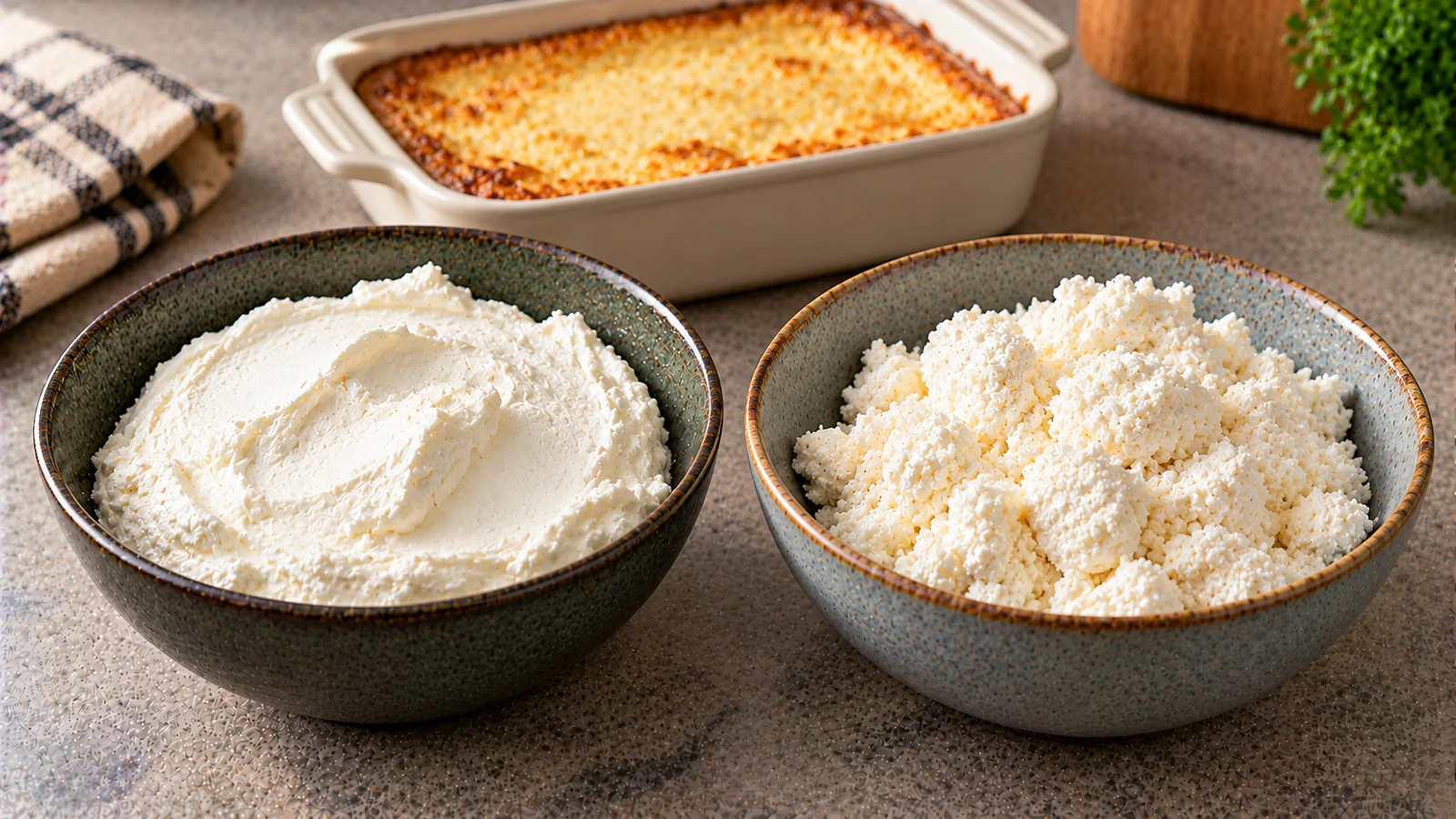
Baking with quark and baking with ricotta are not interchangeable decisions. Both are fresh dairy foods, both can form a soft filling, and both are often sold in tubs, but the amount of fat, protein, visible curd and mobile liquid can change a cake or savoury bake. A comparison that only says which food has more protein misses the main practical question: what will happen in the oven, and what should you change in the recipe?
For a concrete comparison, this guide uses ja! Speisequark Magerstufe and Galbani Ricotta Cremosa, rather than pretending that every quark and every ricotta has the same composition. The nutritional figures are those published for these specific products, not laboratory measurements of a baked dish. The prices below are an illustrative German shopping scenario, not a current REWE checkout quotation.
Quick answer: which is better for baking?
Choose low-fat quark when you want a relatively tangy, dense dairy filling with more protein and very little fat, and your recipe already includes enough egg, starch or other structure. Choose ricotta when you want softer curds and more fat-driven richness, such as a delicate baked filling or a savoury pie. Neither is automatically more moist after baking: free water, draining, oven heat and the other ingredients determine that result.
If you replace ricotta with low-fat quark, expect a leaner and potentially firmer or sharper-tasting result. If you replace quark with ricotta, the filling may become richer, milder and less smooth unless the ricotta is blended. A one-to-one replacement by weight is a starting test, not a reliable universal instruction.
What the actual product labels say
The comparison uses two packages sold through REWE: ja! quark at the fat-free end of the quark range and Galbani ricotta formulated with cream and whey-derived ingredients. The labels show a large fat difference, which matters much more in baking than a marketing description such as “creamy.” Read the exact pack you buy because formulations can change. See the ja! quark label and the Galbani ricotta label.
| Label figure per 100 g | ja! low-fat quark | Galbani Ricotta Cremosa |
|---|---|---|
| Energy | 67 kcal | 164 kcal |
| Protein | 12.3 g | 8 g |
| Total fat | 0.2 g | 12 g |
| Carbohydrate | 4.1 g | 6 g |
| Salt | 0.10 g | 0.40 g |
Quark provides 4.3 g more protein per 100 g in this comparison, while ricotta supplies 11.8 g more fat and 97 more kcal. This does not mean that ricotta always has less protein: another ricotta label may be different. In fact, a separate Marca Italia ricotta example lists 10 g protein and 9 g fat per 100 g. Ingredient choice must be product-specific.
The moisture question: wet is not the same as creamy
Many recipes call quark “wet” and ricotta “dry,” or make exactly the opposite claim. Neither shorthand is dependable. Low-fat quark usually looks smooth and cohesive, but it may release whey when stirred, salted or heated. Ricotta shows soft curds and may contain visible liquid; formulations with extra cream can still feel rich despite some separated whey.
Neither of the two product labels above declares water content, so we cannot infer a tested moisture percentage from the nutrition panel. You can make a rough mass-balance observation, but it would be misleading to label all remaining weight as pure water: minerals, organic acids and other solids also contribute. The practical check is to stir each product separately, rest it in a sieve for ten minutes, and record any liquid collected. Do not treat that quick kitchen test as a scientific moisture assay.
In the oven, both products lose some moisture. The same 300 g of dairy can finish at different weights depending on pan surface, temperature, baking time, flour, eggs and whether the filling is covered. Water loss changes kcal per 100 g of finished bake, but not the total calories of ingredients merely because water evaporates. Our guide to Portion Size vs Serving Size: What’s the Difference? explains why a stated serving must specify the weight actually served.
Why fat and protein change the texture
Protein helps a baked filling set when heated, particularly alongside egg proteins. But “more protein” does not translate into “always firmer”: acidity, mixing, egg amount, starch and the treatment of the dairy all matter. Very lean quark can bake up more tightly and may develop a grainy or squeaky mouthfeel if driven too hot. A high-ricotta batter may be softer and feel richer because fat changes lubrication and mouthfeel; that does not guarantee a more stable slice.
A recipe built around low-fat quark may include some butter, cream, oil or eggs for a balanced crumb. Replacing it with ricotta while keeping every added fat unchanged can alter the richness and structure. Conversely, replacing ricotta with low-fat quark may make a pastry filling noticeably less rich. Do not compensate with random extra water: that can weaken a set filling and create seepage at the base.
Worked substitution: 300 g of dairy in a filling
Consider two identical hypothetical fillings differing only in their 300 g dairy component. The flour, eggs, sugar and any butter are held constant and are deliberately excluded from this particular calculation. Multiply each per-100-g label value by three; these numbers describe only the dairy, not a complete cheesecake.
| Dairy contribution for 300 g | Low-fat quark | Ricotta |
|---|---|---|
| Energy | 201 kcal | 492 kcal |
| Protein | 36.9 g | 24 g |
| Fat | 0.6 g | 36 g |
| Carbohydrate | 12.3 g | 18 g |
| Illustrative dairy cost | €0.95 | €2.39 |
Here the substitution adds 291 kcal and 35.4 g fat to the full mixture if you switch from quark to ricotta at equal weight, while reducing the dairy's protein by 12.9 g. It is not correct to divide those changes by a guessed number of slices and call that a real cake's nutritional label. First account for every other ingredient; then weigh or define the slices. For a worked approach, see How to Calculate Nutrition per Slice of a Homemade Loaf or Cake.
Before baking: use a short test to control the filling
Start with 100 g of the dairy you intend to use. Stir gently, not with a high-speed mixer. If the ricotta is granular and the recipe expects a perfectly smooth cheese layer, press it through a sieve or blend it briefly. For quark, stir out large lumps without incorporating excessive air. Put a spoonful of each on a plate for five minutes. A ring of released whey warns that your formula may benefit from draining or a starch adjustment.
If the original recipe names an exact brand or fat percentage, prioritize that information over generic advice. A ricotta sold as “creamy” can behave differently from a traditional basket-drained ricotta. A 20% or 40% fat-in-dry-matter designation should not be confused with grams of fat per 100 g of finished food; use the nutrition table for that number. Under EU Regulation 1169/2011, nutrition figures are generally declared on a per-100-g basis, making side-by-side comparisons possible.
Cheesecake, muffins, pastries and savoury bakes
For baked cheesecake, lean quark can provide a tangy, dense center, while ricotta can create a gentler grain and richer mouthfeel. A recipe designed for one should not be switched blindly: adjust slowly, test a small batch and keep the same pan depth. If the top colors before the center sets, reduce aggressive heat rather than simply baking longer.
For muffins and quick breads, adding quark can increase protein in the batter while adding water and acidity. Ricotta contributes a different fat-to-protein balance. Either may work in a recipe formulated for it, but swapping 200 g without checking the rest of the liquid ingredients can make the crumb heavy or uneven.
For filled pastries, lasagne and spinach bakes, ricotta curds can give a characteristic soft filling. Quark is often smoother and tangier; draining and extra seasoning may be more important than calories. If a cheese filling needs to hold shape when cut, look at egg, breadcrumbs or starch in the original formula, not only the dairy's protein number.
Why the oven can mislead calorie tracking
Imagine the hypothetical 300 g dairy portion is part of a mixture that weighs 600 g before cooking. After baking it weighs 520 g because moisture escaped. The total energy added by the dairy remains 201 or 492 kcal in the two examples; evaporation does not produce or remove dairy fat or protein. The concentration of calories per 100 g of finished cake can increase because the denominator shrank, but the complete calorie total also depends on flour, sugar, eggs and additions.
For an accurate homemade recipe log, add the nutrition of every raw ingredient and record the actual baked yield. Then calculate per slice based on its measured weight. If a slice is 65 g from a 520-g cake, it is one eighth of the total, not automatically one eighth of a previous 600-g unbaked mass. The page Calories in Quark: Nutrition and Serving Sizes covers quark as a food, while Calories in Ricotta: Nutrition and Serving Sizes has separate ricotta serving values; this article focuses on what happens when you bake them.
Price per tub versus price per usable recipe amount
REWE states that concrete shelf prices depend on the location, so the figures here are hypothetical example prices, not a verified offer: suppose a 500-g quark tub costs €1.59 and a 250-g ricotta tub costs €1.99. Your supermarket could have different brands, discounts and pack sizes.
| Shopping calculation | Quark (€1.59/500 g) | Ricotta (€1.99/250 g) |
|---|---|---|
| Price per 100 g | €0.32 | €0.80 |
| Cost of 250 g used | €0.80 | €1.99 |
| Cost of 300 g used | €0.95 | €2.39 |
| Cost of 500 g used | €1.59 | €3.98 |
| Amount needed for 20 g protein | 163 g | 250 g |
| Approximate cost for 20 g protein | €0.52 | €1.99 |
Buying 300 g ricotta might require two 250-g tubs, so the money spent at checkout could be €3.98 even though only €2.39 of ricotta is used. The leftover is still an ingredient and should not all be charged to the initial cake unless it will go to waste. Conversely, a 300-g quark recipe uses part of a 500-g tub. Compare usable grams and total purchase separately; neither dairy is automatically cheaper in every country or store.
Allergens, egg safety and chilled storage
Both selected foods are milk products and not suitable for people with a milk-protein allergy. Lactose content and tolerance also differ between people, and ordinary quark or ricotta should not be presented as universally lactose-free. Read the individual label, including any additional ingredients. The German Nutrition Society's dairy guidance offers wider dietary context, not a promise about a specific recipe.
If a baked dairy filling contains eggs, the FDA recommends cooking egg dishes to 71°C / 160°F, checked with a thermometer; oven dial temperature is not the internal temperature of the custard. Cool prepared dishes promptly and refrigerate. FoodSafety.gov recommends chilling leftovers within two hours and using refrigerated leftovers within three to four days. Always follow an earlier use-by date or product-specific instruction when it is stricter.
How to make the decision in the supermarket
First, read the exact fat and protein numbers rather than assuming “quark” equals lean or “ricotta” equals a particular fat level. Second, ask what the recipe needs: a tangy smooth set, a soft granular filling or a spoonable mixture. Third, consider whether the recipe already includes oil, butter, cream or egg. Fourth, plan for draining or blending only when the product actually needs it. Finally, calculate the grams used and the pack price before calling a swap economical.
The most reliable substitution rule is simple but not effortless: start with a small trial at equal weight, observe the mixture, and adjust the formula rather than the headline protein number. A quark-and-skyr comparison answers a different question about everyday dairy uses; see Quark vs Skyr: Protein, Texture and Uses for that context. In baking, the ideal ingredient depends on texture and formulation, not one metric alone.
Sources
- REWE: ja! Speisequark Magerstufe, 500 g — product-specific nutrition per 100 g.
- REWE: Galbani Ricotta Cremosa, 250 g — product-specific nutrition and ingredients.
- REWE: Marca Italia Ricotta, 250 g — example of variation among ricottas.
- EU Regulation 1169/2011, food information to consumers — reference for food-label presentation.
- DGE: milk and dairy products — general dairy guidance.
- FDA: what you need to know about egg safety — internal temperature for egg dishes.
- FoodSafety.gov: safe handling of leftovers — cooling and storage timeframes.