
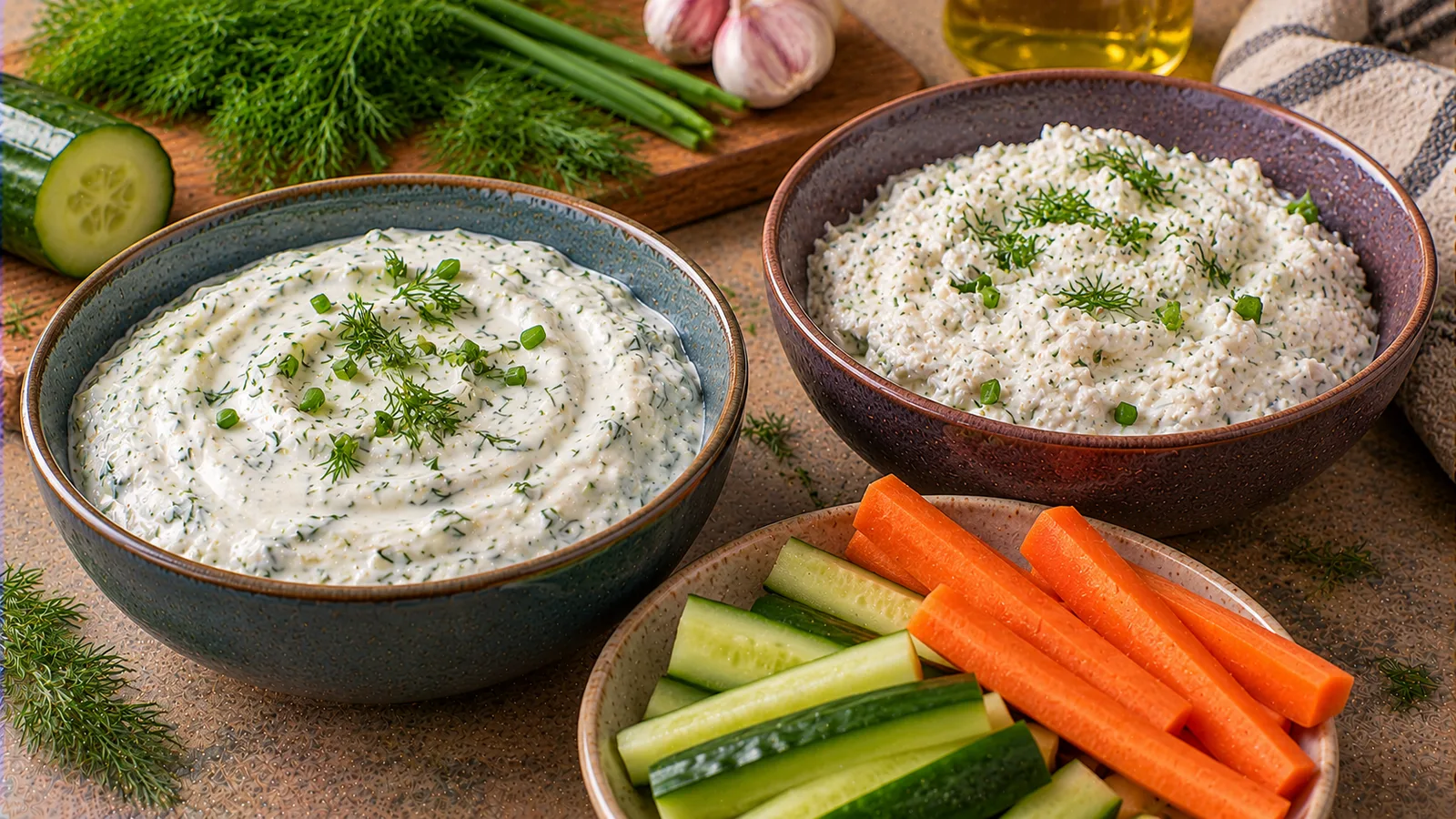
A savory yogurt dip and a quark dip can look almost identical beside roasted potatoes or vegetables, yet the dairy chosen for the same recipe can change protein, fat, texture and the cost of the bowl. This comparison keeps the recipe and the dairy weight identical. It does not compare a spoonful of yogurt with a large tub of quark, and it does not assume that every product labelled Greek yogurt has the same nutrition.
For an auditable example, we use Greco Greek cream yogurt, 10% fat, 450 g tub and ja! low-fat quark (Magerquark), 500 g tub. Their current product pages disclose nutrient declarations but require a shop location to display a price. Our euro figures are therefore illustrative prices, not a quote from REWE. Check the actual shelf label before shopping.
The two dairy labels: what is actually being compared?
The Greco Greek cream yogurt label lists 135 kcal, 6.8 g protein and 10 g fat per 100 g. The ja! Magerquark label lists 67 kcal, 12.3 g protein and 0.2 g fat per 100 g. These are two specific products, not an industry average. Greek-style yogurt can range from very rich varieties to low-fat strained versions with substantially different protein values.
| Label value | Greco Greek yogurt per 100 g | ja! Magerquark per 100 g |
|---|---|---|
| Energy | 135 kcal | 67 kcal |
| Protein | 6.8 g | 12.3 g |
| Total fat | 10.0 g | 0.2 g |
| Saturated fat | 6.9 g | 0.1 g |
| Sugars | 4.2 g | 4.1 g |
| Salt | 0.01 g | 0.10 g |
Both contain milk and are not suitable for someone with a milk-protein allergy. The listed sugar values are the total sugars on these plain dairy labels; they do not imply that table sugar was added. The two products also differ in fermentation and manufacturing, so their texture is not explained by fat alone. For background, the German Federal Centre for Nutrition (BZfE) describes why yogurt, quark and skyr differ in production and composition.
One matched garlic-and-herb dip: two versions
Make one bowl, approximately 284 g, using the same amounts with either dairy base. This yields two side-dip portions of approximately 142 g each. The weights refer to food actually added: squeeze the cucumber first and then weigh the 60 g of drained cucumber. That avoids silently comparing a watery yogurt dip with a thicker quark dip.
| Ingredient | Greek yogurt bowl | Quark bowl | Weight basis |
|---|---|---|---|
| Plain dairy base | 200 g | 200 g | As sold, chilled |
| Grated, squeezed cucumber | 60 g | 60 g | After squeezing |
| Lemon juice | 10 g | 10 g | Edible juice |
| Fresh dill | 5 g | 5 g | Finely chopped |
| Garlic | 4 g | 4 g | Peeled, crushed |
| Olive oil | 5 g | 5 g | Weighed, not an assumed spoon |
| Total nominal bowl | 284 g | 284 g | Before transfer losses |
- Wash and grate the cucumber. Squeeze it through a clean sieve or cloth, then weigh out 60 g. If you begin with 60 g before squeezing, your bowl will be lighter than the model.
- Stir 200 g of yogurt or 200 g of quark until smooth. Fold in cucumber, 10 g lemon juice, 5 g dill, 4 g crushed garlic and 5 g olive oil.
- Taste before adding salt: the dip already has the product's naturally declared salt, while optional seasoning would change the salt comparison. Refrigerate until served; use clean utensils.
- Divide into two equal bowls if serving with a meal. An approximate 142 g portion is a side condiment, not a complete high-protein lunch.
Texture in practice: Greco's rich yogurt produces a softer, glossy dip that flows easily over warm potatoes. Magerquark usually gives a firmer, more spreadable dip and a sharper tang. If you add 10–20 g of cold water to the quark to loosen it, the quark bowl becomes approximately 294–304 g, so it is no longer a strict 284 g weight comparison. The absolute protein contributed by the quark does not vanish when water is added; only its concentration per 100 g falls. Conversely, draining extra liquid from yogurt can make it thicker but changes yield.
Protein and calories in the same 200 g dairy base
First calculate the dairy contribution before cucumber, oil and herbs. Multiplying the label per-100-g figures by two avoids giving false precision to the nutrient contribution of small variable additions.
| From 200 g dairy alone | Greek yogurt | Magerquark | Quark minus yogurt |
|---|---|---|---|
| Protein | 13.6 g | 24.6 g | +11.0 g |
| Calories | 270 kcal | 134 kcal | −136 kcal |
| Total fat | 20.0 g | 0.4 g | −19.6 g |
| Saturated fat | 13.8 g | 0.2 g | −13.6 g |
| Total sugars | 8.4 g | 8.2 g | −0.2 g |
| Label salt | 0.02 g | 0.20 g | +0.18 g |
Thus the quark base provides 24.6 g versus 13.6 g of protein per whole bowl, and 12.3 g versus 6.8 g from the dairy in one half-bowl. The other ingredients contribute some nutrients, including the 5 g olive oil's energy and fat, so these figures are not total-recipe nutrition values. A full dietary calculation would use verified data for every ingredient and actual finished weight. The very low listed salt for Greco is reported as its manufacturer label, not laboratory measurement of a homemade dip; adding salt, pickles or seasoning would change it immediately.
A high-protein Greek yogurt is a different product from the 10%-fat Greco used here; some versions could match or exceed quark for protein. Likewise, full-fat quark would not have the low-fat figures above. Read the actual label, rather than treating the food names as interchangeable nutrient categories. EU Regulation 1169/2011 provides the framework for standardized nutrition declarations, including per-100-g values.
Cost of one bowl: used dairy versus full-pack checkout
For a transparent worked example, assume a €2.79 tub of 450 g Greco and a €1.29 tub of 500 g ja! quark. Also assume €0.55 for the used quantities of cucumber, lemon, dill, garlic and oil together, identical for both versions. These are illustrative inputs; the REWE product pages do not provide one nationwide live price.
| Cost component | Greek yogurt version | Quark version |
|---|---|---|
| Hypothetical full dairy pack | €2.79 / 450 g | €1.29 / 500 g |
| Dairy actually used: 200 g | €1.24 | €0.52 |
| Shared additions actually used | €0.55 | €0.55 |
| Ingredient cost per 284 g bowl | €1.79 | €1.07 |
| Ingredient cost per 142 g half-bowl | about €0.90 | about €0.53 |
| Dairy left in opened pack | 250 g | 300 g |
The formula is pack price ÷ pack grams × 200 g, plus the modeled €0.55 for other used ingredients. With unrounded arithmetic: yogurt is €2.79 ÷ 450 × 200 = €1.24; quark is €1.29 ÷ 500 × 200 = €0.516, or €0.52. Total costs round to €1.79 and €1.07. The estimated difference is €0.72 per whole bowl, or about €0.36 per half-bowl. Do not interpret leftover pack value as money returned to you.
If buying from an empty kitchen, the checkout is at least the full dairy pack rather than €1.24 or €0.52. You may also need to buy whole cucumber, herb and lemon packages, making the cash receipt greater still. The €0.55 is not a claim that you can buy all five additions for €0.55. Keep the receipts and price by actual grams used when comparing meals at home.
What if the price changes?
Do not assume quark will always be cheaper. Write down the real shelf prices at your store and compare the ratio price per 100 g for the two tubs, then multiply by 2 for this recipe. With the illustration above, yogurt costs approximately €0.62 per 100 g and quark €0.26 per 100 g. At promotional or different-brand prices, those numbers can change quickly. The shared €0.55 cancels out when calculating which base is cheaper, provided the other ingredients stay the same.
Which base makes the more useful dip?
Choose Greek yogurt for a rich, round mouthfeel, a thinner sauce for baked vegetables, or a dressing-style topping. The 10%-fat product supplies much more saturated fat per matched 200 g bowl; that may matter if you are specifically comparing saturated fat in your overall diet. Its 6.8 g of protein per 100 g is still protein, but this product is not especially protein-dense compared with the selected Magerquark.
Choose Magerquark when you want the dip to stay on a spoon, spread on bread, or offer more dairy protein for the same weight. It may need a little water and more acidity/herbs for a softer texture. A recipe asking for creamy, flowing tzatziki can change noticeably when yogurt is replaced 1:1 by quark. For a separate comparison of cultured dairy texture and protein rather than this exact dip, see quark versus skyr for protein, texture and kitchen uses.
A 50:50 blend of 100 g of each dairy base, with the same additions, gives a middle texture: calculated from dairy labels alone, 19.1 g protein and 202 kcal per full bowl, before the extras. Using the example prices, 100 g Greco costs €0.62 and 100 g quark costs about €0.26; after €0.55 of additions the ingredient cost is approximately €1.43. This is a practical compromise but requires access to both opened tubs; the cash cost of buying both is higher than the ingredient cost allocated to one bowl.
Storage, substitutions and common accounting mistakes
Keep both dairy products refrigerated as directed on the pack, prepare with clean utensils and return the finished dip promptly to refrigeration. The Greco page says store at a maximum of 7 °C; other products have their own label instructions. Use opened products within their stated storage guidance rather than treating a homemade herb-and-garlic dip as shelf-stable. If you are transporting a packed lunch, maintain a safe cold temperature. Discard dip that has sat unrefrigerated for an unsafe period; taste is not a safety test.
The biggest comparison mistakes are switching from a full-fat Greek yogurt to a 0%-fat high-protein Greek yogurt without adjusting the label figures, confusing the 450 g/500 g checkout with 200 g used cost, and using 60 g cucumber before squeezing in only one version. The same recipe can be scaled to four half-bowls by doubling every ingredient and calculating actual purchase needs. Do not claim either dip is a complete meal simply because the quark base contains more protein.