
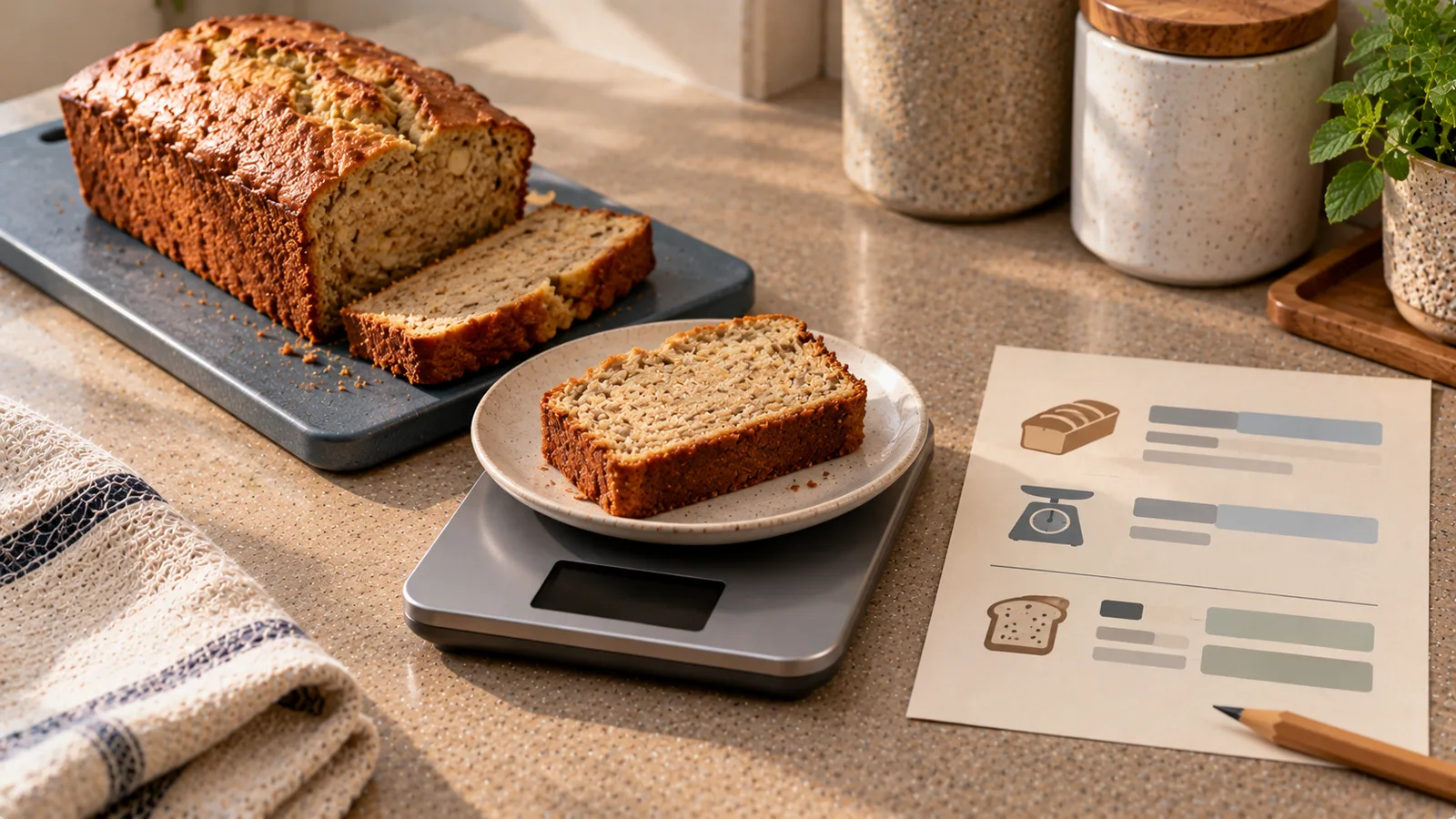
Homemade bread, loaf cakes and cakes are easy to track when every piece is identical. In real life, slices are rarely perfectly equal.
One slice may weigh 55 g, another 72 g and the final piece may be much smaller.
The most reliable way to calculate nutrition for unequal pieces is to calculate the nutrition of the entire recipe, weigh the finished baked food and then calculate nutrition according to the weight of the slice you actually eat.
The basic method
You need three pieces of information:
- the total nutrition of all ingredients;
- the finished weight of the baked loaf or cake;
- the weight of your slice.
Once you have those numbers, you can calculate the nutrition per gram and then multiply it by the weight of your portion.
For example, suppose your finished loaf contains:
- 2,400 kcal;
- 80 g protein;
- 320 g carbohydrate;
- 90 g fat.
After baking and cooling, the loaf weighs:
900 g
Calories per gram:
2,400 ÷ 900 = 2.67 kcal/g
If your slice weighs 70 g:
70 × 2.67 ≈ 187 kcal
The same method works for protein, carbohydrates and fat.
Why finished weight matters
A common mistake is to use the weight of the raw batter or dough.
During baking, water is usually lost.
Suppose your ingredients weigh 1,100 g before baking, but the finished loaf weighs 900 g. (USDA — FoodData Central)
The total calories have not disappeared simply because water evaporated.
The finished loaf therefore contains the same recipe energy in a smaller final mass.
Using the raw weight would underestimate the calorie density of the baked product.
For portion calculations, weigh the finished food after baking and preferably after it has cooled enough to reach a reasonably stable weight.
Step 1: calculate the whole recipe
Record every ingredient used in the recipe.
For example:
- flour: 500 g;
- eggs: 150 g;
- butter: 120 g;
- sugar: 180 g;
- milk: 200 g;
- other ingredients as applicable.
Calculate the nutrition contributed by each ingredient and add everything together.
Imagine the totals are:
| Nutrient | Whole recipe |
|---|---|
| Calories | 3,200 kcal |
| Protein | 72 g |
| Carbohydrates | 410 g |
| Fat | 140 g |
These totals belong to the entire baked item.
Step 2: weigh the finished product
After baking, remove packaging, baking paper or anything else that is not eaten.
Then weigh the finished loaf or cake.
Suppose it weighs:
1,050 g
This is your finished edible yield.
If you use a container or cake tin during weighing, subtract its weight.
Step 3: calculate nutrition per gram
Divide each total by the finished weight.
Calories:
3,200 ÷ 1,050 ≈ 3.05 kcal/g
Protein:
72 ÷ 1,050 ≈ 0.0686 g/g
Carbohydrates:
410 ÷ 1,050 ≈ 0.3905 g/g
Fat:
140 ÷ 1,050 ≈ 0.1333 g/g
You now have the nutritional value of one gram of the finished cake.
Step 4: weigh your slice
Suppose your slice weighs:
85 g
Multiply the per-gram values by 85.
Calories:
3.05 × 85 ≈ 259 kcal
Protein:
0.0686 × 85 ≈ 5.8 g
Carbohydrates:
0.3905 × 85 ≈ 33.2 g
Fat:
0.1333 × 85 ≈ 11.3 g
That is a much better estimate than assuming every slice contains exactly one-tenth of the recipe.
A faster method: calculate per 100 g
Instead of keeping per-gram numbers, you can calculate nutrition per 100 g.
Using the same recipe:
Finished weight: 1,050 g
Total calories: 3,200 kcal
Calories per 100 g:
3,200 ÷ 1,050 × 100 ≈ 305 kcal per 100 g
Protein:
72 ÷ 1,050 × 100 ≈ 6.9 g
Carbohydrates:
410 ÷ 1,050 × 100 ≈ 39.0 g
Fat:
140 ÷ 1,050 × 100 ≈ 13.3 g
You can save the homemade recipe using these per-100-g values.
If you later eat 63 g, 92 g or 110 g, your tracker can scale the nutrition automatically.
Why counting slices alone can be inaccurate
Suppose you cut a cake into eight pieces.
If every piece were exactly equal, each slice would contain:
1 ÷ 8 = 12.5% of the recipe
A 3,200 kcal cake would therefore contain:
3,200 ÷ 8 = 400 kcal per slice
But imagine the actual slice weights are:
- 105 g;
- 119 g;
- 126 g;
- 141 g;
- 132 g;
- 137 g;
- 150 g;
- 140 g.
Calling every one of them a 400 kcal slice ignores a substantial difference in portion size.
Weighing each portion solves this problem.
When equal slices are good enough
You do not always need to weigh every piece.
If you deliberately divide the food into nearly identical portions, dividing the recipe total by the number of servings can be perfectly practical.
For example:
Total recipe: 2,400 kcal
12 similar slices:
2,400 ÷ 12 = 200 kcal per slice
This is reasonable when the slices are genuinely similar.
The weight-based method becomes more useful when portions differ noticeably.
Worked example: banana bread
Suppose a homemade banana bread contains:
- 300 g flour;
- 300 g banana;
- 120 g sugar;
- 100 g butter;
- 100 g eggs;
- 150 g yogurt.
After entering the exact products and quantities, the recipe totals are:
- 2,850 kcal;
- 62 g protein;
- 390 g carbohydrates;
- 118 g fat.
After baking and cooling, the banana bread weighs:
920 g
Nutrition per 100 g
Calories:
2,850 ÷ 920 × 100 ≈ 310 kcal
Protein:
62 ÷ 920 × 100 ≈ 6.7 g
Carbohydrates:
390 ÷ 920 × 100 ≈ 42.4 g
Fat:
118 ÷ 920 × 100 ≈ 12.8 g
Now suppose you cut a slice weighing 74 g.
Calories:
310 × 0.74 ≈ 229 kcal
Protein:
6.7 × 0.74 ≈ 5.0 g
Carbohydrates:
42.4 × 0.74 ≈ 31.4 g
Fat:
12.8 × 0.74 ≈ 9.5 g
You can repeat the calculation for any slice regardless of its size.
Worked example: a frosted cake
Layered cakes can be handled using the same principle.
Suppose the cake layers contain:
3,600 kcal
The frosting contains:
1,400 kcal
Total:
3,600 + 1,400 = 5,000 kcal
After assembly, the complete edible cake weighs:
1,650 g
Calories per 100 g:
5,000 ÷ 1,650 × 100 ≈ 303 kcal
A 120 g piece contains approximately:
303 × 1.20 ≈ 364 kcal
This works best when the frosting and filling are reasonably distributed through the cake.
What if frosting is uneven?
A weight-based calculation assumes that the nutrients are distributed reasonably evenly throughout the finished food.
That assumption may be imperfect.
A corner piece with unusually thick frosting may contain more calories per gram than a piece with little frosting.
Likewise, a cake with concentrated fillings or toppings may not be nutritionally uniform.
For ordinary tracking, the recipe-average method is usually still practical.
If components differ dramatically, you can track them separately.
For example:
- weigh the cake slice;
- estimate or weigh additional frosting separately;
- add both entries.
What about crust and end pieces?
Bread crust may contain slightly less water than the center, making its energy density somewhat different by weight.
For normal food tracking, using the average nutrition of the entire loaf is usually sufficient.
You generally do not need separate nutrition entries for the crust and center.
Include every calorie-containing ingredient
Recipe calculations can become inaccurate when small ingredients are forgotten.
Common examples include:
- butter used to grease the tin;
- oil;
- chocolate chips;
- nuts;
- icing;
- glaze;
- syrup;
- cream;
- fillings.
If a meaningful amount ends up in the finished food, include it in the recipe.
What about ingredients left in the bowl?
Some batter or dough may remain on:
- mixing bowls;
- spoons;
- beaters;
- spatulas.
For most home recipes, attempting to measure every small residue is unnecessary.
If a substantial amount of batter is clearly discarded, the calculated recipe total may slightly overestimate the finished product.
You can account for a large measurable loss, but avoid creating false precision around tiny residues.
What if part of the cake is discarded?
Suppose the entire cake was calculated as 4,000 kcal.
After baking, you remove a burnt 80 g section and throw it away.
If you simply weigh the remaining cake but leave all 4,000 kcal assigned to it, you will overestimate its calorie density.
For a significant discarded portion, estimate and subtract the nutrition of the discarded food when practical.
For tiny crumbs or trimming losses, the difference is usually not worth reconstructing.
Use edible finished weight
The denominator should represent the food that can actually be eaten.
Do not include:
- baking paper;
- wrappers;
- removable decorations that are not eaten;
- the baking tin;
- packaging.
If something is included in the scale reading but will not be consumed, subtract its weight.
What if you forgot to weigh the whole loaf?
If you already cut the loaf before recording its finished weight, you can still recover the total.
Weigh all remaining slices and add the weight of portions already eaten if you know or can estimate them.
For example:
Remaining slices total: 720 g
Previously eaten slice: approximately 80 g
Estimated original finished weight:
720 + 80 = 800 g
This is less precise than weighing the loaf before cutting, but it can still be useful.
What if you forgot to weigh an eaten slice?
If the remaining slices are reasonably similar, use their average weight.
Suppose five remaining slices weigh:
- 62 g;
- 66 g;
- 64 g;
- 69 g;
- 65 g.
Average:
(62 + 66 + 64 + 69 + 65) ÷ 5 = 65.2 g
If the missing slice looked similar, about 65 g is a reasonable estimate.
Do not pretend it was exact.
Water loss changes weight, not recipe calories
This principle is central to homemade baking.
If dough contains 3,000 kcal before baking, ordinary water evaporation does not turn it into a 2,500 kcal loaf.
Instead, the loaf becomes lighter while most of the recipe energy remains.
That increases calories per gram.
For this reason, nutrition calculated from raw recipe weight should not be treated as finished-product nutrition per gram.
What if you add water?
Water contributes essentially no calories, but it changes the weight of the mixture.
Before baking, that can reduce calories per gram.
During baking, some of that water may evaporate again.
The final baked weight captures the result automatically.
That is why using the actual finished yield is so useful.
How to handle multiple batches
Suppose one dough produces two loaves.
The entire recipe contains:
4,800 kcal
After baking:
Loaf A weighs 760 g
Loaf B weighs 840 g
Total finished weight:
760 + 840 = 1,600 g
Average calorie density:
4,800 ÷ 1,600 = 3 kcal/g
If both loaves came from the same well-mixed dough, you can use the same average value.
A 90 g slice would contain approximately:
90 × 3 = 270 kcal
Muffins and cupcakes
The same method works when individual baked items differ in size.
Suppose 12 muffins contain:
2,640 kcal
Finished total weight:
960 g
Calories per gram:
2,640 ÷ 960 = 2.75 kcal/g
A 70 g muffin:
70 × 2.75 = 193 kcal
A 90 g muffin:
90 × 2.75 = 248 kcal
This is more accurate than assigning every muffin:
2,640 ÷ 12 = 220 kcal
when their sizes differ substantially.
Cookies
Cookies can also vary in size.
If the dough is well mixed, calculate the entire batch and weigh the finished cookies together.
Suppose:
Total batch: 3,300 kcal
Finished cookie weight: 1,100 g
Calories per gram:
3,300 ÷ 1,100 = 3 kcal/g
A 25 g cookie contains about:
25 × 3 = 75 kcal
A 40 g cookie contains about:
40 × 3 = 120 kcal
Saving a reusable homemade-food entry
If you make the same recipe repeatedly, save it as a recipe in your food tracker.
A useful approach is to store nutrition per 100 g of the finished food.
Next time you eat it:
- weigh your portion;
- enter the number of grams;
- let the tracker scale the saved nutrition.
However, if the finished yield changes substantially between batches, recalculate it.
Why the same recipe can vary between batches
Even with identical ingredients, finished weight can change because of:
- baking time;
- oven temperature;
- ingredient moisture;
- cooling time;
- evaporation;
- small ingredient differences.
Suppose one loaf finishes at 900 g and another at 820 g.
If both contain the same total calories, the second loaf is more calorie-dense per gram.
For highly accurate tracking, update the finished yield for each batch.
For ordinary tracking, a typical average may be sufficient if the variation is small.
Do you need to calculate every micronutrient?
Not necessarily.
If your main goal is calorie and macro tracking, you may focus on:
- calories;
- protein;
- carbohydrates;
- fat;
- fiber when relevant.
A recipe database may calculate vitamins and minerals automatically if the ingredient data includes them.
Do not invent missing micronutrient values simply to make the recipe look complete.
Avoid rounding too early
If you calculate:
2,850 ÷ 920 = 3.097826...
do not immediately round this to 3.1 and repeatedly use rounded intermediate values for every nutrient.
Keeping a few extra decimal places during calculation reduces cumulative rounding error.
Round the final portion result to a practical number.
For example:
228.7 kcal → 229 kcal
is usually sufficient.
A reusable calculation workflow
For any homemade loaf, cake, muffin batch or similar baked food:
- weigh or accurately measure every ingredient;
- calculate total recipe calories and macros;
- bake the food;
- weigh the finished edible product;
- calculate nutrition per gram or per 100 g;
- weigh the portion you eat;
- multiply the finished-food nutrition by your portion weight.
This method automatically handles unequal slices.
Quick formula
If you know the total recipe calories:
Calories in portion = total recipe calories × portion weight ÷ finished recipe weight
Example:
Total recipe = 3,200 kcal
Finished weight = 1,050 g
Slice = 85 g
3,200 × 85 ÷ 1,050 ≈ 259 kcal
You can use exactly the same structure for protein, carbohydrates, fat or another nutrient.
When dividing by slices is enough
Use a simple serving count when:
- pieces are intentionally similar;
- you do not need high precision;
- weighing each slice would add unnecessary effort.
Use finished-weight calculations when:
- slices differ visibly;
- you cut different portion sizes;
- you want to log by grams;
- the recipe is eaten gradually over several days;
- several people take different amounts.
Common calculation errors
The most important mistakes to avoid are:
- dividing by raw dough weight instead of finished weight;
- forgetting calorie-containing ingredients;
- including the baking tin in finished weight;
- assuming visibly unequal slices are equal;
- using nutrition per 100 g as if it were nutrition for the whole slice;
- forgetting to scale macros along with calories;
- counting toppings separately when they were already included in the recipe;
- using a database entry for a generic cake when you already calculated your exact homemade recipe.
The practical takeaway
For homemade bread, loaf cakes, cakes and similar foods, you do not need perfectly equal slices.
Calculate the nutrition of the whole recipe, weigh the finished edible product and then weigh the portion you eat.
The core calculation is:
total recipe nutrition × portion weight ÷ finished recipe weight
This approach accounts for unequal slices and for the weight change that occurs during baking.
It also lets you save the finished food per 100 g, making future portions much easier to track.
For homemade baking, finished weight is the bridge between the nutrition of the recipe and the nutrition of the slice actually on your plate.