
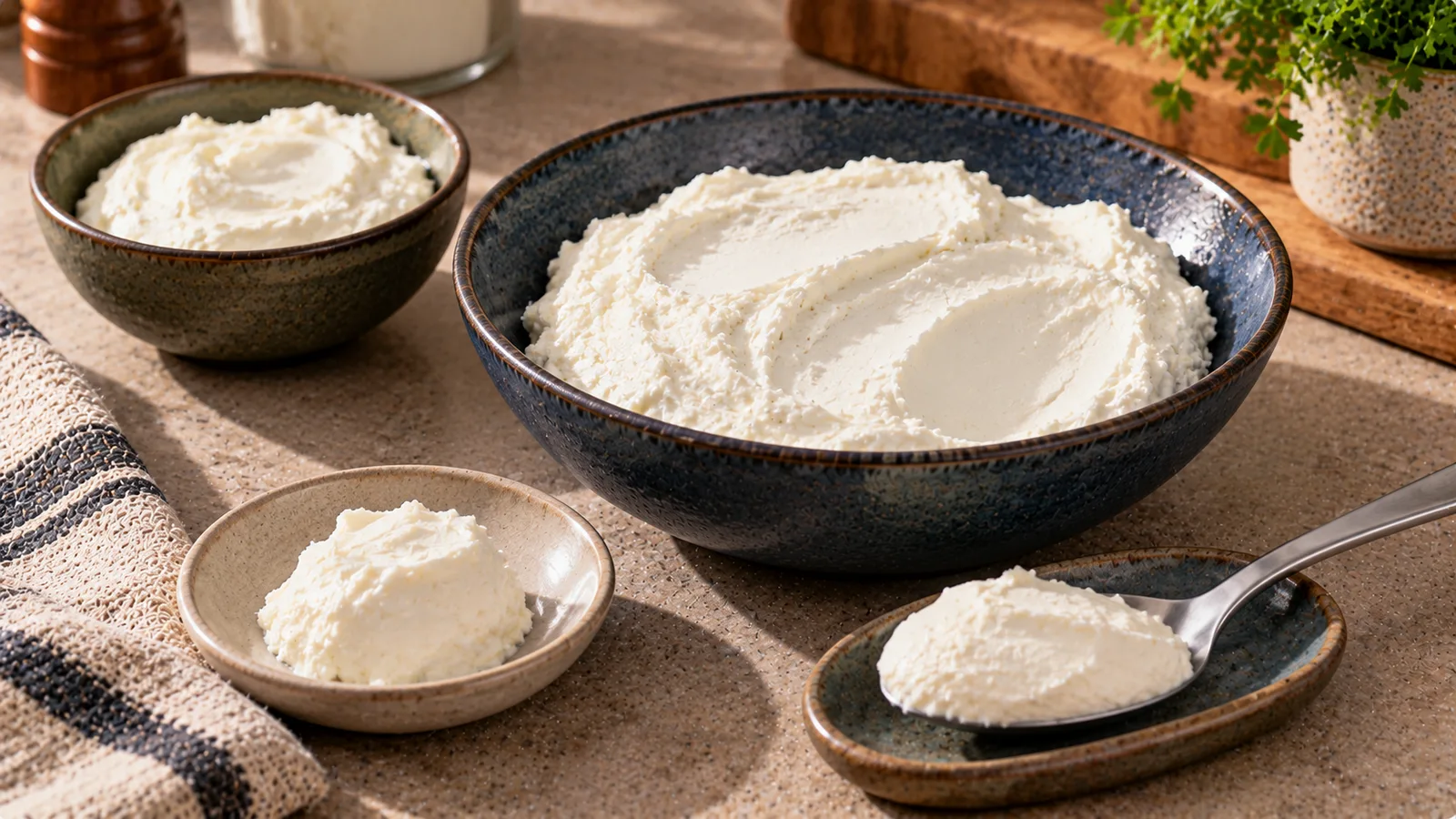
Quark is a fresh dairy product whose calorie content can vary considerably depending on its fat level.
This matters especially in Germany and other European countries, where supermarket shelves may contain everything from very lean Magerquark to quark with substantially more fat.
As a practical range, plain quark can provide roughly 65 to more than 150 kcal per 100 g, depending on the product. Very lean Magerquark is usually near the bottom of that range, while higher-fat varieties can contain much more.
For accurate tracking, use the nutrition label on the specific package you buy.
Quark calories at a glance
Typical values can look approximately like this:
| Type of quark | Calories per 100 g | Protein | Carbs | Fat |
|---|---|---|---|---|
| Magerquark / very low-fat quark | 65–75 kcal | 12–13 g | 3–4.5 g | 0.2–0.5 g |
| Low-fat quark | 80–110 kcal | 10–13 g | 3–5 g | 2–5 g |
| Higher-fat quark | 120–160+ kcal | 8–12 g | 3–5 g | 7–12+ g |
These are practical ranges rather than universal values.
Brands, countries and fat classifications differ, so two products both called quark may not have identical nutrition.
How many calories are in 100 g of quark?
For Magerquark, a common German low-fat version, 100 g often provides around:
- 65–75 kcal;
- 12–13 g protein;
- 3–4.5 g carbohydrates;
- less than 1 g fat.
A representative example might be:
67 kcal per 100 g
with approximately:
- 12 g protein;
- 4 g carbohydrates;
- 0.2 g fat.
Quark with more fat can easily provide 100 kcal or considerably more per 100 g.
That is why entering simply "quark" in a food diary without checking the fat level can produce a meaningful tracking error.
Calories by serving size
Using an example Magerquark containing 67 kcal per 100 g:
| Portion | Calories |
|---|---|
| 50 g | 34 kcal |
| 100 g | 67 kcal |
| 150 g | 101 kcal |
| 200 g | 134 kcal |
| 250 g | 168 kcal |
| 300 g | 201 kcal |
| 500 g | 335 kcal |
The calculation is:
calories = grams × calories per 100 g ÷ 100
For 250 g:
250 × 67 ÷ 100 = 167.5 kcal
Rounded, that is about 168 kcal.
Calories in 250 g of Magerquark
A 250 g portion is common because quark is often sold or eaten in relatively large amounts.
At 67 kcal per 100 g:
250 g = approximately 168 kcal
If the product contains 72 kcal per 100 g:
250 × 72 ÷ 100 = 180 kcal
The difference is small for one portion, but it becomes more important when comparing a very lean product with a higher-fat quark.
Calories in 500 g of Magerquark
A full 500 g container at 67 kcal per 100 g contains:
500 × 67 ÷ 100 = 335 kcal
If the label says 70 kcal per 100 g:
500 × 70 ÷ 100 = 350 kcal
Always calculate from the actual package when possible.
How much protein is in quark?
One of the main nutritional characteristics of low-fat quark is its relatively high protein content.
Magerquark commonly provides around 12–13 g protein per 100 g.
At 12 g per 100 g:
- 100 g = 12 g protein;
- 200 g = 24 g;
- 250 g = 30 g;
- 500 g = 60 g.
A 250 g portion can therefore provide roughly 30 g of protein while remaining relatively low in calories when a very lean version is used.
Higher-fat quark may contain slightly less protein per 100 g because a greater proportion of the product consists of fat.
Why quark calories vary so much
The biggest factor is usually fat content.
Protein and carbohydrates provide roughly 4 kcal per gram, while fat provides about 9 kcal per gram.
That means even a moderate increase in fat can noticeably increase the calorie density.
Consider two simplified products.
Product A
Per 100 g:
- 12 g protein;
- 4 g carbohydrates;
- 0.3 g fat.
Approximate energy from macros:
12 × 4 + 4 × 4 + 0.3 × 9
= 48 + 16 + 2.7
= approximately 67 kcal
Product B
Per 100 g:
- 10 g protein;
- 4 g carbohydrates;
- 10 g fat.
Approximate energy:
10 × 4 + 4 × 4 + 10 × 9
= 40 + 16 + 90
= approximately 146 kcal
Both products can be quark, but their calorie density is very different.
What is Magerquark?
Magerquark is the very low-fat form of quark commonly sold in Germany.
"Mager" refers to its low fat level.
It typically has:
- high protein;
- very little fat;
- relatively low calorie density;
- a thick texture.
Because much of the energy comes from protein rather than fat, Magerquark can have considerably fewer calories than richer quark varieties.
Magerquark vs regular quark
The word "regular" can be ambiguous because quark is sold at several fat levels.
A practical comparison might look like this:
| Per 100 g | Magerquark | Higher-fat quark |
|---|---|---|
| Calories | ~65–75 kcal | ~120–160+ kcal |
| Protein | ~12–13 g | ~8–12 g |
| Carbs | ~3–4.5 g | ~3–5 g |
| Fat | <1 g | ~7–12+ g |
The exact difference depends on the products being compared.
The package label is more reliable than assuming a value from the product name alone.
What does "20% fat in dry matter" mean?
Quark labels in Germany may describe fat as a percentage of fat in dry matter, often written as "Fett i. Tr.".
This is not the same as saying that 20% of the entire product by weight is fat.
Quark contains a large amount of water.
The percentage refers to the fat proportion of the dry matter after water is excluded from the calculation.
Therefore, a quark labeled "20% Fett i. Tr." can contain much less than 20 g of actual fat per 100 g of product.
For calorie tracking, use the nutrition table showing fat per 100 g, rather than trying to calculate calories directly from the fat-in-dry-matter classification.
Does quark contain carbohydrates?
Yes.
Plain quark naturally contains some carbohydrate, largely associated with lactose.
A typical plain product may contain roughly 3–5 g carbohydrates per 100 g.
Flavored quark can contain considerably more if sugar, fruit preparations, syrups or other carbohydrate-containing ingredients are added.
Do not assume that a fruit-flavored quark has the same calories as plain Magerquark.
Plain vs flavored quark
Plain quark gives you a relatively simple nutritional profile.
Flavored products may contain:
- added sugar;
- fruit preparations;
- sweetened sauces;
- chocolate;
- cream;
- starches or other ingredients.
These can change calories and macros substantially.
For example, if plain Magerquark contains 70 kcal per 100 g but a sweetened dessert-style quark contains 120 kcal per 100 g, a 250 g portion differs by:
Plain:
250 × 70 ÷ 100 = 175 kcal
Sweetened:
250 × 120 ÷ 100 = 300 kcal
Difference:
125 kcal
The product name alone is therefore not enough for accurate logging.
Quark with fruit
If you add fruit yourself, calculate the quark and fruit separately.
Example:
- 250 g Magerquark at 67 kcal/100 g = about 168 kcal;
- 150 g strawberries at about 32 kcal/100 g = about 48 kcal.
Total:
168 + 48 = approximately 216 kcal
Any additional honey, sugar, granola, nuts or other toppings should also be included.
Quark with honey
Suppose you eat:
- 250 g Magerquark = 168 kcal;
- 20 g honey at about 304 kcal/100 g.
Honey:
20 × 304 ÷ 100 = approximately 61 kcal
Total:
168 + 61 = approximately 229 kcal
A relatively small topping can therefore make a noticeable difference.
Quark with nuts
Nuts are much more calorie-dense than quark.
Suppose you combine:
- 250 g Magerquark = about 168 kcal;
- 30 g nuts at 600 kcal/100 g = 180 kcal.
Total:
348 kcal
The nuts provide valuable nutrients, but they almost double the calories of the example meal.
For food logging, toppings should not be included in the quark entry itself unless they are already part of the packaged product.
Quark vs Greek yogurt
Quark and Greek yogurt are different dairy products, and their nutrition varies by fat level.
A low-fat quark may contain:
- more protein than many regular yogurts;
- very little fat;
- around 65–75 kcal per 100 g.
Full-fat Greek yogurt can contain substantially more fat and calories.
However, low-fat Greek yogurt can be much closer nutritionally.
Instead of assuming one product is always lower in calories, compare:
- calories per 100 g;
- protein;
- fat;
- added sugar.
Quark vs cottage cheese
Low-fat quark and cottage cheese can both be protein-rich dairy foods.
Quark generally has a smooth, thick texture, while cottage cheese contains visible curds.
Calories depend on fat content.
A very lean quark may be lower in calories than many cottage cheeses, while higher-fat quark can be similar to or higher than some low-fat cottage cheese products.
Again, the exact package is what matters.
Quark vs skyr
Quark and skyr can have similar nutritional profiles when comparing plain low-fat products.
Both may be:
- high in protein;
- low in fat;
- relatively low in calories.
But they are separate foods with different manufacturing methods, textures and product formulations.
For calorie tracking, use the entry for the food actually eaten rather than treating quark and skyr as interchangeable.
Does cooking change the calories in quark?
Heating quark does not create calories.
However, a cooked dish containing quark may lose water or include other ingredients.
For example, a quark-based casserole might contain:
- quark;
- eggs;
- sugar;
- flour;
- butter.
The nutrition of the final dish should be calculated from the entire recipe rather than from the quark alone.
If water evaporates during baking, the finished dish may contain more calories per 100 g even though the total calories remain broadly determined by the ingredients.
How to log quark accurately
For packaged quark, the simplest method is:
- check calories per 100 g on the package;
- weigh or identify the amount eaten;
- calculate from the package value.
For example:
Label:
68 kcal per 100 g
Amount eaten:
220 g
Calculation:
220 × 68 ÷ 100 = 149.6 kcal
Rounded:
approximately 150 kcal
Do you need to weigh quark?
If you eat the entire container and its net weight is known, you may not need to weigh it.
For example, a 250 g package eaten in full can be logged as 250 g.
If you eat only part of a larger container, weighing the amount gives a more reliable estimate than judging it visually.
Net weight vs drained weight
Unlike products stored in brine, ordinary quark usually does not require a separate drained-weight calculation.
Use the edible amount taken from the package.
If a particular product separates and you deliberately discard a meaningful amount of liquid, the exact nutritional effect can be difficult to quantify.
For ordinary tracking, using the manufacturer's labeled product values is generally the most practical approach.
Common mistake: using a generic quark entry
A generic database entry may not match your product.
For example:
Database entry:
70 kcal per 100 g
Actual package:
145 kcal per 100 g
For a 250 g portion:
Generic entry:
250 × 70 ÷ 100 = 175 kcal
Actual product:
250 × 145 ÷ 100 = 363 kcal
That is a difference of almost 190 kcal.
The higher the fat content, the more important it becomes to select the correct product.
Common mistake: confusing fat classification with actual fat grams
A front label may describe a traditional fat category, while the nutrition panel gives actual fat grams per 100 g.
For calorie and macro tracking, use the nutrition panel.
Do not enter 20 g of fat per 100 g simply because a package says "20% Fett i. Tr."
Those values describe different things.
Common mistake: logging toppings as plain quark
If you mix plain quark with:
- honey;
- jam;
- granola;
- nuts;
- nut butter;
- chocolate;
- fruit;
the finished bowl no longer has the same calorie density as plain quark.
Log those additions separately or create a recipe if you make the same combination regularly.
Is quark low in calories?
Very low-fat quark can be relatively low in calories for the amount of protein it provides.
But "quark" is not one fixed-calorie food.
A higher-fat or sweetened version may contain substantially more energy.
Whether a serving is low or high in calories also depends on the portion and any additions.
A practical comparison
Imagine three products:
Magerquark
67 kcal per 100 g
250 g:
168 kcal
Moderate-fat quark
100 kcal per 100 g
250 g:
250 kcal
Rich quark
150 kcal per 100 g
250 g:
375 kcal
The same 250 g serving can therefore differ by more than 200 kcal depending on the product.
Quick reference
For plain Magerquark around 67 kcal per 100 g:
- 100 g = about 67 kcal;
- 150 g = about 101 kcal;
- 200 g = about 134 kcal;
- 250 g = about 168 kcal;
- 300 g = about 201 kcal;
- 500 g = about 335 kcal.
Protein commonly falls around 12–13 g per 100 g for many Magerquark products.
Higher-fat quark can contain substantially more calories.
The most reliable number is always the one on the package you actually use.
The simplest way to calculate your portion
Take the calories listed per 100 g and multiply them by the grams eaten:
grams eaten × kcal per 100 g ÷ 100
If your quark contains 72 kcal per 100 g and you eat 275 g:
275 × 72 ÷ 100 = 198 kcal
This method works regardless of the fat level, brand or package size and avoids relying on a generic quark value that may not match your product.
Nutrition data sources and product differences
The records below describe only the named foods, fat levels and preparation states. USDA figures are per 100 g; manufacturer figures retain their stated unit. These sources do not independently prove every approximate figure in the article.
OMIRA Magerquark is labeled 67 kcal per 100 g; this does not establish the values for every other quark fat grade.
Examples from manufacturer labels (product-specific, checked 16 October 2026):
- OMIRA Magerquark 500 g — 67 kcal/100 g.