
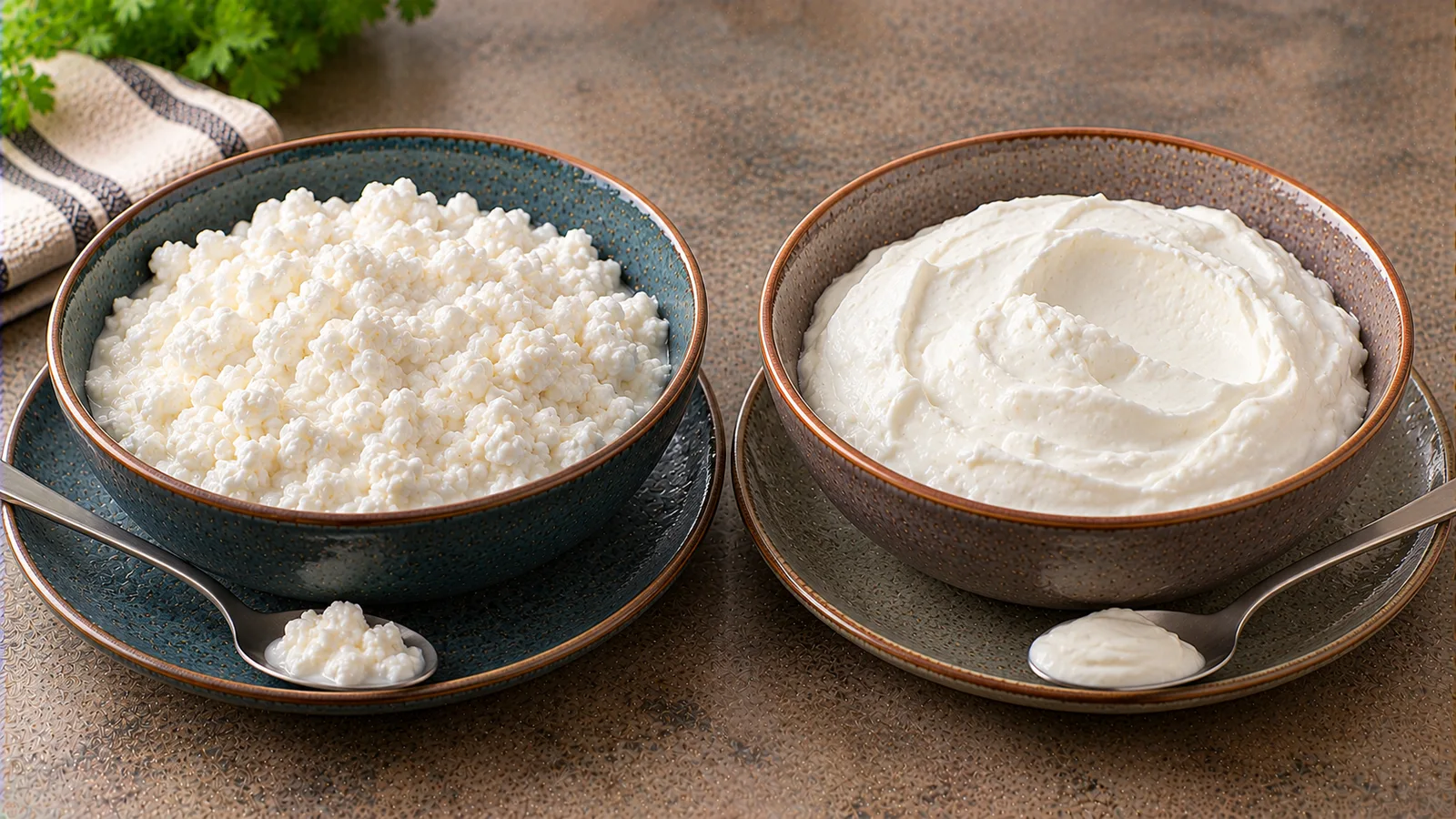
Cottage cheese and quark are both chilled dairy foods, but the difference between them matters when you want a 150 g protein-rich serving. Cottage cheese has distinct soft curds and is often sold with added salt; quark is smoother, and plain low-fat quark often contains much less salt. Neither label can be inferred from the food name alone: fat levels, ingredients, protein and salt vary by product.
This comparison uses two specific plain German supermarket products, at the same edible weight, rather than averaging unrelated versions or mixing cottage cheese with skyr. The results are especially close on protein but noticeably different on salt and regular shelf cost.
Cottage cheese vs quark: 150 g comparison
The first example is MILSANI Körniger Frischkäse Leicht, Aldi Süd's plain light cottage cheese in a 200 g tub. The second is MILSANI Speisequark Magerstufe 0.3%, plain low-fat quark in a 500 g pack. Their retailer labels report the following per 100 g, converted by multiplying by 1.5.
| Label value | Cottage cheese, 150 g | Quark, 150 g |
|---|---|---|
| Protein | 19.05 g | 18.30 g |
| Salt (label equivalent) | 0.90 g | 0.15 g |
| Energy | 108 kcal | 105 kcal |
| Fat | 0.60 g | 0.45 g |
| Carbohydrates | 6.00 g | 5.85 g |
| Source pack | 200 g | 500 g |
| Listed pack price | €1.19 | €1.19 |
| Cost for 150 g | €0.89 | €0.36 |
Sources: Aldi Süd MILSANI light cottage cheese and Aldi Süd MILSANI low-fat quark, publicly displayed on 22 October 2026. Prices are listed regular product prices, not a promotion. A store can have different availability or prices; verify the pack you actually buy. These are the lowest regular comparable item prices we could substantiate from the checked large-chain listings, not a proven nationwide minimum across every store.
Protein: the serving difference is small
The light cottage cheese label gives 12.7 g protein per 100 g, so 12.7 × 1.5 = 19.05 g per 150 g. The quark label gives 12.2 g per 100 g, so 12.2 × 1.5 = 18.30 g per 150 g. This is only 0.75 g more protein for the cottage cheese serving. For most everyday meals, that small measured difference should not outweigh taste, texture, overall dietary needs or cost.
For a person choosing food by grams of protein per euro, the same labels and prices tell a different story. The purchased 200 g cottage cheese tub contains 25.4 g protein, while the 500 g quark pack contains 61.0 g. At €1.19 per pack, that is approximately 21.3 g versus 51.3 g protein per euro, respectively. This comparison assumes the whole purchased product is eaten eventually, without waste, and does not imply that one food delivers better protein quality or health outcomes.
Both foods can contribute substantially to the protein in a snack or meal. They are dairy proteins, not a substitute for dietary variety. See high-protein foods for the wider question of selecting protein-rich foods; this article only compares two chilled products at matched weight.
Salt: check the actual number, not the taste alone
The cottage cheese product declares 0.6 g salt per 100 g, equivalent to 0.90 g per 150 g. The low-fat quark declares 0.1 g salt per 100 g, equivalent to 0.15 g per 150 g. The difference is 0.75 g salt in one 150 g serving. That is substantial relative to the small difference in protein, but should not be generalized to all quarks or cottage cheeses.
In European nutrition tables, the mandatory entry is salt, not the same thing as grams of elemental sodium. Under EU rules the stated salt equivalent is calculated from total sodium using salt = sodium × 2.5; dividing by 2.5 estimates sodium from the declared salt. Thus 0.90 g salt represents about 0.36 g (360 mg) sodium, while 0.15 g salt represents about 0.06 g (60 mg) sodium. These are label-derived estimates subject to rounding, not direct laboratory sodium measurements. See EU interpretation of salt declaration and EU nutrition-labelling rules.
If you season either product with salt, cheese, olives, smoked fish or a packaged dressing, the sodium and salt content of the full meal will increase. If lower salt is your priority, plain low-fat quark is the lower-salt option in this specific matched pair. Read the complete package before deciding that every cottage cheese tub is the same.
What does each 150 g serving actually cost?
Both selected products have a listed €1.19 pack price, but their weights are different. Comparing the prices of the packs alone would therefore be misleading. The correct formula for a fixed portion is pack price × portion grams ÷ net pack grams.
| Product | Calculation | Cost of 150 g |
|---|---|---|
| Cottage cheese | €1.19 × 150 ÷ 200 | €0.89 |
| Low-fat quark | €1.19 × 150 ÷ 500 | €0.36 |
The exact results before rounding are €0.8925 and €0.3570. The difference is approximately €0.54 per 150 g serving using amounts rounded to cents, or €0.5355 before rounding. The unrounded cottage-to-quark cost ratio is 2.5 to 1. Quark is therefore cheaper per edible gram in this checked comparison, even though both packages cost €1.19 at the shelf.
This is a purchase calculation, not a prediction of what you will actually spend over a month. A 500 g quark pack supplies three 150 g servings plus 50 g left over; a 200 g cottage cheese tub supplies one 150 g serving plus 50 g. If leftover food is discarded, the effective cost per eaten serving may be higher. Refrigerate promptly and follow the storage and use-by instructions on the tub.
Which kind of cottage cheese and quark did we compare?
The cottage cheese example is the light variety, not the regular-fat variety. This matters: the Aldi Süd MILSANI Natur cottage cheese lists 12.2 g protein, 0.6 g salt and 103 kcal per 100 g, compared with the light version's 12.7 g protein, 0.6 g salt and 72 kcal per 100 g. The regular-fat product has the same €1.19 listed 200 g price in the checked listing but differs in energy and fat. The price comparison could still hold, while the calorie comparison would change.
The quark is expressly Magerstufe (low-fat), not 20% or 40% fat-in-dry-matter quark, a sweetened dessert, flavored quark or herb quark. A richer version can have a different energy value, texture and price. The labels listed here apply to these specific German products, not to generic English-language cottage cheese from another country or quark from every dairy.
Choosing two unflavored products avoids bringing added fruit, sugar, herbs or ready-made dips into the comparison. The cottage cheese remains a curd-based product with visible pieces, whereas quark is typically thick and more uniform. Texture may matter more than a protein difference smaller than one gram.
Practical uses: where each one works better
Choose cottage cheese when you want distinct curds in a sandwich, savory bowl, salad or spoonable snack. Its naturally uneven texture works with tomatoes, cucumber and herbs. If you eat it straight from the tub, the salt declared on the label is already included—extra salt is optional, not needed to make it a complete food.
Choose low-fat quark for a smooth dip, a creamy topping for potatoes, a breakfast bowl with fruit or a base for a sauce. Stirring in a little water or milk can loosen an especially thick quark; any added ingredient changes the final weight and nutrition. A simple savory dip can use lemon, pepper and herbs without assuming the underlying dairy is already salted.
Neither product contains significant fiber according to its plain dairy ingredient profile. If you want a fiber-containing meal, add fruit, vegetables or a whole-grain accompaniment and count those foods separately. For a more general description of meal components, see balanced meals.
Milk allergy, lactose and label variation
Both products are made from milk and are unsuitable for a person with a milk-protein allergy unless a clinician has explicitly advised otherwise. Neither product should automatically be treated as lactose-free. Naturally occurring milk sugar can remain in both. Lactose intolerance is different from a milk allergy, and special labeled lactose-free products have to be assessed on their own packaging.
Check the ingredient list, the exact product identity, the use-by date and refrigerated storage instructions. EU rules require prepacked foods to identify allergens and list their nutrition information, usually for 100 g. The European Commission labelling guidance explains that allergens must be emphasized in the ingredient list. Different suppliers may produce batches with different nutrient averages; Aldi says to check the package available in-store.
If you are tracking salt for medical reasons, use your prescribed dietary advice rather than assuming a food category is automatically suitable. The data here are label amounts for two named products, not a clinical test or a recommendation to replace a prescribed eating plan.
How to compare other tubs correctly
- Select two plain products and write down the exact fat variety, retailer, package size and date. Do not silently mix flavored quark with unflavored cottage cheese.
- Copy protein, salt and calories from the per-100-g label. Multiply each by 1.5 to obtain a 150 g serving; retain the same units throughout.
- Convert salt and sodium only when you need sodium explicitly. In EU declarations, salt is not sodium: estimated sodium in grams equals declared salt in grams divided by 2.5.
- Divide the ordinary package price by its net weight. Multiply by 150 g, then round monetary amounts once at the end. Do not use an expired discount or a loyalty-app offer as the standard shelf price.
- Record the link, date and whether the price is displayed nationally or depends on the branch. If a lower regular price is actually confirmed for a comparable product, replace the example rather than calling the older figure a universal minimum.
Which is better for this particular goal?
For protein alone, this pair is close: 19.05 g versus 18.30 g for 150 g. For lower salt, the compared quark has a much smaller label value, 0.15 g instead of 0.90 g. For the lowest confirmed cost in this matched example, the quark also costs less per 150 g, €0.36 versus €0.89. For texture, choose according to whether you prefer small curds or a thick, smooth dairy base.
This question is intentionally different from cottage cheese versus skyr and quark versus skyr. Those compare each food with skyr; their results cannot replace the direct cottage-cheese-versus-quark comparison here.
Sources and calculation method
- Aldi Süd MILSANI Körniger Frischkäse Leicht, 200 g: €1.19, 12.7 g protein, 0.6 g salt and 72 kcal per 100 g.
- Aldi Süd MILSANI Speisequark Magerstufe 0.3%, 500 g: €1.19, 12.2 g protein, 0.1 g salt and 70 kcal per 100 g.
- Aldi Süd MILSANI Körniger Frischkäse Natur, 200 g: alternative fat grade, 12.2 g protein, 0.6 g salt and 103 kcal per 100 g.
- Aldi Nord category listing: a separate large-chain cross-check that also lists cottage cheese 200 g and quark 500 g at €1.19 each.
- European Commission — EU nutrition declaration and EU salt-equivalent interpretation: nutrition-panel basis and salt versus sodium.
- European Commission — labelling and allergens: identifying allergens on packaged foods.
Checked 22 October 2026. This is a reproducible comparison of named labels and displayed regular prices in Germany. It does not establish the nationwide minimum for all stores, promise future prices, or measure nutrient composition in a laboratory. All 150 g figures are arithmetic from per-100-g labels; the prices are rounded to the nearest cent only after calculation.