
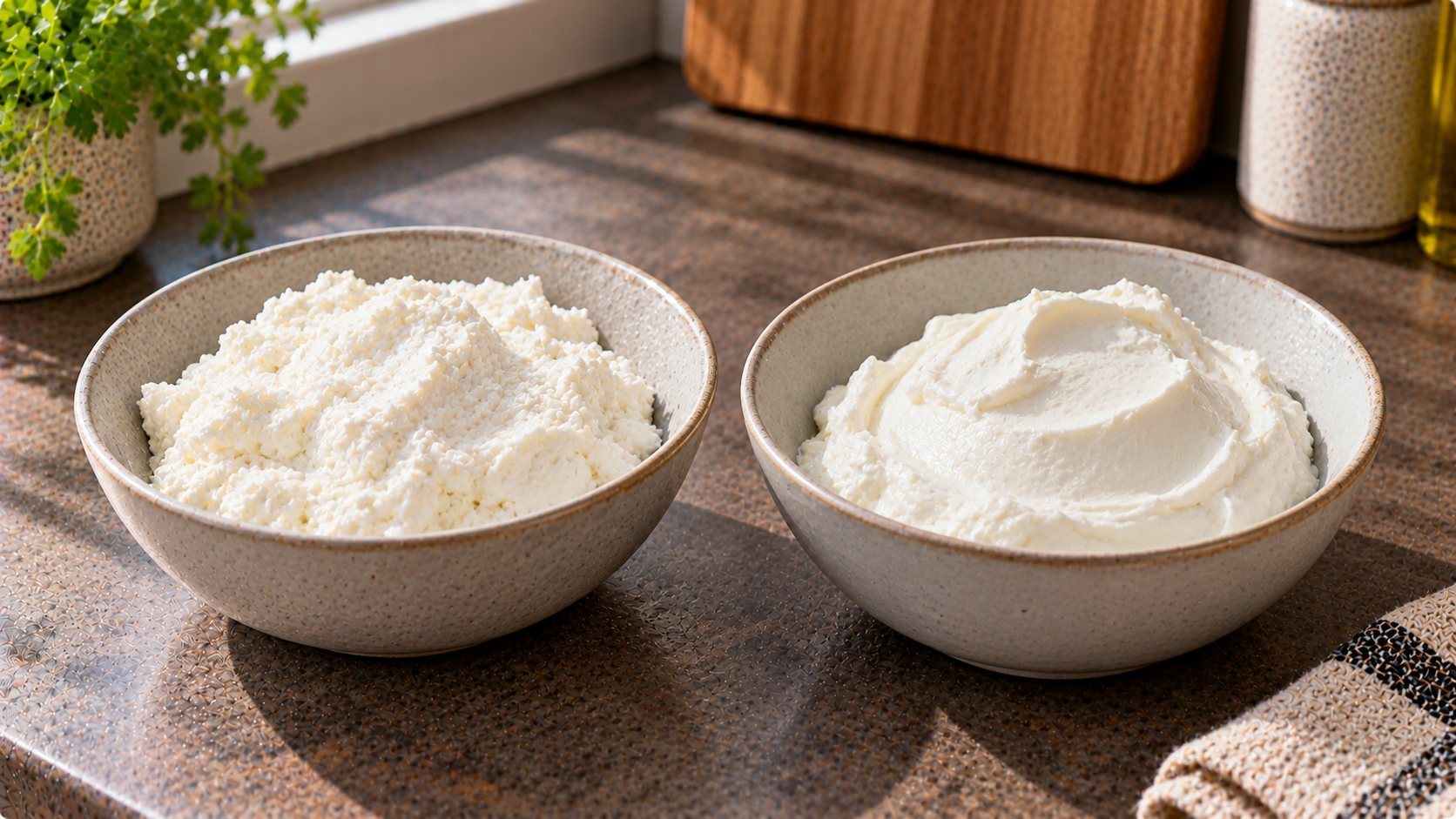
Quark and skyr occupy a similar place in a high-protein breakfast: both are thick, cultured dairy foods, usually eaten cold with fruit or used in simple recipes. Yet the label on a tub matters more than the fashionable name. For a fair comparison, start with plain, unsweetened skyr and low-fat quark (Magerquark), not full-fat quark against a low-fat skyr or a sweetened dessert against a plain product. Magerquark often provides slightly more protein per 100 g; skyr is commonly creamier and may contain more calcium. Neither is automatically healthier for everyone. German Federal Centre for Nutrition (BZfE); Bavarian Consumer Centre, June 2026.
Quark and skyr: the practical answer
If you want a thick, inexpensive base that is easy to use in baking or savory dips, plain low-fat quark is often the better purchase in Germany. If you prefer something smoother that you can spoon directly from the container, plain skyr may be more convenient. Both are useful protein foods; the differences are usually smaller than the difference between plain and flavored versions, or between low-fat and higher-fat quark. For the way moisture and texture change when using ricotta instead of quark, see quark versus ricotta for baking.
The comparison below uses illustrative rounded values from German public food-education sources, not laboratory measurements of two specific brands. Actual figures vary with product and formulation. Read your own label before tracking calories or deciding which product offers better value.
| Per 100 g, plain product | Low-fat quark (Magerquark) | Plain skyr |
|---|---|---|
| Protein | about 12–13 g | about 11 g |
| Calories | often around 65–75 kcal | often around 60–70 kcal |
| Fat | generally very low | generally very low |
| Calcium | roughly 90 mg | roughly 150 mg |
| Texture | dense, sometimes slightly grainy | smoother, creamy and thick |
| Common price position in Germany | often lower | often higher |
The protein and calcium reference values are reported by BZfE, while the price and texture tendencies are also discussed by the Bavarian Consumer Centre. Calories are broad product examples, not official fixed product standards. There is no meaningful nutritional verdict in a difference of a few calories when fruit, oats, honey or oil-based toppings may change the final meal much more.
Compare equal portions, not different tub sizes
A label normally gives nutrition per 100 g. Use the same weight before claiming one dairy food is more protein-rich. Consider an example with 12.5 g protein per 100 g of low-fat quark and 11 g per 100 g of plain skyr. These are illustrative products within the broad reference ranges above.
| Edible serving | Quark protein, illustrative | Skyr protein, illustrative |
|---|---|---|
| 100 g | 12.5 g | 11 g |
| 150 g | 18.8 g | 16.5 g |
| 200 g | 25 g | 22 g |
| 250 g | 31.3 g | 27.5 g |
The arithmetic is simple: protein per serving = grams eaten × protein per 100 g ÷ 100. At 200 g, the model quark supplies 3 g more protein than the model skyr. That is a real difference for the example labels, but not a reason to declare all skyr inferior or to expect a dramatic change in body composition.
If one carton has 400 g and another 500 g, ignore the total protein on the front of the package until you adjust for weight. A larger package naturally contains more of everything. For a breakfast comparison, also decide whether 150 g or 250 g is the serving you actually enjoy and finish; a theoretically superior food that you do not like may be a poor everyday choice.
The separate guides to quark and skyr cover typical serving sizes. To use those figures fairly, match the fat level and compare the same weight rather than different tub sizes.
Protein per calorie: useful, but not a complete score
People pursuing a particular protein target sometimes compare grams of protein per 100 kcal. This removes part of the distortion produced by different calorie contents. Suppose a quark has 70 kcal and 12.5 g protein per 100 g, while a skyr has 65 kcal and 11 g protein. Then:
- Quark: 12.5 ÷ 70 × 100 = about 17.9 g protein per 100 kcal.
- Skyr: 11 ÷ 65 × 100 = about 16.9 g protein per 100 kcal.
The numbers are illustrative, and the ordering can change with actual labels. They show why comparing two defined products is more defensible than repeating that one type always has more protein. Also assess saturated fat, portion size and whether sweeteners or other ingredients were added. Protein density is a useful metric, not an independent measure of a balanced diet.
Both products contain milk proteins and can contribute to daily intake. Neither must be consumed immediately after exercise to be worthwhile. Across ordinary eating patterns, total dietary adequacy, consistent meal choices and individual needs matter more than which spoonable dairy brand wins a narrow macro comparison.
What makes their texture and taste different?
Skyr comes from an Icelandic cultured-dairy tradition. In modern production, skimmed milk is fermented and thickened, with processing methods that create a smooth, high-protein product. Quark is also a fresh cultured dairy product, but its drained curd structure often makes Magerquark more compact, tangier and sometimes slightly grainy. German food educators explain that both use cultured milk, while recipes and final texture vary. BZfE.
This matters in cooking. Skyr is typically ready to spoon into breakfast bowls or smoothies without much adjustment. Quark can feel very thick when spread straight from the tub; adding a little water, milk or sparkling water makes it softer without requiring a sugary flavored product. If you add milk, count its nutrients in a precise recipe. If you add water, the whole bowl's calorie total does not increase, but its calories per 100 g become lower because of dilution.
Neither texture is inherently superior. Plain skyr can be tart too, and a brand's process may matter more than the category label. The consumer-centre advice is practical: try the plain versions and choose the one whose taste and texture support a repeatable meal. Verbraucherzentrale Bayern.
Calcium, fat, carbohydrate and lactose
Protein is only one part of the comparison. The BZfE reports approximately 150 mg calcium per 100 g skyr versus 90 mg per 100 g low-fat quark as general reference figures. At a 200 g serving those examples would contribute around 300 mg and 180 mg respectively. They are not guaranteed values for every product, so check the nutrition information or reliable product specification if calcium is a major purchasing reason. BZfE.
Fat changes the comparison substantially if you move away from Magerquark. Quark is sold in different fat grades. A high-fat quark should not be placed beside low-fat skyr and used to conclude that quark in general contains more fat. Match fat grade deliberately; if the product is for cooking, a richer version may be chosen for texture rather than maximum protein density.
Plain dairy still contains naturally occurring milk sugar, lactose. Skyr is not automatically lactose-free simply because it is fermented. The Bavarian Consumer Centre notes lactose levels can be similar to quark and yogurt. Individuals with lactose intolerance need to rely on their tolerance and the exact labeled product; anyone with a milk-protein allergy should not assume either option is suitable. Verbraucherzentrale Bayern: What is skyr?.
Look beyond the claim on the lid. Vanilla, fruit-layer or dessert-style versions may contain added sugar, sweeteners or flavorings; sugar levels and protein content can vary widely. Read the entire ingredient list rather than assuming a fruit picture signals a better choice. A plain tub with fresh berries is often easier to customize to your preferred sweetness.
Which one is better for breakfast or snacks?
A breakfast bowl is rarely only quark or skyr. The full meal matters, particularly if you track calories, dietary fiber or spending. Here are three realistic ways to choose.
Fast cold breakfast: choose 200 g plain skyr if its smooth texture means you can eat it straight away. Add berries and oats for carbohydrates and fiber. Measure honey, nuts and granola separately rather than attributing their calories to skyr.
Lower-cost high-protein breakfast: choose 200 g plain low-fat quark, loosen with a splash of water or milk and add fruit. In many German supermarkets it costs less than skyr, though a sale or private-label product can reverse the ranking. Compare unit prices at the time of purchase, not a remembered price.
Savory dip or spread: season quark with herbs, lemon and pepper to accompany potatoes, bread or vegetables. Skyr can work too, especially when a lighter, smoother consistency is desired. Treat both as dairy components of the recipe, not complete meals by themselves.
A thick cultured dairy portion can be filling for some people, but individual appetite and portion size differ. Neither product reliably causes weight loss on its own. A dietary pattern supporting your energy and nutrient needs is more relevant than a single label.
Baking, heated dishes and substitutions
Quark has a long history in Central European baking, including quark-based cakes, doughs and fillings. Its firmer structure may be useful when a recipe expects quark's moisture and curd behavior. Replacing it with skyr can work in some preparations but may change thickness, acidity and baked texture. Do a small test before relying on a one-for-one substitution in a recipe where structure is important.
For cold cheesecakes, dips and creamy sauces, the swap is often easier; still, the finished moisture level may differ. When heating either product, dairy proteins can separate or become grainy, especially with high heat or acid. Add gently where relevant and follow the particular recipe's method. The label's protein amount does not guarantee identical culinary behavior.
For a sauce, compare equal starting weights and count the rest of the ingredients. If 200 g quark is thinned with 40 g water, its total energy stays that of 200 g quark, but the finished 240 g sauce has a different energy density. If you thin skyr with 40 g cream, the cream adds energy and fat. These details often matter more than the underlying quark-versus-skyr difference.
Cost: compare euros per 20 g of protein
Price per kilogram answers one question; price per quantity of protein answers another. A hypothetical low-fat quark costs €1.50 for 500 g and has 12.5 g protein per 100 g. It contains 62.5 g protein per tub. A hypothetical skyr costs €1.80 for 450 g and has 11 g per 100 g: 49.5 g protein per tub.
| Illustrative purchase | Low-fat quark | Plain skyr |
|---|---|---|
| Pack weight | 500 g | 450 g |
| Pack price | €1.50 | €1.80 |
| Price per kg | €3.00 | €4.00 |
| Protein per pack | 62.5 g | 49.5 g |
| Approx. cost per 20 g protein | €0.48 | €0.73 |
All prices and product values in this example are hypothetical, not verified live supermarket offers. The calculation is: pack price ÷ grams protein in pack × 20. For shopping today, input the actual shelf price, tub weight and label value. A large promotional skyr tub may beat a premium quark product; this table must not be presented as a current market ranking.
Cost is not only about protein. Consider whether the product will be eaten before its use-by date, whether you prefer its taste, and whether it substitutes for another purchased ingredient. Less expensive food that gets discarded is not a bargain. German consumer organizations identify Magerquark as frequently cheaper, but the precise difference is store- and product-dependent. Verbraucherzentrale Bayern.
Choosing in Germany, France and elsewhere
In Germany, Magerquark clearly specifies the low-fat quark category; Speisequark without that qualifier can refer to several fat grades. French shoppers may see fromage blanc or fromage frais rather than a direct one-to-one equivalent of German Magerquark. Product names, production and fat grades differ, so compare the actual nutrition declaration rather than translating the product name literally. A product sold as skyr is also not necessarily identical across countries.
EU packaged-food labels give an accessible starting point. Check the per-100-g nutrition declaration, product description, ingredient list, unit price and the amount of food you will actually use. For nutrition labeling requirements see Regulation (EU) No 1169/2011. If calcium or lactose claims are central, inspect the relevant product details rather than extrapolating from a category average.
A sensible shopping decision can be completed in under a minute: find two plain products, match their fat grade, compare protein and calories per 100 g, identify any flavoring or added ingredients, then check price per kilogram. Finally choose based on how you plan to eat them. That is more robust than assuming an Icelandic-sounding name means the product is nutritionally superior.
When to choose each product
| Your main priority | Sensible starting choice | What to verify |
|---|---|---|
| Most protein per equal weight | Often low-fat quark | Both labels, same 100 g basis |
| Smooth spoonable breakfast | Often plain skyr | Taste and texture of that brand |
| Lower German grocery spending | Often Magerquark | Current price per kg and food waste |
| Higher calcium in a comparable plain product | Often skyr | Product-specific calcium information |
| Quark-based baking | Quark | Recipe consistency and fat grade |
| Dairy allergy or need for confirmed lactose-free food | Neither by assumption | Allergen statement and explicit lactose-free labeling |
The final choice does not need a winner. For many households the most practical approach is to buy whichever plain product has the right texture, sufficient protein and an acceptable price that week. Compare products as sold and portions as eaten.
Sources and scope
- German Federal Centre for Nutrition (BZfE): Skyr, Joghurt, Quark — how dairy foods differ. Protein and calcium reference comparisons, production and practical use.
- Verbraucherzentrale Bayern (18 June 2026): Skyr oder Quark — was ist besser?. Price tendencies, taste, texture and plain versus flavored products.
- Verbraucherzentrale Bayern: Was ist Skyr?. Product description and lactose context.
- Regulation (EU) 1169/2011 on food information to consumers. General food-labeling requirements.
Numbers in hypothetical examples illustrate calculations. They are not live product prices or universal nutritional specifications; individual labels take precedence.