
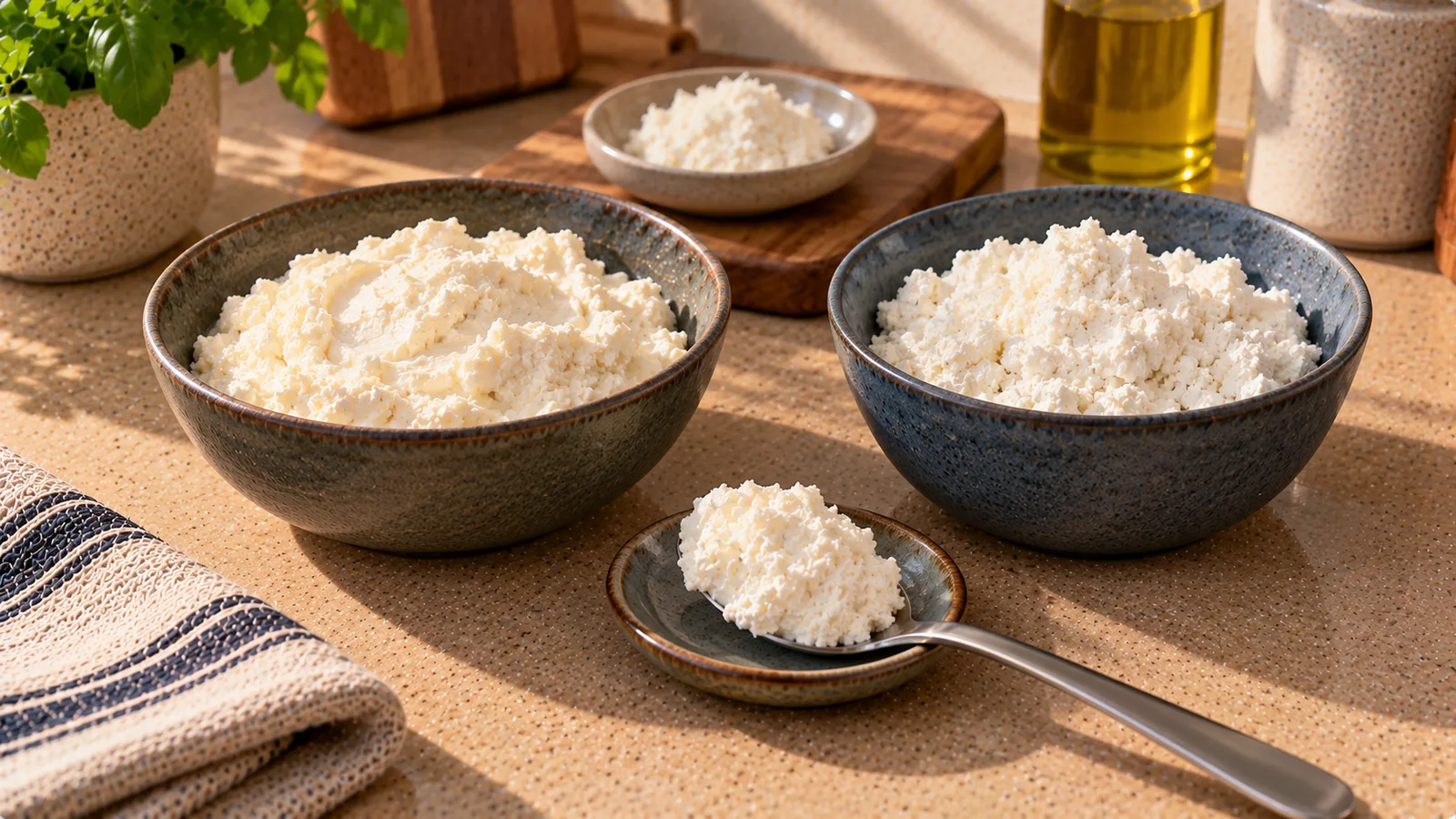
Ricotta is a soft, high-moisture cheese, so its calorie density is generally lower than that of hard aged cheeses such as Parmesan.
A typical ricotta can provide roughly 130–180 kcal per 100 g, but there is substantial variation between whole-milk, part-skim and other products.
The nutrition label on your own package is therefore the best source when you need an exact value.
Ricotta nutrition per 100 g
A practical range for plain ricotta is approximately:
| Nutrient | Per 100 g |
|---|---|
| Calories | 130–180 kcal |
| Protein | 8–12 g |
| Fat | 8–13 g |
| Carbohydrates | 3–6 g |
These numbers are intended as orientation rather than a universal specification.
Milk composition, moisture, manufacturing method and brand can all change the final values.
Whole-milk vs part-skim ricotta
One of the biggest reasons ricotta calories vary is fat content.
Whole-milk ricotta generally contains more fat and therefore tends to contain more calories than part-skim ricotta.
For example, two products might look like this:
| Type | Example calories per 100 g |
|---|---|
| Part-skim ricotta | 135 kcal |
| Whole-milk ricotta (illustrative example) | 175 kcal |
The 175 kcal per 100 g figure is an illustrative whole-milk ricotta example. It is not the value of the specific USDA ricotta records cited below; brands may differ.
These are examples, not fixed values for every product.
A different brand can have noticeably different nutrition.
Calories in common ricotta portions
Using 160 kcal per 100 g as a simple example:
| Ricotta amount | Approximate calories |
|---|---|
| 25 g | 40 kcal |
| 30 g | 48 kcal |
| 50 g | 80 kcal |
| 75 g | 120 kcal |
| 100 g | 160 kcal |
| 125 g | 200 kcal |
| 150 g | 240 kcal |
| 200 g | 320 kcal |
The calculation is:
calories = grams × calories per 100 g ÷ 100
If your ricotta contains 145 kcal per 100 g, use 145 instead of the example value.
How many calories are in 50 g of ricotta?
At 160 kcal per 100 g:
50 × 160 ÷ 100 = 80 kcal
A 50 g portion can work as a small topping, filling or addition to another dish.
If the product is a lower-fat ricotta with 135 kcal per 100 g:
50 × 135 ÷ 100 = 67.5 kcal
So even the same serving weight can produce a different result depending on the product.
Calories in 100 g of ricotta
For many products, 100 g of ricotta will fall somewhere around 130–180 kcal.
Because nutrition labels commonly provide values per 100 g in Europe, this amount is especially convenient for comparing different ricotta products.
It does not mean that 100 g is the required or ideal serving.
Calories in 150 g of ricotta
At 160 kcal per 100 g:
150 × 160 ÷ 100 = 240 kcal
A 150 g serving is large enough that differences between products become more noticeable.
For example:
150 g at 135 kcal per 100 g = 203 kcal
150 g at 175 kcal per 100 g = 263 kcal
That is a difference of about 60 kcal for the same weight.
Calories in 200 g of ricotta
At 160 kcal per 100 g:
200 × 160 ÷ 100 = 320 kcal
If ricotta forms a major part of a meal rather than a small topping, using the exact package value becomes increasingly useful.
Protein in ricotta
Ricotta provides protein, although the amount varies by product.
If a ricotta contains 10 g protein per 100 g:
- 50 g provides about 5 g protein;
- 100 g provides about 10 g;
- 150 g provides about 15 g;
- 200 g provides about 20 g.
Some products contain more or less than this.
When comparing ricotta for protein, check both protein per 100 g and calories per 100 g rather than looking at protein alone.
Fat in ricotta
Fat content is a major contributor to differences in calorie density.
Suppose a whole-milk ricotta contains 12 g fat per 100 g while a part-skim product contains 8 g.
For a 150 g portion:
12 × 1.5 = 18 g fat
versus:
8 × 1.5 = 12 g fat
Because fat provides more energy per gram than protein or carbohydrate, this difference can meaningfully affect total calories.
Carbohydrates in ricotta
Plain ricotta generally contains a modest amount of carbohydrate, much of it associated with naturally occurring milk sugars.
Values vary by product.
Sweetened ricotta fillings and prepared desserts are different foods and can contain considerably more carbohydrate because of added sugar and other ingredients.
Do not use the nutrition values for plain ricotta to track a sweetened ricotta filling.
Why ricotta calories vary
Several factors can change the nutrition values:
- whole milk vs lower-fat milk;
- whey and milk composition;
- final moisture content;
- draining;
- added cream;
- manufacturing method;
- brand formulation.
Ricotta with more water can have fewer calories per 100 g because the nutrients are distributed across a larger mass.
A richer, more concentrated product may have more calories per 100 g.
Is ricotta lower in calories than Parmesan?
Usually, yes, when comparing equal weights.
Parmesan is a hard, aged cheese with relatively little water and commonly provides around 400 kcal per 100 g.
Ricotta contains much more water and often provides roughly 130–180 kcal per 100 g.
That makes equal-weight comparisons very different.
For example:
- 30 g ricotta at 160 kcal/100 g = 48 kcal
- 30 g Parmesan at 410 kcal/100 g = 123 kcal
However, typical serving sizes also differ.
Ricotta may be eaten in much larger quantities than Parmesan, so the total amount used in the meal still matters.
Ricotta vs cottage cheese
Ricotta and cottage cheese can look similar in some dishes, but they are not nutritionally identical.
Cottage cheese is often higher in protein relative to calories, especially in lower-fat versions.
Ricotta is generally smoother and can contain more fat depending on the product.
If substituting one for the other, do not assume identical calories or macros.
Use the nutrition information for the product actually eaten.
Ricotta vs cream cheese
Cream cheese is generally much more calorie-dense than ricotta because it typically contains substantially more fat.
A large spoonful of ricotta and the same weight of full-fat cream cheese therefore may contribute very different calories.
Again, compare them by weight rather than by visual volume.
Does draining ricotta change calories?
Draining removes liquid.
It does not simply remove a proportional amount of all nutrients.
If a ricotta loses water while most solids remain, the drained cheese can become more concentrated per 100 g.
This means a heavily drained homemade or artisanal ricotta may not match the nutrition values of a more moist packaged product.
For a commercial product, use the package value for the product as sold unless you have a specific reason to recalculate it.
Measuring ricotta by tablespoons
Tablespoon measurements are less precise than weighing.
Ricotta can be packed into a spoon with different densities, and a level spoon differs from a heaped one.
If accuracy matters, grams are the better basis.
If a package states that a particular volume corresponds to a specific weight, use that manufacturer's conversion.
Measuring ricotta by cups
Cup measurements have the same limitation.
The actual weight depends on:
- how densely the ricotta is packed;
- moisture;
- container shape;
- whether the cup is level;
- the specific product.
If a recipe gives ricotta in cups but you want accurate nutrition, weighing the ingredient is usually easier.
Ricotta in lasagna
Ricotta is commonly used as part of a larger filling.
Suppose a lasagna contains:
- 500 g ricotta;
- 160 kcal per 100 g.
Ricotta calories in the complete recipe:
500 × 160 ÷ 100 = 800 kcal
If the lasagna is divided into eight equal portions:
800 ÷ 8 = 100 kcal from ricotta per portion
The pasta, meat, sauce, mozzarella, oil and other ingredients must still be counted separately.
Ricotta in pasta
Suppose you stir 120 g ricotta into a pasta dish for two people.
At 160 kcal per 100 g:
120 × 160 ÷ 100 = 192 kcal
If divided evenly:
192 ÷ 2 = 96 kcal from ricotta per serving
This is more reliable than trying to estimate the amount after the cheese has been mixed into the sauce.
Ricotta on toast
For a simple toast, weigh the ricotta before spreading it.
For example:
- bread: tracked separately;
- ricotta: 60 g;
- ricotta label: 150 kcal per 100 g.
Ricotta contribution:
60 × 150 ÷ 100 = 90 kcal
Honey, fruit, nuts or oil added on top should also be counted separately if you are tracking the complete meal.
Ricotta in desserts
Cannoli filling, cheesecake filling and other ricotta-based desserts should not be tracked as plain ricotta alone.
They can include:
- sugar;
- chocolate;
- cream;
- pastry;
- nuts;
- syrups.
The calories of the final dessert depend on the entire recipe.
Plain ricotta nutrition is useful for calculating the ricotta component, not the finished dessert automatically.
How to calculate calories from your ricotta label
Suppose your package states:
147 kcal per 100 g
You eat 85 g.
Calculation:
147 × 85 ÷ 100 = 124.95 kcal
You can reasonably log approximately 125 kcal.
For 130 g:
147 × 130 ÷ 100 = 191.1 kcal
Approximately 191 kcal.
If the label gives calories per serving
Suppose the package says:
- serving size: 62 g;
- calories: 100 kcal.
You eat 90 g.
First calculate the number of labeled servings:
90 ÷ 62 = 1.45 servings
Then:
100 × 1.45 = about 145 kcal
Using the gram value directly is often simpler if the label also provides nutrition per 100 g.
How to track ricotta in a homemade recipe
For a recipe containing ricotta:
- weigh the amount added;
- use the nutrition label from that ricotta;
- include it with all other ingredients;
- calculate the total recipe nutrition;
- divide according to the actual number or weight of servings.
This avoids treating a mixed dish as though it were plain ricotta.
What if you do not know whether it was whole-milk or part-skim?
If you are eating away from home and the exact product is unknown, a reasonable generic ricotta entry can be used as an estimate.
Avoid false precision.
A generic estimate is useful when exact information is unavailable, but it should not be treated as more accurate than the information you actually have.
Is ricotta a high-protein food?
Ricotta contributes meaningful protein, but whether it should be described as “high protein” depends on the product, portion and comparison.
Some other dairy products can provide more protein for the same number of calories.
Rather than relying on the category name, compare the nutrition labels when protein density matters to you.
Is ricotta good for weight loss?
No single food determines weight loss.
Ricotta can fit into meals at many different calorie levels depending on the portion and the rest of the dish.
A 50 g portion and a 200 g portion have very different energy contributions.
For weight management, the overall dietary pattern and energy intake are more relevant than whether one individual food is included.
Sodium in ricotta
Ricotta can contain sodium, but the amount varies substantially between products.
If sodium intake matters to you, check the specific label.
Do not estimate sodium from calories, fat or protein because these values do not reliably predict it.
Calcium and micronutrients
Ricotta can provide calcium and other nutrients found in dairy foods.
Exact micronutrient values vary with production and fortification.
This guide focuses on calories and macronutrients, so the package label or a reliable food-composition database is more appropriate when detailed micronutrient information is required.
A practical portion example
Suppose your breakfast contains:
- 80 g ricotta;
- fruit;
- bread;
- coffee.
Your ricotta has 155 kcal per 100 g.
Ricotta calories:
80 × 155 ÷ 100 = 124 kcal
Only the ricotta contributes those 124 kcal. The other foods and drinks need their own entries.
Quick reference
Using 160 kcal per 100 g as an example:
- 25 g ricotta: about 40 kcal
- 50 g: about 80 kcal
- 75 g: about 120 kcal
- 100 g: about 160 kcal
- 150 g: about 240 kcal
- 200 g: about 320 kcal
The exact value can differ significantly between whole-milk and part-skim products.
For accurate tracking, prioritize the nutrition label on your ricotta and measure the amount you actually eat.
Nutrition data sources and product differences
The records below describe only the named foods, fat levels and preparation states. USDA figures are per 100 g; manufacturer figures retain their stated unit. These sources do not independently prove every approximate figure in the article.
The USDA whole-milk ricotta entries used in this audit report 150 kcal per 100 g. The article’s 175 kcal comparison is a separate example, not a value from these entries.
USDA FoodData Central (search by FDC ID):
- FDC 170851 — Cheese, ricotta, whole milk (150 kcal/100 g)
- FDC 171248 — Cheese, ricotta, part skim milk (138 kcal/100 g)