
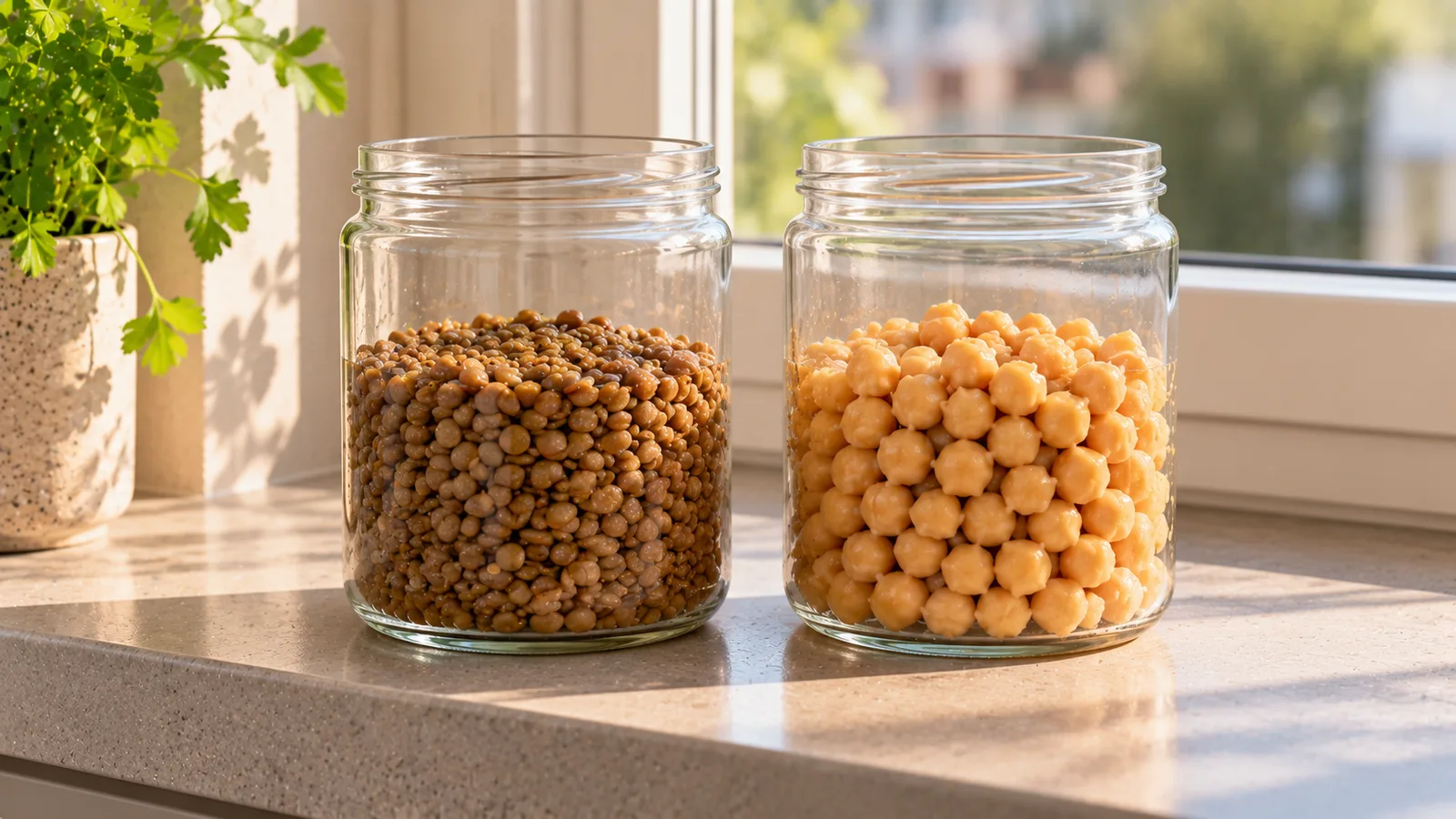
Lentils and chickpeas are both legumes that provide plant protein, carbohydrates, fiber and a range of micronutrients.
But they are not nutritionally identical.
When compared at the same cooked weight, lentils are generally lower in calories and fat, while providing a similar amount of protein. Chickpeas are somewhat more energy-dense and contain more fat.
The better choice depends on what you want from the meal.
Lentils vs chickpeas at a glance
Approximate nutrition per 100 g cooked:
| Nutrient | Lentils | Chickpeas |
|---|---|---|
| Calories | 116 kcal | 164 kcal |
| Protein | 9.0 g | 8.9 g |
| Carbohydrates | 20.1 g | 27.4 g |
| Fiber | 7.9 g | 7.6 g |
| Fat | 0.4 g | 2.6 g |
These are general reference values for plain cooked legumes.
Exact nutrition varies with variety, cooking method, water content and database.
Which has fewer calories?
Lentils.
Per 100 g cooked:
- lentils: about 116 kcal;
- chickpeas: about 164 kcal.
That is a difference of roughly 48 kcal per 100 g.
For a 200 g portion:
| Food | Approx. calories |
|---|---|
| Lentils | 232 kcal |
| Chickpeas | 328 kcal |
The difference becomes more noticeable as portion size increases.
This does not make chickpeas a “bad” food. It simply means they are more energy-dense at the same cooked weight.
Which has more protein?
The difference is very small.
Per 100 g cooked:
- lentils: about 9.0 g protein;
- chickpeas: about 8.9 g protein.
In practical terms, both provide a similar amount of protein by cooked weight.
For 200 g:
- lentils: about 18 g protein;
- chickpeas: about 17.8 g protein.
If your only question is which contains more protein per 100 g cooked, lentils have a slight numerical advantage, but the difference is too small to be the main reason to choose one over the other.
Protein per calorie
The comparison changes when protein is considered relative to calories.
Approximate protein per 100 kcal:
Lentils
9.0 ÷ 116 × 100 ≈ 7.8 g protein per 100 kcal
Chickpeas
8.9 ÷ 164 × 100 ≈ 5.4 g protein per 100 kcal
Lentils therefore provide more protein for the same calorie intake.
This can be useful when someone wants to increase protein while keeping total calories more constrained.
However, neither food needs to be judged only by protein efficiency. Both provide fiber, carbohydrates and other nutrients.
Which has more carbohydrates?
Chickpeas contain more total carbohydrate per 100 g cooked.
Approximate values:
- lentils: 20.1 g;
- chickpeas: 27.4 g.
For a 200 g portion:
| Food | Carbohydrates |
|---|---|
| Lentils | ~40 g |
| Chickpeas | ~55 g |
The difference partly reflects differences in water content and overall calorie density.
Which has more fiber?
They are very similar.
Per 100 g cooked:
- lentils: approximately 7.9 g fiber;
- chickpeas: approximately 7.6 g fiber.
A 200 g portion provides roughly:
- lentils: 15.8 g;
- chickpeas: 15.2 g.
In everyday meal planning, both can make a substantial contribution to fiber intake.
Which has more fat?
Chickpeas.
Approximate fat per 100 g cooked:
- lentils: 0.4 g;
- chickpeas: 2.6 g.
The absolute amount in chickpeas is still moderate, but it helps explain part of their higher calorie density.
Preparation can create a much larger difference than the legumes themselves.
For example, chickpeas roasted with oil or lentils served with a generous oil-based dressing can contain considerably more fat and calories.
150 g serving comparison
A realistic cooked portion gives a useful comparison:
| Nutrient | 150 g lentils | 150 g chickpeas |
|---|---|---|
| Calories | ~174 kcal | ~246 kcal |
| Protein | ~13.5 g | ~13.4 g |
| Carbohydrates | ~30 g | ~41 g |
| Fiber | ~11.9 g | ~11.4 g |
| Fat | ~0.6 g | ~3.9 g |
At this serving size, protein and fiber remain very similar, while chickpeas provide more calories, carbohydrates and fat.
200 g serving comparison
| Nutrient | 200 g lentils | 200 g chickpeas |
|---|---|---|
| Calories | ~232 kcal | ~328 kcal |
| Protein | ~18 g | ~17.8 g |
| Carbohydrates | ~40 g | ~55 g |
| Fiber | ~15.8 g | ~15.2 g |
| Fat | ~0.8 g | ~5.2 g |
This illustrates the central difference clearly: similar protein and fiber, but different calorie density.
Which is better for weight loss?
Neither food automatically causes weight loss.
Weight loss depends primarily on maintaining an appropriate energy deficit over time.
However, lentils provide fewer calories at the same cooked weight while offering similar protein and fiber.
That can make them useful when building meals with a lower calorie density.
Chickpeas can also fit easily into a weight-loss diet.
The important factors include:
- portion size;
- total daily calorie intake;
- preparation method;
- sauces and added fats;
- the rest of the meal.
For example, 150 g of plain chickpeas may fit comfortably into a calorie target, while a smaller serving covered in oil-rich dressing could contain substantially more calories.
Which is better for protein?
If the comparison is based on cooked weight, the protein difference is negligible.
If it is based on calories, lentils provide more protein per calorie.
That makes lentils somewhat more efficient when calorie intake is constrained.
For a higher-protein meal, you can also combine either legume with another protein source rather than simply increasing the legume portion.
Which is better for fiber?
There is no meaningful winner for most practical purposes.
Both provide substantial fiber.
The exact amount can vary by variety and preparation, so choosing the legume you enjoy and eat consistently may matter more than a small difference in a nutrition database.
Which is more filling?
Satiety cannot be predicted from one nutrient alone.
Both lentils and chickpeas contain protein and fiber and can be part of satisfying meals.
The overall meal also matters.
A meal's volume, calorie density, vegetables, added fats, other protein sources and individual preferences can all affect how filling it feels.
Because cooked lentils generally provide fewer calories per 100 g, they can provide more cooked food weight for a given calorie amount.
Lentils vs chickpeas for meal planning
The two foods behave differently in meals.
Lentils work particularly well in
- soups;
- stews;
- dals;
- warm bowls;
- sauces;
- salads;
- dishes where a softer texture is useful.
Chickpeas work particularly well in
- salads;
- grain bowls;
- curries;
- roasted snacks;
- wraps;
- hummus;
- dishes where a firmer texture is useful.
This practical difference may matter more than small nutrient differences.
Dry vs cooked values can distort the comparison
Always compare the same preparation state.
Dry lentils and dry chickpeas are much more calorie-dense per 100 g than their cooked versions because they contain less water.
Comparing dry chickpeas with cooked lentils would not be meaningful.
Use:
- cooked vs cooked;
- dry vs dry.
For calorie tracking, match the nutrition entry to the state in which the food was weighed.
See Raw vs Cooked Weight: How It Changes Calorie Tracking.
What about canned chickpeas and lentils?
Canned versions are already cooked.
Their calorie density can vary because of differences in:
- water content;
- variety;
- processing;
- packing liquid;
- whether the nutrition information refers to drained or undrained weight.
When comparing two canned products, the package labels are more useful than generic database averages.
If possible, compare both products on the same basis, such as per 100 g drained.
Preparation can outweigh the basic difference
Plain lentils and chickpeas are only the starting point.
Consider two examples.
Lentils
200 g plain cooked lentils:
~232 kcal
Add 20 g oil:
+ ~180 kcal
Total:
~412 kcal
Chickpeas
150 g plain cooked chickpeas:
~246 kcal
Add mostly low-calorie vegetables and little or no oil, and the final meal may still contain fewer calories than the lentil dish with substantial added oil.
So the base food matters, but the entire recipe matters more.
Chickpeas as hummus
Hummus should not be compared gram-for-gram with plain cooked lentils as if it were simply chickpeas.
Hummus commonly contains tahini and sometimes additional oil.
These ingredients increase calorie density.
If you are comparing a lentil dish with hummus, use the nutrition data for the finished hummus rather than the values for plain chickpeas.
Roasted chickpeas vs cooked lentils
Roasting chickpeas can remove water and may involve added oil.
Both factors can increase calories per 100 g compared with boiled chickpeas.
A direct comparison with cooked lentils should therefore use the nutrition values of the actual roasted product or recipe.
Can you substitute lentils for chickpeas?
Often, but not always.
They can perform similar nutritional roles, yet their textures are different.
Lentils are smaller and many varieties soften substantially during cooking.
Chickpeas are larger and generally retain a firmer structure.
In soups, curries and bowls, substitution can often work.
For hummus or roasted whole-legume dishes, the result will be much more different.
Using both in the same diet
There is no nutritional reason to choose only one.
Using both can add variety to meals.
For example:
- lentil soup one day;
- chickpea salad another day;
- lentil curry;
- roasted chickpeas;
- mixed-legume bowls.
Dietary variety can also make meal planning easier and more enjoyable.
If your priority is lower calorie density
Lentils generally have the advantage when comparing equal cooked weights.
They contain substantially fewer calories per 100 g while providing similar protein and fiber.
If your priority is protein per calorie
Lentils again have the advantage.
Approximate protein per 100 kcal:
| Food | Protein per 100 kcal |
|---|---|
| Lentils | ~7.8 g |
| Chickpeas | ~5.4 g |
If your priority is maximum fiber
Both are strong options.
Their typical fiber values are close enough that product choice, portion size and the rest of the diet are likely to matter more.
If your priority is versatility
This depends on the dish.
Chickpeas hold their shape well and work particularly well in salads, bowls, roasting and hummus.
Lentils are convenient in soups, stews, dals and dishes where a softer texture is desirable.
Quick decision table
| Goal | Better fit |
|---|---|
| Fewer calories per 100 g cooked | Lentils |
| More protein per 100 kcal | Lentils |
| Protein per 100 g cooked | Nearly equal |
| Fiber | Nearly equal |
| Lower fat | Lentils |
| Firm texture for salads/roasting | Chickpeas |
| Soups, stews and dals | Lentils |
| Hummus | Chickpeas |
“Better” here refers only to the stated criterion, not overall nutritional quality.
The bottom-line comparison
Lentils and chickpeas are both nutritious legumes and can serve similar roles in a balanced diet.
For the same cooked weight, lentils are generally lower in calories and fat while providing approximately the same protein and fiber.
Chickpeas provide more calories and carbohydrates per 100 g and have a firmer texture that works well in many dishes.
If calorie density or protein per calorie is the priority, lentils have an advantage.
If texture, recipe compatibility or personal preference points toward chickpeas, they remain a useful nutrient-rich option.
The most practical choice is often the one that fits the complete meal rather than the food with the smallest numerical advantage.