
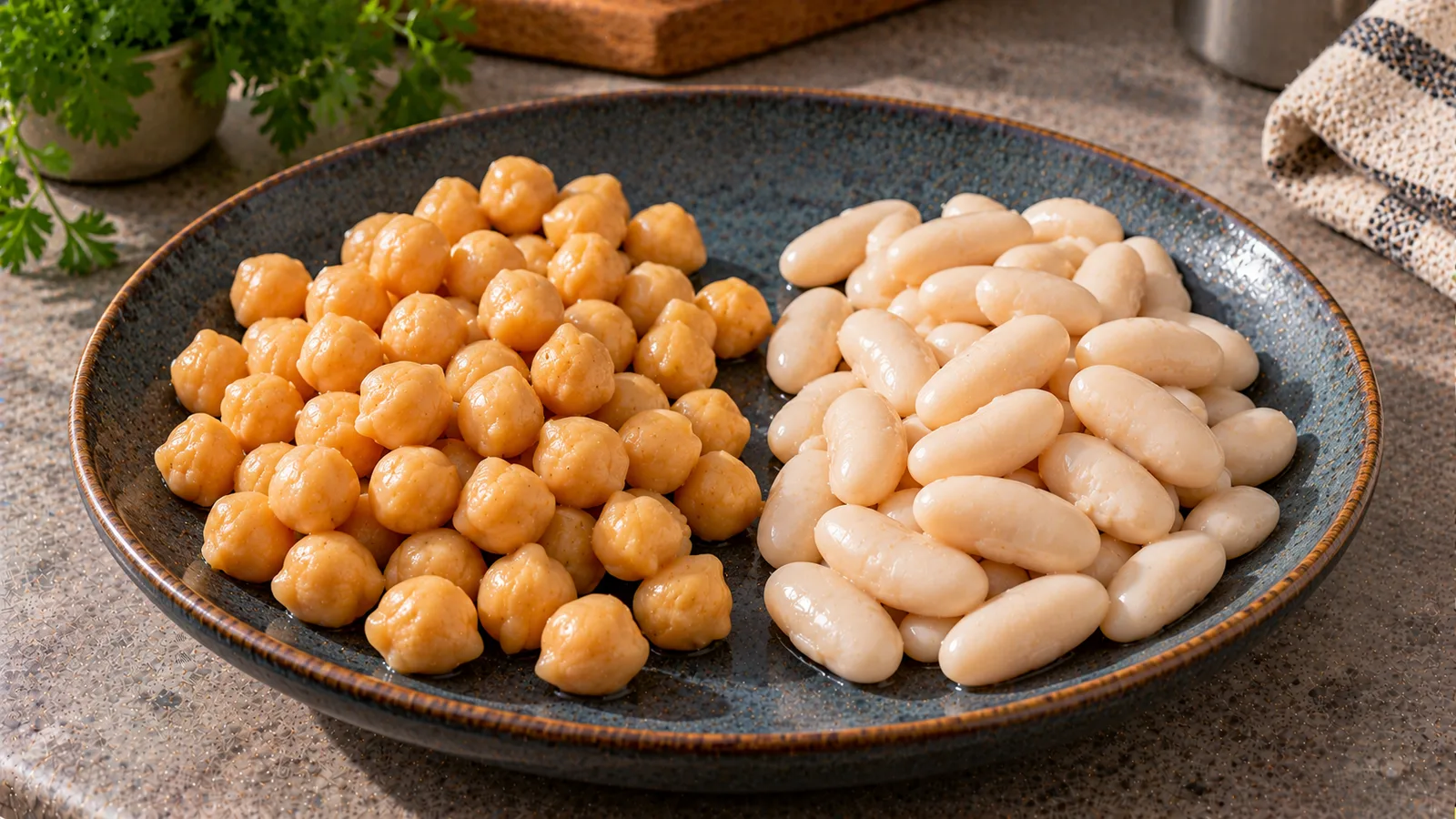
Chickpeas and white beans are both versatile, fibre-rich pulses, but the better choice depends on your goal. Per 100 g of cooked, unsalted edible beans, chickpeas have 164 kcal, 8.86 g protein and 7.6 g fibre. White beans have 139 kcal, 9.73 g protein and 6.3 g fibre in the selected USDA SR Legacy entries. Thus white beans edge ahead on protein and calories, while chickpeas supply a little more fibre in this particular like-for-like comparison.
Cost is more complicated. The relevant comparison is the price of edible beans on the plate, not the price per kilo of dry beans or the liquid-filled weight printed on a can. This guide compares 600 g of ready-to-eat beans from both routes, accounts for assumed water absorption and home cooking electricity, and clearly separates observed German canned-product prices from illustrative dry-bean and utility prices.
Nutritional comparison: same cooked state, same weight
The first table is sourced to two distinct USDA FoodData Central SR Legacy foods. Both are mature seeds, cooked by boiling without added salt. They are not dry-bean values, cans in seasoned brine or restaurant portions. Numbers are per 100 g edible, cooked beans; oil, dressings and other ingredients are excluded.
| USDA cooked edible food | kcal | Protein | Fibre | Fat | Carbohydrates | Sodium |
|---|---|---|---|---|---|---|
| Chickpeas, boiled, unsalted | 164 | 8.86 g | 7.6 g | 2.59 g | 27.4 g | 7 mg |
| White beans, boiled, unsalted | 139 | 9.73 g | 6.3 g | 0.35 g | 25.1 g | 6 mg |
USDA chickpeas, cooked, FDC 173757 and USDA white beans, cooked, FDC 175203 document the two reference foods. Their sodium figures are low because the entries are unsalted. A salted can can contain more sodium even if its energy content is similar. There are several varieties of white beans, including cannellini and navy types; the USDA generic entry should not be passed off as a nutrient measurement of every specific variety.
A 0.87 g protein difference per 100 g is real in this reference comparison, but small next to the influence of serving size and the rest of a meal. Likewise the 25-kcal gap does not mean a chickpea-based dinner is intrinsically high-calorie: oil, bread and sauces can add more calories than the difference between the legumes.
How much protein and fibre are in a serving?
Use the actual cooked or drained edible mass, without the water left in the pot or tin. These portions are arithmetic conversions from the USDA 100 g figures; they are not independent measurements of four household serving sizes.
| Edible cooked portion | Chickpeas kcal | Chickpeas protein | Chickpeas fibre | White beans kcal | White beans protein | White beans fibre |
|---|---|---|---|---|---|---|
| 75 g | 123 | 6.6 g | 5.7 g | 104 | 7.3 g | 4.7 g |
| 100 g | 164 | 8.9 g | 7.6 g | 139 | 9.7 g | 6.3 g |
| 150 g | 246 | 13.3 g | 11.4 g | 209 | 14.6 g | 9.5 g |
| 200 g | 328 | 17.7 g | 15.2 g | 278 | 19.5 g | 12.6 g |
At 150 g, chickpeas provide roughly 246 kcal, 13.3 g protein and 11.4 g fibre. The same weight of white beans supplies approximately 209 kcal, 14.6 g protein and 9.5 g fibre. A 75 g side dish and a 200 g main ingredient should not be described as the same serving. A bean salad's nutritional total also includes oil, grains, vegetables and dressing.
These are substantial amounts of fibre, but they do not establish that everyone should suddenly eat a large bowl of pulses. People who currently eat little fibre may prefer smaller servings and gradually increase their intake. See Mealisa's guide to high-fibre foods for comparisons across a broader range of foods.
Dried versus canned: the weight that matters
A 500 g bag of dry pulses is not equivalent to 500 g of canned drained beans. During soaking and cooking, beans take up water; some solids may also be lost in cooking liquid. Consequently, a 100 g dry nutrition value must never be multiplied by the weight of the same food after boiling. The cooked values above apply only when you weigh the edible cooked result.
In a worked kitchen scenario, 250 g dry chickpeas become 600 g cooked at an assumed 2.4× yield, and 240 g dry white beans become 600 g cooked at 2.5×. These are practical calculation assumptions, not universal yields or claims that all chickpeas absorb the same amount of water. Actual yield depends on variety, age, soaking, doneness, and how thoroughly the beans are drained. Weigh your own finished batch to update the equation.
Ready-cooked products require another conversion. The dmBio chickpea can lists 220 g drained from a 350 g total fill. The dmBio cannellini can lists 240 g drained from 400 g total fill. The liquid does not belong in the edible bean weight if you discard it. For a canned recipe, use the actual label's nutrition values as well, rather than pretending these canned products have been analysed in the USDA's plain-boiled reference state.
Cooking and shopping costs for the same 600 g
For the can comparison, the German dm online listings examined for this article showed €0.85 for 220 g drained chickpeas and €1.15 for 240 g drained cannellini beans. These are observed offers for those named products, not national market averages; prices and availability can change.
For dried beans, publicly available listings such as Wurzener dried white beans at REWE show a 500 g product but do not provide a nationwide checkout price. Therefore this worked model deliberately uses hypothetical dry prices of €4.00/kg chickpeas and €3.60/kg white beans. Electricity is also assumed: €0.35/kWh, with 0.45 kWh for the chickpea batch and 0.60 kWh for white beans; water is estimated at €0.05 per batch. These are example inputs, not measurements of a real cooker's consumption or current tariff.
| Cost scenario for 600 g edible | Chickpeas | White beans |
|---|---|---|
| Dried starting weight | 250 g | 240 g |
| Assumed cooked yield multiplier | 2.4× | 2.5× |
| Dry grocery cost | €1.00 | €0.86 |
| Cooking electricity | €0.16 | €0.21 |
| Cooking water allowance | €0.05 | €0.05 |
| Total for 600 g dried preparation | €1.21 | €1.12 |
| Canned edible unit and price | 220 g / €0.85 | 240 g / €1.15 |
| Canned prorated 600 g | €2.32 | €2.88 |
| Canned checkout: 3 full packs | €2.55 | €3.45 |
| Dry cooked cost per 150 g | €0.30 | €0.28 |
| Canned drained cost per 150 g | €0.58 | €0.72 |
Under those assumptions, 600 g home-cooked chickpeas cost about €1.21, while the same mass of white beans costs €1.12, excluding your time and equipment. Using the published canned prices and prorating by drained mass yields approximately €2.32 for 600 g chickpeas and €2.88 for 600 g cannellini. These canned costs are theoretical fractions of packs. To buy at least 600 g at the checkout, you need three cans of either product: €2.55 buys 660 g chickpeas, while €3.45 buys 720 g cannellini, leaving 60 g or 120 g respectively.
The dried comparison is not proof that either pulse always wins. Dry prices, cooking energy, heat losses, and kitchen equipment vary. Electricity figures must be replaced with measured consumption if exact savings matter. Nor can the full price of three cans be treated as the price of exactly 600 g without accounting for the unused leftovers. Mealisa's protein-and-fibre-per-euro guide discusses other reasons that a food's purchasing unit and its edible portion can differ.
How much does cooked yield change the answer?
Holding dry package prices, electricity and water fixed, only vary the cooked yield. The next table shows why someone who gets soft, thoroughly drained beans at 2.2× may pay more per 150 g than someone whose batch yields 2.6×. Both can be preparing the same starting dry mass, but the water retained at the end differs.
| Cooked yield assumption | Edible mass from starting dry batch | Estimated cost per 150 g |
|---|---|---|
| Chickpeas, boiled, unsalted — 2.2× | 550 g | €0.33 |
| Chickpeas, boiled, unsalted — 2.4× | 600 g | €0.30 |
| Chickpeas, boiled, unsalted — 2.6× | 650 g | €0.28 |
| White beans, boiled, unsalted — 2.3× | 552 g | €0.31 |
| White beans, boiled, unsalted — 2.5× | 600 g | €0.28 |
| White beans, boiled, unsalted — 2.7× | 648 g | €0.26 |
This calculation should not be used to claim that extra cooking water increases the intrinsic protein in the batch. Nutrients are spread over a larger final weight. If your goal is cost per gram of protein, calculate from the ingredient's reliable nutrient data on a compatible dry or cooked basis and account for losses; do not count absorbed water as protein. The sensitivity table is intentionally a cost-per-weight comparison, not a new laboratory nutrient estimate.
For home accounting, record the unopened bag price, dry grams used, actual cooked-and-drained yield, and energy consumed if you know it. Calculate total cost first and divide by the actual edible grams. Keep water and cooking fuel as separate transparent assumptions when they cannot be measured.
Texture, recipes, salt and preparation time
Chickpeas are usually pleasantly firm and nutty, so they hold their shape in couscous bowls, warm salads, hummus and crunchy roasted snacks. White beans tend to be creamier and are useful for soups, bean purées, stews and thickened sauces. Their roles are flexible, however: neither needs to be confined to a recipe category, and seasonings often matter more to taste than the nutrient differences in the first table.
The convenience difference is real: a can is already cooked, while dry pulses require soaking, heating, cooling and cleanup. Consider the value of time, batch size and available refrigeration. Cooking one large batch and freezing it in suitable containers can be economical if it fits your household. A small serving cooked in an inefficient pot may use disproportionately more fuel than the example.
Canned beans can come with added salt. The cited dmBio products contain sea salt, unlike the unsalted USDA reference. Compare sodium or salt on the actual label and use drained, edible grams. Rinsing may reduce some surface brine, but it also changes retained liquid and sometimes the recorded portion weight. Our guide to rinsing canned legumes covers that separate practical question; the cost table here assumes the drained weight printed on the can.
Cook dried beans safely; do not rely on soaking alone
Uncooked pulses contain lectins that can cause gastrointestinal illness if the food is inadequately cooked. Germany's Federal Institute for Risk Assessment advises soaking dried pulses for at least five hours, discarding soaking water, and boiling them thoroughly in fresh water. Its guidance notes that gentle steaming is not an appropriate replacement for thorough boiling for most pulses. Follow the product's specific preparation instructions and continue cooking until the beans are genuinely soft. Read the BfR explanation of lectins and food safety.
Never assume that soaking overnight makes raw beans ready to eat. The time needed varies with variety and age; a small cost saving is not a reason to shorten safe cooking. Properly canned chickpeas and white beans are already heat-treated and usually ready to use according to their label. Chill leftovers promptly and obey the stated opened-pack storage period: the dmBio chickpea listing specifies two days refrigerated after opening, while the cannellini page gives three to four days, in a non-metal container.
How to choose for your actual meal
If your goal is slightly more protein and fewer calories per equal cooked mass, the selected USDA white-bean reference has a modest advantage. If you want somewhat more fibre and a firmer texture, cooked chickpeas may suit your dish better. If preparation time is limited, choose drained canned beans and compare labels; if you cook large batches regularly, measure your own dry-to-cooked yield before declaring dried beans cheaper.
In either case, beans are ingredients rather than a complete meal by themselves. Vegetables, grains and fats determine much of a finished plate's energy and nutritional balance. And when a recipe calls for “one can”, check the edible weight rather than replacing it with 400 g of dry or cooked beans. Mealisa's white-bean calorie and serving guide adds detail for that individual ingredient; the amount sold, the declared serving and what you actually eat are different quantities.
Sources and calculation notes
Nutrition: USDA SR Legacy boiled chickpeas, FDC 173757 and boiled white beans, FDC 175203. Product-specific drained weights and observed German offers: dmBio chickpeas and dmBio cannellini. Dry-product context: REWE white beans. Food safety: BfR lectin guidance. Dry yields, dry prices, energy use, water allowance and all scenario totals are explicitly illustrative arithmetic, not independently measured market or cooking data.