
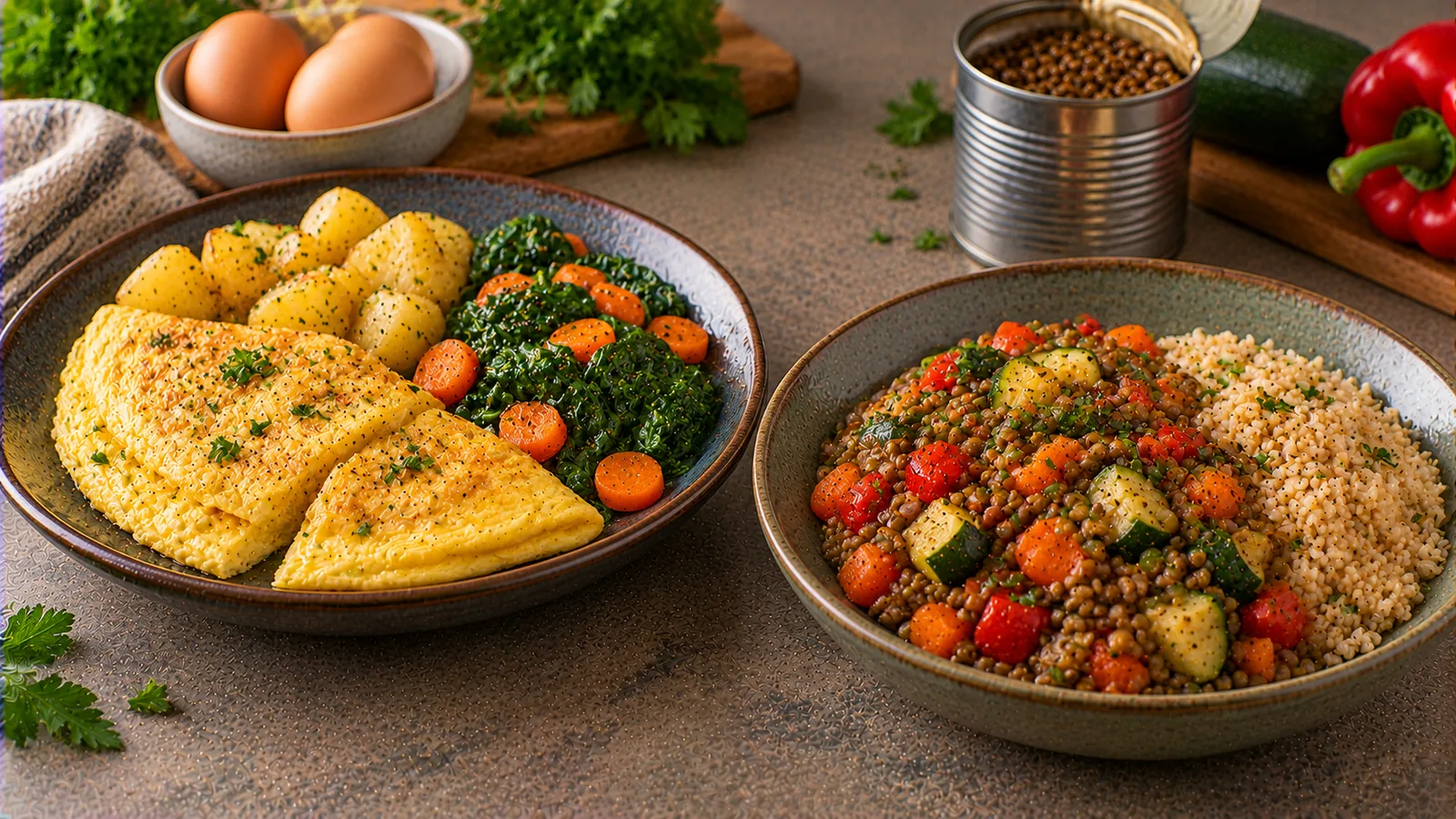
Comparing eggs with canned lentils for a 20 g protein dinner is not as simple as putting two 100 g nutrition labels next to one another. People buy eggs by the piece and canned lentils by the tin; the amount you can actually eat matters. A realistic dinner may need a little wholegrain bread alongside the lentils. Both dinners can clear roughly 20 g of protein, but they bring different amounts of fiber, fat, salt and food volume.
Here we use three cooked eggs or one 240 g drained tin of ready-to-eat brown lentils plus 25 g wholegrain bread. These are protein-contributing components of a meal, not precise totals for an entire plate of vegetables. A vegetable side makes each a fuller dinner and adds a variable amount of protein. The DGE protein food table reports 7 g per cooked egg with 60 g edible portion and 7 g protein per 100 g wholegrain bread (DGE). The dmBio brown lentil label reports 7.7 g protein per 100 g, a 240 g drained weight and 400 g total fill (product label). These inputs are not interchangeable with a dry-lentil label or a different brand.
The two plates that reach approximately 20 g
| Measured protein component | Egg dinner | Lentil dinner |
|---|---|---|
| Core food | 3 cooked eggs, 60 g edible portion each | 240 g canned brown lentils, drained |
| Complement | Vegetables to taste | 25 g wholegrain bread plus vegetables |
| Core protein | 3 × 7 = 21.0 g | 240 × 7.7 / 100 = 18.48 g |
| Bread protein counted | None | 25 × 7 / 100 = 1.75 g |
| Counted protein total | 21.0 g | 20.23 g |
| Fiber from main ingredient | Eggs: essentially none | Lentils: 11.04 g |
| Core ingredient salt on cited label | Varies by egg product and seasoning | Lentils: 0.84 g before bread |
The egg plate has 21.0 g from its eggs alone. The lentil plate has 20.23 g from lentils plus bread. This is deliberately not a claim that their complete meal protein is exactly the same: tomatoes, mushrooms, broccoli, oil, dressings and bread brands change the actual meal totals. Do not report 20.23 g as the protein in the whole plate while quietly including other foods.
Where the source numbers come from
The German Nutrition Society's example portion is one cooked egg, 60 g edible part, 7 g protein. Three matching portions therefore supply 21 g. A smaller egg need not supply exactly 7 g; if your packet gives a different weight, use that food's edible quantity and its nutrition data. Cooked eggs also lose some water, which is why the weight basis must remain explicit. Using a raw egg labeled 50 g and treating it as DGE's 60 g cooked edible portion would be inconsistent.
The dmBio lentils are ready-to-eat, already cooked. Their label lists 7.7 g protein, 96 kcal, 4.6 g fiber and 0.35 g salt per 100 g. A 240 g drained portion contributes approximately 18.48 g protein, 230.4 kcal, 11.04 g fiber and 0.84 g salt. The 400 g total tin content includes packing liquid; it is not 400 g lentils for this calculation. Check that the nutrition declaration is interpreted on the correct drained/prepared basis for the purchased product. If a different tin declares values per product with liquid, the comparison needs recalculating.
From the same DGE protein table, 50 g wholegrain bread provides 3.5 g protein. Halving that serving to 25 g provides 1.75 g, giving 18.48 g + 1.75 g = 20.23 g from the lentil-and-bread combination. This does not mean the dinner provides exactly 20 g after the vegetable side is added. The bread may add fiber, sodium, carbohydrate and energy; the quantities depend on its actual label.
Portion size and dinner satisfaction
Three eggs are a compact centerpiece. To make a complete-feeling dinner, add a substantial side such as 200 g vegetables and, if desired, a small potato or grain portion. These extras raise the energy and total protein to a degree that depends on what you serve. An omelet with spinach is also possible, but frying oil and cheese turn it into a different nutritional calculation. Eggs provide fat as well as protein, and their fiber contribution is near zero.
A 240 g portion of drained lentils is much bulkier. Warm them with onions, tomatoes and cumin; put the 25 g bread alongside rather than mixing it into the protein calculation under another weight. The lentils bring carbohydrate and fiber as well as protein. Some diners find 240 g of legumes a large first serving: starting with 120 g, and adding another protein food, may be more comfortable. That smaller lentil quantity alone delivers only 9.24 g protein, so the 20 g target has to be recalculated rather than silently retained.
Because the dishes are not identical in calories or fiber, neither is inherently the 'better' dinner. The right comparison is what foods and portion sizes actually fit the rest of the person's day. The DGE guidance on plant and animal proteins emphasizes variety and combinations of food sources. This guide evaluates one dinner structure, not the superiority of a single nutrient number.
Price: ingredient used vs checkout
A price statement without a quantity basis can be seriously misleading. For an illustrative German basket, assume €2.49 for 10 eggs and €1.80 for a 500 g wholegrain loaf. Those two numbers are made-up example inputs, not verified current store offers. The cited dmBio lentil product is listed at €1.15 for a 240 g drained tin on the retailer page when checked; that is a dated product-page observation and not a guarantee for every shop, region or later date (dm). Recheck any prices before buying.
| Quantity and price basis | Egg main components | Lentil main components |
|---|---|---|
| Example store units | 10 eggs: €2.49 | 240 g drained tin: €1.15; bread 500 g: €1.80 |
| Amount used for dinner | 3 eggs | 240 g lentils + 25 g bread |
| Calculation | 3 × €2.49 / 10 | €1.15 + 25 × €1.80 / 500 |
| Cost of protein components used | €0.75 (unrounded €0.747) | €1.24 |
| Counted protein | 21.0 g | 20.23 g |
| Not included | Vegetables, oil, seasonings | Vegetables, oil, seasonings |
The egg protein components cost about €0.49 less in this particular mixed real/illustrative example: €1.24 − €0.747 = €0.493. This does not mean eggs are generally cheaper than lentils. Eggs sold in a six-pack, organic free-range eggs, a discount lentil tin, leftover cooked dry lentils or pricier bread can change the result. If your question is what a complete dinner costs, add the sides to both plates on the same basis.
In this illustration, buying all three packages at once costs €2.49 + €1.15 + €1.80 = €5.44 at checkout. The dinner uses three of ten eggs, the entire drained can and 25 g of a 500 g loaf. You still own seven eggs and 475 g bread for future meals. Do not assign the whole €5.44 purchase to either single dinner or subtract the value of leftovers as cash already refunded.
A second lentil option without bread
If you want protein from lentils alone, 20 ÷ 7.7 × 100 = 259.74 g, so round to 260 g drained canned lentils, giving about 20.02 g protein. This exceeds the 240 g drained content of one tin by 20 g. You would need to open a second tin or use leftovers from another meal. Two tins would cost €2.30 at checkout at €1.15 each, but only 260/240 × €1.15 ≈ €1.25 of lentils are used; approximately 220 g drained is left for another dish.
A practical one-tin dinner with a modest bread addition avoids opening a second tin. Conversely, if you already have a second opened tin in your fridge and can use it safely, the 260 g option may suit you. For the broader method of comparing protein to the amount actually paid, see how to compare protein per euro in German supermarkets. For the distinct question of whether dry or canned lentils are cheaper per cooked portion, see the difference between canned and dried lentils by cooked-portion cost. Neither answer can be transplanted here without checking the protein denominator.
Fiber, salt, fat and nutrient differences
The cited lentils provide 4.6 g fiber per 100 g, or 11.04 g from 240 g, before bread and vegetables. Eggs have negligible fiber. On the other hand, an egg dinner provides protein in a much smaller food volume; it also contains dietary fat and cholesterol, whereas the plain canned lentils have 0.4 g fat per 100 g on their label. These traits are not interchangeable. The lentil dish has more carbohydrate, the egg core has more fat, and adding oil or cheese changes either plate.
The dmBio lentil label states 0.35 g salt per 100 g, so 240 g gives 0.84 g salt before bread, cooking salt or sauce. If you rinse the lentils, sodium might change, but the label no longer directly measures the rinsed final meal. Do not claim a particular sodium reduction without testing. Check the sodium or salt entry on your actual loaf. Eggs are not 'salt-free' simply because you have not salted them at the stove.
There are also differences in amino acid composition. The DGE explains that animal and plant protein sources have different amino acid patterns, while combinations of grains and pulses can improve overall balance (DGE FAQ). That does not justify converting 20 g of protein from one dinner into a fixed 'quality-corrected' gram total for the other, because such a conversion would require more detailed digestibility information.
Step-by-step: two measured dinners
Dinner A — eggs and vegetables, one adult. Use 3 eggs matching the cited protein portion assumption and about 200 g vegetables of choice: for example 100 g cherry tomatoes, 50 g mushrooms and 50 g greens. Steam or sauté the vegetables with a little water; if you add oil, measure it and add its cost separately. Cook the eggs thoroughly until both whites and yolks are firm. Arrange eggs and vegetables on the plate. This preparation gives 21 g of counted egg protein; the vegetable protein is additional and variable. A potato or slice of bread can be included if you need more energy, but not invisibly counted as free.
Dinner B — warm lentils and bread, one adult. Drain a 400 g total-fill tin to obtain its labeled 240 g edible drained lentils. Heat them thoroughly with 100 g chopped tomatoes and 100 g other vegetables, seasoning with pepper, garlic or cumin. Serve with 25 g wholegrain bread. The counted protein is 20.23 g before vegetables. If your drained tin weighs less than the declared 240 g in practice, use the measured quantity and recalculate. Some canned legumes are ready to eat cold; follow the product label and handle opened cans hygienically.
For cooked egg dishes, the USDA FSIS egg-safety advice is to cook eggs until whites and yolks are firm and egg-containing dishes to 160 °F (about 71 °C) when measured with a suitable food thermometer. Refrigerate perishables promptly; an opened lentil tin should be transferred to a clean non-metal container and, according to the dmBio package guidance, refrigerated and consumed within 3–4 days. Never rely solely on a recipe's nominal minutes for safe egg doneness.
Is eating three eggs regularly recommended?
A single three-egg example is not a recommended daily egg allowance. In its 2024 food-based guidance for healthy adults eating a mixed diet, the DGE describes one additional egg per week as sufficient within the overall dietary pattern, alongside eggs already present in processed foods (DGE guidance). This is a population-level dietary pattern, not a toxicity threshold, and it is not meant to imply that one three-egg dinner by itself is dangerous. People with particular lipid disorders or clinician-directed diets should follow individual medical advice. Rotating eggs with legumes and other foods makes more sense than repeating this example every day.
How to recalculate with your own labels
Write the protein per 100 g and drained weight from the lentil tin, count the actual egg size, and use the loaf's protein per 100 g. For lentils use drained grams × label protein / 100; for bread, grams × label protein / 100. If your lentils say 6.0 g per 100 g rather than 7.7 g, 240 g supplies 14.4 g, and 25 g bread at 7 g/100 g supplies 1.75 g—only 16.15 g counted, not 20.23 g. Your recipe then needs a different portion or extra food.
For budget use price of pack × amount used ÷ edible quantity in pack. For eggs bought by piece, use pack price × eggs used ÷ eggs in pack. Report checkout total separately from ingredient used cost and explain any saved leftovers. Do not equate one tin's 400 g total fill with 400 g drained lentils, and do not confuse dry-weight protein concentrations with already-cooked canned food.
What the comparison actually tells you
At these clearly named food weights, three eggs contribute about 21.0 g protein, while 240 g drained dmBio lentils plus 25 g wholegrain bread contribute about 20.23 g. The measured lentils add 11.04 g fiber before bread, a feature missing from eggs. In our partly hypothetical price illustration the protein components cost around €0.75 vs €1.24, but prices, side dishes and dietary preferences can reverse or complicate the decision. Choose the portion based on actual labels, desired meal balance and how the leftovers will be used.
Sources
- DGE: Protein FAQs, protein portions of egg and wholegrain bread.
- dmBio brown lentils: 240 g drained weight, product nutrition and storage.
- DGE: 2024 food-based dietary recommendations.
- USDA FSIS: Shell Eggs from Farm to Table.
Editorial calculation note: German basket prices for eggs and bread are hypothetical, and the dm listing is a time-dependent retailer observation. All arithmetic is for the stated edible quantities; neither complete plate has undergone nutrient laboratory testing.