
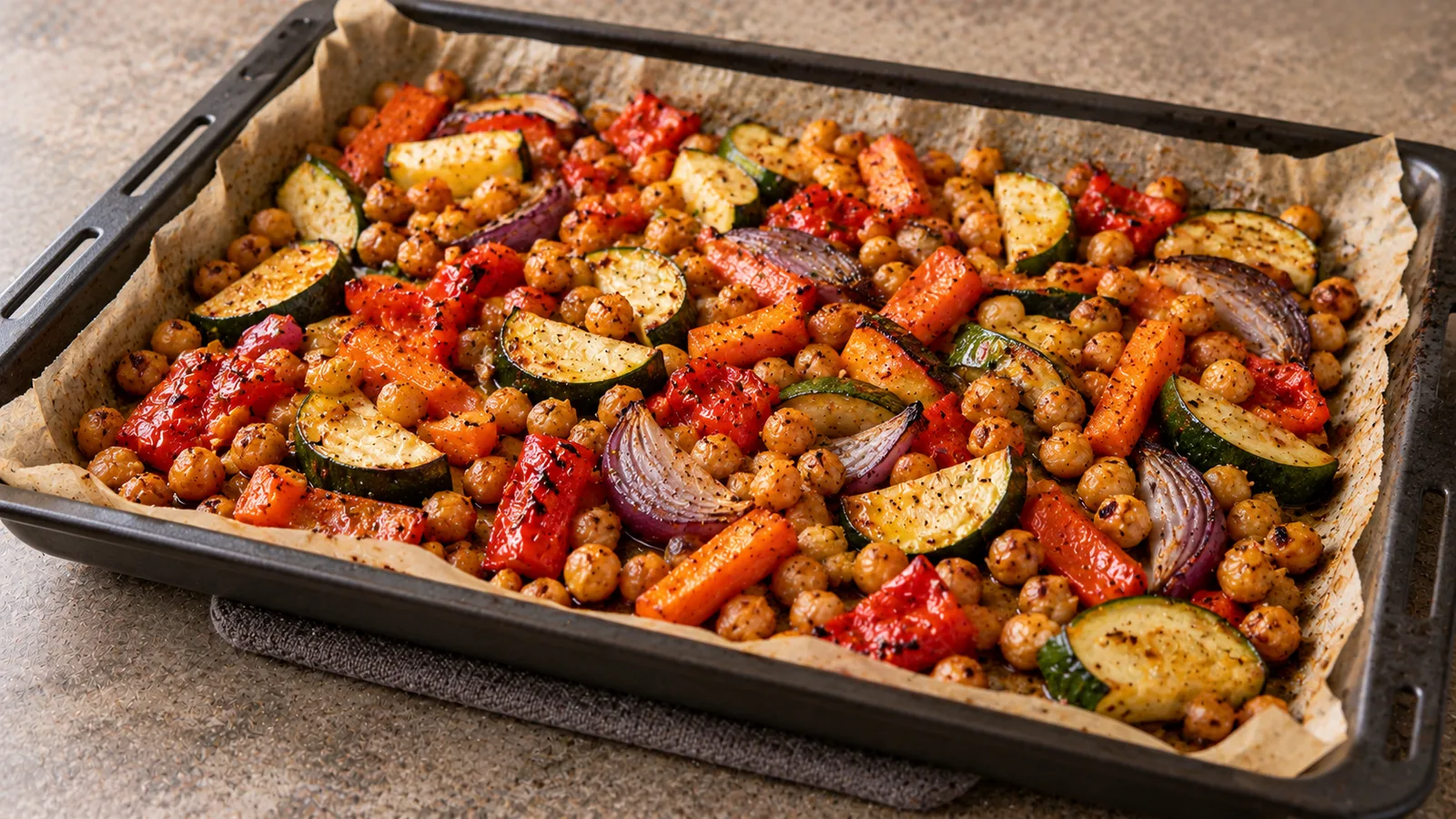
A tray of roasted vegetables with chickpeas can be a practical weeknight dinner, but the word crispy needs an explanation. Cooked chickpeas contain moisture, vegetables release more moisture in the oven, and a crowded pan traps steam. The method below uses two roomy baking trays, properly dried chickpeas and a measured amount of oil. The result is a substantial vegetable-and-legume dinner with browned edges and some crisp chickpea surfaces—not the uniformly brittle texture of a packaged snack.
This recipe makes four portions. All vegetable weights are raw, edible weights after trimming; the chickpeas are already cooked and drained. You do not need to cook dried chickpeas from scratch. The nutrition calculation is a transparent reference model, not a laboratory analysis of the final roasted dish. Oil and the liquid left in the can must not be confused with the drained chickpea weight.
The recipe at a glance
- Yield: four main-dish portions.
- Preparation: approximately 15–20 minutes, including draining, washing, chopping and drying.
- Roasting: approximately 30–40 minutes, depending on oven, tray size and how dry the vegetables are.
- Oven: 220°C conventional heat (or about 200°C fan); use this as a starting point and adjust to your oven.
- Equipment: two large rimmed trays, clean towels or kitchen paper, mixing bowl, spatula and optional kitchen scale.
- Allergens: the base recipe contains no deliberately added wheat, egg, milk or nuts, but check canned-food and seasoning labels if allergies matter.
The recipe is naturally plant-based. It is not designed to be an unusually high-protein dinner: the chickpeas provide much of the protein, but the vegetables and oil make up a significant share of the finished plate. You can serve it as written or pair it with a protein-rich side depending on the rest of your day's meals.
Ingredients: four portions, measured before roasting
| Ingredient | Quantity used | Measuring condition | Function |
|---|---|---|---|
| Cooked chickpeas | 480 g | Drained edible weight, e.g. two 240 g drained cans | Protein, fibre, roasted edges |
| Courgette (zucchini) | 400 g | Raw, trimmed and cut | Juicy vegetable base |
| Red sweet pepper | 300 g | Raw, deseeded | Sweetness and colour |
| Carrots | 240 g | Raw, trimmed | Firm texture and caramelisation |
| Onion | 160 g | Raw, peeled | Savoury sweetness |
| Olive oil | 30 g | Weighed, not assumed from a spoon | Coating and browning |
Season with 2 teaspoons smoked or sweet paprika, 1 teaspoon ground cumin, 1 teaspoon garlic powder, black pepper, and a modest pinch of salt. Dried spices are not included in the modelled energy or price except for a small illustrative cost allowance. Use extra salt only after tasting, particularly if the chickpeas were canned with salt. Lemon juice or chopped parsley at serving is optional; count significant additions separately.
The cooked chickpea figure is the weight you put on the tray after pouring off the preserving liquid. If your cans yield 220 g each, two cans provide 440 g, not 480 g. Either adjust the recipe or open another can and weigh the actual amount. See Mealisa's guide to rinsing canned legumes for how draining, rinsing and sodium relate; rinsing does not turn a canned ingredient into a raw dry bean.
Step-by-step: crisp chickpeas, browned vegetables
- Heat and prepare. Preheat the oven to 220°C conventional / 200°C fan. Line two large trays with baking paper only if your oven and paper allow that temperature; otherwise use a suitable lightly oiled tray. Leave room between ingredients.
- Drain and dry the chickpeas. Rinse if you prefer, then let excess water run off. Spread on a clean towel or paper and pat thoroughly. A little surface moisture is normal; visible droplets are not helpful for browning. Discard loosened skins if convenient, but peeling every chickpea is unnecessary.
- Cut vegetables to roast at compatible speeds. Slice carrots into thin half-moons around 6–8 mm; cut courgette into approximately 2 cm chunks, pepper into 2–3 cm pieces and onion into thick wedges. Smaller carrots soften more predictably than thick chunks.
- Weigh the oil. Put 18 g on the vegetable tray and 12 g on the chickpea tray. Toss each separately. This still adds up to the promised 30 g—do not add an uncounted second drizzle at the end.
- Season and spread. Add paprika, cumin, garlic and pepper to both trays. Spread the chickpeas in one layer on one tray and the vegetables in as loose a layer as possible on the other. Two crowded trays are not better than one; if necessary roast vegetables in two batches.
- Roast and check. Put both trays into the hot oven. After roughly 15–18 minutes, turn the vegetables and shake the chickpeas. Swap upper and lower positions if browning is uneven. Continue until carrots are tender and the chickpeas have dry, lightly crisp exteriors—often another 12–20 minutes. Watch thin onion pieces closely so they do not burn.
- Serve promptly. Divide into four portions. Add a squeeze of lemon only on the plate, not before roasting. Crispy surfaces soften as the food cools, so serve soon after the trays leave the oven.
Ovens differ more than exact-looking recipe times imply. A tray of cold, wet ingredients may need longer; a thin tray in a powerful fan oven can brown too fast. Doneness means tender vegetables and lightly crisp chickpea edges, not a fixed temperature reading or an assurance that every bean will crunch.
The oil calculation: why weighing matters
Olive oil contributes approximately 884 kcal per 100 g in a commonly used USDA reference profile. For this recipe, 30 g × 884 ÷ 100 = 265.2 kcal in the entire batch, or 66.3 kcal per serving. That energy is in the ingredients even though the oil is distributed thinly and partly remains on the tray; the model conservatively counts the full 30 g. Using a different oil or a product label can produce slightly different figures.
If you use only 15 g oil, the modelled batch is approximately 132.6 kcal lower, or 33.2 kcal lower per serving. You may need to stir more carefully or accept less browning. If you double the oil to 60 g, add approximately 265 kcal to the batch; do not continue calling the recipe a 340-kcal portion. A tablespoon is not a reliable universal measure because spoons and pouring habits vary; a small kitchen scale is simpler.
Roasting removes water. It does not automatically remove the calories from the chickpeas or from oil retained in the food. If the finished batch weighs less than the raw ingredients, calories per 100 g roasted food can rise while the total batch calories remain approximately the same. For logging, start from the complete ingredient weights, then divide by four. For a fuller explanation, see portion size versus serving size.
Nutritional reference values and transparent assumptions
The table uses a consistent per-100-g edible ingredient basis. Chickpeas use the USDA-style profile for boiled cooked chickpeas, not a claim that every commercial can has identical nutrients. Vegetables use raw edible-weight profiles; olive oil is the pure oil profile. These are starting figures before cooking losses, brand differences or drained-can salt. The nutrient model excludes dried spices and optional toppings.
| Ingredient | kcal/100 g | Protein/100 g | Fibre/100 g |
|---|---|---|---|
| Cooked chickpeas | 164 | 8.86 g | 7.6 g |
| Raw courgette | 17 | 1.21 g | 1.0 g |
| Raw red pepper | 26 | 0.99 g | 2.1 g |
| Raw carrot | 41 | 0.93 g | 2.8 g |
| Raw onion | 40 | 1.10 g | 1.7 g |
| Olive oil | 884 | 0 g | 0 g |
The exact food state matters. A value listed for 100 g of dry uncooked chickpeas cannot be multiplied by the drained canned weight. Likewise, a 100 g serving of cooked roasted vegetables has lost water, so its nutrient density need not match the raw vegetable row. The model makes a practical ingredient-level estimate, not a false claim of an experimentally measured final plate.
Mealisa's high-fibre foods overview gives further context for pulses as a source of fibre. The German Nutrition Society also recommends regularly including legumes in a varied diet. That does not mean one chickpea dinner supplies everyone's daily protein requirement. The usefulness of the meal depends on actual serving size and the other foods eaten during the day.
Nutrients per batch and per portion
Here is the multiplication behind the headline result. For example, 480 g cooked chickpeas × 8.86 g protein ÷ 100 = 42.53 g protein in the batch. The 30 g oil adds energy and fat but no meaningful protein or fibre. Values are estimates rounded only after combining ingredient contributions.
| Ingredient | Batch kcal | Batch protein | Batch fibre |
|---|---|---|---|
| Chickpeas, 480 g | 787.2 | 42.53 g | 36.48 g |
| Courgette, 400 g | 68.0 | 4.84 g | 4.00 g |
| Red pepper, 300 g | 78.0 | 2.97 g | 6.30 g |
| Carrots, 240 g | 98.4 | 2.23 g | 6.72 g |
| Onion, 160 g | 64.0 | 1.76 g | 2.72 g |
| Olive oil, 30 g | 265.2 | 0 g | 0 g |
| Full four-portion batch | 1,360.8 | 54.33 g | 56.22 g |
| One quarter of batch | 340.2 | 13.58 g | 14.06 g |
These numbers describe the specified ingredient input. Canned chickpea brands can contain less energy or fibre per 100 g than the boiled reference. The vegetables' precise variety and edible yield also vary. Calculate with your package if accuracy matters; do not describe these estimates as nutrition-lab results. The salt content in particular depends on the can and how much seasoning you add.
A realistic illustrative cost for four dinners
To show the method without claiming current supermarket prices, assume €0.89 per 240 g drained can of chickpeas, €2.29/kg courgette, €3.49/kg red pepper, €1.19/kg carrots, €1.49/kg onions, €11/kg olive oil and €0.15 for the spices used. These are deliberately hypothetical teaching prices; they are neither retailer quotations nor a guarantee of a basket available today.
| Item | Illustrative cost used | Reason |
|---|---|---|
| Two chickpea cans (480 g drained) | €1.78 | 2 × €0.89 |
| Courgette, 400 g | €0.92 | €2.29/kg × 0.4 kg |
| Red pepper, 300 g | €1.05 | €3.49/kg × 0.3 kg |
| Carrots, 240 g | €0.29 | €1.19/kg × 0.24 kg |
| Onion, 160 g | €0.24 | €1.49/kg × 0.16 kg |
| Olive oil, 30 g | €0.33 | €11/kg × 0.03 kg |
| Dried seasonings used | €0.15 | Illustration only |
| Four portions | €4.76 | Sum of rounded item costs |
| One portion | €1.19 | €4.76 ÷ 4 |
Used-ingredient cost is not checkout cost. You may need to buy whole bags, peppers or a bottle of oil; that makes the first receipt larger, with unused food remaining. Your local price, availability, trimmed waste and use of sale items change the total. Compare prices on the actual edible grams you use, rather than comparing two cans with a kilogram of dry beans as if they were the same thing.
Make the pan fit your appetite
For a bigger dinner, serve each quarter with a measured slice of wholegrain bread, a grain portion or plain yogurt-based sauce (if dairy suits you). These extras are not included in 340 kcal. If you want more protein without much additional oil, try tofu or a plain yogurt dip and record the package values. Adding 100 g tofu is not a fixed protein bonus across all tofu types; firmness and water content matter. If you choose a smaller bowl, weigh a sixth or an eighth of the batch rather than silently reusing the one-quarter calculations.
For two people, halve everything: 240 g drained chickpeas, 200 g courgette, 150 g pepper, 120 g carrots, 80 g onion and 15 g oil. The same 2-person meal still needs enough tray surface to roast rather than steam. A single large tray may be sufficient for a half batch; the full four-person batch usually benefits from two.
This is also a flexible vegetable recipe: broccoli florets can replace some courgette, but timings change; potatoes need smaller pieces or a head start; frozen vegetables often release additional surface water. If you replace chickpeas with another bean, the original nutrient table no longer applies. The point is a repeatable method, not an arbitrary label of 'healthy' attached to every variation.
Troubleshooting: soggy beans, burnt spices and pale vegetables
If the chickpeas are soft, check surface drying and spacing first. They were cooked before roasting, so softness is not evidence that they are undercooked. Dry them more carefully next time, spread them with gaps and give the tray enough hot airflow. Their centres can remain creamy, and that is fine.
If courgette is watery, cut slightly larger pieces and avoid salting it long before roasting, which can draw water to the surface. Avoid pouring pooled marinade onto the tray. If carrots remain hard while the peppers darken, cut carrots thinner or start them a few minutes earlier. If paprika tastes bitter, it may have scorched; mix with oil rather than leaving a thick dry dusting on exposed pan edges.
If the pan is greasy, the solution is not to claim the oil disappeared. Use the measured amount more evenly next time. If you add an oily sauce afterward, record that separately. If ingredients crowd the tray, use another tray or cook in batches; otherwise the high oven temperature alone cannot overcome steam.
Storage and reheating: expect a softer texture
Eat the crispest portion immediately. Refrigerate leftovers promptly in shallow containers at 4°C or below, ideally within 2 hours of cooking; use a shorter one-hour limit when food has been exposed to temperatures above 32°C. USDA food-safety guidance generally gives 3–4 days for refrigerated cooked leftovers. Reheat thoroughly to 74°C (165°F) if reheating, and expect the beans to be less crisp than fresh. Do not rely on smell or appearance to decide whether mishandled leftovers are safe.
You can also use cold roasted vegetables and chickpeas as a next-day lunch after proper rapid cooling. If you add yogurt sauce, keep it separately refrigerated and follow its package instructions. Never leave a prepacked lunch at room temperature for an extended commute without appropriate chilling.
How this recipe fits a balanced meal
The chickpeas provide a substantial share of the fibre in this dish, while peppers, carrots, courgette and onion broaden the range of vegetables. Olive oil adds flavour and helps browning but is energy-dense; the 30 g budget belongs in the calculation. To think about what complements the tray bake rather than judging it by one nutrient, refer to Mealisa's balanced meal guide.
This recipe is different from a chicken-and-vegetable tray bake: there is no raw poultry to cook safely, and the beans were already cooked. It is also different from a sheet-pan snack of chickpeas only: here the dinner portion includes more than a kilogram of vegetables, which affects oven space, moisture, cost and serving size. The practical success criterion is a tasty, repeatable meal made from measured everyday ingredients—not maximal crispness at any cost.
Sources
- USDA FoodData Central: cooked chickpeas, SR Legacy search
- USDA FoodData Central: raw courgette, SR Legacy search
- USDA FoodData Central: raw red sweet pepper, SR Legacy search
- USDA FoodData Central: raw carrots, SR Legacy search
- USDA FoodData Central: raw onions, SR Legacy search
- USDA FoodData Central: olive oil, SR Legacy search
- DGE: legumes and nuts as part of healthy eating
- USDA FSIS: leftovers and food safety