
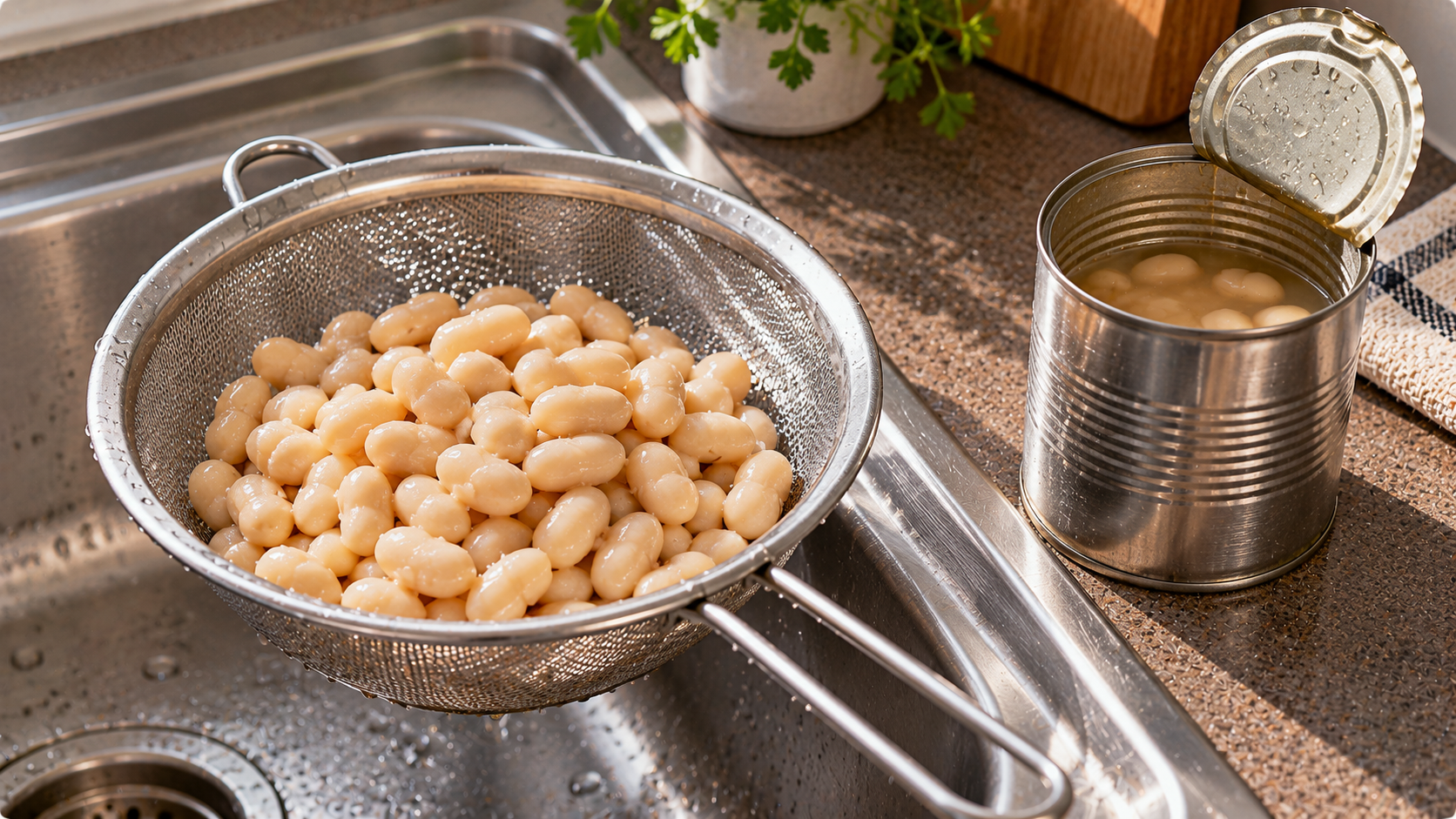
Canned beans can make a filling lunch or dinner faster, yet the nutrition calculation becomes confusing as soon as a tin is opened. Does the sodium on the label include the packing liquid? Does rinsing wash away protein or calories? Is a 400 g can the same as a 400 g serving? No single answer applies to every product: the bean variety, brine, label basis, discarded liquid and weight actually eaten all matter. This guide separates those questions so you can make a practical decision without relying on a universal sodium-reduction percentage.
The short answer: drain for a recipe, rinse when it helps
Draining removes packing liquid. Rinsing follows draining with water, which can remove some liquid and soluble salt remaining on the surface of the beans. Neither process transforms a salted can into a guaranteed salt-free product. A study comparing five varieties and multiple brands found statistically meaningful sodium reductions after draining and after draining plus rinsing, but the result is not a fixed percentage that should be subtracted from every nutrition label. Duyff, Mount and Jones, Journal of Culinary Science & Technology (2011).
If you are adding beans to a salad, grain bowl or wrap, draining is convenient because excess liquid can dilute a dressing. Rinsing can additionally remove residual brine and change the surface texture or taste. For a soup where the packing liquid becomes part of the final meal, the nutritional calculation is different: the liquid is no longer discarded. A reduced-salt or no-added-salt can is often a more predictable purchasing choice than assuming a home rinse erases the initial difference.
First check what the label actually measures
Three figures on the same package may refer to different things:
| Packaging term | What it usually describes | Why it matters |
|---|---|---|
| Net weight | Beans plus packing liquid | Not the mass of beans left after draining |
| Drained net weight | Solid beans after the prescribed draining method | Usually a better starting quantity for a drained recipe |
| Nutrition per 100 g | A declaration that must be read with the product's stated basis | Do not assume without checking that it refers exclusively to drained solids |
In the European Union, when solid food is presented in a liquid medium such as water or brine, a drained net weight must also be declared under Annex IX of Regulation (EU) No 1169/2011. Nutrition information follows the separate rules for food declarations and must be interpreted according to the label's actual description. EU Regulation 1169/2011, Annex IX and European Commission nutrition-labelling guidance.
Consider an illustrative can labelled 400 g net weight and 240 g drained weight. If you drain it and eat all the beans, your starting serving is around 240 g, not 400 g. If you rinse further, weigh the actual beans after rinsing when precise tracking matters. The example weights are hypothetical, not a universal yield: a different can can contain a very different solid-to-liquid ratio.
To avoid confusing a 400 g can with 400 g of edible beans, see the guide to drained weight and calories on canned food labels. It explains the weight basis to use when logging the beans after draining or rinsing.
What happens to sodium when beans are drained and rinsed?
Sodium can be present in the liquid and in the beans themselves. When you pour off liquid, you remove whatever dissolved sodium that discarded liquid contains. Rinsing removes some remaining brine and may also change the composition of the portion retained. The starting sodium level, variety, processing method, liquid volume, rinse intensity and measurement basis all influence the apparent reduction.
The 2011 canned-bean study analyzed several brands representing five bean varieties under three conditions: beans with packing liquid, drained beans and drained-then-rinsed beans. The researchers found significant reductions under the drained and drained-and-rinsed conditions. Original study. A US National Academies discussion of an earlier study describes approximately 36% after draining and 41% after a particular rinse-and-drain procedure in its study setup. Those figures are useful evidence that the technique can work, not a guarantee for every tin, especially with modern reformulations or different weighing assumptions. National Academies, Strategies to Reduce Sodium Intake.
That distinction is essential when comparing an ordinary can with one labelled no added salt. A low-salt can might already have far less sodium before opening, so subtracting a historical study average from its label could give an implausibly low estimate. Use the product's declared values first. If you need medically precise sodium accounting, the exact drained-and-rinsed amount is generally unknown unless the product provides tested information for that preparation.
Example: comparing two cans without pretending to know the rinse effect
Suppose two fictional 400 g cans each contain 240 g drained beans:
| Property | Can A: regular brine | Can B: no added salt |
|---|---|---|
| Net weight | 400 g | 400 g |
| Drained weight | 240 g | 240 g |
| Hypothetical sodium per 100 g on a comparable labelled basis | 300 mg | 25 mg |
| Sodium for 240 g on that same basis | 720 mg | 60 mg |
These are illustrative numbers, not verified product analyses. The arithmetic is 240 ÷ 100 × the stated amount per 100 g. It works only when the nutrition basis and edible serving correspond. After you drain or rinse, sodium may change and the 720 mg calculation is no longer a laboratory-confirmed analysis of the prepared solids. The table is primarily a way to understand why comparing original label values on a matched basis is more defensible than subtracting a fixed rinse percentage from both cans.
For European labels the mandatory panel usually declares salt, not sodium. The regulatory conversion is salt = sodium × 2.5 by weight. Thus 0.75 g of salt corresponds to about 300 mg sodium on the same 100 g basis. Be careful not to treat 0.75 g salt as 0.75 g sodium. Regulation 1169/2011, Annex I and Annex XV.
How to drain and rinse canned beans without complicating dinner
- Read the can first. Note the type of bean, whether salt was added, net and drained weights, and how the nutrition table is defined.
- Open the can with clean equipment. Pour beans into a clean sieve or colander over the sink. If the liquid belongs in a soup recipe, decide that before discarding it.
- Let the excess liquid drain. For a salad or bowl, rinse under cool running potable water if you want to remove brine and reduce the salty surface taste. Mix or turn the beans gently so water reaches more than the upper layer.
- Let the rinse water drain away. If you track portion weights, measure the retained beans now, rather than logging the can's full net weight.
- Serve, refrigerate or cook the beans as the recipe requires. Don't assume that rinsing resets the product's storage clock or makes mishandled food safe.
There is no need to claim that exactly ten seconds under the tap removes exactly 40% of sodium. That is a research-method detail, not a household measurement of your specific beans. If avoiding unnecessary water is a priority, buying the desired salt level can be preferable to washing away brine.
Do you lose protein, fiber or vitamins by rinsing?
Beans retain their core structure after a gentle rinse. You are not washing the entire protein or fiber content down the sink. But the absolute claim that rinsing causes zero nutrient change is also too strong. Water-soluble compounds can move into packing liquid or rinse water, and products differ. Research on other canned vegetables has measured changes in both sodium and certain water-soluble vitamins during draining and rinsing; those findings cannot be transferred as exact percentages to beans. USDA-ARS research on canned vegetables.
For meal planning, the more important sources of tracking error are usually using a 400 g can as 400 g of eaten beans, selecting a dry-bean database entry for canned cooked beans, or forgetting a generous dressing. A rinsed kidney bean is still a cooked bean, not dry beans with dry-bean calorie density.
A starchy or cloudy liquid is not proof that protein has been lost in a nutritionally important amount. If you want to use chickpea liquid (aquafaba) as a recipe ingredient, treat it as part of the recipe rather than discarding it and then pretending it never existed. A prepared dip or hummus that uses beans, oil and tahini must be calculated from the whole recipe.
Worked example: weighing a bean salad for two
Imagine a can with 240 g drained beans. After rinsing and allowing water to drain, your scale reads 235 g. You combine them with 150 g chopped tomatoes, 100 g cucumber, 20 g olive oil and lemon juice. The example is a portion-planning exercise; use the actual nutrition values for the products you buy.
If the beans' applicable reference provides 110 kcal per 100 g of prepared beans, the 235 g beans contribute approximately 259 kcal. The 20 g oil contributes about 180 kcal. Both numbers are estimates: the tomatoes, cucumber and lemon must also be included. Divide the entire recipe's ingredient totals by the amount actually eaten, not merely by two if portions are unequal. The calories do not fall in proportion to the sodium removed by rinsing.
For sodium, record either a relevant tested drained/rinsed reference or a clearly flagged estimate. Do not insert a highly precise value such as “exactly 37% less sodium” without data for that can. If your app accepts ingredient notes, “drained and rinsed, weight 235 g” is more informative than “one can of beans.”
The role of bean type, liquid and recipe
Kidney, black, cannellini and other beans: sodium and packing ratios differ by brand and recipe. Choose an appropriate product and cooked-bean entry; do not assign the same nutrient profile to every pulse.
Chickpeas: draining and rinsing is practical for a firm-textured salad or hummus, but aquafaba may be retained in recipes where its cooking properties are useful. A comparison should consider whether the liquid is eaten.
Canned lentils: they are often smaller and more delicate. A fine sieve and gentle rinse can reduce losses through the mesh, and the declared drained weight matters as much as it does for larger beans.
Beans in tomato sauce or seasoned chili: the sauce is intentionally part of the product, not simple brine. Rinsing it away changes the food and recipe completely. A generic “rinse canned beans” recommendation does not apply indiscriminately.
Homemade cooked dried beans: soaking and cooking liquid, salt added during cooking and edible yield differ. A canned-food rinsing study does not describe those processes. Use a matching cooked-food reference or track the recipe inputs.
When should you choose reduced-salt beans instead?
If sodium intake is an important health constraint, choosing a canned product with a lower declared salt amount is easier to verify than trying to calculate a precise home-rinsing reduction. Compare the actual nutritional declarations per 100 g on comparable bases. Check whether a “reduced salt” claim is relative to a reference product and whether the whole recipe also contains salted stock, cheese, cured meat or sauces.
Rinsing still has a role: it can be an inexpensive step when you already own a salty can and prefer it less salty. It should not be presented as a substitute for individual medical advice for people with conditions requiring strict sodium management. For readers with a special medically prescribed intake, prefer documented values or consultation with a qualified clinician or dietitian over invented precision.
Cost can matter too. Compare the price per 100 g drained edible beans, not merely price per tin. A cheap-looking can with a high liquid proportion may be more expensive per useful serving. For dry beans, additionally count cooking time and other ingredients rather than treating the dry 100 g weight as directly comparable with canned 100 g. For practical meals using canned beans while considering salt and portions, see balanced lunches with canned beans.
Five mistakes that distort the numbers
| Mistake | Better approach |
|---|---|
| Treating a 400 g can as 400 g drained beans | Read drained weight and measure the portion eaten |
| Assuming rinsing removes exactly the same sodium percentage everywhere | Use the actual product label and describe any rinse effect as uncertain |
| Comparing one label's salt with another source's sodium | Convert correctly: salt = sodium × 2.5 |
| Applying dry-bean calories to cooked canned beans | Match the preparation state and edible weight |
| Counting plain beans while eating oil, sauce or packing liquid | Include the components actually eaten |
The most useful practical rule is simple: log what you ate, not what the unopened can weighed. Draining and rinsing can be helpful, but nutrient data must match the preparation and measurement basis. For everyday meal planning, selecting the right product, weighing the edible beans and counting the remaining ingredients provide a more trustworthy result than a universal rinsing formula.
Sources and evidence
- Duyff RL, Mount JR, Jones JB (2011): Sodium Reduction in Canned Beans After Draining, Rinsing — direct analysis of multiple bean varieties and brands; not a universal percentage for all products.
- National Academies: Preservation and Physical Property Roles of Sodium in Foods — context for brines and a published experimental procedure.
- Regulation (EU) No 1169/2011 — Annex IX on drained net weight and nutrition-labelling definitions.
- European Commission: Nutrition labelling — the required nutrition declaration for packaged foods.
- USDA-ARS: Effects of draining and rinsing canned vegetables — relevant methodological context, not a bean-specific conversion factor.