
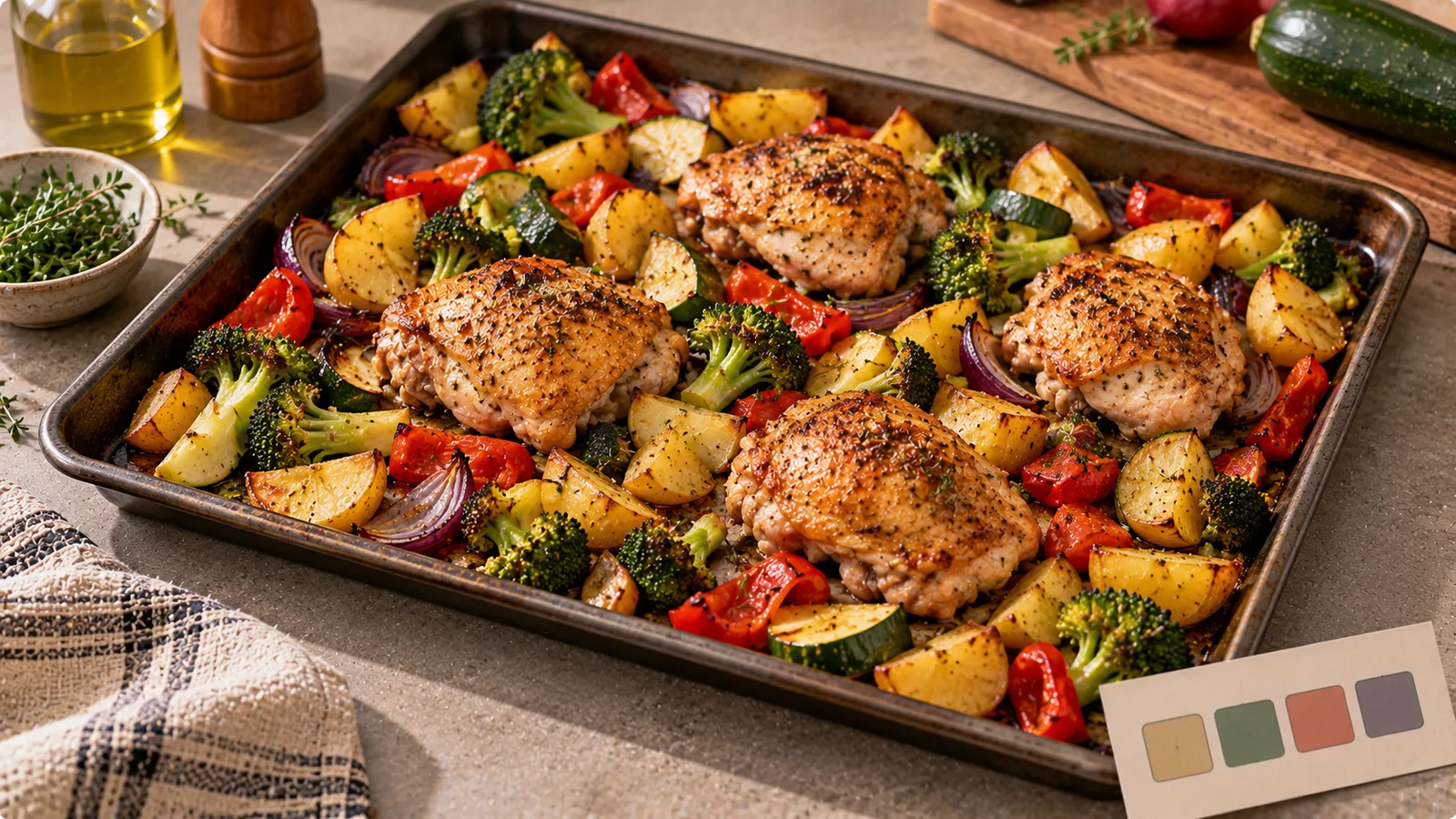
This chicken and vegetable tray bake combines boneless chicken thighs, potatoes and colorful vegetables in one oven-cooked meal.
The recipe makes 4 servings and uses measured quantities so the finished dish is easy to divide and track.
Recipe at a glance
- Servings: 4
- Preparation time: about 15 minutes
- Cooking time: about 35–45 minutes
- Oven temperature: 220°C / 425°F
- Main protein: boneless skinless chicken thighs
- Cooking method: oven tray bake
Ingredients
Chicken and vegetables
- 700 g boneless, skinless chicken thighs
- 700 g potatoes
- 250 g red bell peppers
- 250 g zucchini
- 200 g red or yellow onion
- 20 g olive oil
Seasoning
- 3 garlic cloves, finely chopped or crushed
- 2 teaspoons smoked paprika
- 1 teaspoon dried oregano
- 1 teaspoon dried thyme
- 1 teaspoon salt, or to taste
- 1/2 teaspoon black pepper
- 20 ml lemon juice
Optional for serving:
- fresh parsley
- lemon wedges
Optional garnishes are not included in the nutrition estimate.
Why this recipe uses chicken thighs
Boneless, skinless chicken thighs work particularly well in a tray bake because they remain relatively juicy during the time needed to roast the potatoes and vegetables.
This recipe specifically uses boneless, skinless thighs.
Bone-in thighs, skin-on thighs and chicken breast have different cooking behavior, edible yield and nutrition, so they should not be treated as identical substitutions when tracking the recipe.
Ingredients per serving
The complete recipe contains:
- 700 g raw chicken thighs;
- 700 g potatoes;
- 700 g vegetables;
- 20 g olive oil.
Divided into four equal portions, the starting quantities correspond approximately to:
- 175 g raw chicken per serving;
- 175 g raw potatoes per serving;
- 175 g vegetables per serving;
- 5 g olive oil per serving.
Cooking changes the weights because water is lost, but it does not create additional calories.
1. Preheat the oven
Heat the oven to 220°C / 425°F.
If using a fan-assisted oven, approximately 200°C fan is usually appropriate.
Line a large baking tray if desired.
Use a tray large enough to spread the ingredients rather than stacking them deeply.
Crowding traps steam and reduces browning.
2. Cut the potatoes
Cut the potatoes into pieces approximately 2–3 cm across.
Keeping the pieces reasonably uniform helps them cook at the same rate.
Potatoes usually need longer in the oven than zucchini or peppers, so they receive a head start.
3. Start roasting the potatoes
Place the potatoes on the tray.
Add approximately 8 g of the olive oil, part of the paprika, oregano, thyme, salt and pepper.
Mix well.
Roast for 15 minutes before adding the remaining ingredients.
This first stage helps the potatoes become tender without overcooking the vegetables later.
4. Prepare the chicken
While the potatoes begin roasting, trim any obvious excess fat from the chicken thighs if desired.
Cut very large thighs into two pieces so the chicken cooks more evenly.
Combine the chicken with:
- approximately 7 g olive oil;
- garlic;
- remaining paprika;
- oregano;
- thyme;
- black pepper;
- part of the salt;
- lemon juice.
Mix until evenly coated.
5. Prepare the vegetables
Cut:
- peppers into large strips or chunks;
- zucchini into thick half-moons;
- onion into wedges.
Avoid cutting the zucchini too thinly because it cooks faster than the potatoes.
Toss the vegetables with the remaining approximately 5 g olive oil and a small amount of seasoning.
6. Add chicken and vegetables
After the potatoes have roasted for 15 minutes, remove the tray carefully.
Turn the potatoes.
Add the chicken, peppers and onion.
Arrange the chicken so the pieces are not piled on top of one another.
Return the tray to the oven.
7. Add the zucchini later
Roast the chicken, potatoes, peppers and onion for approximately 10 minutes.
Then add the zucchini.
Mix the vegetables carefully while keeping the chicken distributed across the tray.
Return to the oven for another 10–15 minutes, or until the chicken is safely cooked and the potatoes are tender.
Chicken cooking temperature
Chicken should reach a safe internal temperature.
A commonly used food-safety target is 74°C / 165°F in the thickest part.
Use a food thermometer when possible rather than judging safety only by color.
The exact cooking time depends on:
- thickness of the chicken;
- starting temperature;
- oven performance;
- tray size;
- how crowded the ingredients are.
If the chicken reaches a safe temperature before the potatoes are fully tender, remove the cooked chicken and allow the vegetables to continue roasting.
8. Rest briefly
After removing the tray from the oven, allow the chicken to rest for approximately 5 minutes.
Taste the vegetables and adjust seasoning if needed.
Add fresh parsley or extra lemon only if desired.
Estimated nutrition per serving
Exact nutrition depends on the chicken thighs, potato variety and other ingredients used.
A quarter of the recipe is approximately:
| Nutrient | Approximate amount |
|---|---|
| Calories | 520–580 kcal |
| Protein | 38–45 g |
| Carbohydrate | 40–48 g |
| Fat | 20–26 g |
| Fiber | 7–10 g |
These values are estimates.
For precise tracking, use the nutrition information for the actual chicken, oil and other ingredients.
Why chicken thigh calories vary
Chicken thigh nutrition can differ substantially depending on whether the values refer to:
- raw or cooked meat;
- skinless or skin-on meat;
- edible meat only;
- meat with bone included in the listed weight.
This recipe defines the ingredient as 700 g raw boneless skinless chicken thighs.
If your package provides nutrition per 100 g, use those package values for the 700 g entered into the recipe.
Raw versus cooked chicken weight
Chicken loses water during cooking.
For example, 700 g of raw chicken might weigh considerably less after roasting.
That does not mean calories disappeared in proportion to the lost weight.
Most of the weight reduction is water.
If the full 700 g of raw chicken is used in the recipe, calculate its nutrition from the raw ingredient entry and then divide the finished dish into portions.
Do not enter 700 g raw chicken and then add the cooked chicken again.
Potato weight
The recipe uses 700 g raw potatoes.
That means each quarter of the recipe begins with:
700 ÷ 4 = 175 g raw potato
Potatoes also lose water during roasting.
The cooked potato weight can therefore be lower than 700 g even though the calories from the original potatoes remain in the tray.
Why the oil should be measured
Oil can significantly affect the calorie total of a tray bake.
This recipe uses 20 g olive oil for the entire tray.
At approximately 9 kcal per gram of fat, 20 g of oil contributes roughly:
20 × 9 = 180 kcal
Across four portions:
180 ÷ 4 = 45 kcal per serving
This is why pouring oil freely from the bottle can make the final calorie estimate less predictable.
If you use 40 g instead of 20 g, the additional 20 g can add roughly another 180 kcal to the full tray.
Can you use chicken breast?
Yes, but it changes the recipe.
Chicken breast is generally leaner and can dry out more easily during a long tray-bake cooking time.
If using breast:
- cut thick pieces into similar sizes;
- monitor the internal temperature carefully;
- consider adding it later than the potatoes;
- use the nutrition information for chicken breast rather than keeping the thigh values.
Do not assume 700 g of breast has the same calories and fat as 700 g of thighs.
Can you use skin-on chicken thighs?
Yes, but the nutritional profile will be different.
Skin contributes additional fat and calories.
Bone-in pieces also mean that some of the purchased weight is not edible meat.
If using bone-in or skin-on thighs, track the actual product rather than the boneless skinless ingredient used in this recipe.
Cooking time will also usually be longer.
Vegetable substitutions
The vegetables can be adjusted according to availability.
Possible replacements include:
- broccoli;
- cauliflower;
- carrots;
- green beans;
- aubergine;
- mushrooms.
Cooking times differ.
Hard vegetables such as carrots may need to go into the oven with the potatoes.
Fast-cooking vegetables such as mushrooms or zucchini can be added later.
If the substitution changes the quantity significantly, update the saved recipe.
Can you use sweet potatoes?
Yes.
Replace the potatoes with the same raw weight of sweet potatoes if preferred.
The flavor and nutrition will change, so use the actual sweet potato entry when tracking.
Cut them into similarly sized pieces and monitor doneness because cooking time can vary.
Making the tray bake more filling
If you need a larger meal, you can increase:
- potatoes;
- chicken;
- vegetables;
- or serve another food alongside the tray bake.
Each addition should be tracked separately or included in the saved recipe.
Adding more vegetables generally increases the volume substantially without changing the recipe in the same way as adding a large amount of oil or another energy-dense ingredient.
Making a smaller serving
If four equal servings are larger than needed, you do not have to change the recipe ingredients.
Instead, weigh the finished batch and take a smaller fraction.
For example, suppose the finished edible tray weighs 1,800 g.
One quarter is:
1,800 ÷ 4 = 450 g
If you eat 350 g instead, your portion is:
350 ÷ 1,800 = 0.1944
or about 19.4% of the full recipe.
You can use that fraction to calculate your portion.
Tracking the finished batch by weight
Weighing the cooked food is useful when portions are not identical.
Suppose all ingredients together contain 2,200 kcal and the finished edible dish weighs 1,850 g.
Energy density:
2,200 ÷ 1,850 = 1.189 kcal per gram
A 400 g serving would contain approximately:
400 × 1.189 = 476 kcal
A 500 g serving would contain approximately:
500 × 1.189 = 595 kcal
The actual calorie density depends on your ingredients and cooked yield.
Should bones or scraps be included?
This recipe uses boneless thighs, so there should be little inedible weight.
If you adapt the recipe to bone-in chicken, do not assume the full purchased weight represents edible chicken.
Bones are not eaten and should not be treated as edible meat in portion calculations.
The easiest approach is to use a nutrition entry designed for the exact form of chicken you purchased or determine the edible cooked meat separately.
What about juices left on the tray?
Chicken and vegetables release water and juices during roasting.
Some fat and seasoning can also remain on the tray.
If you eat the juices with the meal, they remain part of the dish.
If a visible amount of oily liquid is discarded, actual intake can be somewhat lower than a calculation that assumes every gram of added oil was eaten.
For ordinary home tracking, using the measured ingredients consistently is usually more practical than trying to estimate tiny residues after every meal.
Meal-prep storage
Divide the tray bake into containers after cooking.
Refrigerate promptly rather than leaving cooked chicken at room temperature for an extended period.
When properly refrigerated, cooked chicken dishes are commonly used within approximately 3–4 days.
If food has been stored unsafely or shows signs of spoilage, discard it.
Reheating
Reheat the portion thoroughly.
Potatoes and chicken can dry slightly during reheating, so adding a small splash of water before reheating can help.
Avoid repeatedly reheating and cooling the same container.
Only reheat the amount you plan to eat.
Can you freeze the chicken tray bake?
Yes.
The cooked chicken and potatoes can be frozen in portions.
Some vegetables, especially zucchini, may become softer after thawing.
For best results:
- cool the cooked food appropriately;
- divide it into individual portions;
- freeze promptly;
- thaw safely before reheating.
If texture is important, you can freeze the chicken and potatoes while preparing fresh quick-cooking vegetables later.
How to log this recipe
Create one saved recipe containing:
- 700 g raw boneless skinless chicken thighs;
- 700 g raw potatoes;
- 250 g red bell peppers;
- 250 g zucchini;
- 200 g onion;
- 20 g olive oil;
- garlic, lemon and seasonings as appropriate.
Then set the recipe to 4 servings.
If you divide the tray evenly, one serving equals one quarter of the total recipe.
If portions are visibly different, weighing the cooked batch provides a more accurate way to divide it.
A simple one-tray dinner
The main advantage of a tray bake is that the protein, potatoes and vegetables can cook as one meal without requiring several separate pans.
The key to a good result is timing:
- give the potatoes a head start;
- add the chicken and firmer vegetables;
- add zucchini later;
- cook the chicken to a safe internal temperature;
- divide the finished meal according to the portion size you actually eat.
Using exact chicken, potato and oil quantities also makes the recipe easier to reproduce and considerably easier to track.