
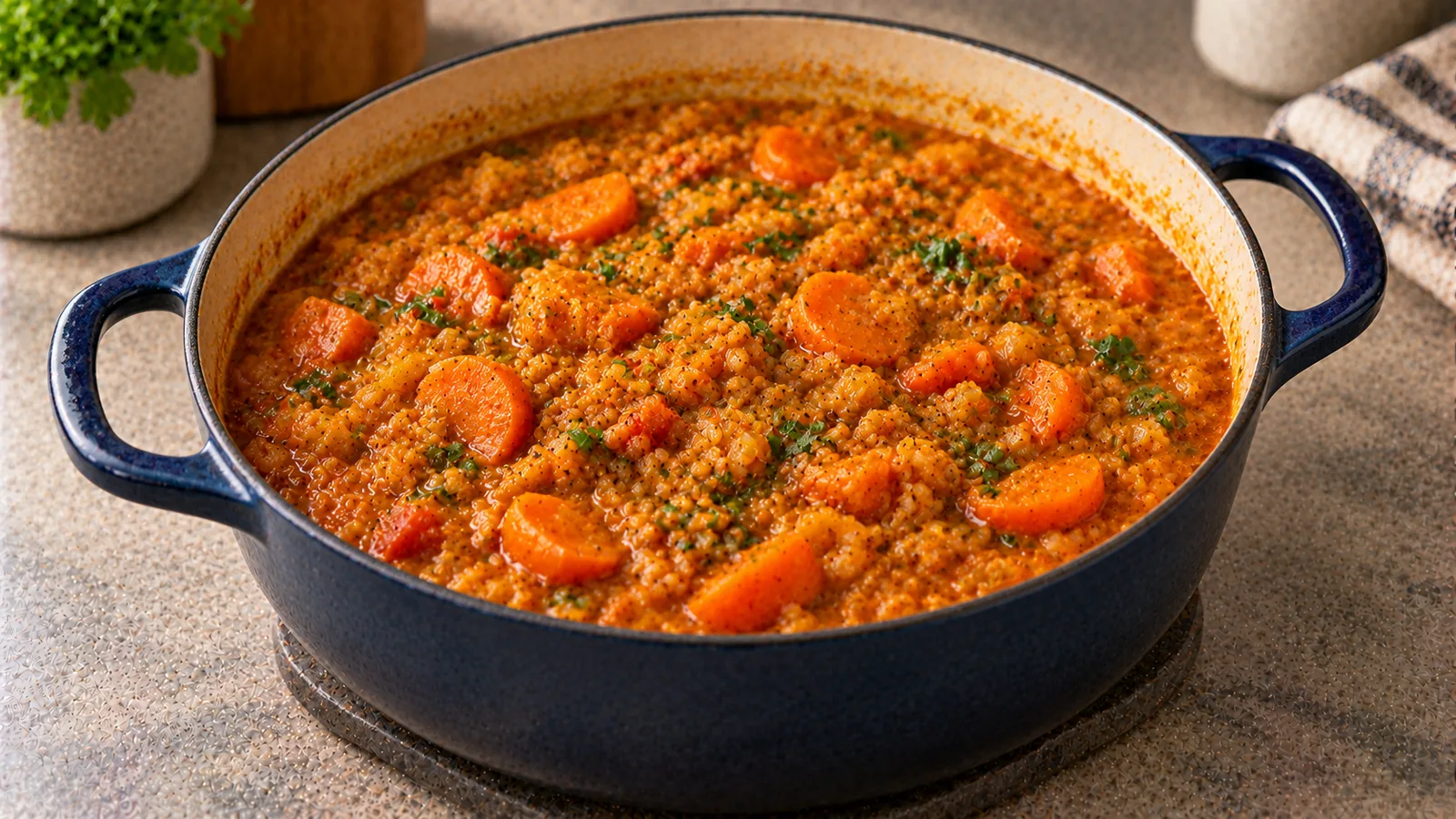
One-pot red lentil and carrot curry is a practical dinner for two generous servings, built from a short shopping list rather than a collection of specialist ingredients. Sweet carrots soften into a tomato-and-spice base while split red lentils thicken the sauce. A little coconut milk rounds out the flavour; it does not turn the curry into a coconut-heavy soup. Everything cooks in one saucepan, and the recipe needs no separate frying stage or pre-cooked lentils.
The key measurements are 160 g dry red lentils, 300 g prepared raw carrots, and 60 ml full-fat coconut milk. These are deliberately measured before cooking. Water and evaporation change the final weight but do not create or remove the protein contained in the ingredients you put into the pot.
What this two-person curry is designed to do
This is a thick, spoonable lentil curry, not the lighter broth of a red lentil soup. The carrots remain recognizable rather than disappearing into a puree, and the split lentils partially break down to bind the sauce. Unlike a chickpea-and-spinach curry, the lentils themselves do most of the thickening. You can eat it from two deep bowls as a standalone main course. Rice, flatbread, yogurt and chutney are optional extras and are not included in the nutrition or price calculations below.
A useful benchmark is the label of dmBio dried red lentils: per 100 g dry product it lists 341 kcal, 26 g protein and 13 g fiber. This is the basis for this exact recipe, not a generic value taken from a ready-to-eat lentil pouch. For wider context on lentil nutrition and edible serving weights, see our lentil calorie and portion guide.
Ingredients for exactly two servings
Use a medium saucepan of roughly 2.5–3 liters with a reasonably heavy base and a lid. Weigh the edible vegetables after peeling and trimming. The recipe contains no rice, stock cube or added sweetener.
| Ingredient | Amount for two | Measuring note | Purpose |
|---|---|---|---|
| Dry split red lentils | 160 g | Weigh before rinsing | Protein and body |
| Carrots | 300 g | Peeled, edible weight | Sweetness and texture |
| Onion | 120 g | Peeled weight | Savory base |
| Plain tomato passata | 300 g | Weigh from package | Sauce and acidity |
| Full-fat coconut milk | 60 ml | Stir can before measuring | Rounds the sauce |
| Olive oil | 10 ml | Measure rather than free-pour | Softening aromatics |
| Fresh ginger and garlic | 12 g + 6 g | Finely chopped | Aroma |
| Curry spice blend | 5 g | Unsalted if possible | Warm seasoning |
| Water | Start with 350 ml | Add up to 100 ml more as needed | Controls consistency |
A pinch of salt and black pepper can be added to taste; the nutrition calculation does not assume a specific added-salt quantity. If the spice blend already contains salt, taste before adding more. For a more cumin-forward result, replace part of the blend with ground cumin rather than increasing the total seasoning indefinitely.
Why these ingredients work together
Split red lentils are usually sold hulled and do not hold the firm round shape of green or Beluga lentils. When simmered, they soften quickly and release starch into the surrounding liquid. The manufacturer suggests rinsing and cooking its product for roughly 5–10 minutes, but carrots and a thicker tomato base can take longer; use tenderness as the endpoint rather than the packet's minute count alone. The lentils still need to be thoroughly cooked, never tasted raw. Germany's DGE information on legumes explains why pulses should be cooked before eating.
Carrots cut into small 8–10 mm half-moons generally soften in the same overall cooking period, especially if sautéed before the liquid goes in. Large thick coins are more likely to remain hard while the lentils turn mushy. Tomato passata provides acidity and a consistent sauce; the particular dmBio passata label gives 34 kcal per 100 g, so using 300 g contributes 102 kcal. Changing to a concentrated tomato paste would require new quantities and a new nutrition calculation.
The coconut milk is intentionally modest. The dmBio coconut milk label lists 220 kcal and 22 g fat per 100 ml. Therefore 60 ml adds 132 kcal and approximately 13.2 g fat to the whole pan. Pouring in an entire 200 ml package would not be a minor flavour adjustment: it would add 308 extra kcal compared with this recipe's measured amount.
Prepare everything before heating the pan
Put the dry lentils in a sieve, rinse them under running water until most loose powder has washed away, and allow them to drain. There is no need to soak split red lentils overnight for this quick method. Peel the carrots and dice or thinly slice them to approximately the same thickness. Finely chop the onion, garlic and ginger. Keep the measured coconut milk, tomato passata and water beside the stove.
Read the spice blend ingredient list: a curry seasoning can contain salt, sugar, mustard, celery or other allergens, depending on the manufacturer. The final dish is not automatically free of every allergen merely because the base recipe is vegan. If a guest has a serious allergy, use brands and utensils that meet their needs and check possible cross-contact.
Cook the curry step by step
- Heat 10 ml olive oil over medium heat in the saucepan. Add the onion and diced carrots. Stir for 5–6 minutes, until the onion softens and the carrot edges begin to look glossy. The vegetables do not need to brown strongly.
- Stir in the garlic, ginger and 5 g spice blend for about 30 seconds. Keep the heat moderate so the garlic and spices do not burn. If the base becomes dry, add a spoonful of the measured water, not extra uncounted oil.
- Add the rinsed 160 g dry lentils, 300 g passata, 60 ml coconut milk and the initial 350 ml water. Scrape the bottom of the pan thoroughly, especially if any spice has stuck.
- Bring to a gentle simmer, reduce the heat, and cook partly covered for approximately 15–20 minutes, stirring every few minutes. Add the reserved up to 100 ml water gradually if the lentils start sticking before the carrots are tender.
- Taste a lentil and a carrot. Both should be soft all the way through. If the lentils remain chalky or the carrot centers are hard, simmer longer and add a splash of water. Only when fully cooked should you season with salt and pepper.
- Turn off the heat and leave the curry for 3–5 minutes. The lentils continue to absorb liquid. Stir again and divide the pan into two equal portions by weight if you want the closest match to the calculated values.
The times are working estimates, not a safety or doneness guarantee. Pan size, cut size and stove power make a difference. The dish is ready when the lentils are completely cooked and the carrots are comfortably tender.
Make a curry, not an accidental lentil soup
Begin with 350 ml water. If everything is submerged in a deep layer of liquid after the first simmer, leave the lid ajar and reduce gently. If a wooden spoon dragged across the bottom exposes a dry trail and the lentils stick immediately, add water in 25–50 ml increments. A properly finished curry forms a soft mound on the spoon before slowly falling back into the pan. The sauce should be thick but not clumpy or scorched.
Adding another 100 ml of water does not add calories, protein or fiber. It only distributes the same totals across a larger cooked mass. In a simple illustrative yield scenario, if the final dish weighs 1,100 g, its 1,048 estimated kcal equate to roughly 95 kcal per 100 g. If you dilute it to 1,200 g, the pan is still about 1,048 kcal, but becomes approximately 87 kcal per 100 g. Neither cooked mass is promised: measure your actual batch if you log food per 100 g.
Nutrition from raw ingredients, not the wet finished weight
The following model uses the red-lentil label, passata label, coconut-milk label and olive-oil label. Raw carrot and onion values are rounded from USDA-based entries available through FoodData Central. Ginger, garlic and spices have a small rounded allowance of 15 kcal per pan, including roughly 0.4 g protein and 0.4 g fiber; salt is not included. Consequently the figures are estimates, not laboratory-tested values for the finished recipe.
| Measured ingredient | Energy for pan | Protein for pan | Fiber for pan |
|---|---|---|---|
| Red lentils, 160 g dry | 545.6 kcal | 41.60 g | 20.80 g |
| Carrots, 300 g | 123.0 kcal | 2.79 g | 8.40 g |
| Onion, 120 g | 48.0 kcal | 1.32 g | 2.04 g |
| Passata, 300 g | 102.0 kcal | 4.80 g | 5.10 g |
| Coconut milk, 60 ml | 132.0 kcal | 1.02 g | negligible |
| Olive oil, 10 ml | 82.4 kcal | 0 g | 0 g |
| Aromatics and spices, estimated | 15.0 kcal | 0.40 g | 0.40 g |
| Whole pan | 1,048 kcal | 51.93 g | 36.74 g |
| One of two servings | 524 kcal | 25.96 g | 18.37 g |
The same estimate yields about 70.69 g carbohydrate and 13.02 g fat per serving. Label discrepancies, vegetable varieties and measuring methods can change these results. The red-lentil quantity matters most for protein; coconut milk and oil account for a substantial share of fat. Use the actual brands and edible weights when you require precision for personal tracking. See how serving size differs from portion size for the logic of dividing a home-cooked batch.
Serving size and whether to add rice
For two people, divide the finished pot into two portions. That creates a full lentil-based dinner rather than an accompaniment to another main course. If you prefer smaller servings, divide it into three portions; each would contain approximately 349 kcal and 17.31 g protein, before garnishes. Do not silently retain the two-person nutrition numbers when changing the count.
If you add cooked rice, flatbread, yogurt or fried onions, their nutrition must be added separately. For example, if a package lists 130 kcal per 100 g cooked rice, adding 150 g to one plate means 195 additional kcal, giving approximately 719 kcal for that plate. This is a mathematical illustration, not a universal calorie value for all cooked rice. A little lemon juice or chopped coriander can be added at the table, but neither is part of the fixed model.
For the carrot's role in the plate, our carrot nutrition and portions article explains the difference between raw weights, edible portions and cooked food. We keep the carrots recognizable here instead of blending them, because texture is part of the recipe's specific appeal.
A transparent grocery-cost example
Cost per serving and cash paid at checkout are different. The prices below include verified example shelf prices for dmBio red lentils (€1.45 for 500 g) and passata (€0.70 for 500 g), alongside deliberately assumed illustrative prices for the remaining products. These are not a promise of availability or a live nationwide basket quotation. Carrots are modeled at €1.39/kg, onion at €1.29/kg, coconut milk at €1.05/200 ml, olive oil at €5.49/500 ml and ginger/garlic/spice allowance at €0.25 for the portion used.
| Ingredient or group | Cost of quantity used | Full-package shopping assumption | Pricing status |
|---|---|---|---|
| Red lentils, 160 g | €0.46 | €1.45 / 500 g | dm example price |
| Carrots, 300 g | €0.42 | €1.39 / 1 kg | illustrative |
| Onion, 120 g | €0.15 | €1.29 / 1 kg | illustrative |
| Passata, 300 g | €0.42 | €0.70 / 500 g | dm example price |
| Coconut milk, 60 ml | €0.32 | €1.05 / 200 ml | illustrative |
| Olive oil, 10 ml | €0.11 | €5.49 / 500 ml | illustrative |
| Ginger, garlic and spices | €0.25 | Depends on pantry | illustrative allowance |
| Total for two | €2.13 | Not the checkout total | mixed model |
| Cost per serving | €1.07 | — | rounded |
Buying every full package from scratch would require substantially more than €2.13 and leave lentils, vegetables, passata, coconut milk and oil unused. You can build a better meal budget by sharing these pantry ingredients across several recipes; see our budget grocery-list method. If you substitute brands, calculate cost as package price × quantity used ÷ package quantity, keeping grams and milliliters consistent.
Variations that keep the recipe recognizable
For a less rich curry, omit the coconut milk and replace it with 60 ml water. The calculated whole pan falls by approximately 132 kcal and 13.2 g fat, assuming every other ingredient stays identical. This makes a sharper tomato-based result; add a little extra spice at the end if desired. A light coconut drink is not a reliable one-for-one substitute for full-fat canned coconut milk: its label and texture may be completely different.
For extra vegetables, add a handful of spinach in the last minutes or small pieces of cauliflower with the carrots. Record these additions if you are calculating nutrition. For more heat, use chilli to taste rather than assuming a spicy curry powder is necessary. For a more pronounced ginger flavour, grate the 12 g finely instead of increasing the quantity. Frozen carrots can work in a pinch, but check their cooking instructions and expect a softer texture.
Practical limitations, allergens and who may want a smaller portion
The fixed recipe is made from plant ingredients, but the packaged spice blend may introduce mustard, celery or other allergens, and lentil brands may carry cross-contact warnings. Coconut is another ingredient to check according to personal needs. People requiring a medically prescribed lower-potassium, lower-fiber or otherwise restricted diet should not treat the nutrient totals as individualized advice. One serving contains about 18.37 g fiber, a relatively large amount at a single sitting for someone unaccustomed to lentils; a smaller serving may be easier to tolerate.
DGE describes pulses as useful sources of plant protein and dietary fiber, but no individual curry can guarantee weight loss or a clinical outcome. Prefer a varied eating pattern rather than making a health claim from this meal alone. This curry is different from our red lentil soup in cooking liquid, final texture, portion purpose and the supporting carrot-coconut base; it should not be substituted blindly into that soup recipe.
Cooling, leftovers and reheating
Because the batch makes two portions, leftovers are most likely if one person eats alone or one portion is saved for another meal. Transfer remaining curry to a shallow container promptly and refrigerate within two hours of cooking; in very hot conditions above 32 °C, use the shorter one-hour rule. Refrigerated cooked leftovers are generally used within three to four days, following USDA FSIS guidance. Reheat thoroughly until steaming hot throughout; USDA specifies 74 °C (165 °F) for reheated leftovers.
When reheating, the lentils will be thicker because they keep absorbing liquid. Stir in a tablespoon or two of water and reheat evenly, checking that the middle is hot. Freeze in meal-sized portions if you will not use the curry within the recommended refrigerated period. Label each container with the date. Never judge food safety by smell or appearance alone.
Sources and how the estimates were made
- dmBio red lentils: ingredients, dry nutrition and cooking instructions.
- dmBio plain passata: nutrition and ingredients.
- dmBio canned coconut milk: nutrition per 100 ml.
- dmBio olive oil: energy and fat per 100 ml.
- USDA FoodData Central: raw vegetable food-composition search.
- German Nutrition Society (DGE): legumes and nuts.
- USDA FSIS: leftovers and food safety.
All recipe totals are calculated from measured raw or package quantities, divided by two, and rounded for reading. Water changes cooked weight, not ingredient-level energy. Verify the actual labels when changing products.