
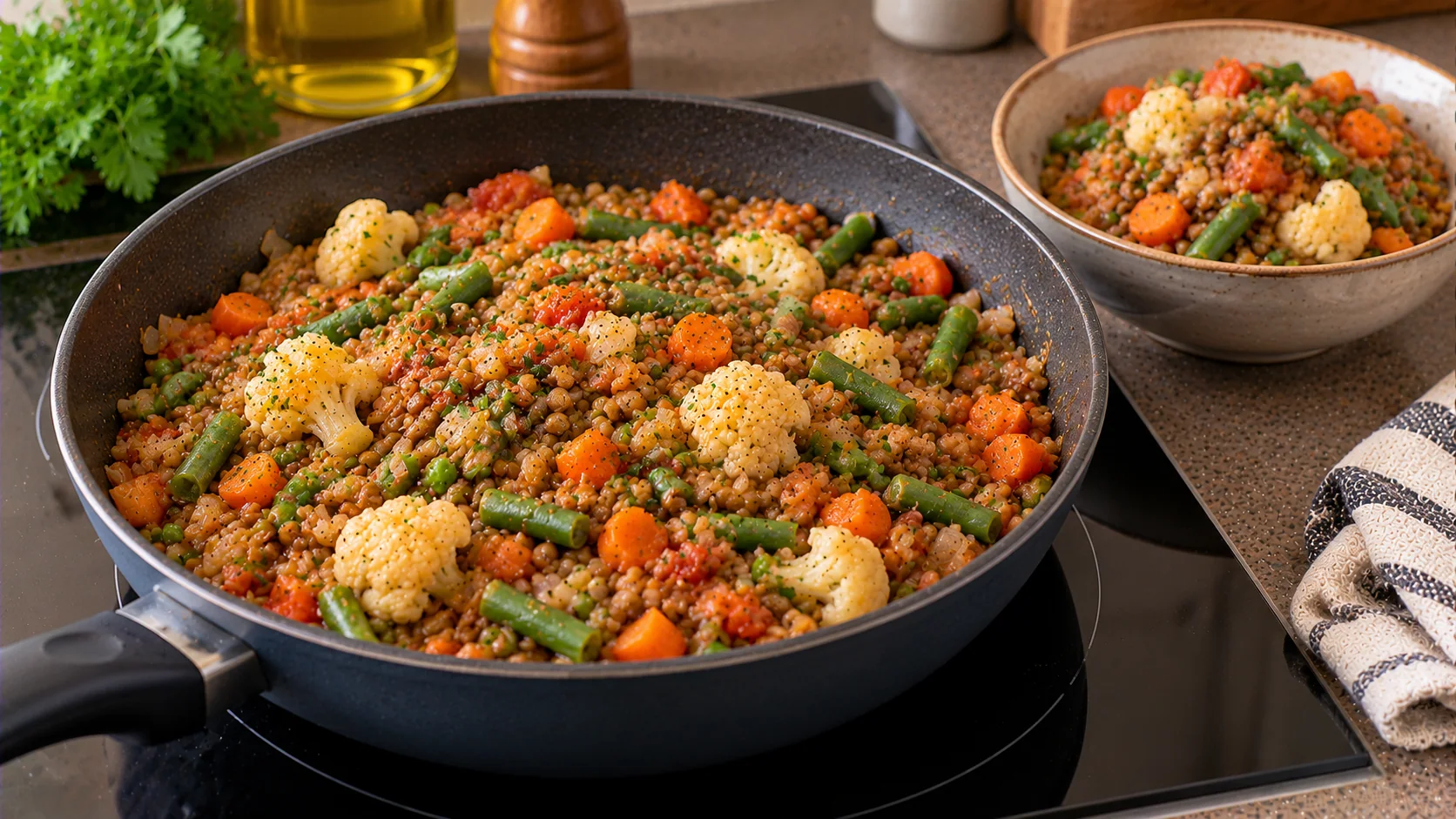
Brown Lentil and Frozen Vegetable Skillet for Two
An affordable two-serving dinner from ordinary ingredients
This is one complete stovetop recipe, not another list of possible dinners. Brown lentils remain pleasantly firm alongside frozen mixed vegetables, softened onion, lemon and paprika. Serve the skillet as it is for two substantial plant-based portions, or add bread if you need more energy. The recipe uses 120 g dry brown lentils, not 120 g already cooked. Frozen vegetables are weighed directly from the bag before heating, and the oil is measured rather than poured freely.
Makes: 2 servings. Active preparation: about 10 minutes. Total time: 35–45 minutes, depending on the lentils. Equipment: saucepan, large frying pan with lid, strainer and spoon. Check the lentil package: some small varieties cook faster, and old lentils can take longer. Use a large enough pan to heat vegetables evenly.
Ingredients for two servings
| Ingredient | Quantity | Measurement note |
|---|---|---|
| Dry brown lentils | 120 g | Weigh before cooking; do not use canned lentils without adjusting |
| Frozen mixed vegetables | 400 g | Unsauced mix such as peas, carrots and green beans |
| Onion | 100 g | Peeled, chopped |
| Olive or rapeseed oil | 15 g | Approximately one measured tablespoon |
| Garlic | 6 g | About two small cloves, chopped |
| Sweet paprika | 3 g | About one teaspoon |
| Lemon juice | 20 g | Add at the end |
| Water for lentils | 500–600 ml | Cooking liquid, mostly drained or absorbed |
| Water for pan | 60 ml | Adjust if vegetables release plenty of moisture |
| Black pepper, dried herbs | To taste | Check any blend for added salt |
Unsauced frozen vegetables are easier to cost and season accurately than ready-made creamy or salty vegetable mixtures. Choose a blend without added sauces if possible. The lentils contain no wheat, but check any stock, seasoning mix or packaged additions if avoiding allergens.
Step-by-step preparation
- Rinse the lentils under running water and remove any debris. Bring 500–600 ml water to a simmer in a saucepan. Add 120 g dry brown lentils. Cook gently for around 20–30 minutes or according to the pack, until tender but not collapsing. Add more water if required, then drain. No pre-soaking is normally necessary for standard brown lentils.
- Prepare the aromatics. While lentils cook, peel and dice the 100 g onion and mince the garlic. Heat the 15 g measured oil in a large pan over medium heat. Cook the onion for 4–5 minutes, stirring, then add garlic and paprika for 30 seconds so the spices do not burn.
- Cook the frozen vegetables. Add all 400 g directly from frozen plus 60 ml water. Cover and cook 6–9 minutes, stirring once or twice, until piping hot throughout and cooked according to the package directions. Larger frozen bean pieces may need longer.
- Combine. Stir in the drained lentils and herbs. Heat together for another 2–3 minutes until hot throughout. If watery, remove the lid and simmer briefly; do not reduce the lentils to a dry paste.
- Finish and divide. Turn off the heat, mix in 20 g lemon juice, season with pepper and split into two equal bowls. Taste before adding salt: the seasoning may already contain it.
Dry lentils versus cooked lentils
The 120 g dry lentils absorb water as they cook. Depending on variety and drainage, this may result in roughly 270–330 g cooked lentils. That range is for kitchen planning, not a guaranteed yield. The recipe remains two servings regardless of the exact finished weight; the package nutrient figures for dry lentils should be applied to 120 g, never to 300 g cooked lentils on top of the dry quantity. For canned lentils, start from about 300 g drained cooked lentils, then recalculate nutrition, salt, cost and cooking time from the can label.
Frozen vegetables also release and absorb water. Weigh the stated 400 g while frozen and avoid adding both frozen and cooked weights to a nutrient calculation. Do not confuse the volume of added cooking water with a source of calories.
Cost per serving: a transparent model
These are illustrative prices, not live supermarket prices. They represent the ingredient quantities consumed, not the full checkout price when a new bottle of oil or bag of lentils must be purchased.
| Component | Amount used | Model cost |
|---|---|---|
| Dried brown lentils | 120 g | €0.36 |
| Frozen vegetables | 400 g | €1.12 |
| Onion and garlic | 106 g | €0.33 |
| Oil | 15 g | €0.13 |
| Lemon and paprika | 23 g | €0.25 |
| Total for recipe | 2 servings | €2.19 |
| Per serving | Half the skillet | €1.10 |
The exact division is €2.19 ÷ 2 = €1.095, rounded to €1.10. Electricity is not included; to add it, multiply actual metered kWh by your electricity price per kWh, then divide by two. An optional bread slice, cheese or yogurt accompaniment must be priced separately. A full supermarket receipt can be higher because ingredients are sold in packages.
Protein, fibre and energy: how to estimate accurately
Generic food-composition databases are useful for planning but do not describe every brand. Suppose dry lentils contain 24 g protein and 11 g fibre per 100 g according to a particular label. The 120 g dry amount contributes 28.8 g protein and 13.2 g fibre to the whole recipe, or 14.4 g protein and 6.6 g fibre per serving from the lentils alone. Vegetables contribute additional amounts; do not describe the lentil contribution as the full meal total. The 15 g oil adds approximately 135 kcal for the whole pan, or about 67.5 kcal per serving, without meaningful protein or fibre.
For a complete estimate, use USDA FoodData Central for reference values and the exact packaged labels for lentils and vegetables. Multiply each item's grams by its nutrient amount per 100 g ÷ 100; sum ingredients once; divide by two. Keep dry and cooked reference states consistent. Fibre conventions and packaging values can differ between Europe and the United States. Do not assume this recipe meets a particular medical protein or fibre target for everyone.
Variations that keep the method reliable
Use frozen broccoli and peas rather than a carrot-bean mix, but follow the cooking time on the bag and recalculate the nutrition. For a smoky version, use smoked paprika instead of sweet paprika. A spoonful of plain yogurt served separately makes the meal creamier but changes allergens, protein and cost. If you want a thicker stew, save 50 ml of lentil cooking liquid before draining and add just enough while mixing. Avoid replacing dry lentils with the same weight of canned lentils: the two weights are not nutritionally equivalent.
Cooling, storage and reheating
If eating later, divide into shallow containers and refrigerate promptly. The USDA FSIS leftovers guidance recommends using most cooked leftovers within 3–4 days in a refrigerator at 4°C or below and reheating to 74°C (165°F). Do not leave the pan overnight at room temperature. Freeze individual cooled portions promptly if you need longer storage; thaw safely in the refrigerator and reheat thoroughly. Frozen vegetable bags may carry specific preparation instructions that should take priority.
Where this recipe fits in your meal rotation
This skillet is useful when you have a half-bag of frozen vegetables and a cupboard of dry pulses. It differs from collections of multiple dinners because the quantities, sequence and yield are all fixed for one meal. For other ideas, explore ideas for cooking with frozen vegetables; if you want to understand how cooked lentils compare with canned ones in cost, use a comparison of lentil cooking costs.
Sources
- USDA FoodData Central — reference nutrient composition; packaged-food labels take priority for brand-specific calculations.
- USDA FSIS: Leftovers and Food Safety — cooling, refrigerator storage and reheating.