
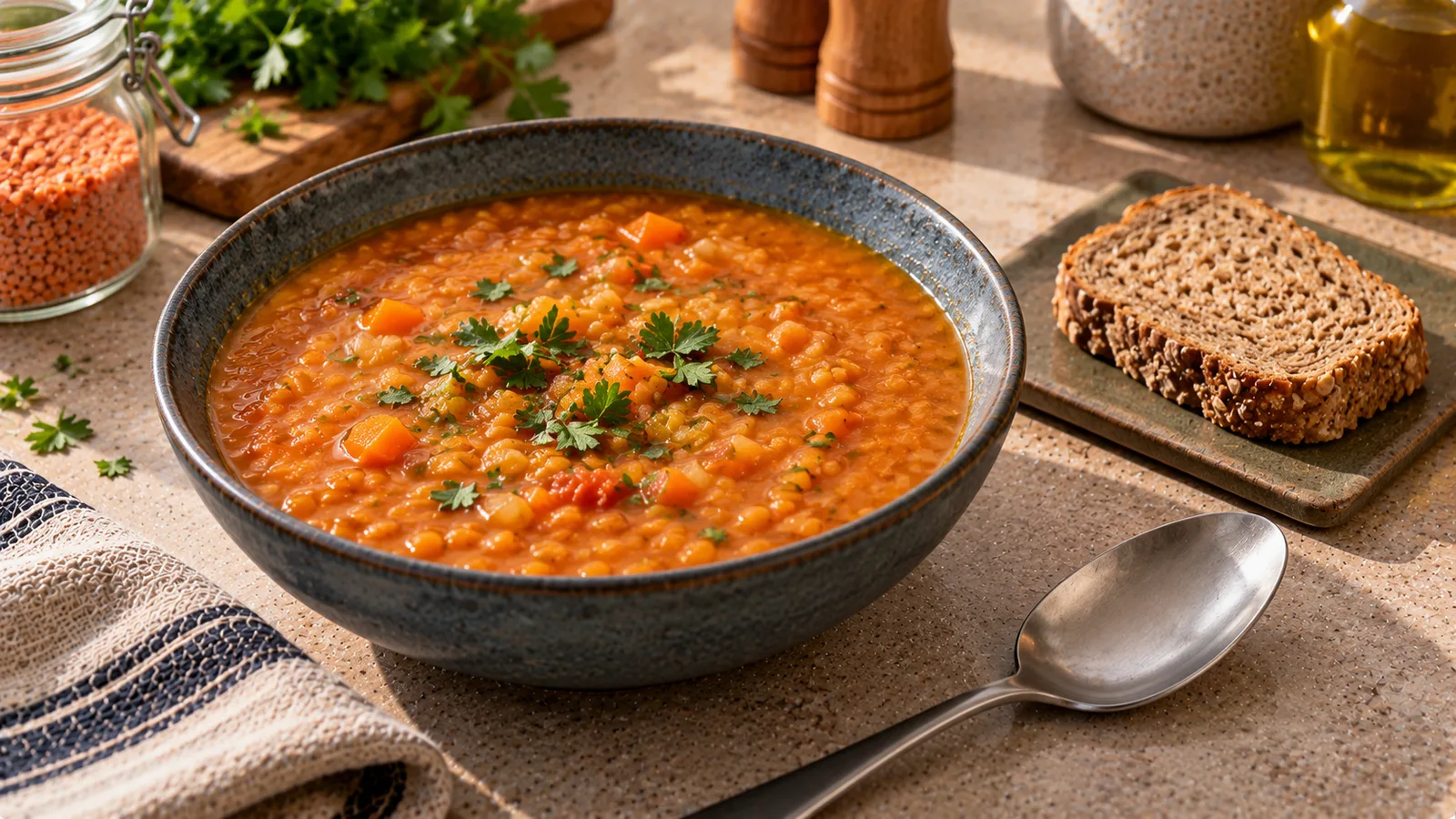
Red lentils are well suited to soup because they cook quickly and soften enough to create a naturally thick texture without requiring cream.
This version combines red lentils with onion, carrot, tomatoes and a small amount of olive oil. It is designed as a straightforward main-meal soup rather than a thin starter. For a different one-pot recipe built around red lentils and carrots, see red lentil and carrot curry.
The recipe makes approximately 4 servings.
Ingredients
For 4 servings:
- 250 g dry red lentils
- 150 g onion
- 200 g carrots
- 10 g garlic
- 15 g olive oil
- 400 g canned chopped tomatoes
- 1,000 ml vegetable stock or water
- 5 g ground cumin
- 3 g ground paprika
- 1 g ground turmeric
- black pepper to taste
- salt to taste, depending on the stock
- 20 g lemon juice
- 10 g fresh parsley or coriander, optional
The lentil quantity refers to dry weight before cooking.
How to make red lentil soup
1. Rinse the lentils
Place the dry red lentils in a fine sieve and rinse them under cold water.
There is no need to soak red lentils overnight for this recipe.
2. Prepare the vegetables
Dice the onion and carrots.
Finely chop or crush the garlic.
Keeping the vegetables reasonably small helps them soften during the same cooking period as the lentils.
3. Cook the onion and carrot
Heat 15 g olive oil in a large saucepan over medium heat.
Add the onion and carrot.
Cook for about 5–7 minutes, stirring occasionally, until the onion softens.
Add the garlic, cumin, paprika and turmeric.
Cook for another 30–60 seconds, stirring so the spices do not burn.
4. Add lentils, tomatoes and liquid
Add:
- 250 g rinsed red lentils;
- 400 g chopped tomatoes;
- 1,000 ml vegetable stock or water.
Stir thoroughly.
Bring the soup to a gentle boil, then reduce the heat.
5. Simmer
Cook partially covered for approximately 20–25 minutes.
Stir occasionally, especially toward the end, because softened lentils can settle on the bottom of the pan.
The lentils should become very soft.
If the soup becomes thicker than you prefer, add a little more hot water.
6. Adjust the texture
You can leave the soup as it is for a rustic texture.
For a smoother result, blend part or all of the soup with an immersion blender.
Blending changes the texture but does not meaningfully change the calories of the recipe.
7. Finish the soup
Stir in the lemon juice.
Taste before adding extra salt, particularly if you used salted vegetable stock.
Add black pepper and fresh parsley or coriander if desired.
Cooked yield
The exact finished weight depends on:
- how much water evaporates;
- whether extra water is added;
- how long the soup simmers;
- the exact vegetables and tomatoes used.
A batch like this will commonly produce roughly 1.8–2.0 kg of finished soup.
Instead of assuming a fixed final weight, weigh the entire cooked batch if you want more precise nutrition per gram.
For example, if your finished soup weighs 1,920 g and you divide it into four equal servings:
1,920 ÷ 4 = 480 g per serving
Approximate nutrition per serving
Using typical ingredient values and dividing the recipe into four equal portions, one serving provides approximately:
| Per serving | Approximate amount |
|---|---|
| Calories | 330–370 kcal |
| Protein | 17–20 g |
| Fat | 5–7 g |
| Carbohydrates | 52–60 g |
| Fiber | 10–14 g |
These are estimates.
The actual values depend on the lentils, tomatoes, stock and other ingredients you use.
For precise tracking, use the nutrition information for your specific products.
Where the calories come from
Most of the calories in this soup come from the red lentils.
The olive oil contributes a smaller but concentrated amount of energy, while the vegetables and tomatoes contribute additional carbohydrates, fiber and micronutrients.
Because the recipe contains a substantial amount of water, the finished soup has a much lower calorie density per 100 g than dry lentils.
This is why comparing 100 g dry lentils directly with 100 g finished lentil soup is misleading.
Dry lentils vs cooked soup
The recipe begins with 250 g dry lentils.
During cooking, the lentils absorb water and become part of a much heavier finished dish.
The calories in the lentils do not disappear when they absorb water.
Instead, the same energy is distributed across a larger final weight.
For example, imagine the complete recipe contains 1,400 kcal and weighs 1,900 g after cooking.
Calories per 100 g would be:
1,400 ÷ 1,900 × 100 = about 74 kcal per 100 g
If additional water increases the finished weight to 2,100 g without adding calories:
1,400 ÷ 2,100 × 100 = about 67 kcal per 100 g
The total calories of the pot remain approximately the same. Only the calorie density changes.
How to calculate nutrition from the finished batch weight
For accurate homemade-recipe tracking:
- Record every ingredient before cooking.
- Calculate the nutrition for the entire recipe.
- Weigh the finished soup.
- Use the finished weight to calculate nutrition per gram or per 100 g.
- Weigh the amount you serve yourself.
Suppose the entire recipe contains 1,420 kcal and the cooked batch weighs 1,940 g.
Calories per gram:
1,420 ÷ 1,940 = 0.732 kcal per gram
A 450 g bowl would contain:
450 × 0.732 = about 329 kcal
This approach automatically accounts for the actual amount of water remaining after cooking.
What if you add more water?
Adding plain water changes the soup's weight and consistency but does not add calories.
If you add 300 ml of water because the soup is too thick, do not add calories for that water.
However, if you track the soup by weight, update the final cooked batch weight because the calories are now distributed over a larger quantity.
What if you use stock instead of water?
Vegetable stock can contain some calories, depending on the product.
Some are very low in calories, while others contain additional ingredients.
Use the label from the stock, stock cube or concentrate you actually use.
Stock can also contribute a substantial amount of sodium, so taste the soup before adding additional salt.
Can you use green or brown lentils instead?
You can make lentil soup with them, but the result will not be the same.
Red lentils tend to break down during cooking and naturally thicken the soup.
Green and brown lentils usually retain their shape better and may require different cooking times.
If you substitute them, adjust the cooking process and calculate nutrition using the lentils actually used.
Can you use canned lentils?
Canned lentils are already cooked and contain much more water than dry lentils.
Do not replace 250 g dry red lentils with 250 g canned lentils and expect the same recipe or nutrition.
If using canned lentils, you would need to reformulate the quantities and reduce the cooking time.
How to make the soup thinner
Add hot water or additional stock in small amounts until the soup reaches your preferred consistency.
If you are tracking the recipe by final cooked weight, weigh the finished batch after making this adjustment.
How to make it thicker
For a thicker soup you can:
- simmer it slightly longer;
- use a little less liquid;
- blend more of the cooked lentils.
Remember that longer simmering primarily removes water.
It can increase calories per 100 g by reducing the final weight even though the total calories in the pot remain essentially unchanged.
Optional additions
The basic recipe can be changed with ingredients such as:
- spinach;
- celery;
- chili;
- ginger;
- coconut milk;
- yogurt;
- additional olive oil.
These additions can substantially change the nutrition.
For example, adding coconut milk or extra oil will increase calories more than adding spinach or herbs.
If you modify the recipe, calculate the new version rather than continuing to use the original nutrition estimate.
Adding more protein
Red lentils already provide a meaningful amount of plant protein.
If you want to increase the protein further, possible additions include:
- Greek-style yogurt as a topping;
- skyr;
- cooked chicken;
- tofu;
- additional lentils.
Each option changes the calories and macronutrients differently.
There is no need to modify the soup simply to reach a universal protein target; the appropriate amount depends on your overall diet and individual needs.
Serving ideas
The soup can be eaten on its own or served with:
- whole-grain bread;
- pita;
- a side salad;
- yogurt;
- roasted vegetables.
If you are calculating the nutrition of the complete meal, count these additions separately.
A 350 kcal bowl of soup does not remain a 350 kcal meal after adding bread, oil, cheese or other sides.
Meal prep
Red lentil soup works well for batch cooking because it can be divided into individual portions after cooking.
For consistent portions:
- weigh the empty cooking pot before cooking, or transfer the finished soup to a weighed container;
- determine the net weight of the finished soup;
- divide by the number of portions;
- portion the soup by weight.
If the finished batch weighs 1,880 g and you want four equal portions:
1,880 ÷ 4 = 470 g per portion
This is more consistent than filling four bowls by eye.
Refrigerating the soup
Cool leftovers promptly and store them covered in the refrigerator.
For practical home storage, use refrigerated leftovers within a few days.
Reheat the portion until thoroughly hot before eating.
If the soup has been left at room temperature for an extended period, normal food-safety considerations apply.
Freezing
Red lentil soup generally freezes well.
Allow the soup to cool, divide it into freezer-safe portions and freeze.
Leave some space in the container because liquids can expand when frozen.
Defrost safely before reheating.
The soup may become thicker after refrigeration or freezing. Adding a small amount of water while reheating can restore the preferred consistency.
Why reheated soup can weigh differently
Water can evaporate during reheating.
If you reheat a portion uncovered for a long time, its final weight may decrease even though almost all of the original food energy remains.
For normal everyday tracking, this difference is usually not worth recalculating.
For batch tracking, the most practical approach is to divide the original cooked batch into portions before storage.
Four equal servings vs servings by weight
If the ingredients are distributed evenly, dividing the complete batch into four equal portions gives each portion approximately one quarter of the recipe's calories.
But bowls filled by eye may not be equal.
If you want repeatable portions, use the finished batch weight.
For example:
Finished soup: 1,960 g
Four servings:
1,960 ÷ 4 = 490 g each
If you instead eat 600 g, you consumed more than one quarter of the batch.
Making six smaller servings
You can divide the same recipe into six servings instead of four.
The total recipe does not change.
If the whole pot contains approximately 1,400 kcal:
Four servings:
1,400 ÷ 4 = 350 kcal each
Six servings:
1,400 ÷ 6 = about 233 kcal each
The smaller calorie number comes from dividing the same food into smaller portions, not from changing the recipe.
Common tracking mistake: logging cooked weight as dry lentils
Suppose your bowl contains 400 g of finished soup.
Do not enter 400 g dry red lentils.
The bowl includes water, vegetables, tomatoes and only part of the original lentils.
Instead, save the complete soup as a recipe and log your portion of that recipe.
Another mistake: forgetting the oil
The recipe uses 15 g olive oil.
Even though that quantity looks small compared with the entire pot, oil is energy-dense and should be included when estimating total calories.
If you use 30 g instead of 15 g, update the recipe.
Practical recipe summary
For four servings:
- Rinse 250 g dry red lentils.
- Cook 150 g onion and 200 g carrots in 15 g olive oil.
- Add 10 g garlic, cumin, paprika and turmeric.
- Add 400 g chopped tomatoes, 1,000 ml stock or water and the lentils.
- Simmer for 20–25 minutes until the lentils are soft.
- Blend partially or fully if desired.
- Finish with 20 g lemon juice and season to taste.
- Divide into four portions.
One serving will typically provide around 330–370 kcal and 17–20 g protein, depending on the ingredients and portioning.
For the most accurate result, calculate the complete recipe using your own products and divide it according to the actual finished batch weight.