
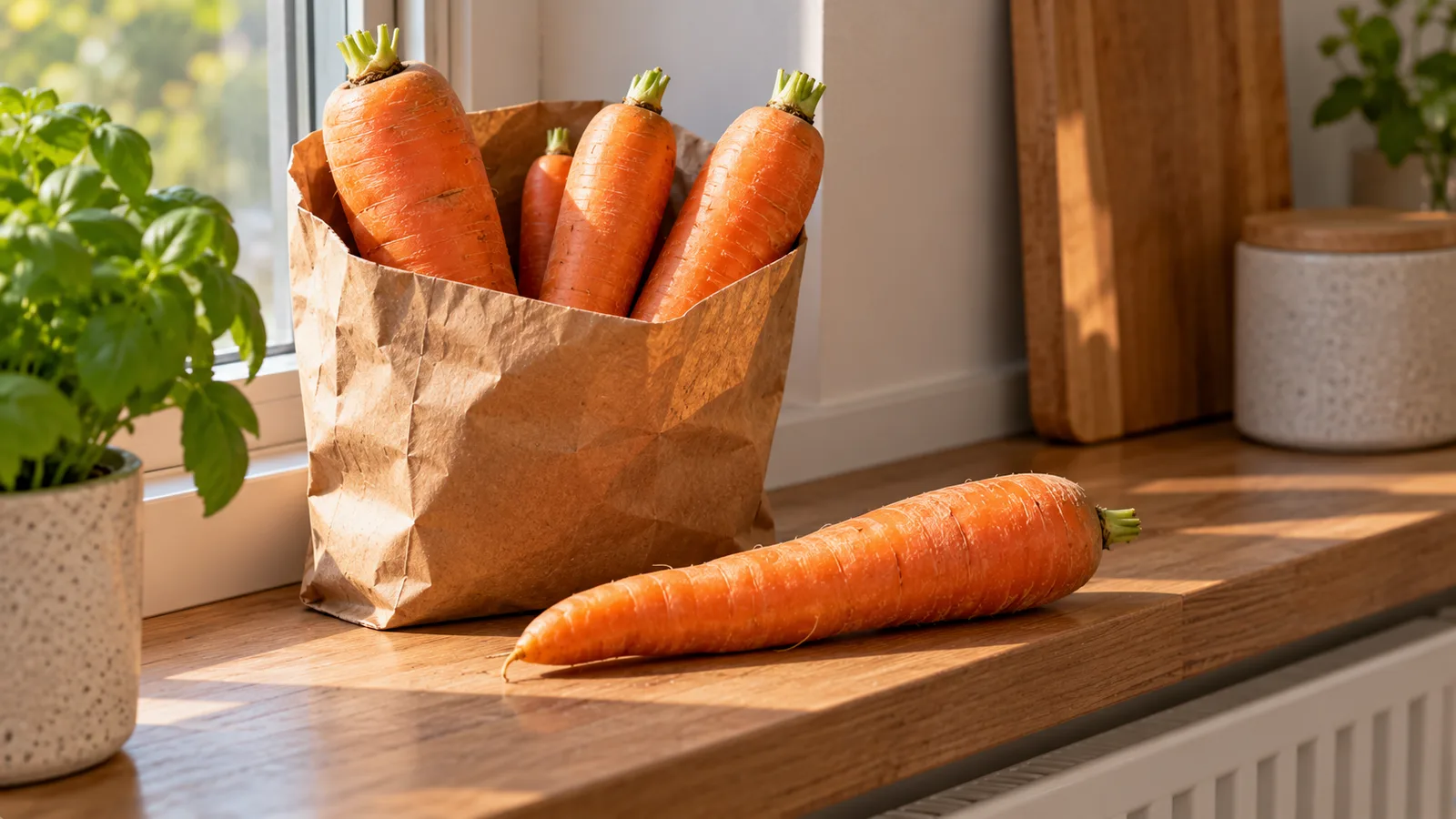
Carrots are relatively low in calories, but the number you log depends on the amount you actually eat and whether the database entry refers to raw or cooked carrots.
As a practical reference, 100 g of raw carrots contains about 41 kcal.
That makes carrots useful for meals where you want substantial volume, color and texture without adding a large amount of energy.
Carrot calories at a glance
Approximate values for raw carrots:
| Amount | Approximate calories |
|---|---|
| 50 g | 21 kcal |
| 75 g | 31 kcal |
| 100 g | 41 kcal |
| 150 g | 62 kcal |
| 200 g | 82 kcal |
| 250 g | 103 kcal |
| 300 g | 123 kcal |
The simplest calculation is:
calories = carrot weight in grams × 41 ÷ 100
For example, if your carrots weigh 180 g:
180 × 41 ÷ 100 = about 74 kcal
How many calories are in 100 g of carrots?
A useful reference for raw carrots is approximately:
- 41 kcal
- 9.6 g carbohydrate
- 4.7 g sugars
- 2.8 g fiber
- 0.9 g protein
- 0.2 g fat
per 100 g.
Exact values can vary slightly by variety, maturity and nutrition database.
For everyday food tracking, the difference between reputable database entries is usually less important than recording the correct portion.
Calories in one carrot
“One carrot” is not a precise serving size because carrots vary considerably in length and thickness.
A small carrot may weigh much less than a large one.
Using 41 kcal per 100 g as the reference:
| Edible carrot weight | Approximate calories |
|---|---|
| 40 g | 16 kcal |
| 60 g | 25 kcal |
| 80 g | 33 kcal |
| 100 g | 41 kcal |
| 120 g | 49 kcal |
| 150 g | 62 kcal |
If accuracy matters, weigh the edible portion rather than relying on “one medium carrot.”
Calories in two carrots
The answer depends on their combined weight.
For example:
- two carrots totaling 100 g: about 41 kcal;
- two carrots totaling 150 g: about 62 kcal;
- two carrots totaling 200 g: about 82 kcal;
- two carrots totaling 250 g: about 103 kcal.
Counting carrots is convenient, but weighing them is more consistent when sizes differ.
Calories in a cup of carrots
A cup is a volume measurement, so the weight depends on how the carrots are prepared.
Whole baby carrots, thick slices, finely chopped carrots and grated carrots do not pack into a cup in exactly the same way.
For tracking, use a food-specific cup weight from your nutrition source rather than assuming that every cup of carrots has one universal gram value.
If possible, grams are simpler.
Raw vs cooked carrots
Cooking does not magically create calories in carrots, but it can change their weight by changing water content.
This affects calories per 100 g.
Imagine you start with 300 g of raw carrots.
At roughly 41 kcal per 100 g:
300 × 41 ÷ 100 = about 123 kcal
If cooking reduces the final weight to 250 g without adding oil, the batch still contains roughly the same total energy.
But now:
123 ÷ 250 × 100 = about 49 kcal per 100 g cooked
The increase per 100 g comes from water loss, not from calories appearing during cooking.
Boiled carrots
Boiling can change both water content and the values shown by nutrition databases.
If you weigh boiled carrots, use an entry specifically for boiled or cooked carrots whenever possible.
Do not automatically apply a raw-carrot value to a cooked weight.
The difference may be modest, but matching the measured state to the database state makes tracking more consistent.
Roasted carrots
Roasted carrots require extra attention because recipes often contain oil.
The carrots themselves remain relatively low in calories, but added oil can materially increase the total.
For example, a tray may contain:
- carrots;
- olive oil;
- herbs;
- salt;
- spices.
When tracking the recipe, include the oil rather than logging only the carrots.
If the tray is divided into several portions, distribute the total recipe calories across the portions.
Carrots cooked with butter
The same principle applies to butter.
A serving of cooked carrots with butter is not nutritionally equivalent to the same weight of plain carrots.
Track:
- the carrots;
- the butter used;
- other calorie-containing ingredients.
This is more reliable than searching for a generic “buttered carrots” entry that may represent a very different recipe.
Glazed carrots
Glazed carrots may contain ingredients such as:
- butter;
- sugar;
- honey;
- maple syrup;
- oil.
These additions can make the calorie total substantially higher than plain carrots.
If you know the recipe, calculate the ingredients together.
If you are eating away from home, treat the result as an estimate and account for the visible glaze.
Baby carrots
Baby-cut carrots are still carrots.
Their smaller size makes counting easy, but the number of pieces is not a universal weight.
If the package provides nutrition information and a serving weight, use that information.
For example, if the label gives nutrition per 100 g, simply weigh the portion and calculate from grams.
Carrot sticks
Cutting a carrot into sticks does not meaningfully change its calories.
A 100 g carrot remains approximately the same amount of energy after being cut into sticks.
What changes is the visual appearance.
This is one reason visual portion estimates can be misleading: chopped, sliced and whole vegetables can occupy different amounts of space even when their weights are similar.
Grated carrots
Grating also does not inherently add calories.
However, grated carrots are often used in dishes containing other ingredients.
Examples include:
- salads with dressing;
- coleslaw-style mixtures;
- carrot cake;
- fritters;
- yogurt or mayonnaise-based salads.
For these foods, do not use the calorie value for plain carrots as the calorie value for the complete dish.
Frozen carrots
Plain frozen carrots can be tracked similarly to other plain carrots, but check the product label when available.
Frozen vegetable products may be sold:
- plain;
- with sauce;
- with butter;
- as part of a mixed vegetable blend.
Added ingredients change the nutrition profile.
For a plain product, use the package information when it is available because it directly describes the product you purchased.
Canned carrots
Canned carrots can differ from raw carrots because of processing and the liquid in the container.
When tracking canned carrots:
- check whether the label values refer to drained or undrained product;
- use the package nutrition information when available;
- weigh the drained portion if that is how the food is consumed.
Do not assume that the raw-carrot value is automatically the best match.
Carrot juice is different from whole carrots
Carrot juice should not be tracked as if it were the same portion of whole carrots.
Juicing changes how much carrot can fit into a drink and removes much of the structure associated with the whole vegetable.
Use a specific carrot-juice nutrition entry or the product label.
A glass of juice can represent more carrot than its volume might suggest from looking at whole vegetables.
Carrot soup depends on the recipe
The calories in carrot soup cannot be determined from carrots alone.
A soup may contain:
- carrots;
- potatoes;
- onions;
- cream;
- coconut milk;
- butter;
- oil;
- stock.
Two bowls of carrot soup can therefore have very different calorie totals.
For homemade soup, calculate the complete recipe and divide by servings or finished weight.
For packaged soup, use the label.
Carrot salad depends on the additions
Plain grated carrots are low in calories.
A carrot salad can be very different if it includes:
- oil;
- mayonnaise;
- nuts;
- seeds;
- dried fruit;
- cheese;
- sweet dressing.
When the goal is calorie tracking, the additions may contribute more calories than the carrots themselves.
Carrots with hummus
Carrots are often paired with hummus as a snack.
Track the two components separately.
For example:
- carrot portion;
- hummus portion.
The hummus is usually more energy-dense than the carrots, so estimating its quantity reasonably can have a larger effect on the snack total.
Carrots and dip
The same applies to other dips.
A plate containing 150 g of carrots does not have the same calorie total when paired with:
- plain yogurt dip;
- hummus;
- mayonnaise-based dip;
- cheese dip;
- nut-based dip.
If you are estimating the meal, pay attention to the dip rather than focusing only on the vegetable quantity.
Are carrots high in sugar?
Carrots contain naturally occurring sugars, but describing them only by their sugar content gives an incomplete picture.
Raw carrots also contain water and fiber and have relatively low calorie density.
Approximately 100 g of raw carrots provides around 4.7 g of sugars within roughly 41 kcal.
The more useful question for calorie tracking is usually how much carrot you ate and what else was added to it.
Are carrots high in carbs?
Carrots contain carbohydrate, but they are not particularly calorie-dense.
Approximately 100 g of raw carrots provides around 9.6 g of total carbohydrate.
If you track carbohydrates, use the portion weight rather than assuming every carrot has the same amount.
For example, a 200 g portion contains roughly twice the carbohydrate of a 100 g portion.
Fiber in carrots
Raw carrots provide roughly 2.8 g of fiber per 100 g.
That means:
- 100 g: about 2.8 g fiber;
- 150 g: about 4.2 g;
- 200 g: about 5.6 g.
These are approximate values.
If you use a specific product or database entry, keep the calorie and nutrient values from the same source rather than mixing numbers from several entries.
Protein and fat in carrots
Carrots contain only small amounts of protein and fat.
Per 100 g of raw carrot, a typical reference is approximately:
- protein: 0.9 g;
- fat: 0.2 g.
Carrots can contribute to the overall nutrient profile of a meal, but they are not a major protein or fat source.
How portion size changes the numbers
Because nutrition values scale with weight, doubling the portion approximately doubles the calories and macronutrients.
Using 41 kcal per 100 g:
| Portion | Calories | Carbohydrate | Fiber |
|---|---|---|---|
| 50 g | ~21 kcal | ~4.8 g | ~1.4 g |
| 100 g | ~41 kcal | ~9.6 g | ~2.8 g |
| 150 g | ~62 kcal | ~14.4 g | ~4.2 g |
| 200 g | ~82 kcal | ~19.2 g | ~5.6 g |
| 250 g | ~103 kcal | ~24.0 g | ~7.0 g |
The table uses approximate raw-carrot values and simple proportional calculations.
How to log carrots accurately
For plain raw carrots:
- remove any parts you will not eat;
- weigh the edible portion;
- choose a raw-carrot entry;
- enter the weight in grams.
For cooked carrots:
- weigh them in the state you are logging;
- choose a matching cooked entry;
- include oil, butter, sauces or glaze separately when appropriate.
The main goal is to keep the measured state and nutrition entry consistent.
Should you weigh carrots before or after peeling?
If you eat peeled carrots and want a precise edible weight, weighing after peeling is simplest.
If you weigh before peeling, a small amount of the measured weight may be discarded.
For everyday tracking, this difference is often small, but the principle is useful:
track the portion you actually eat whenever practical.
What about the carrot tops?
If the leafy tops are removed and not eaten, they should not be part of the edible carrot weight.
The same principle applies to discarded or inedible parts of other foods.
A nutrition entry normally represents the edible portion unless the source states otherwise.
Does cutting carrots change calories?
No meaningful calories are added or removed merely by:
- slicing;
- chopping;
- grating;
- cutting into sticks.
The relevant changes happen when ingredients are added or when cooking changes water content.
If 200 g of raw carrots are chopped, you still have approximately the calories associated with 200 g of raw carrots.
Why database values can differ
You may find slightly different calorie numbers for carrots across food databases and apps.
Possible reasons include:
- different varieties;
- raw vs cooked state;
- rounding;
- laboratory variation;
- different database records.
A small difference between reputable entries is normal.
For tracking, consistency and correct portion size are usually more useful than repeatedly switching entries to find a supposedly perfect number.
Carrots in mixed dishes
When carrots are part of a mixed meal, their calories are only one part of the total.
For example, a stir-fry may include:
- carrots;
- other vegetables;
- chicken or tofu;
- noodles or rice;
- oil;
- sauce.
If you cooked it yourself, a recipe calculation is usually the easiest method.
If you are estimating a restaurant dish, focus on the major ingredients and remember that oils and sauces may contribute substantially more energy than the carrots.
A practical example
Suppose you prepare a snack with:
- 180 g raw carrots;
- 50 g hummus.
For the carrots:
180 × 41 ÷ 100 = about 74 kcal
Then add the calories from the 50 g of hummus using its package or database entry.
This is more accurate than searching for a generic “carrots with hummus” item because the actual ratio between carrots and hummus can vary widely.
Another example: roasted carrots
Suppose you roast:
- 500 g carrots;
- 15 g olive oil.
The raw carrots contribute approximately:
500 × 41 ÷ 100 = 205 kcal
The oil must then be added separately.
If you divide the finished tray into four equal portions, divide the total recipe calories by four.
This method keeps the carrot calories and added-fat calories clear.
Are carrots useful for calorie-conscious meals?
Carrots can be useful when you want:
- vegetable volume;
- crunch;
- sweetness;
- color;
- a relatively low calorie density.
But the calorie content of the complete meal still depends on everything else included.
A large serving of carrots with a calorie-dense dressing can contain substantially more energy than plain carrots.
The simplest way to remember carrot calories
For quick estimation, remember:
raw carrots ≈ 41 kcal per 100 g
Then scale the value to your portion.
Examples:
- 100 g ≈ 41 kcal;
- 150 g ≈ 62 kcal;
- 200 g ≈ 82 kcal;
- 250 g ≈ 103 kcal.
If the carrots are cooked, packaged with sauce or prepared with oil, use the relevant cooked/product entry and include added ingredients.
Tracking carrots with Mealisa
Mealisa can help record foods using different input methods depending on the situation.
For carrots, you might use:
- manual gram weight;
- a food photo;
- package information;
- a saved previous portion;
- a recipe when carrots are part of a mixed dish.
For plain carrots, grams provide a straightforward reference.
For a complete meal, the carrots should be considered together with the other ingredients rather than treated as the entire calorie estimate.
Key takeaway
Raw carrots provide approximately 41 kcal per 100 g.
The most useful way to estimate your portion is to use the edible weight whenever possible.
Remember that:
- carrot size varies;
- cups depend on how carrots are cut and packed;
- cooking can change weight through water gain or loss;
- oil, butter, glaze and dips add calories;
- mixed dishes should be tracked as complete recipes or meals.
For everyday tracking, a consistent portion estimate is more useful than trying to make every carrot fit a universal serving size.
Nutrition data sources
Reference values below are per 100 g of the specified food. Product varieties and preparation methods can differ.
- USDA FoodData Central — Carrots, raw (FDC 170393; 41 kcal/100 g).