
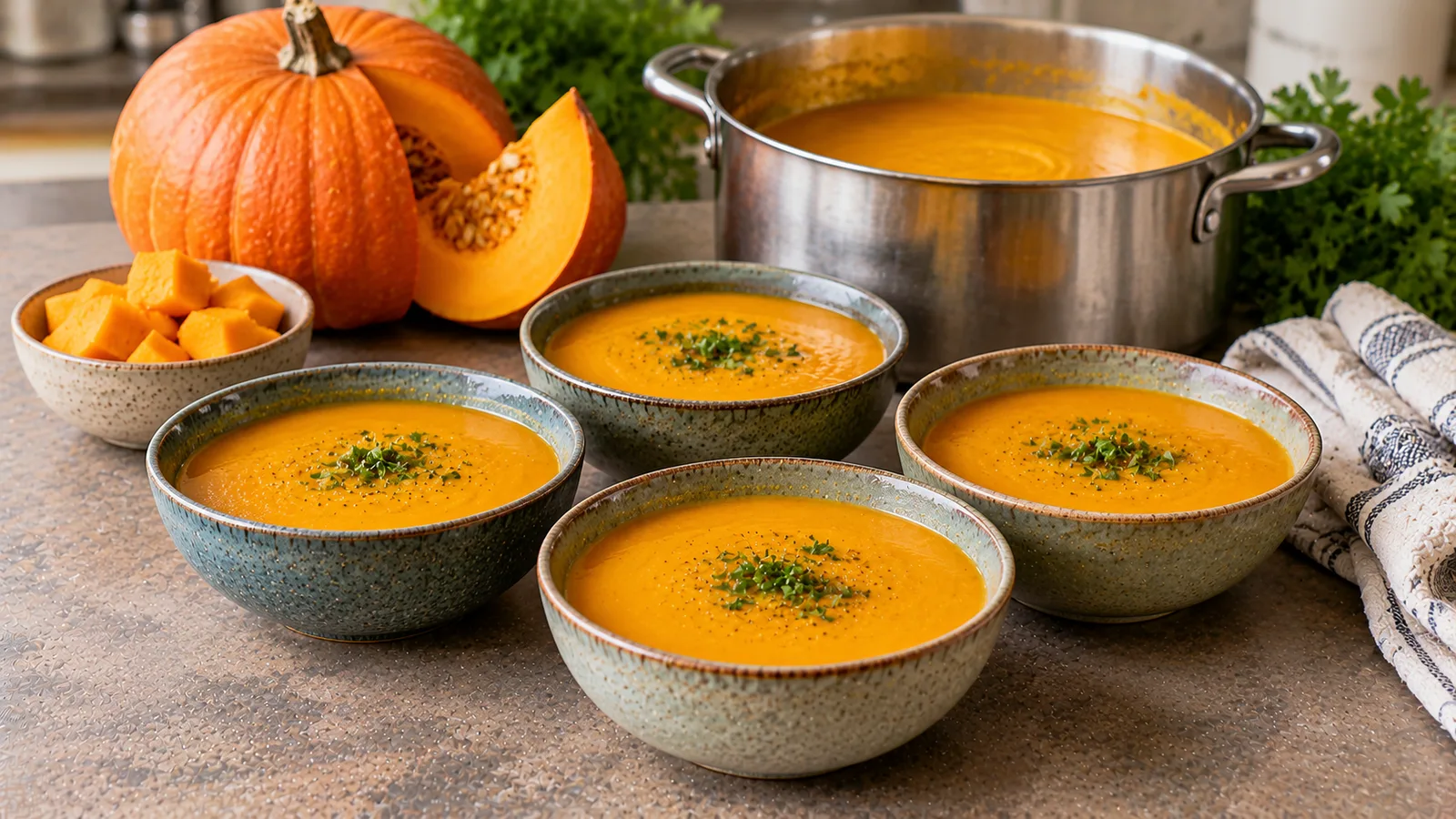
The plan: one whole pumpkin, four measured bowls
This soup starts at the shop, not the chopping board. Buy one whole pumpkin weighing about 1.6 kg. In this worked recipe, cleaning away the stalk, hard rind, seeds and unusable fibres leaves 1,000 g of edible pumpkin flesh. That is a 62.5% edible yield, not a universal yield for every pumpkin. A thinner-skinned variety or a pumpkin with a very large seed cavity will behave differently. Weigh your own usable flesh after preparation. The recipe gives four generous servings, and the cost calculation includes the entire pumpkin you paid for, rather than pretending the trimmings were free.
The intended result is a simple, smooth autumn soup with onion, carrot and vegetable stock. It is not a baked-pumpkin recipe or a separate calorie profile of pumpkin. If you need the ingredient-specific raw, roasted and puréed values, see the relevant food profile rather than treating this complete soup as pure pumpkin.
Ingredients for four portions
| Ingredient | Amount | Measurement note |
|---|---|---|
| Whole pumpkin | 1,600 g purchased | Target 1,000 g edible flesh after trimming |
| Onion | 180 g | Peeled, chopped weight |
| Carrot | 160 g | Washed and trimmed weight |
| Olive oil | 15 g | Weigh it, instead of estimating a tablespoon |
| Garlic | 6 g | Peeled weight, roughly one large clove |
| Vegetable stock | 700 ml | Choose a stock you like; nutrition varies by label |
| Black pepper, herbs, salt | To taste | Adjust seasoning after tasting the stock |
Use a medium-large pot, a sharp knife, a cutting board and either an immersion blender or a countertop blender suited to hot food. Allow roughly 15–20 minutes for preparation plus 25–30 minutes cooking; the size of the pumpkin pieces determines when they soften. The soup makes four servings regardless of whether you thin it with a little extra water; extra water changes volume, not the energy in the pot.
How to turn the pumpkin into soup
- Wash the outside of the pumpkin before cutting. Place it on a stable board, halve it carefully and scoop out the seeds. Remove the stalk and any rind you do not intend to eat. Some culinary varieties have tender edible skin; if you keep it, the usable yield changes. Weigh 1,000 g of edible flesh for this batch and cut it into roughly 2–3 cm pieces.
- Heat the 15 g oil in a large pot over medium heat. Add the 180 g onion and 160 g carrot. Cook for about 5–7 minutes, stirring, until the onion starts to soften. Add the 6 g garlic for the final 30–60 seconds. Do not brown the garlic heavily.
- Add the 1,000 g pumpkin and 700 ml vegetable stock. Bring to a simmer, cover loosely and cook for roughly 20–25 minutes. Test a large piece with a fork: it should mash without resistance. If it remains firm, continue cooking rather than relying on the clock alone.
- Switch off the heat and blend carefully until smooth. If using a jug blender, follow its hot-liquid instructions and blend in batches. Adjust texture with a little water or stock; taste before adding salt because prepared stock may already be salty.
- Divide into four containers or bowls. Stir before weighing the final soup if you need an exact portion. The number of bowls is fixed; the final grams per bowl depend on evaporation and added liquid.
Why edible yield matters more than the size on the label
The arithmetic in this example is 1,000 ÷ 1,600 × 100 = 62.5% edible yield. The remaining 600 g covers peel, stalk, seeds and other discarded parts. This is a measurement scenario, not a claim that every variety wastes 37.5%. An 1.6 kg pumpkin yielding only 850 g of flesh needs either a smaller soup, adjusted ingredients or extra edible pumpkin. A pumpkin yielding 1.2 kg can make a thicker soup or supply a second dish. Record actual bought and edible weights to learn which varieties are best value locally.
For cost comparisons, divide the whole pumpkin price by edible kilograms, not the shop price per gross kilogram. If a whole pumpkin is priced at €2.00/kg, the 1.6 kg purchase costs €3.20. With 1 kg of flesh, the effective cost is €3.20/kg edible, before any other ingredients. Buying 1 kg of ready-cut pumpkin is only cheaper when its actual price is below that effective figure after allowing for convenience and storage losses.
Worked price for four bowls — an example, not a shop quote
| Ingredient | Illustrative price basis | Cost in this batch |
|---|---|---|
| Whole pumpkin, 1.6 kg | €2.00 per kg purchased | €3.20 |
| Onion, 180 g | €1.50 per kg | €0.27 |
| Carrot, 160 g | €1.40 per kg | €0.22 |
| Olive oil, 15 g | €8.00 per kg | €0.12 |
| Garlic, 6 g | €10.00 per kg | €0.06 |
| Stock, 700 ml | €0.50 per litre | €0.35 |
| Total / four portions | Hypothetical input prices | €4.22 |
That is about €1.06 per portion after rounding. These are illustrative assumptions, not current verified supermarket prices in Germany or any other country. Replace the assumptions with the receipt and stock label you actually used. If the pumpkin costs €3.00/kg instead, add €1.60 to the pot or €0.40 to each portion, with all other quantities unchanged. This is more informative than claiming one permanent price for a seasonal vegetable.
Approximate calories: count the recipe, not the cooked water
The USDA reference for raw pumpkin is 26 kcal per 100 g (FoodData Central 168448): 1,000 g supplies about 260 kcal. For illustration, use about 72 kcal from 180 g onion, 66 kcal from 160 g carrot, 133 kcal from 15 g olive oil, 9 kcal from 6 g garlic, and 70 kcal from stock only if its label states 10 kcal per 100 ml. The sum is approximately 610 kcal in the complete pot, or about 150 kcal per serving when divided four ways. These are ingredient-reference estimates, not laboratory-tested nutrition for the finished soup. Check the actual stock, oil and vegetable entries before displaying precise macros. USDA-based pumpkin record.
Evaporation makes the soup thicker but does not add energy. If you add 200 ml water, the pot contains essentially the same calories spread through more grams of soup. If you add 100 ml cream, croutons or a spoonful of oil, those add calories and must be logged separately. The bowl's actual weight matters if you split the soup unevenly; do not treat a 250 ml cup as automatically equal to one quarter of the batch.
Texture, serving and useful substitutions
For a thicker soup, begin with 600 ml stock and add the final 100 ml only if needed; for a thinner soup, add hot water after blending. Carrots round out the flavour, while black pepper, nutmeg or smoked paprika can change the character without turning this into another recipe. Roasting the pumpkin first is possible, but it requires accounting for any roasting oil and altered weight. A butternut squash is not identical to ordinary pumpkin in either price or the nutrient record. If substituting, recalculate rather than copying 26 kcal per 100 g automatically.
Because the soup is predominantly vegetables and water, it is not a complete high-protein dinner on its own. Pair it with bread and beans, a boiled egg, tofu or another protein source according to your needs, and calculate the full plate separately. For a useful comparison, see raw and roasted pumpkin nutrition · edible yield in another soup ingredient · calculating protein in homemade soup.
Cool, refrigerate and freeze safely
Do not leave a deep pot of soup at room temperature to cool overnight. Divide the soup into shallow containers and refrigerate promptly, within two hours of cooking; if room temperature exceeds 32°C, the US guidance shortens this to one hour. Keep refrigerated at 4°C or below. USDA guidance is to use properly cooled soups within 3–4 days or freeze portions, with 2–3 months a useful freezer quality window. Label each container with its date. USDA food safety guidance.
Reheat only the portion needed, stirring until hot throughout. The US FSIS recommendation for reheated leftovers is 74°C (165°F), and soups should be brought to a rolling boil. Avoid repeated cycles of warming the whole pot and refrigerating it again. If the soup was left out beyond the safe period, reheating it later is not a reliable way to undo unsafe storage. Use local food-safety guidance where it differs from the US reference.