
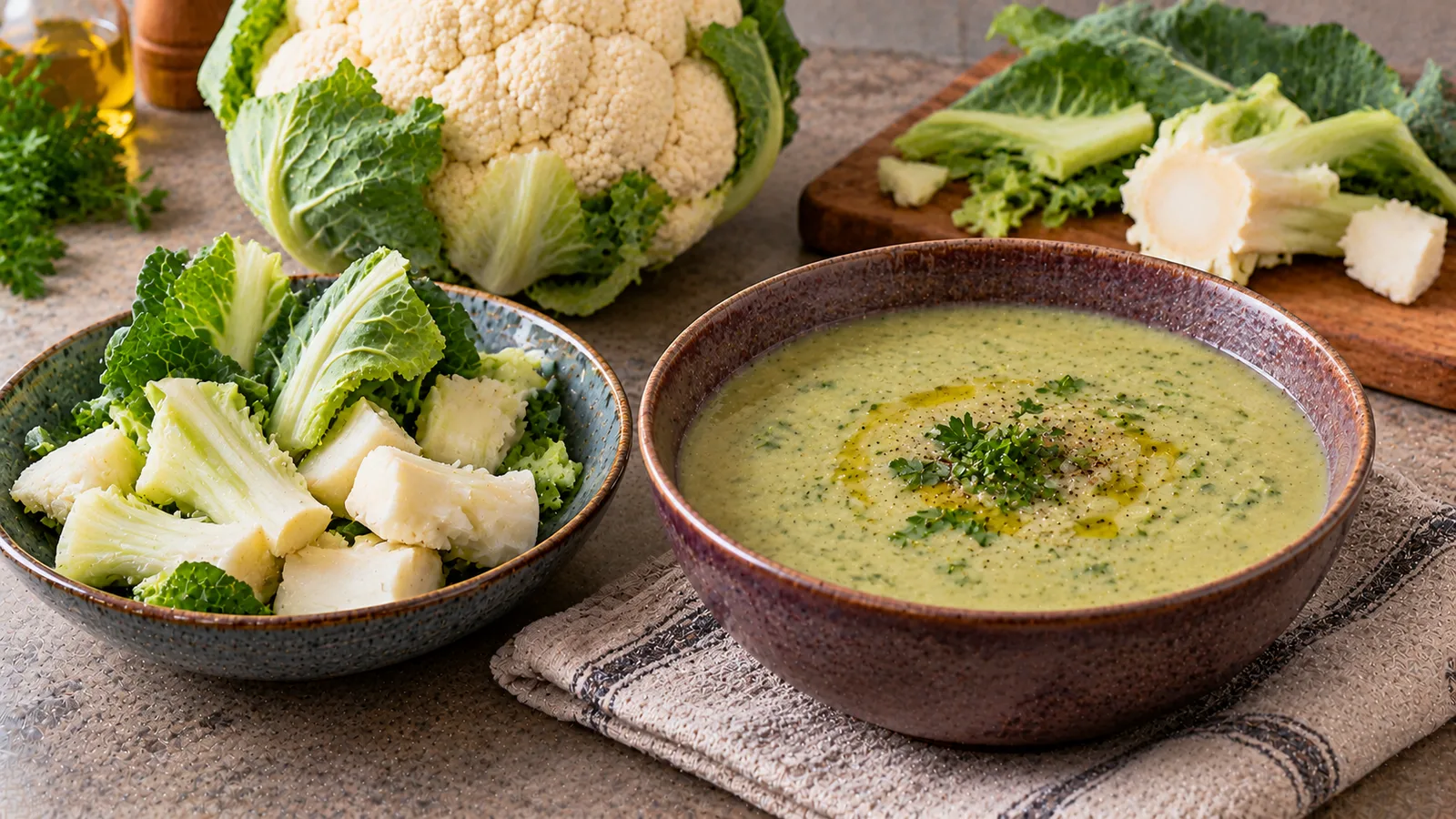
The green leaves and firm central stalk around a cauliflower are not automatically waste. If they are fresh and sound, they can become a smooth, savoury soup instead of going in the bin. This recipe deliberately uses the parts left after removing the florets, with potatoes for body, an onion and carrot for sweetness, and a modest amount of olive oil. It produces four bowls without needing cream.
The key is weighing usable trimmings after washing and cutting away genuinely damaged pieces. An example head weighing 1,400 g may separate into 800 g florets, 420 g edible leaves and stalks, and 180 g discarded or unsuitable material. Those are sample kitchen measurements, not a universal yield rate. Save the florets for a different meal; this soup uses only the 420 g.
This is a cooking and food-waste recipe, not another article about calories in cauliflower florets. The calculation for leaves and stalks is explicitly an estimate based on a whole-cauliflower food entry, because their exact nutrient composition is not represented by one standardized value.
Reference on edible stems and leaves: Love Food Hate Waste.
Which cauliflower parts are suitable?
Use firm, clean inner leaves, tender green ribs and the trimmed central stem. Wash them thoroughly under running water. Cut away bruised, mouldy or slimy leaves and any portion that smells unusual; do not hide spoiled vegetables in a purée. Peel the especially fibrous outside of a large stalk if a knife meets strong resistance. Chop thicker pieces smaller than tender leaves so the pot cooks evenly.
Fresh leaves taste more cabbage-like than the mild white florets. That stronger flavour is useful in a soup with onion, carrot and a little lemon, but older leathery leaves might remain stringy. If a head comes with almost no leaves, weigh what is available and reduce the stock accordingly; never invent 420 g out of a small head. The NSW Love Food Hate Waste guidance explicitly identifies both cauliflower leaves and stalks as edible and describes stalks as suitable for soup.
Weigh first: a reproducible kitchen example
Put the complete cauliflower on a scale before preparation, then use separate containers for florets, edible trimmings and genuine discards. In the example, 800 + 420 + 180 = 1,400 g, so nothing disappears from the accounting. The 420 g soup ingredient is a prepared raw weight: it excludes the coarse exterior that you rejected.
If your usable yield is 300 g, you can make the same style of soup with a smaller batch of liquid; if it is 550 g, cook a slightly thicker mixture or increase the water later. A weighing method is more useful than saying “the leaves from one cauliflower,” because supermarket heads and leaf trimming differ considerably. It also makes future recipes more reliable without treating every leaf as nutritionally identical to the white head.
Ingredients: four bowls
| Ingredient | Raw amount | Reference kcal/100 g | Estimated kcal |
|---|---|---|---|
| Prepared cauliflower leaves and stalks | 420 g | 25* | 105 |
| Peeled raw potato | 300 g | 77 | 231 |
| Prepared raw onion | 120 g | 40 | 48 |
| Prepared raw carrot | 120 g | 41 | 49 |
| Olive oil | 15 g | 884 | 133 |
| Water or unsalted stock | 900 ml | — | 0** |
25 kcal/100 g is a proxy for the trimmings. *0 applies to plain water only; packaged stock must be counted.
Cook the soup step by step
- Prepare the cauliflower. Wash 420 g of trimmed usable leaves and stalks, remove tough or discoloured parts and slice stalks into approximately 1 cm cubes. Shred the leaves. Set the white florets aside for another dish.
- Prepare the base. Dice 120 g onion and 120 g carrot, and cut 300 g potato into similar-size cubes. Keep the vegetables as weighed, pre-cooking quantities.
- Soften the aromatics. Heat 15 g olive oil in a large pan over moderate heat. Cook onion and carrot about 5 minutes, stirring; do not scorch the leaves or rely on oil sprayed without measurement.
- Simmer. Add the trimmings, potato and 900 ml water, or unsalted stock whose label you can count. Bring to a simmer and cook approximately 18–25 minutes until thick stalk pieces and potatoes are fully soft; use tenderness rather than an exact timer as the stopping criterion.
- Blend safely. Remove the pan from heat. Use a hand blender carefully, keeping the head submerged to avoid splashing; if transferring to a jug blender, follow its hot-liquid limits. Adjust consistency with measured water. Season with pepper, lemon and a little salt after tasting.
- Divide and record. Mix well, weigh the finished pot contents after subtracting the pot weight, then divide by four for consistent servings. Evaporation changes serving weight, not the starting ingredient calories.
Calories: calculated from ingredients, not the soup volume
The example calculation uses approximate reference energy values per 100 g: cauliflower 25 kcal, potato 77 kcal, onion 40 kcal, carrot 41 kcal, olive oil 884 kcal. The cauliflower value stands in for the particular leaf-and-stalk mix; it is a practical proxy, not a laboratory measurement of those tissues. Plain water adds no calories; ready-made stock or toppings must be added from their labels.
With the written quantities, the arithmetic is 105 + 231 + 48 + 49 + 133 = approximately 566 kcal per pot, or 142 kcal per bowl when divided four ways. Each number is rounded only after calculating its ingredient contribution. This is an energy estimate, not a verified complete macro analysis. Protein, carbohydrate and sodium will vary with the trimmings, potato type and whether stock or salt was used.
Do not divide by 900 ml of added water and call that “per 100 g”: simmering evaporates water. If the cooled soup weighs 1,500 g, the estimated energy is around 38 kcal per 100 g; if it weighs 1,300 g, it is around 44 kcal per 100 g. Both pots still contain about 566 kcal before any toppings.
Cost: show the assumption instead of inventing a supermarket price
A sample budget might assign €0.45 to potatoes, €0.18 to onion, €0.22 to carrot, €0.08 to measured oil and €0.20 to stock or seasoning. That is €1.13 for the pot, or about €0.28 per bowl, excluding any allocation of the cauliflower purchase cost. These are illustrative input prices, not current verified supermarket offers.
The stalks and leaves are not literally free: you bought the cauliflower. The incremental-cost example assumes the florets were already bought for another recipe and the trimmings otherwise would be discarded. For full household food-cost accounting, allocate some share of the original cauliflower price to this soup and do not simultaneously count the full head in another dish. A more expensive broth, cream or bread changes the total. Save the pack labels or receipts if precision matters.
Texture, flavour and sensible adjustments
If the soup tastes grassy, simmer the thicker stalks fully and finish with a little lemon rather than covering bitterness with excess salt. For a finer texture, blend thoroughly and strain only if necessary; straining throws away some of the very material you intended to use. Potato provides thickness without heavy cream, but if you remove it, expect a lighter broth.
Want a main meal instead of a starter? Serve with beans, lentils, a boiled egg or a separate protein-rich sandwich and count those additions separately. A tablespoon of oil, grated cheese or a splash of cream can substantially alter the portion energy, so avoid quoting 142 kcal after adding them. If you use reduced-salt stock, still read its sodium label rather than assuming “vegetable” means low sodium. A leafy head in autumn and a compact head in spring may give different edible yields, even at similar purchase weights.
Cool, refrigerate and reheat responsibly
Soup is perishable even when it contains only vegetables. Divide the finished pot into shallow containers instead of leaving a deep covered pot to cool for hours. USDA guidance advises refrigerating within 2 hours, or 1 hour if ambient temperature exceeds 32°C (90°F); keep the refrigerator at 4°C or below. Use refrigerated soup within 3–4 days, or freeze individual portions for longer keeping. FoodSafety.gov gives 2–3 months as a freezer-quality guide for soups and stews, not an absolute safety deadline.
Thaw in the refrigerator or reheat frozen soup directly in a saucepan, stirring thoroughly. When reheating leftovers in US household guidance, reach 74°C (165°F) throughout; bring soups to a thorough boil where feasible and avoid cold spots. A soup that sat unrefrigerated too long is not made safe by simply boiling it again. Mark the date and check for safe storage history before serving.
What this recipe does—and does not—prove
Cooking with stems and leaves reduces avoidable disposal in this kitchen example and turns a leftover ingredient into four usable portions. It does not establish a universal percentage of edible cauliflower or scientifically prove a particular reduction in waste for every household. Weigh your own head, record the trimmed edible amount and repeat the recipe with the amount you actually have.
For related questions, look at calorie values for cauliflower · calculating nutrients in a homemade soup when a localized published guide is available. Those pages cover general ingredient calorie tracking; this page remains the owner of the weighed-trimmings soup recipe rather than claiming an independent calorie value for all cauliflower leaves.